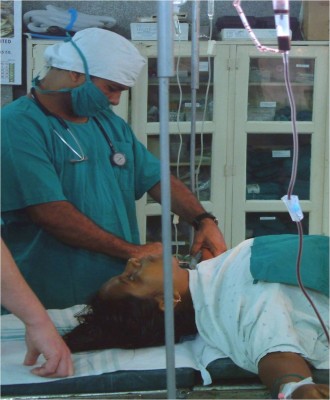
Pregnant patient in theeatre Day Nine: Women’s Health

Birth complications means many women end up with fistulas that leak urine and faeces continuously. Women are socially ostracised.

We watched the story of a lady called Mastula, and her experience of her life being turned upside down by a fistula. Lifetime risk of dying from childbirth and pregnancy. In the west it is 1 in 4300. In Afghanistan, it is 1 in 11.

Day Eight: Trauma & Orthopaedics

Our first talk came from Chris Lavy, husband of Vicky Lavy, who runs the course. He explained that the reason for his haggard experience was her being away for a week, leaving him alone with the children.

The USA have nearly 1% of the population having an operation each year, whereas in Guyana that figure is 0.002%. There are 1700 surgeons per 100,000 population in the UK, whereas in Ethiopa that figure is around 1 per 100,000.

Intra abdominal surgery Day Seven: Surgery

John Rennie and Colin Binks shared the next talks about surgical matters. They both apologised for the dwindling capacities of their ageing neurones, but assured us that with enough prompting they would be able to recall the more important arteries, etc.

“You must take your bible, your toothbrush, your anti-malarials and the Textbook of Primary Surgery. It’s brilliant, full of pictures, and perfect for those of you who are far more comfortable cutting sausages than cranial burr holes”.

Joyce Banda Malawi President Day Six: Aspects of mission work

Mary Hopper has lived and worked in Rhodesia/Zimbabwe and South Africa for many years, and also runs a counselling and trauma workshop for those working in resource poor settings.

Elijah was afraid and ran for his life. When he came to Beersheba in Judah, he left his servant there, while he himself went a day’s journey into the wilderness.

A severely wasted child Day Five: Paediatrics

The first step today was a presentation from the energetic Ian Spillman, with piles of horrific statistics. Sadly, as he said, behind the statistics are real children…

We live in a world of difference. For many families, feeding is a case of “have the rains come?”. 40% of under five deaths are neonatal. If you improve sanitation, you see ~25% improved in under 5 mortality. The most common causes of death are diarrhoea, birth asphyxiation, diarrhoea and malnutrition.

Picture of HIV Virus Day Four: HIV/AIDS

Gisela Schneider opened the day on HIV. She told us two stories, one of a bishop at a national conference, washing the feet of those with HIV, and another, of a pastor apologising, in tears, to a woman who said how she has been unable to speak publically about her HIV status. The pastor apologised, because Christians too easily judge it as a moral problem, and forget that there are people in the midst of it who simply need the love of Christ.

When she first worked in Gambia in the 80s, HIV arrived, but it was simply referred to as “the disease”. No-one would talk about it, no one would accept it, and it was simply hoped that the patients would die and take away the shame from the family. The Lancet article in 1985 was the first to describe a hetrosexual disease spread by sexual contact. At that time, patients simply died.

African Man Drinking Maize Beer Day Two: Medicine

I left a little earlier today so that I could skip the traffic. This was successful to some extent, saving me about 15 minutes. Unfortunately, failing to get a swipecard yesterday meant I spent around 15 minutes waiting outside until someone let me in. Eventually though, I managed to get a cup of coffee before the first session began… Maureen Wilkinson (who spoke yesterday) started us with another picture: “I’d like you to come with me to the edge of the Sahara. You are visiting an old lady, in a cut, nearing the point of death. On the vast horizon, a dust cloud appears, and it become clear that its a group of Arabs on horses. The riders are wearing bright blue robes. The constrast in vitality between their life and the dying lady is vast. Africa is a land of many contrasts. 

Day One: Community Health

Arriving at the beautiful Oak Hill College for the first day of this course, I was taken aback by the peaceful grounds. 5 miles inside the M25, it was a rather a surprise to drive into a green, leafy park, with a large period building with a refreshingly cool, modern interior. Seriously, I think I want to live here.

After a vital cup of tea, we kicked off with the first talk, from Ted Lankester. He is an engaging, amusing speaker, with an obvious passion for helping those in the world who don’t have access to adequate healthcare. He runs InterHealth, which heads up the Community Health Global Networks.

CMF Logo CMF Developing Health Course

For years now, I’ve had a real passion about Africa, and, also for years, I’ve been in training as a doctor. They are passions that have grown together, and my excitement about them overlaps.

I’ve also been a fringe member of CMF – the Christian Medical Fellowship – since my first year in medical school, and recently I discovered that they run an annual course entitled “Developing Health“. It seemed too good to pass on, so this summer I managed to corral the required annual and study leave, and am attending.