Blog

Chris is running the London Marathon

Sponsorship time!

Sponsor me below (please)!

Its been a rough 3 years…

I started training for this marathon in January 2020. I’m FINALLY running it in October 2022.

I’ve done 429 hours (18 days!!) of practice runs, covering 4,363km during that time. (About the same distance as running to Nigeria).
On our recent family holiday to Disneyland, I ran every day, for around an hour, on the boring ring-road around the resort. (This was still better than actual Disneyland).
There have been bleeding nipples, chafed thighs and utter physical exhaustion. On some of the 3 and 4 hour training runs I had to be alone, with no one to talk to, for 4 hours. Can you imagine the pain this causes an extrovert?

Help out a bit

All money donated helps children in the developing world through a charity Chris and Katherine helped set up many years ago: Names Not Numbers Charity.
They provide orphans and vulnerable children with food, shelter, medication and love. Its worth it.
Did you get me a birthday present this year? Thought not. Now’s your chance.

The Die Decides has arrived!

A fun bundle of tiny stories and lots of rolling dice

What’s that? You wrote a book?

That’s right. Much of 2021 involved writing and illustrating “The Die Decides“, and releasing it on the wonderful Beyond Cataclysm publishing house.
You can buy it here…

Intriguing.

A book you say?

Why, tell me more…

What if the course of an entire book was decided by rolling a ten sided die?

Journey with author CM Lowry as he seeks to find out, with this vibrant collection of pin-sharp, bitesize stories.

Feast on fiction as he takes you from satire to sci-fi, from robots to revolutions, from historical drama to horror – and more, in thirty three portions.

Every tale is tailored to a theme and length determined by the roll of The Die, and each piece has been individually illustrated, bringing the many worlds of CM Lowry into life.

Read on, for a multitude of adventures, and together, let’s find out what The Die Decides…

Visit BeyondCataclysm.co.uk to buy a shiny new copy of The Die Decides!


Ten of the Best Underrated Games

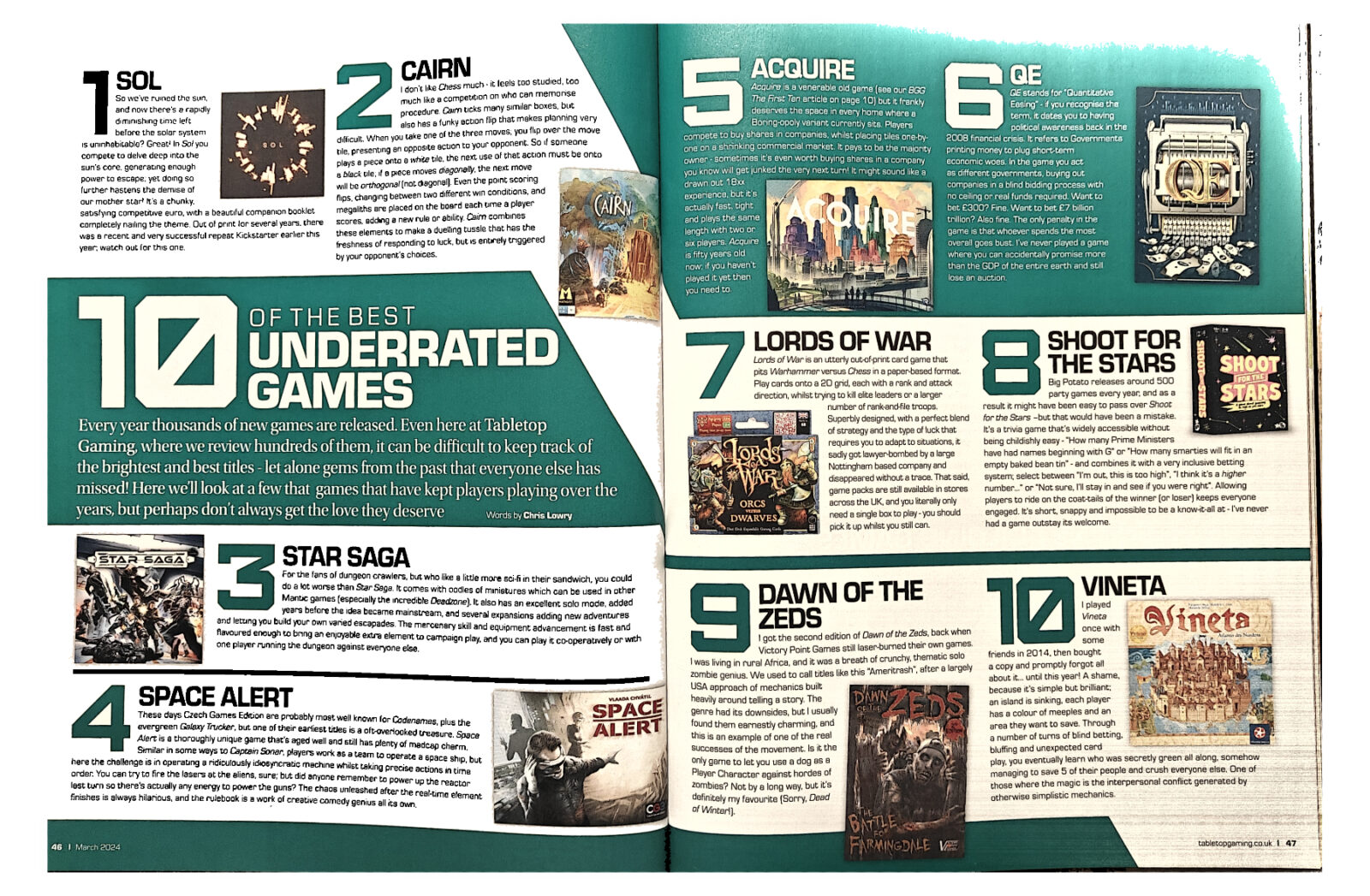
Every year thousands of new games are released. Even here at Tabletop Gaming, where we review hundreds of them, it can be difficult to keep track of the brightest and best titles – let alone gems from the past that everyone else has missed! In the list below, join me as I highlight a few of the games that have kept me playing over the years.

Sol

So we’ve ruined the sun, and now there’s a rapidly diminishing time left before the solar system is uninhabitable? Great! In Sol you compete to delve deep into the sun’s core, generating enough power to escape; yet doing so further hastens the demise of our mother star! It’s a chunky, satisfying competitive euro, with a beautiful companion booklet completely nailing the theme. Out of print for several years, there was a recent and very successful repeat Kickstarter earlier this year; watch out for this one.


Cairn

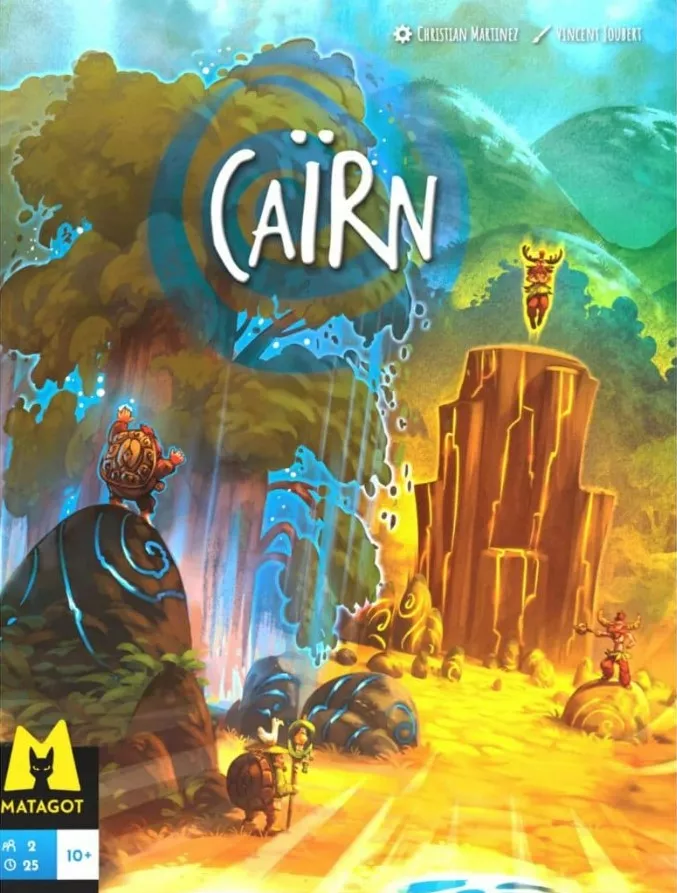
I don’t like Chess much – it feels too studied, too much like a competition on who can memorise procedure. Cairn ticks many similar boxes, but also has a funky action flip that makes planning very difficult. When you take one of the three moves; you flip over the move tile, presenting an opposite action to your opponent. So if someone plays a piece onto a white tile, the next use of that action must be onto a black tile; if a piece moves diagonally, the next move will be orthogonal. Even the point scoring flips, changing between two different win conditions, and megaliths are placed on the board each time a player scores, adding a new rule or ability. Cairn combines these elements to make a duelling tussle that has the freshness of responding to luck, but is entirely triggered by your opponent’s choices.


Star Saga

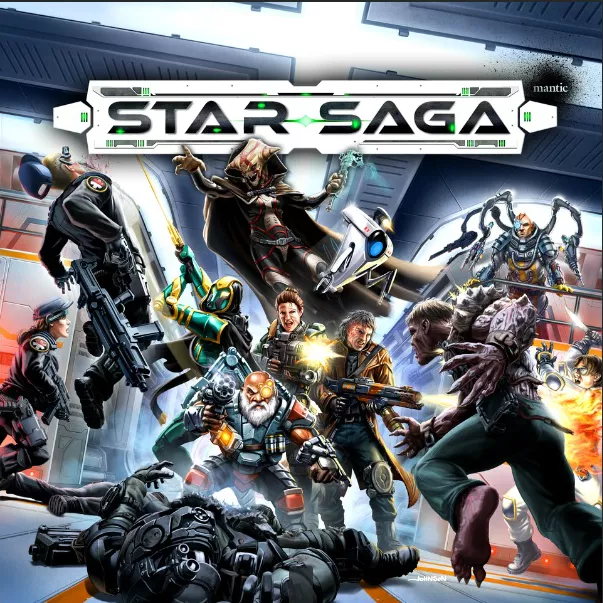
For the fans of dungeon crawlers, but who like a little more sci-fi in their sandwich, you could do a lot worse than Star Saga. It comes with oodles of miniatures which can be used in other Mantic games (especially the incredible Deadzone). It also has an excellent solo mode, added years before the idea became mainstream, and several expansions adding new adventures and letting you build your own varied escapades. The mercenary skill and equipment advancement is fast and flavoured enough to bring an enjoyable extra element to campaign play, and you can play it co-operatively or with one player running the dungeon against everyone else.

Space Alert

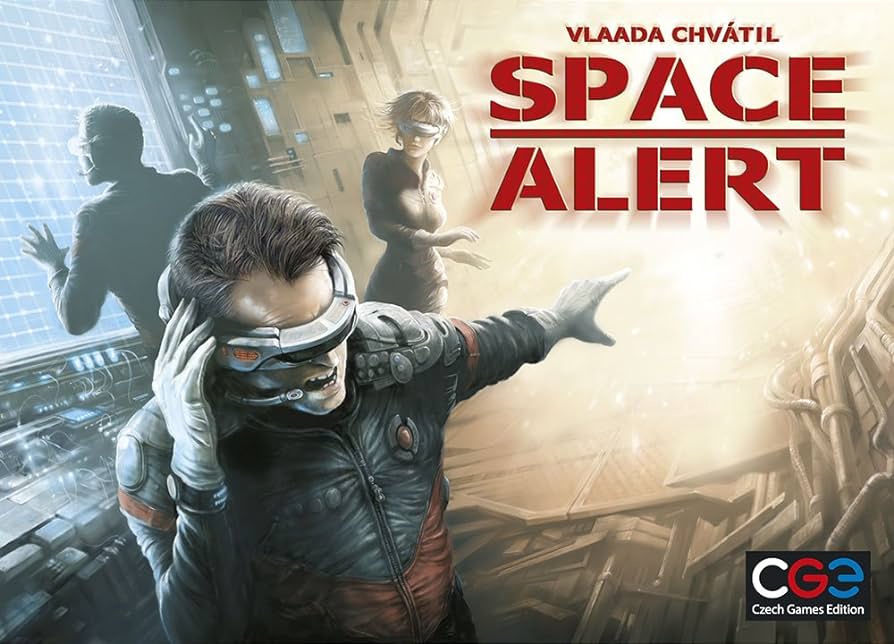
These days Czech Games Edition are probably most well known for Codenames, plus the evergreen Galaxy Trucker, but one of their earliest titles is a oft-overlooked treasure. Space Alert is a thoroughly unique game that’s aged well and still has plenty of madcap charm. Similar in some ways to Captain Sonar, players work as a team to operate a space ship, but here the challenge is in operating a ridiculously idiosyncratic machine whilst taking precise actions in time order. You can try to fire the lasers at the aliens, sure; but did anyone remember to power up the reactor last turn so there’s actually any energy to power the guns? The chaos unleashed after the real-time element finishes is always hilarious, and the rulebook is a work of creative comedy genius all its own.

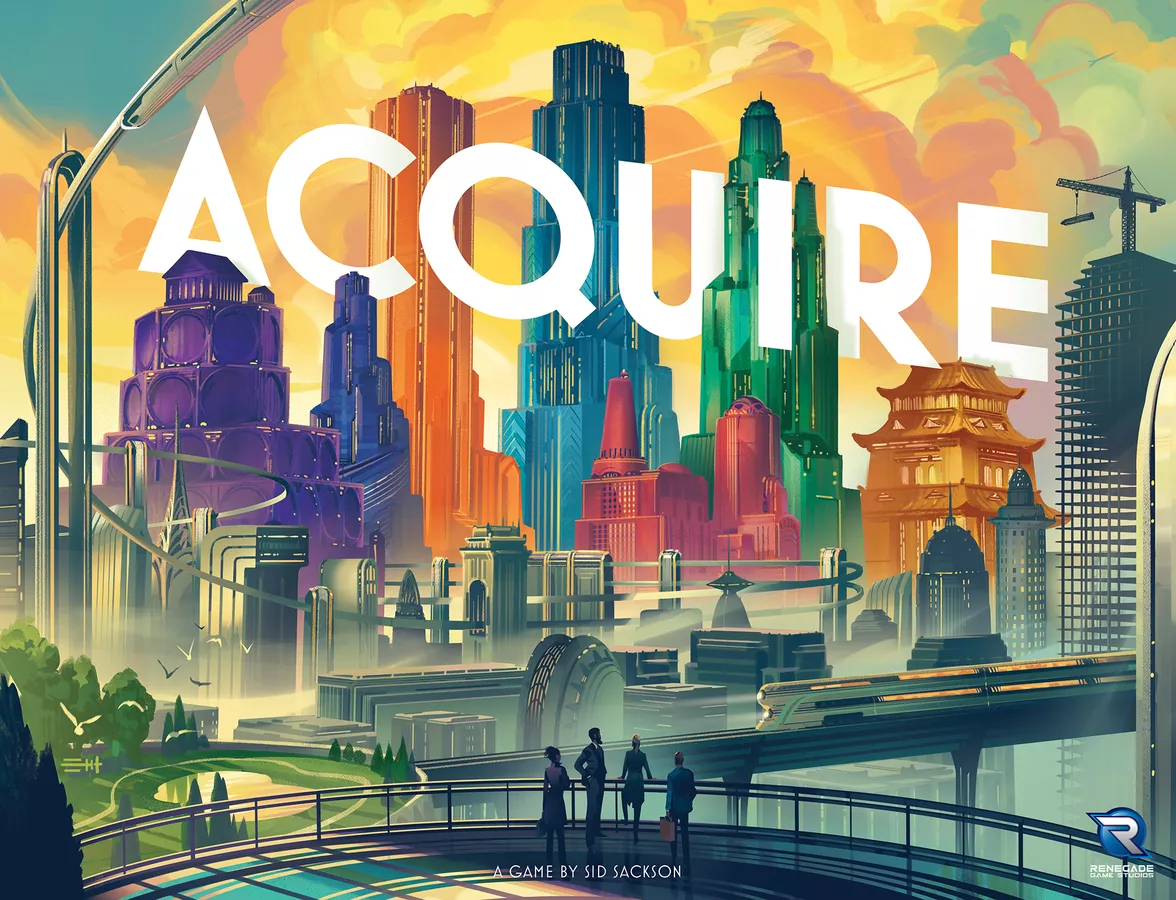
Acquire

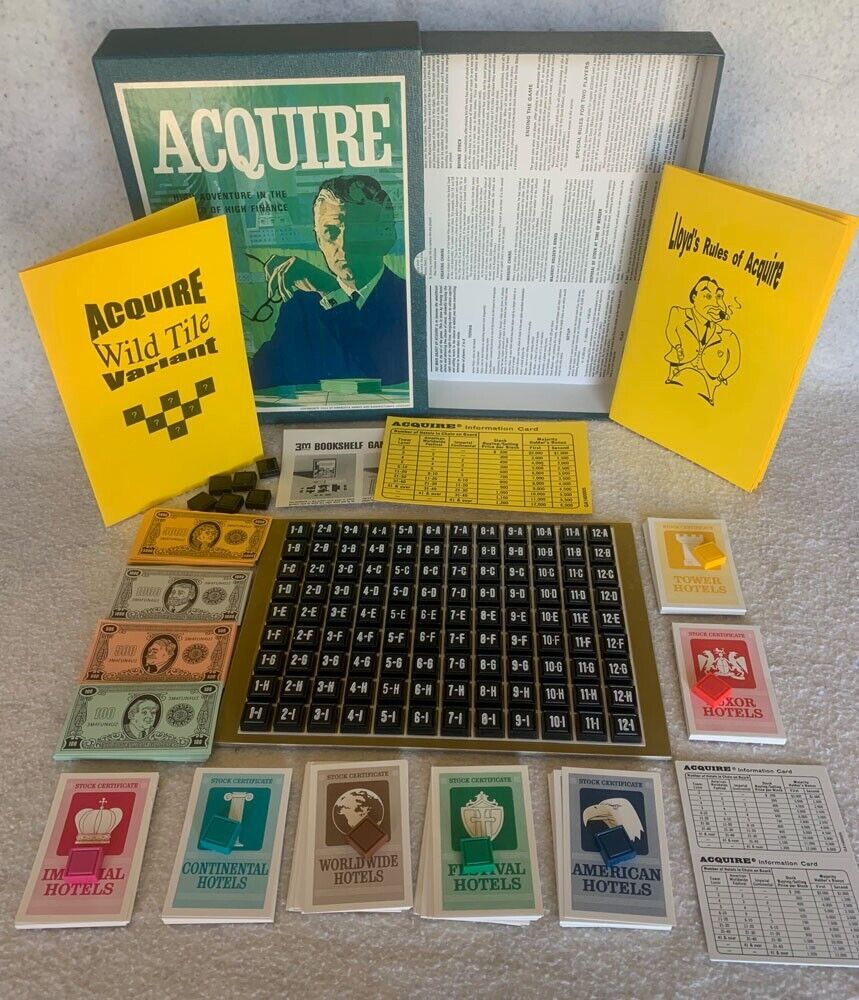
Acquire is a venerable old game (see our BGG The First Ten article on page ##) but it frankly deserves the space in every home where a Boring-opoly variant currently sits. Players compete to buy shares in companies, whilst placing tiles one-by-one on a shrinking commercial market. It pays to be the majority owner – sometimes it’s even worth buying shares in a company you know will get junked the very next turn! It might sound like a drawn out 18xx experience, but it’s actually fast, tight and plays the same length with 2 or 6 players. Acquire is fifty years old now; if you haven’t played it you need to, there’s no excuse.

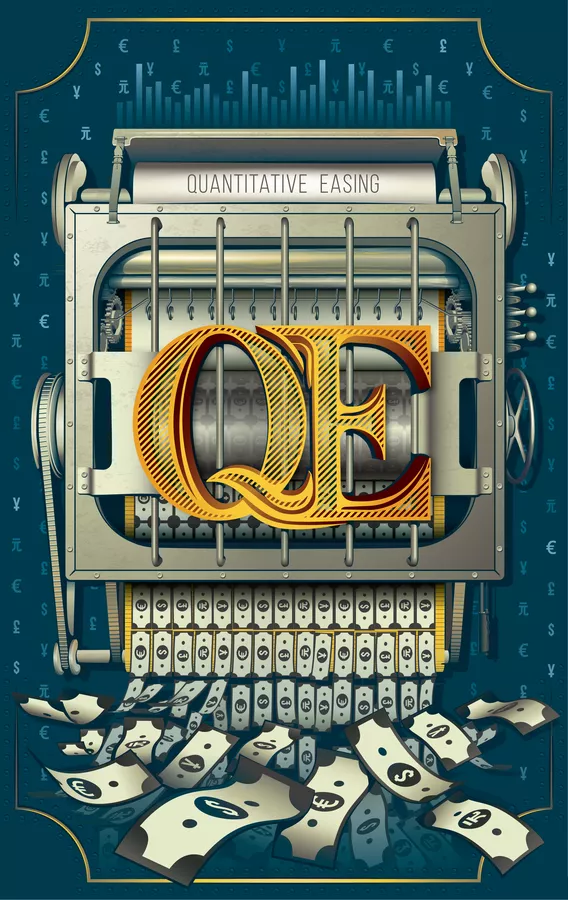
QE

QE stands for “Quantitative Easing” – if you recognise the term, it dates you to having political awareness back in the 2008 financial crisis. It refers to Governments printing money to plug short-term economic woes. In the game you act as different governments, buying out companies in a blind bidding process with no ceiling or real funds required. Want to bet £300? Fine. Want to bet £7 billion trillion? Also fine. The only penalty in the game is that whoever spends the most overall goes bust. I’ve never played a game where you can accidentally promise more than the GDP of the entire earth and still lose an auction.


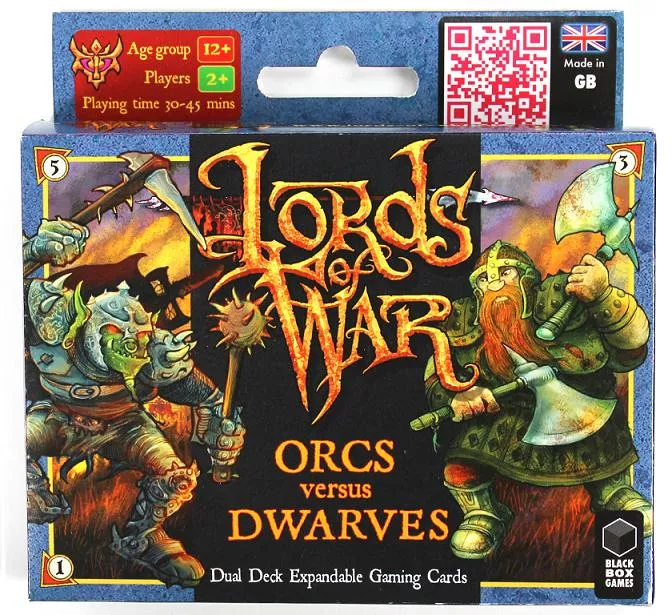
Lords of War

Lords of War is an utterly out-of-print card game that pits Warhammer versus Chess in a paper-based format. Play cards onto a 2D grid, each with a rank and attack direction, whilst trying to kill elite leaders or a larger number of rank-and-file troops. Superbly designed, with a perfect blend of strategy and the type of luck that requires you to adapt to situations, it sadly got lawyer-bombed by a large Nottingham based company and disappeared without a trace. That said, game packs are still available is stores across the UK, and you literally only need a single box to play – you should pick it up whilst you still can.

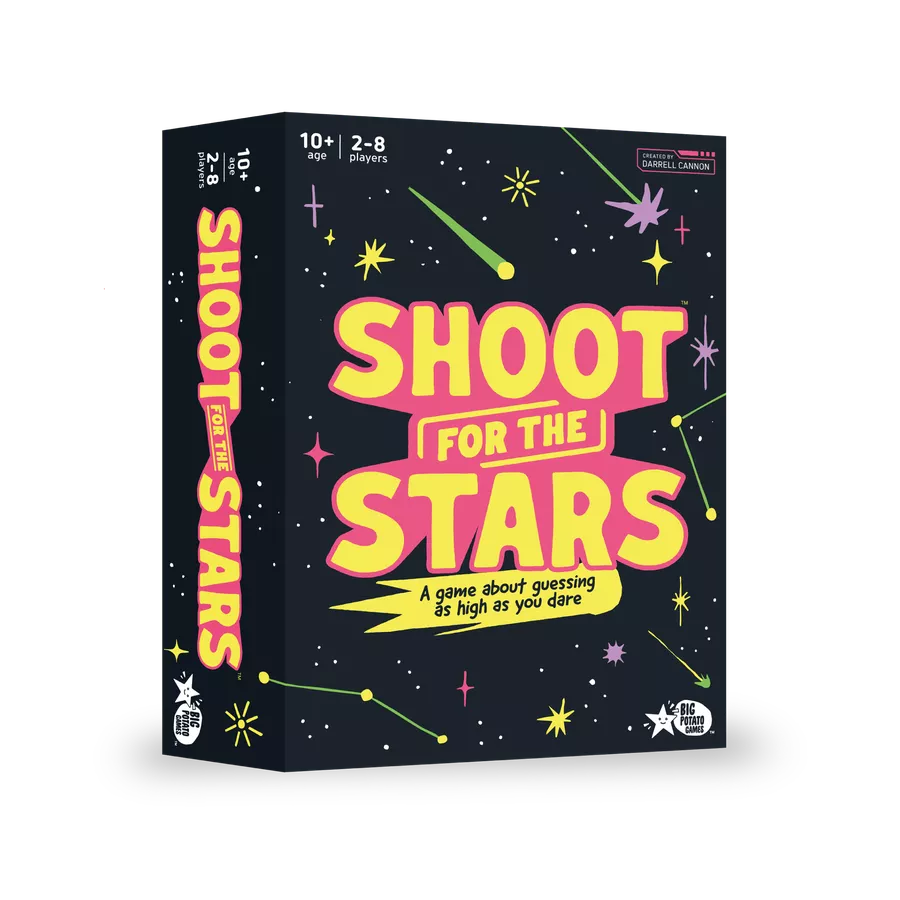
Shoot for the Stars

Big Potato releases around 500 party games every year, and it might have been easy to pass over Shoot for the Stars; that would have been a mistake. It’s a trivia game that’s widely accessible without being childishly easy – “How many Prime Ministers have had names beginning with G” or “How many smarties will fit in an empty baked bean tin” – and combines it with a very inclusive betting system; select between “I’m out, this is too high”, “I think it’s a higher number…” or “Not sure, I’ll stay in and see if you were right”. Allowing players to ride on the coat-tails of the winner (or loser) keeps everyone engaged. It’s short, snappy and impossible to be a know-it-all at – I’ve never had a game outstay its welcome.


Dawn of the Zeds

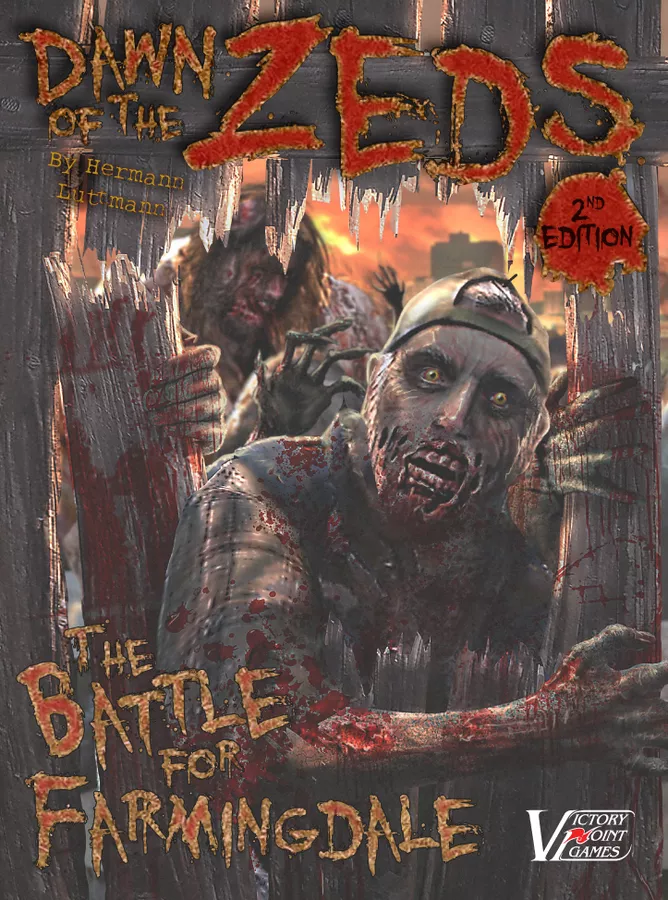
I got the second edition of Dawn of the Zeds, back when Victory Point Games still laser-burned their own games. I was living in rural Africa, and it was a breath of crunchy, thematic solo zombie genius. We used to call titles like this “Ameritrash”, after a largely USA approach of mechanics built heavily around telling a story. The genre had its downsides, but I usually found them earnestly charming, and this is an example of one of the real successes of the movement. Is it the only game to let you use a dog as a Player Character against hordes of zombies? Not by a long way, but it’s definitely my favourite (Sorry, Dead of Winter!).


Vineta

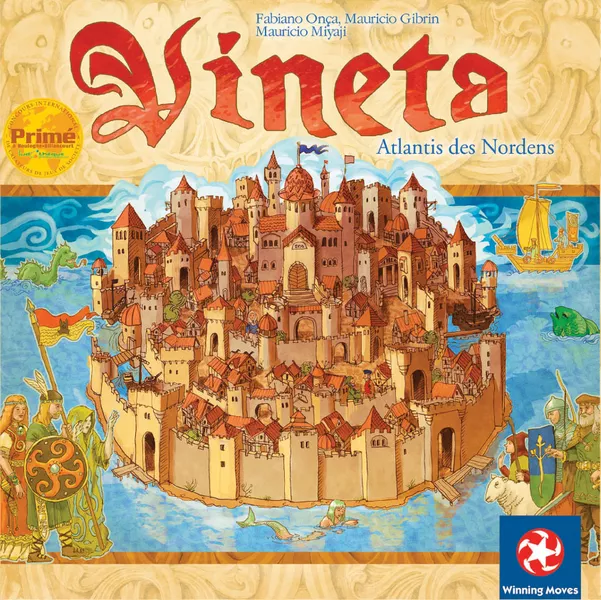
I played Vineta once with some friends in 2014, then bought a copy and promptly forgot all about it… until this year! A shame, because it’s simple but brilliant; an island is sinking, each player has a colour of meeples and an area they want to save. Through a number of turns of blind betting, bluffing and unexpected card play, you eventually learn who was secretly green all along, somehow managing to save 5 of their people and crush everyone else. One of those where the magic is the interpersonal conflict generated by otherwise simplistic mechanics.

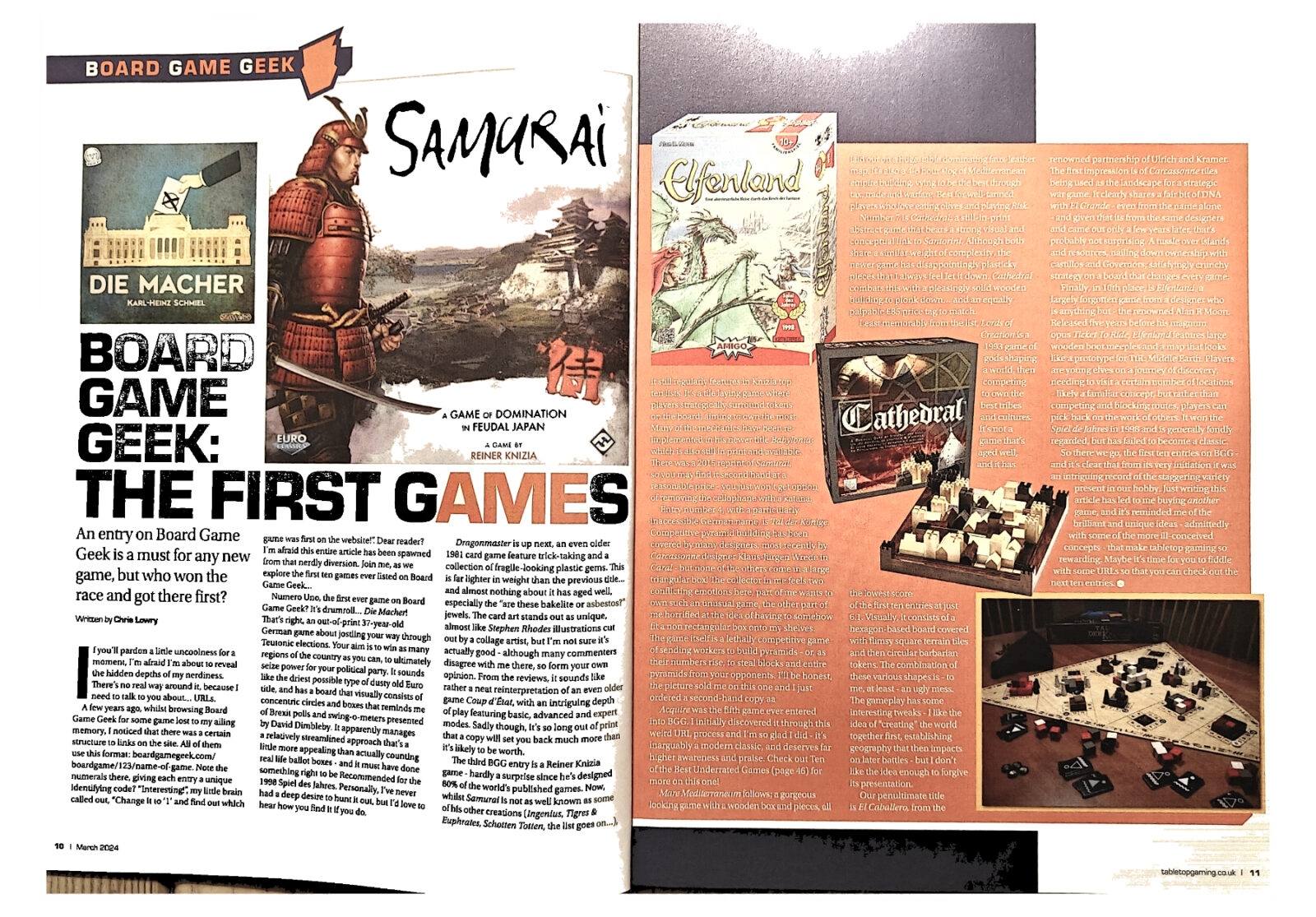
BGG The First Ten Double page feature

If you’ll pardon a little uncoolness for a moment, I’m afraid I’m about to reveal the hidden depths of my nerdiness. There’s no real way around it, because I need to talk to you about… URLs.

A few years ago, whilst browsing Board Game Geek for some game lost to my ailing memory, I noticed that there was a certain structure to links on the site. All of them use this format: https://boardgamegeek.com/boardgame/123/name-of-game. Note the numerals there, giving each entry a unique identifying code? “Interesting!”, my pathetic little brain called out, “Change it to ‘1’ and find out which game was first on the website!”. Dear reader? I’m afraid this entire article has been spawned from that nerdly diversion. Join me, as we explore the first ten games ever listed on BoardGameGeek.com…

Numero Uno, the first ever game on Board Game Geek? It’s drumroll… Die Macher! That’s right, an out-of-print 37-year-old German game about jostling your way through Teutonic elections. Your aim is to win as many regions of the country as you can, to ultimately seize power for your political party. It sounds like the driest possible type of dusty old Euro title, and has a board that visually consists of concentric circles and boxes that reminds me of Brexit polls and swing-o-meters presented by David Dimbleby. It apparently manages a relatively streamlined approach that’s a little more appealing than actually counting real life ballot boxes – and it must have done something right to be Recommended for the 1998 Spiel des Jahres. Personally, I’ve never had a deep desire to hunt it out, but I’d love to hear how you find it if you do.

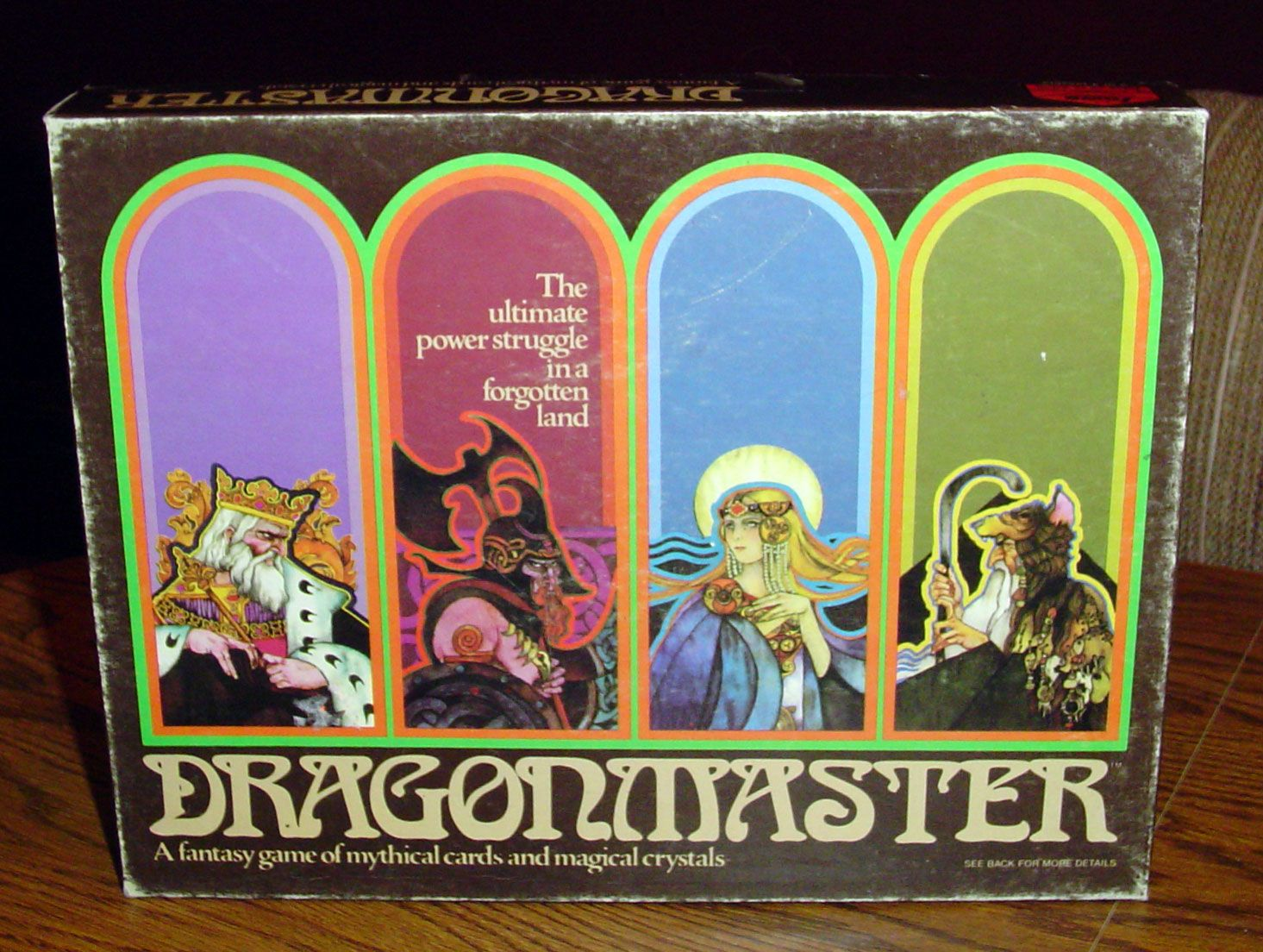
Dragonmaster is up next, an even older 1981 card game feature trick-taking and a collection of fragile-looking plastic gems. This is far lighter in weight than the previous title… and almost nothing about it has aged well, especially the “are these bakelite or asbestos?” jewels. The card art stands out as unique, almost like Stephen Rhodes illustrations cut out by a collage artist, but I’m not sure it’s actually good – although many commenters disagree with me there, so form your own opinion. From the reviews, it sounds like rather a neat reinterpretation of an even older game Coup d’État, with an intriguing depth of play featuring basic, advanced and expert modes. Sadly though, it’s so long out of print that a copy will set you back much more than it’s likely to be worth.

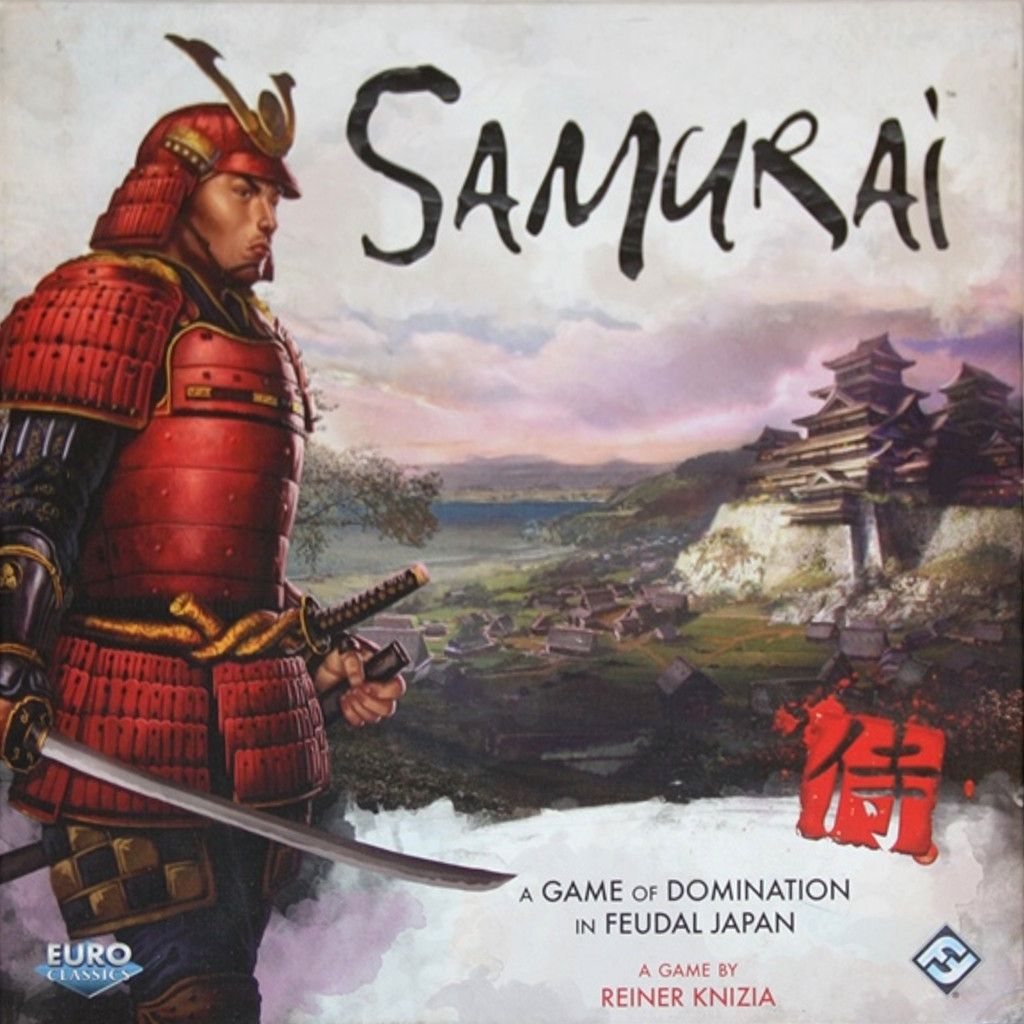
The third BGG entry is a Reiner Knizia game – hardly a surprise since he’s designed 80% of the world’s published games. Now, whilst Samurai is not as well known as some of his other creations (Ingenius, Tigres & Euphrates, Schotten Totten, the list goes on…), it still regularly features in Knizia top ten lists. It’s a tile laying game where players strategically surround tokens on the board, aiming to own the most. Many of the mechanics have been re-implemented in his newer title Babylonia; which is also still in print and available. There was a 2015 reprint of Samurai, so you may find it second hand at a reasonable price – you just won’t get option of removing the cellophane with a katana.

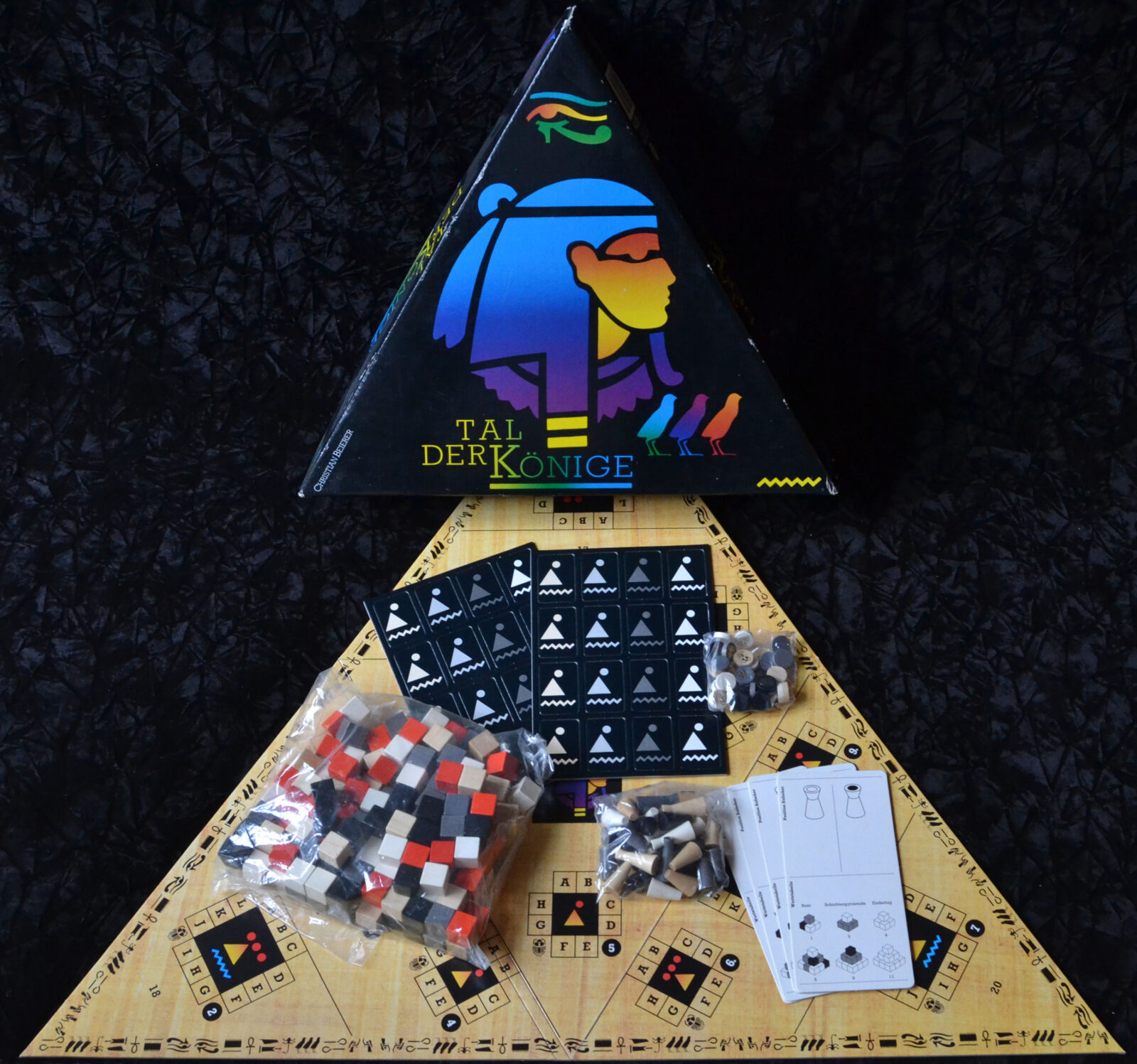
Entry number 4, with a particularly inaccessible German name, is Tal der Könige. Competitive pyramid building has been covered by many designers, most recently by Carcassonne designer Klaus-Jürgen Wrede in Caral – but none of the others come in a large triangular box! The collector in me feels two conflicting emotions here, part of me wanting to own such an unusual game, the other half of me horrified at the idea of having to somehow fit a non rectangular box onto my shelves. The game itself is a lethally competitive game of sending workers to build pyramids – or, as their numbers rise, to steal blocks and entire pyramids from your opponents. I’ll be honest, the picture sold me on this one and I just ordered a second hand copy.

Acquire was the fifth game ever entered into BGG. I initially discovered it through this weird URL process and I’m so glad I did – it’s inarguably a modern classic, and deserves far higher awareness and praise. Check out Ten of the Best Underrated Games (page ##) for more on this one!


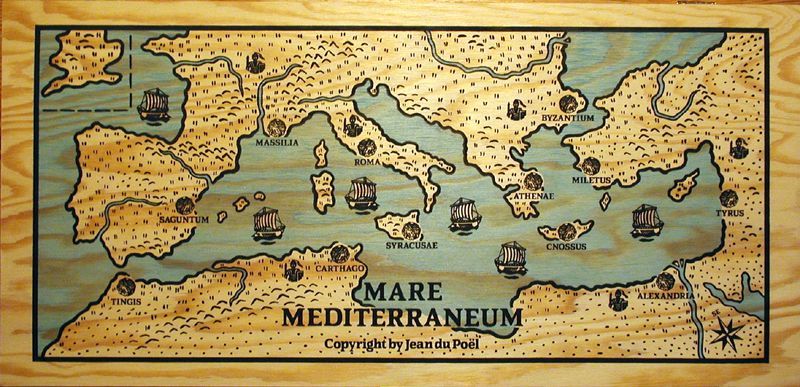
Mare Mediterraneum follows; a gorgeous looking game with a wooden box and pieces, all laid out on a huge, table dominating faux-leather map. It’s also a 4-6 hour slog of Mediterranean empire building, vying to be the best through tax, trade and warfare. Best for well-tanned players who love eating olives and playing Risk.

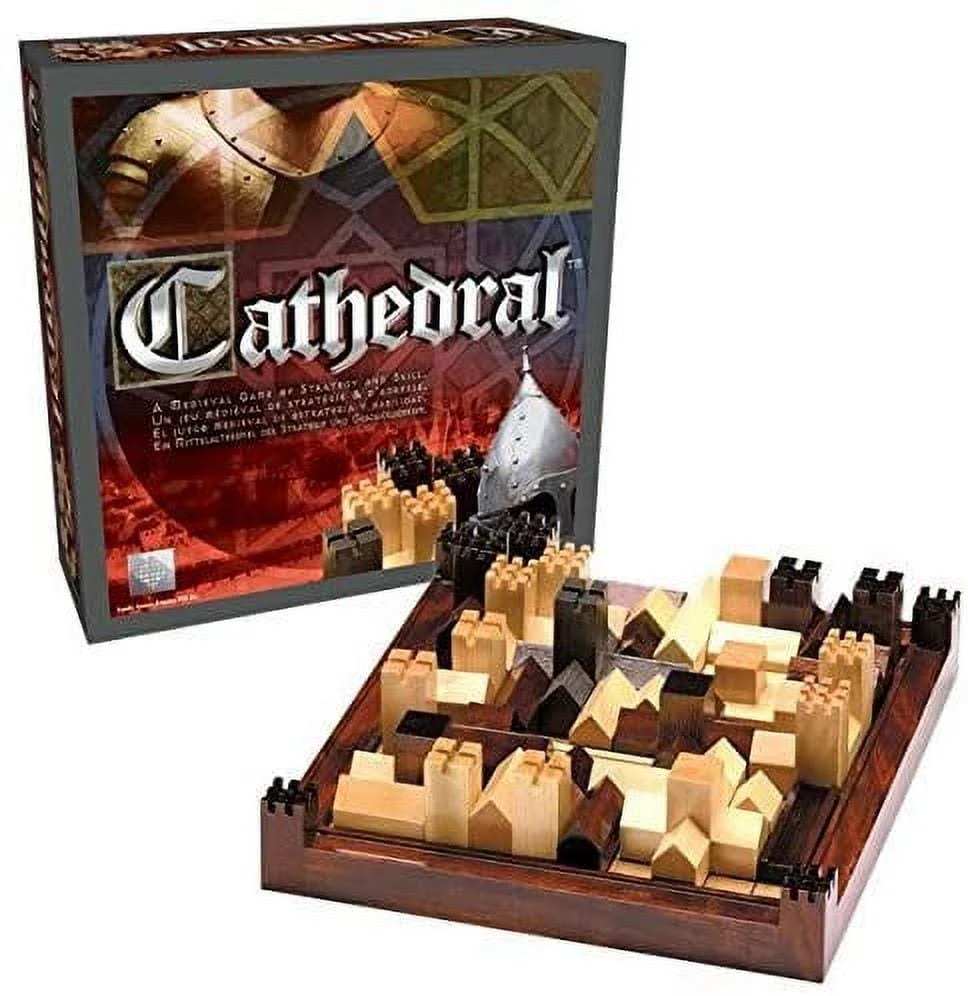
Number 7 is Cathedral; a still-in-print abstract game that bears a strong visual and conceptual link to Santorini. Although both share similar weight of complexity, the newer game has disappointingly plasticky pieces that I always feel let it down. Cathedral combats this with pleasingly solid wooden building to plonk down… and an equally palpable £85 pricetag to match.


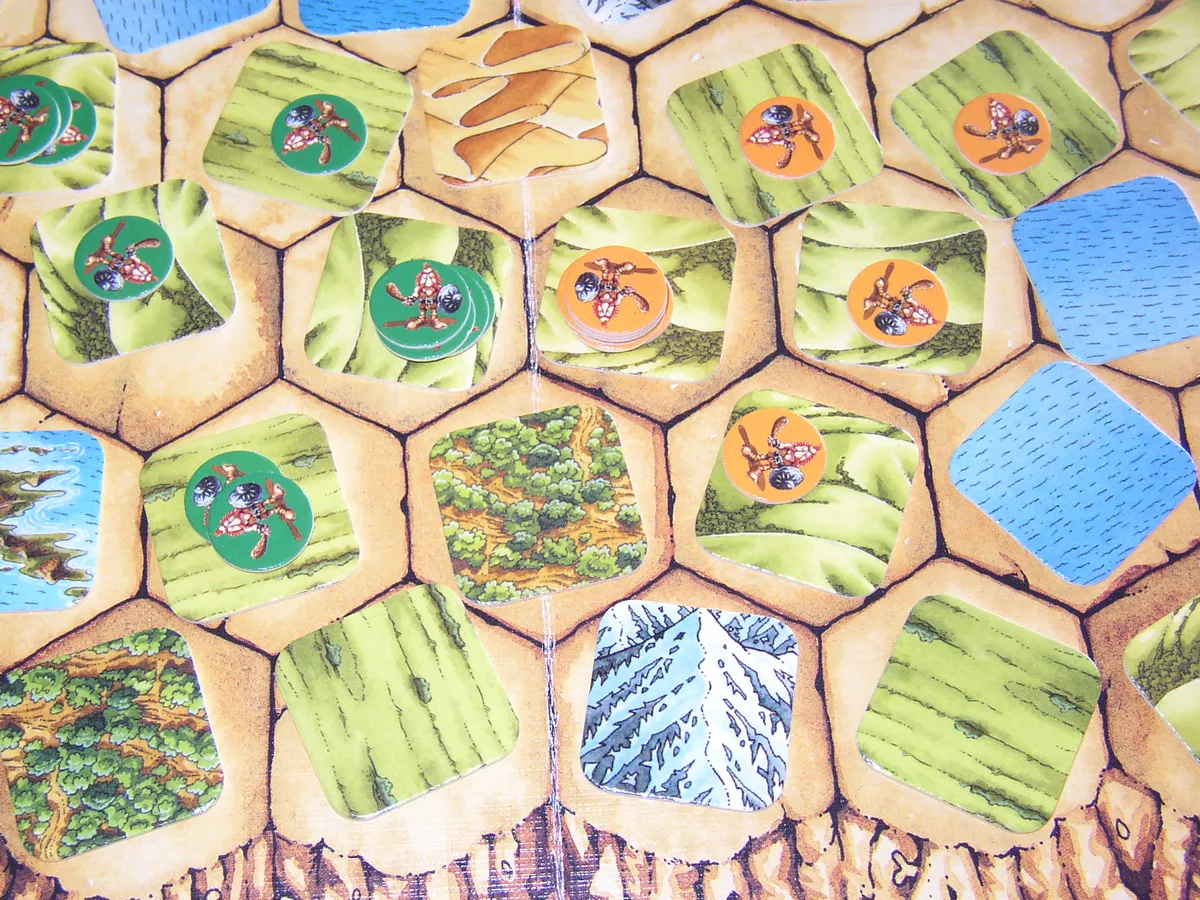
Least memorably from the list, Lords of Creation is a 1993 game of gods shaping a world, then competing to own the best tribes and cultures. It’s not a game that’s aged well, and it has the lowest score of the first ten entries at just 6.1. Visually, it consists of a hexagon-based board covered with flimsy square terrain tiles and then circular barbarian tokens. The combination of these various shapes is – to me, at least – an ugly mess. The gameplay has some interesting tweaks – I like the idea of “creating” the world together first, establishing geography that then impacts on later battles – but I don’t like the idea enough to forgive its presentation.

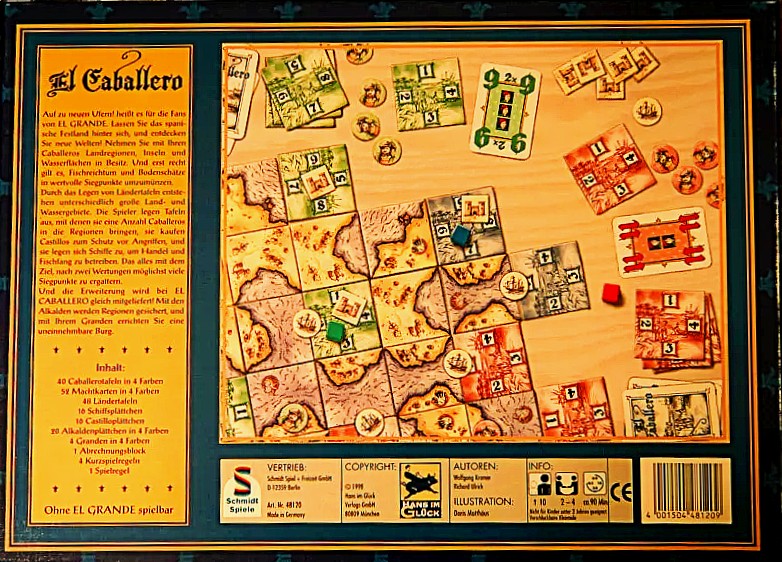
Our penultimate title is El Caballero, from the renowned partnership of Ulrich and Kramer. The first impression is of Carcassonne tiles being used as the landscape for a strategic war game. It clearly shares a fair bit of DNA with El Grande – even from the name alone – and given that its from the same designers and came out only a few years later, that’s probably not surprising. A tussle over islands and resources, nailing down ownership with castillos and Governors; satisfyingly crunchy strategy on a board that changes every game.

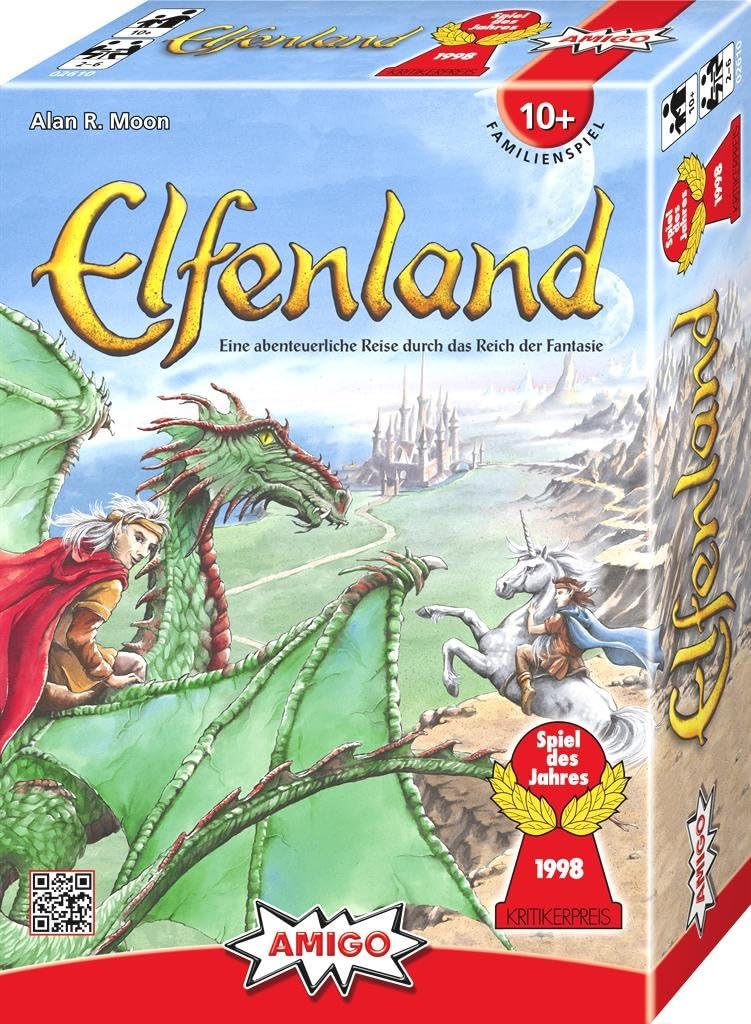
Finally, in 10th place, is Elfenland, a largely forgotten game from a designer who is anything but – the renowned Alan R Moon. Released 5 years before his magnum opus Ticket To Ride, Elfenland features large wooden boot meeples and a map that looks like a prototype for TtR: Middle Earth. Players are young elves on a journey of discovery, needing to visit a certain number of locations – likely a familiar concept, but rather than competing and blocking routes, players can pick-back on the work of others. It won the Spiel de Jahres in 1998 and is generally fondly regarded, but has failed to become a classic.

So there we go, the first ten entries on BGG – and its clear that from it’s very initiation it was an intriguing record of the staggering variety present in our hobby. Just writing this article has led to me buying another game, and it’s reminded me of the brilliant and unique ideas – admittedly with some of the more ill-conceived concepts – that make tabletop gaming so rewarding. Maybe its time for you to fiddle with some URLs so that you can check out the next 10 entries?

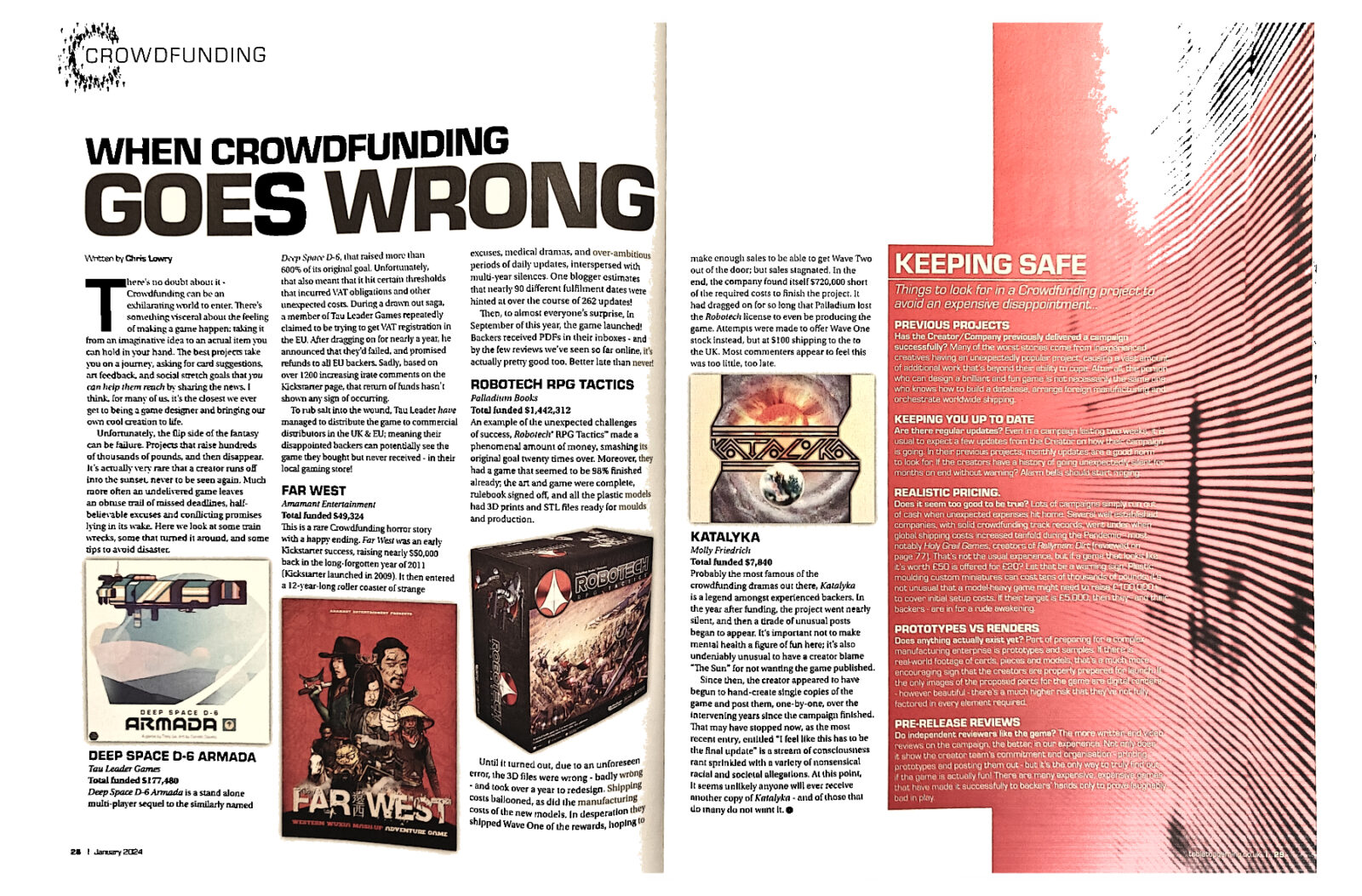
When Crowdfunding Goes Wrong

There’s no doubt about it – Crowdfunding can be an exhilarating world to enter. There’s something visceral about the feeling of making a game happen; taking it from an imaginative idea to an actual item you can hold in your hand. The best projects take you on a journey, asking for card suggestions, art feedback, and social stretch goals that you can help them reach by sharing the news. I think, for many of us, its the closest we ever get to being a game designer and bringing our own cool creation to life.

Unfortunately, the flip side of the fantasy can be failure. Projects that raise hundreds of thousands of pounds, and then disappear. It’s actually very rare that a creator runs off into the sunset, never to be seen again. Much more often an a undelivered game leaves an obtuse trail of missed deadlines, half-believable excuses and conflicting promises laying in its wake. Here we look at some train-wrecks, and some tips to avoid disaster.

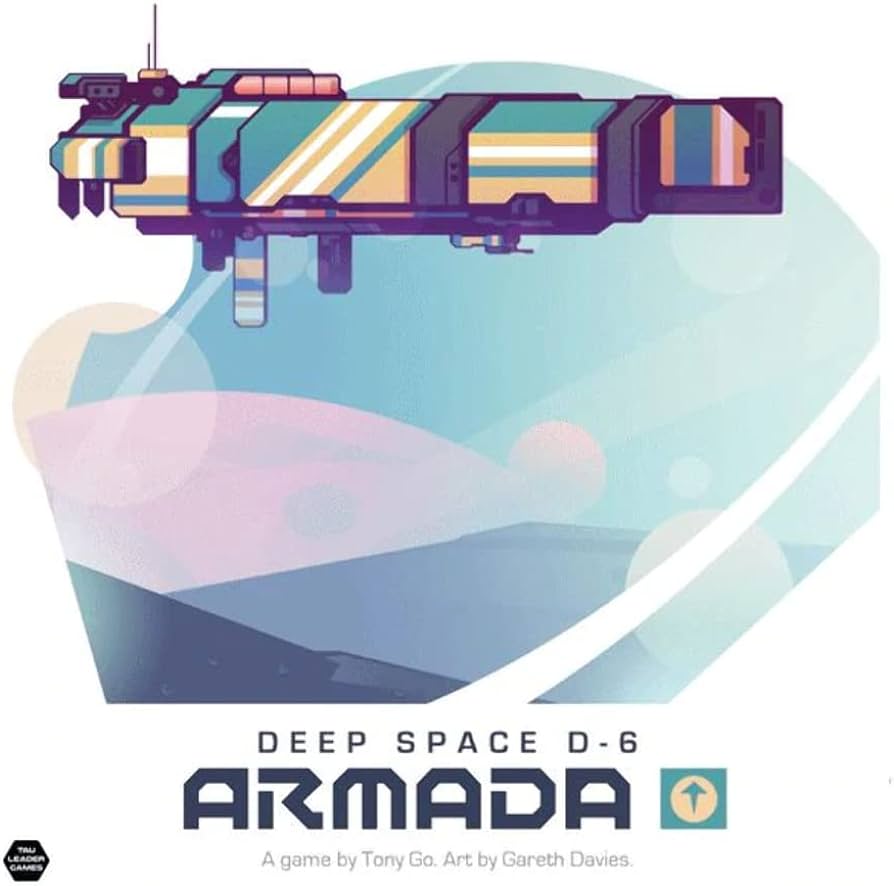
Deep Space D-6 Armada

Tau Leader Games

Total funded $177,480

Deep Space D-6 Armada is a stand alone multi-player sequel to the similarly named Deep Space D-6. It raised more than 600% of its original goal – a tearaway success. Unfortunately, that also meant that it hit certain thresholds that incurred VAT obligations and other unexpected costs. During a drawn out – and unresolved saga – Tony from Tau Leader repeatedly claimed to be trying to get VAT registration in the EU. After dragging on for nearly a year, he announced that they’d failed, and promised refunds to all EU backers. Sadly, based on over 1200 increasing irate comments on the Kickstarter page, that return of funds hasn’t shown any sign of occurring.

To rub salt into the wound, Tau Leader have managed to distribute the game to commercial distributors in the UK & EU; meaning their disappointed backers can potentially see the game they bought but never received – in their local gaming store!


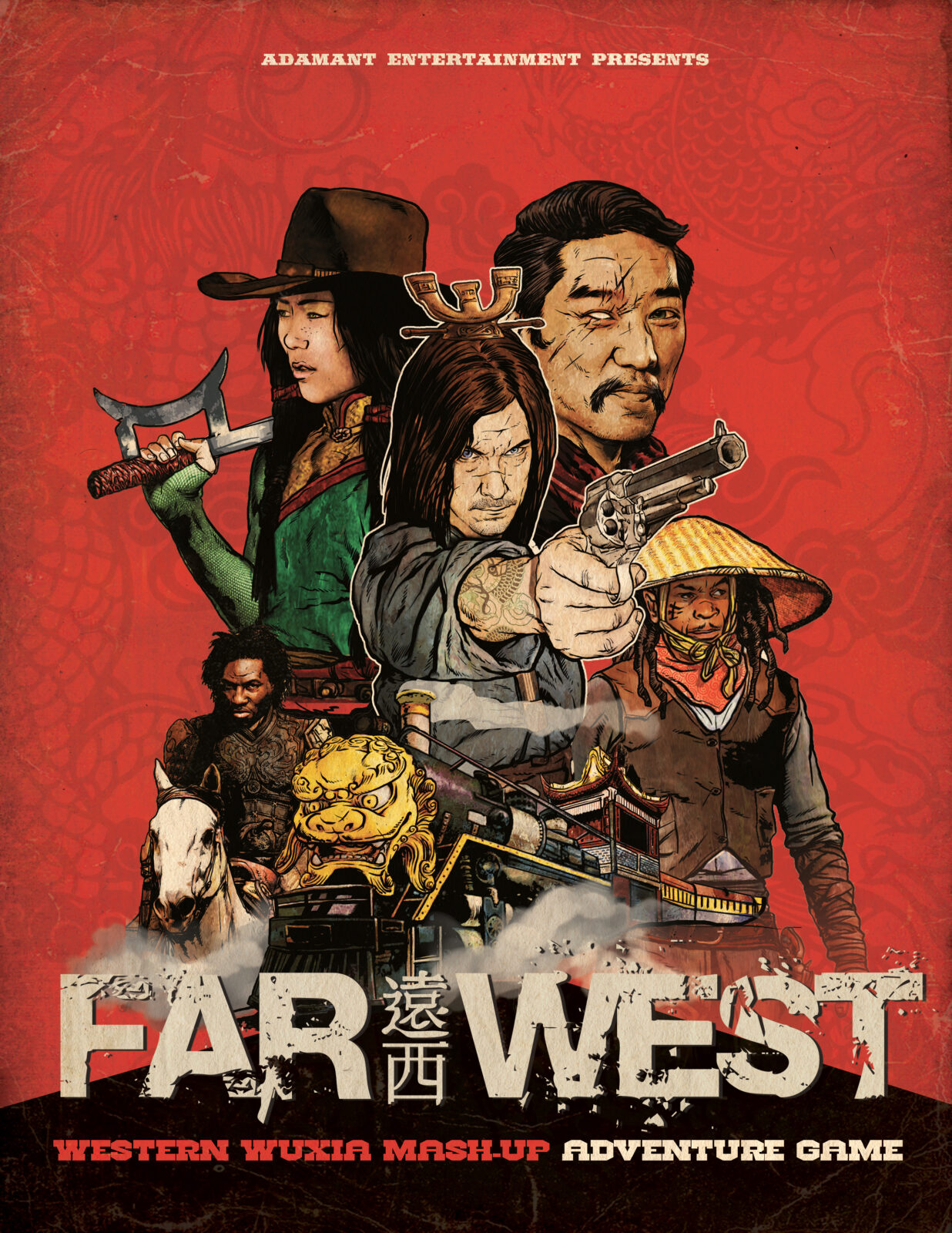
Far West

Adamant Entertainment

Total funded $49,324

This is a rare Crowdfunding horror story with a happy ending. Far West was an early Kickstarter success, raising nearly $50,000 back in the long-forgotten year of 2011 (Kickstarter launched in 2009). It then entered a 12-year-long roller coaster of strange excuses, medical dramas, and over-ambitious periods of daily updates, interspersed with multi-year silences. One blogger estimates that nearly 90 different fulfilment dates were hinted at over the course of 262 updates!

Then, to almost everyone’s surprise, in September of this year, the game launched! Backers received PDFs in their inboxes – and by the few reviews we’ve seen so far online, it’s actually pretty good too; although we hold back any opinion until we get our hands on a copy. Better late than never though!


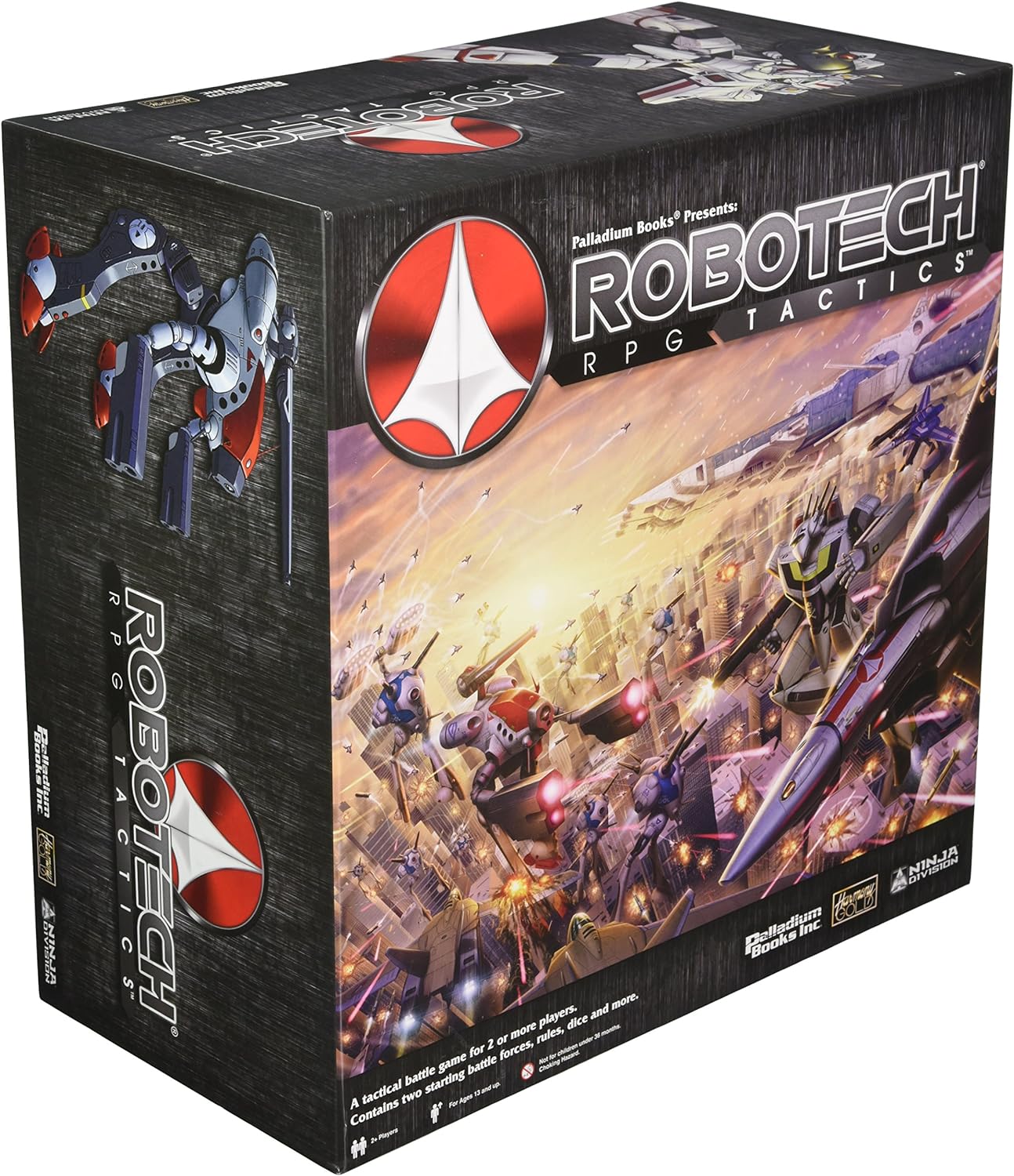
Robotech® RPG Tactics™

Palladium Books

Total funded $1,442,312

An example of the unexpected challenges of success, Robotech® RPG Tactics™ ****made a phenomenal amount of money, smashing its original goal twenty times over. Moreover, they had a game that seemed to be 98% finished already; the art and game were complete, rulebook signed off, and all the plastic models had 3D prints and STL files ready for moulds and production.

Until it turned out, due to an unforeseen error, the 3D files were wrong – badly wrong – and took over a year to redesign. Shipping costs ballooned, and the newly complicated models cost three times more to manufacture than expected. In desperation they shipped Wave One of the rewards, hoping to make enough sales to be able to get Wave Two out of the door; but sales stagnated. In the end the company found themselves $720,000 short of the required costs to finish the project. It had dragged on for so long that Palladium lost the Robotech license to even be producing the game! They did offer a reward exchange for people to get extra Wave One stock instead of the missing products, but even that came with a hefty shipping charge – $100 to the UK! Most commenters appear to feel this was too little, too late.

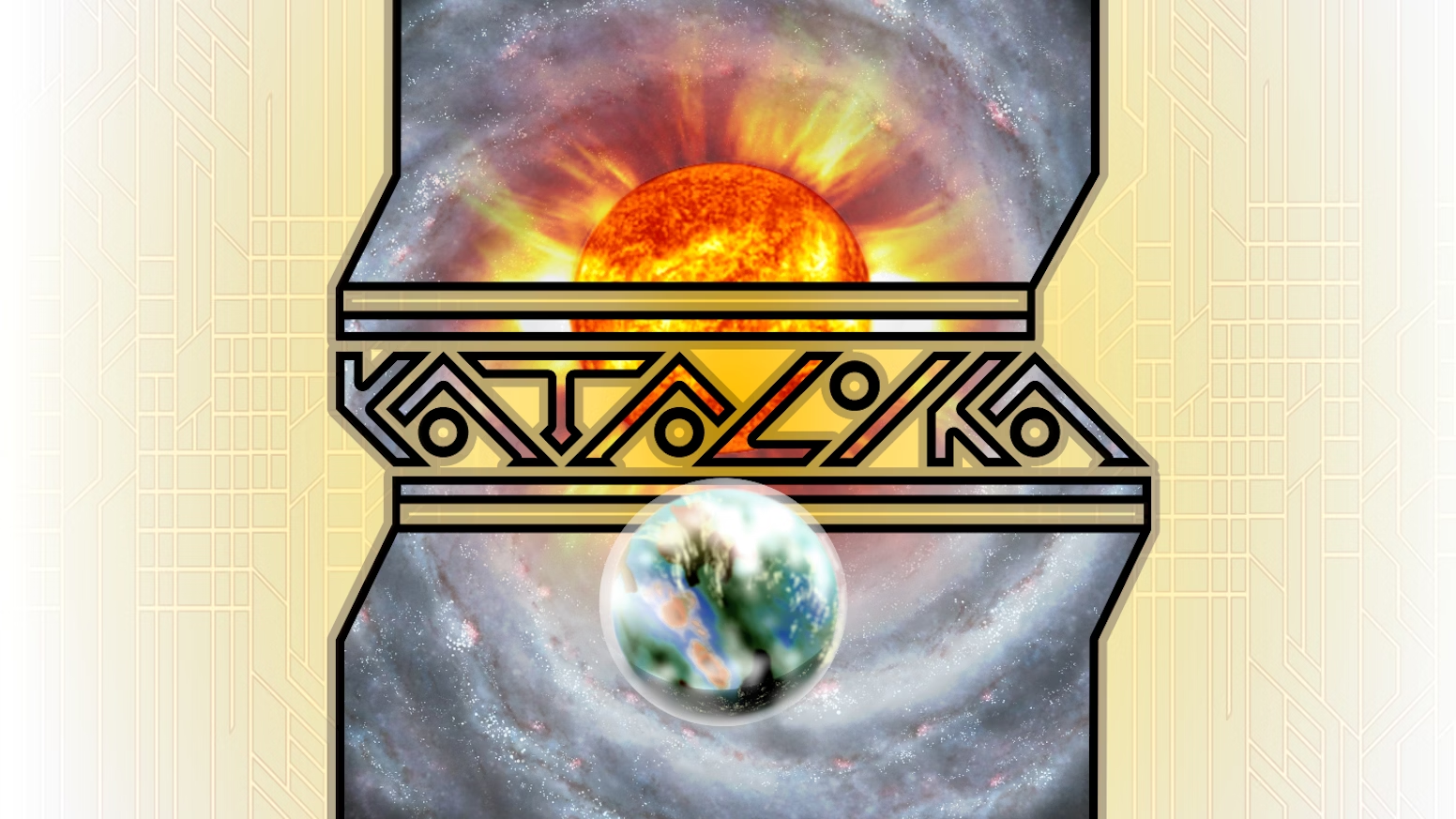
Katalyka

Molly Friedrich

Total funded $7,840

Probably the most famous of the crowdfunding meltdowns out there, Katalyka is a legend amongst experienced backers. In the year after funding, the project went nearly silent, and then a tirade of unusual and somewhat delusional posts began to appear. It’s important not to make mental health a figure of fun here; its also undeniably unusual to have a creator blame “The Sun” for not wanting the game published.

Even more erratically, the creator appears to have begun to hand create single copies of the game and post them, one-by-one, over the intervening years since the campaign finished. That may have stopped now, as the most recent entry, entitled “I feel like this has to be the final update” is a stream of consciousness rant blaming her backers, multiple named families, “DEATH PRESSURE”, and many others, all sprinkled with a variety of nonsensical racial and societal allegations. At this point, it seems unlikely anyone will ever receive another copy of Katalyka – and those that do many not want it!


Keeping Safe

Things to look for in a Crowd-funding project to avoid an expensive disappointment…

Previous projects

Has the Creator/Company previously delivered a campaign successfully? Many of the worst stories come from inexperienced creatives having an unexpectedly popular project; a magnitude more success than they’d expected, causing a vast amount of additional work that’s beyond their ability to cope. After all, the person who can design a brilliant and fun game is not necessary the same one that knows how to build a database, arrange foreign manufacturing and orchestrate worldwide shipping.

Keeping you up to date

Are there regular updates? Even in a campaign lasting two weeks, it is usual to expect a few updates from the Creator on how their campaign is going. In their previous projects, monthly updates are a good norm to look for. If the creators have a history of going unexpectedly silent for months-on-end without warning? Alarm bells should start ringing.

Realistic Pricing.

Does it seem too good to be true? Lots of campaigns simply run out of cash when unexpected expenses hit home. Several well established companies, with solid crowdfunding track records, went under when global shipping costs increased tenfold during the Pandemic – most notably Holy Grail Games, creators of Rallyman: Dirt (reviewed on page #). That’s not the usual experience, but if a game that looks like it’s worth £50 is offered for £20? Let that be a warning sign. Plastic moulding custom miniatures can cost tens of thousands of pounds; it’s not unusual that a model-heavy game might need to raise £100,000+ to cover initial setup costs. If their target is £5,000, then they – and their backers – are in for a rude awakening.

Prototypes vs Renders

Does anything actually exist yet? Part of preparing for a complex manufacturing enterprise is prototypes and samples. If there is real-world footage of cards, pieces and models, that’s a much more encouraging sign that the creators are properly prepared for launch. If the only images of the proposed parts for the game are digital renders – however beautiful – there’s a much higher risk that they’ve not fully factored in every element required.

Pre-release reviews

Does independent reviewers like the game? The more written and video reviews on the campaign, the better, in our experience. Not only does it show the creator team’s commitment and organisation – printing prototypes and posting them out – but it’s the only way to truly find out if the game is actually fun! There are many expensive, expansive games that have made it successfully to backers hands only to prove laughably bad in play.

The Soloist

Board Games To Play On Your Own

Sometimes you don’t have anyone to play games with. It’s not that you don’t have friends – I can already tell that you are a lovely person who is fun to be around – it’s just that you don’t have someone to game with at this particular moment in time.

We’ve all been there. You send a few messages out, but no one is free tonight. “I can do Tuesday!” comes back, but that’s no good, because today is Wednesday. This actually represents a significant problem, because you rather fancied a board game tonight. Sure you could read a book, watch some TV or… shudder… play a computer game… but that won’t quite scratch the itch. Covering a tabletop with colourful bits of cardboard is its own reward; but you have nobody to share that joy with.

Now, solo games exist, you know that; but you don’t own any! It’s never really appealed quite as much as the latest multi-player marvel. Of course, you have a few of ‘the classics’ – the games that are the hallmark of our hobby. There’s a copy of Settlers of Catan over by the coffee table; you’ve got Camel Up, Castles of Burgundy and Carcassonne on the shelf; there’s Ticket to Ride too, if you can remember which cupboard you put it in. But few of them are built with only one person in mind, right?

Don’t worry. I’m here to tell you that you aren’t alone. I mean, you are. Obviously. We’ve just been talking about that. What I mean is; you aren’t alone in your dilemma. We have all been there. In fact, two or three years ago, we literally all were there. The world was under the grip of COVID lockdowns, and no one was meeting up to play games at all. It was a weird and horrible time, it felt like my universe had imploded, and I hope we never end up there again.

The upside of such universal unhappiness is that an awful lot of board game designer were stuck at home with no one to play with. As a result, they took a look at their own games, and realised there needed to be a way to play them alone. As a result, 2021 was the first year in Board Game Geek’s records where more games were released with a solo mode than without one.

It also meant that the creators of classics – the gateway drugs that pulled many of us into this lifelong addiction – realised that established games could be altered to cater to just one at the table. Lots of publishers released official solo rules; even for games that were first released decades ago. You may not have realised this, but amongst your well-loved gaming shelves hide hundreds of solo-friendly games.

All of this means, hopefully, that you can play something tonight, even if it doesn’t say 1+ players on the box…

Carcassonne

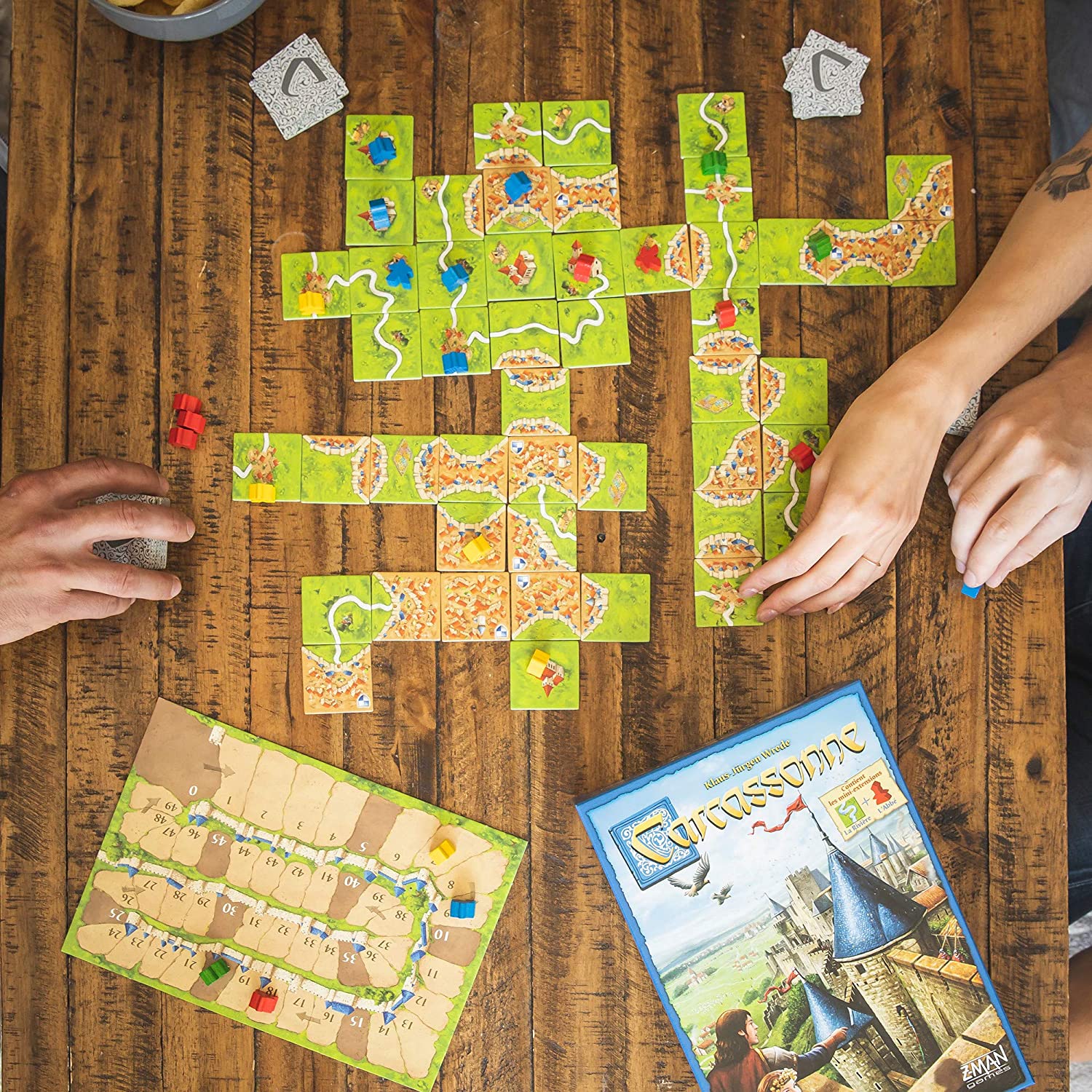
Our first solo stop is the tile-laying titan Carcassonne. For many of us it’s probably our favourite game. It balances the personal puzzle of placing pieces to build a pretty little tableau on the table. The added spice comes with the oppositional layer of competition in building the best things to gain the most points. Obviously the first half of that still works solo, but how does the game function without the opponents. How is the fiesty free-for-all of field fiefdoms when your friends forsake you?

Well, interestingly, the official solo rules – downloadable for free from Z Man Games – keep this element but turn it inside out; you are battling for balance. You take meeples of three different colours and play, effectively, as three different players. You use an abbot meeple to show which colour is active, and try to gather the most points for each – but your score at the end is based on whichever colour scores lowest. A similar approach to scoring as Reiner Knizia’s excellent Ingenious, this presents an unusual challenge; it’s not about just pushing ahead as much as you can in one area. Opportunities taken with blue may hinder you by further hindering your less well-developed score in red.

There are some other adjustments too; no farmers in fields, and you must claim a feature if one exists. This adds tension to the tile placement approach – no more dumping uninteresting tiles round the edges. It’s a slightly more cerebral change, and one that would normally contribute to the problem of analysis paralysis. The joy of solo is that time between turns is never a problem; take as long as you need in order to make the perfect choice! The added thinky-ness also replaces some of the missing interpersonal conflict.

Is it as good as the normal game? Very nearly. Some may even prefer it. If you want more of the same; there’s also Mists Over Carcassonne which has been built from the ground up for solo and co-operative play; fighting the ghost-filled mists flooding over the land.

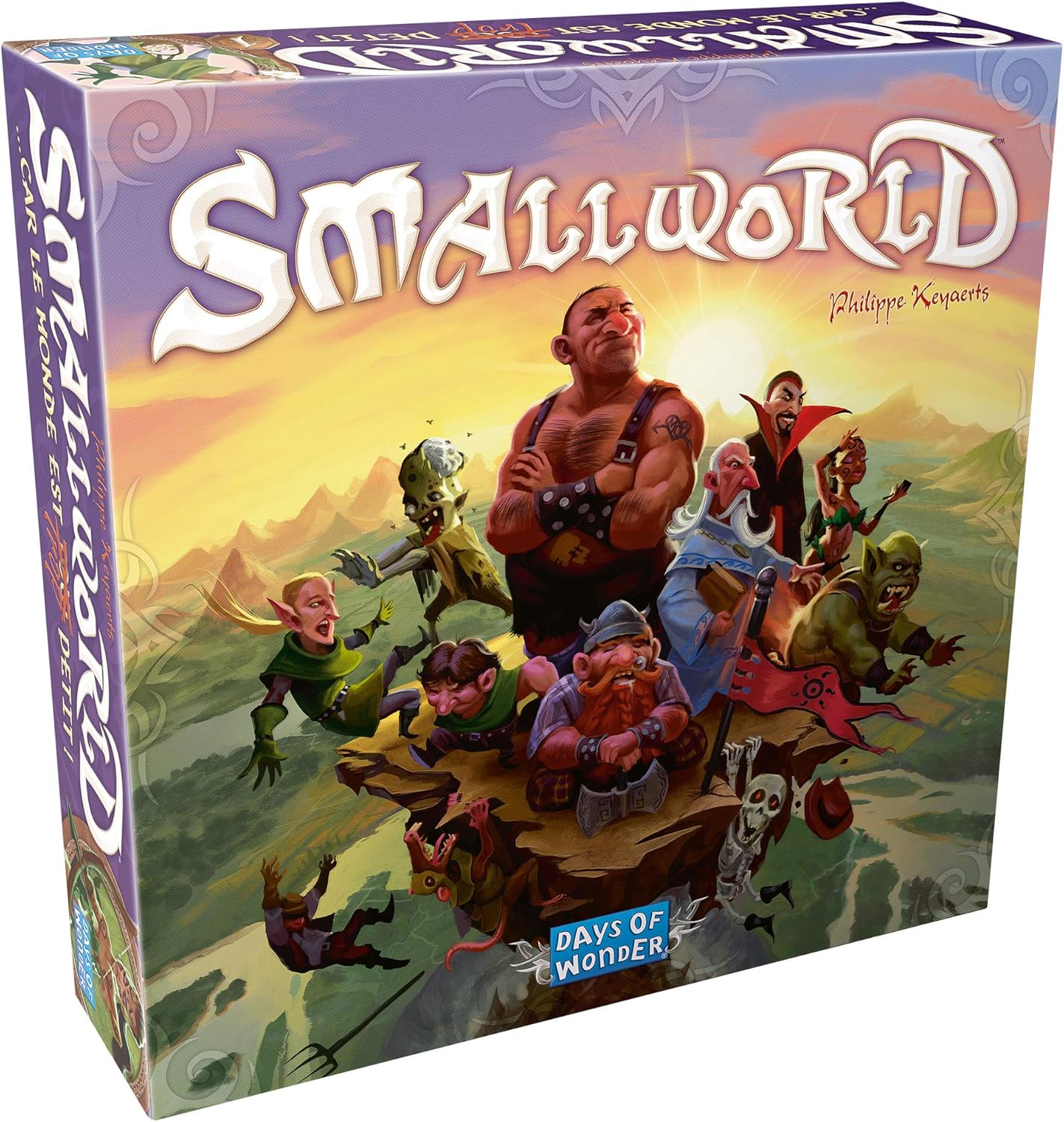
Small World

Small World is a well regarded game of tribal conquest and declining dominance. Present on many gamers improbably heaped Ikea shelves, its also indubitably a multi-person game. Players place tribespeople on areas, gaining points for holding and conquering. As turns pass, each tribe loses stamina, faltering and waning. Players must decided when to let each civilisation fade away, replacing it with the next Big Thing. The game models concepts of evolution and casually critiques colonialism, but without taking itself particularly seriously. Different races combine with special powers to meld unique characteristics, such as Forest Skeletons that gain points for occupying forested regions, and bring dead tokens back to life, or Merchant Rats, that have a million tokens and the double the point-earning ability.

Days of Wonder have released official solo rules for free on their website. In The Lost Tribes’ Crusade, you fight against a non-human opponent – The Lost Tribes. Simple but detailed rules govern the opponent’s decisions. Unlike you, the Lost Tribes never go into decline, remaining on the board as a constant menace, and the opponent rules are well-rafted to ensure that they will always strategically take the territory most annoying to you.

Build to work with Small World base game and both the Underground & River World expansions, its a surprisingly slick addition. In fact, it works so well that its hard to believe it wasn’t already part of the game. I’m not sure it quite holds up to satisfaction of crushing your friend’s tribes, but I do think its an excellent training mode for getting to grips with the oodles of potential combinations of races and special powers.

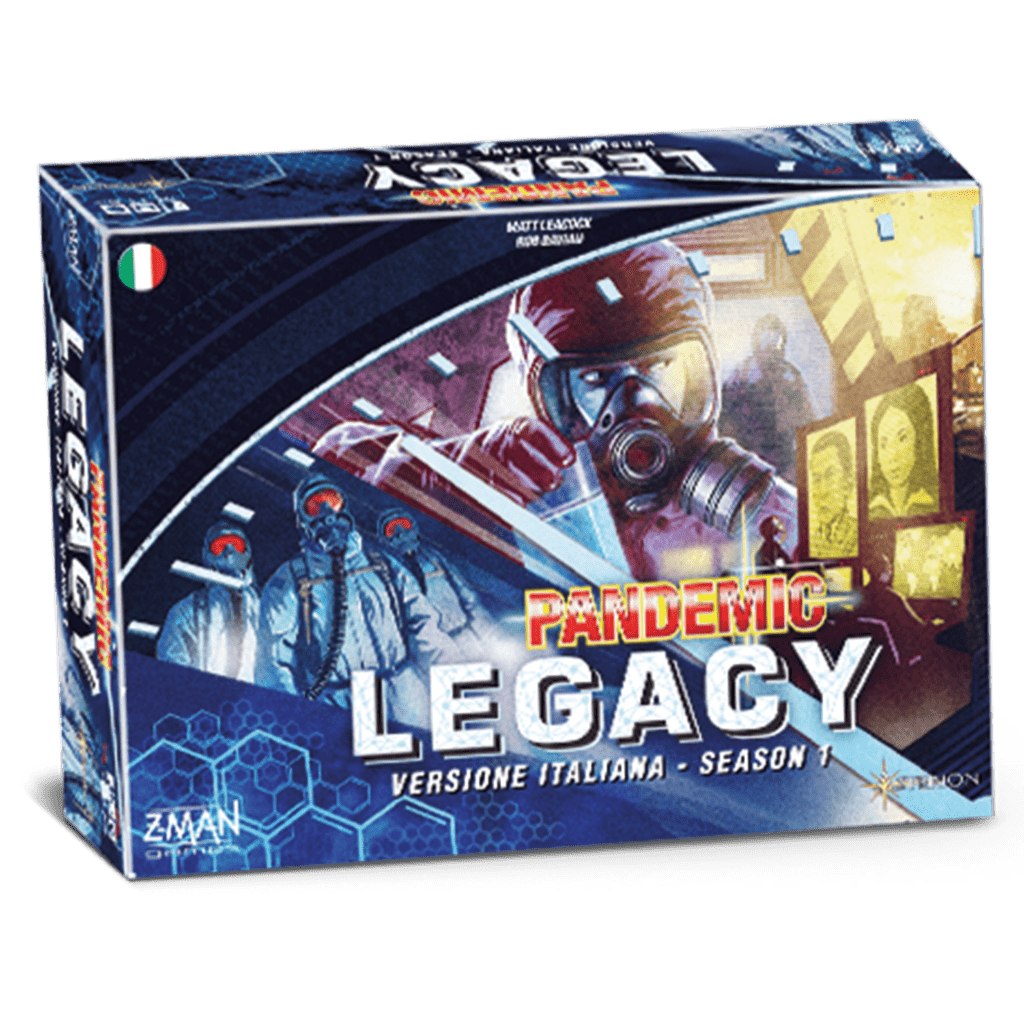
Pandemic: Legacy

Look, there’s a massive problem with legacy games that none of us talk about. Getting five people round a table is challenging at the best of times. Doing it repeatedly, with the same people, for potentially twenty-four repeated plays of the same game? That’s basically entirely impossible. Not so with a solo attempt! The only co-ordinating you have to do is with yourself.

Not just that, but you can tackle four plays in one go, if you want? Pandemic is a cataclysmic co-operative game that is renowned for having a little bit of a “quarterback” problem; where one opinionated player tells everyone else what to do. Absolutely not a concern if the only player who needs ordering about is you!

Most reports recommend a solo player controlling three characters at once; two characters means that the scary events that Pandemic relies on come less frequently. Pandemic thrives in its tension; it loses something if you intentionally run it in “easy” mode.

Working through a campaign with your friends is fantastic, but doing it on your own sounds pretty attractive too. Unwrapping each of the surprise boxes and cards as you go through, all this exciting stuff, just for you? I envisage an involuntary Gollum-esque “my preeeccioussss!!!” hissing out when your friends notice the box on a shelf and ask if if they can play. Also, if the experience goes well? There’s three seasons of Pandemic Legacy released so far. You may never need to play with anyone else ever again!

A review written for Tabletop Gaming Magazine. Copyright and rights TTG Magazine 2022.

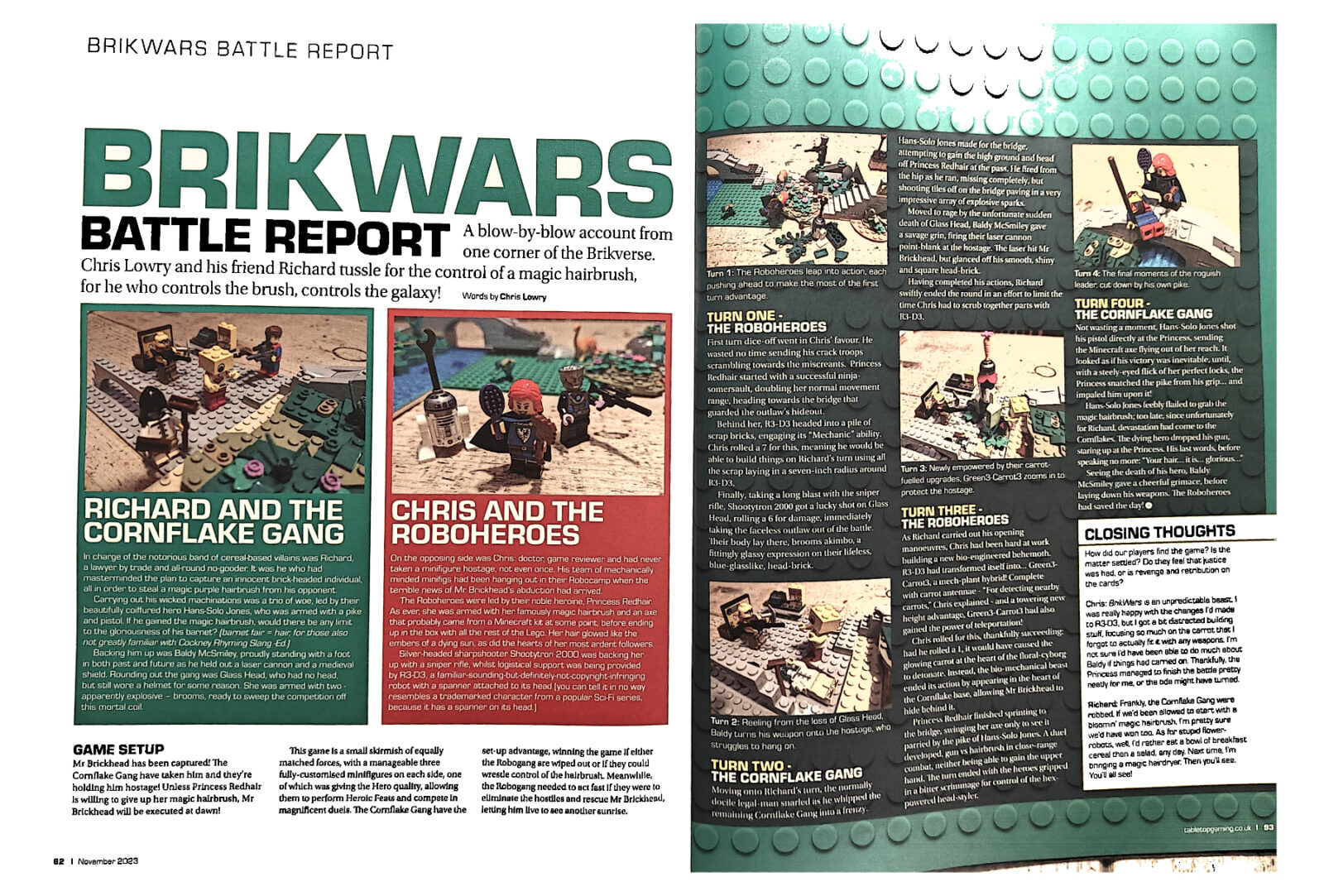
BrikWars BATTLE REPORT

A blow-by-blow BrikWars battle report brought to you from the insane galaxy of the Brikverse. Columnist Chris Lowry and his friend Richard tussle for the control of a magic hairbrush - and thus, the galaxy!

Game Setup

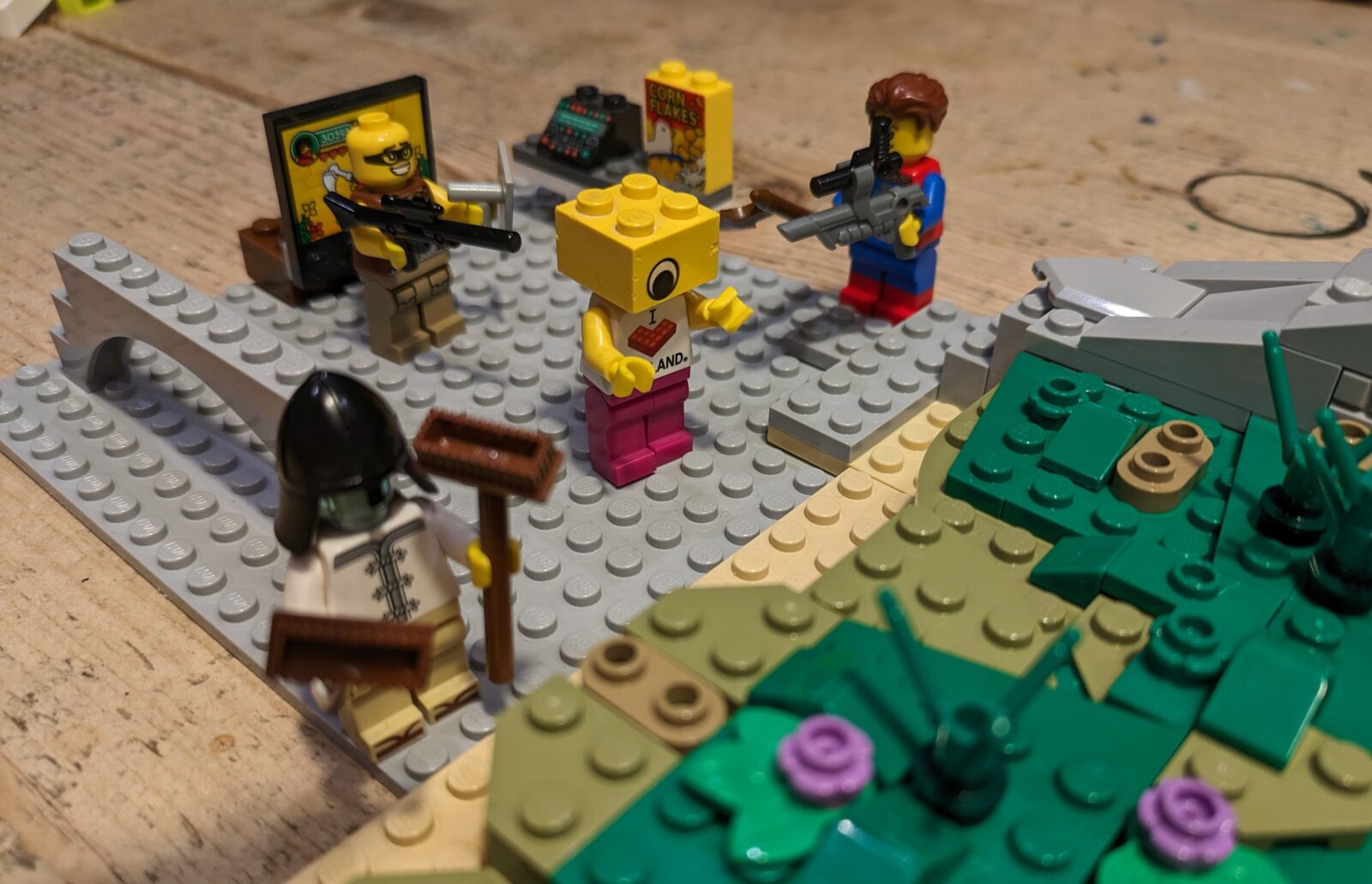
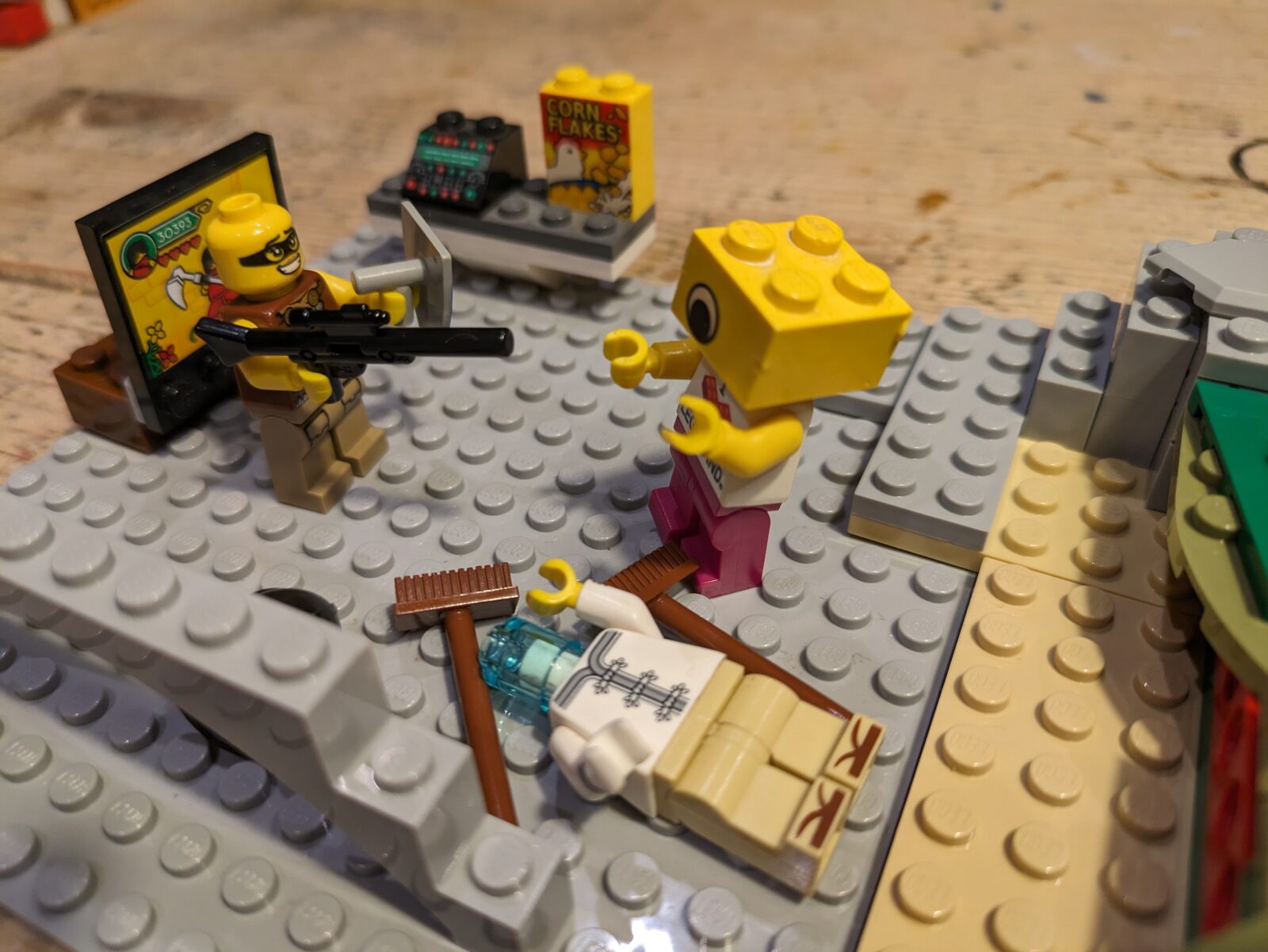
“Mr Brickhead has been captured! The Cornflake Gang have taken him – they’re holding him hostage!”. The message came back into the Robocamp. “Unless Princess Redhair is willing to give up her magic hairbrush, Mr Brickhead will be executed at dawn!”

We set up our game of BrikWars ready for a little skirmish. Armies in the game are balanced by the numbers of the little minifigures on each side. Full games can involve dozens of them, coupled with vehicles, monsters, possessed dice – and much more (see our BrikWars review on page # for an idea of much madness it contains).

We started with a very manageable three minifigures on each side. Each team also had one hero to lead each gang, able to perform Heroic Feats and compete in magnificent duels.

Richard and the Cornflake Gang

Running one team was Richard, a lawyer and all round no-gooder. It was he who had masterminded the plan to capture an innocent brick-headed individual, all in order to steal a magic purple hairbrush from his opponent.
Carrying out his wicked machinations were the evil Cornflake Gang, led by their beautifully coiffured hero; Hans-Solo Jones, armed with a pike and pistol. If he gained the magic hairbrush, would there be any limit to the gloriousness of his barnet?

Backing him up was Baldy McSmiley, proudly standing with a foot in both past and future, holding a laser cannon and a medieaval shield. Rounding out the gang was Glass Head, who had no head, but still wore a helmet for some reason. She was armed with two – apparently explosive – brooms.

Chris and the Roboheroes

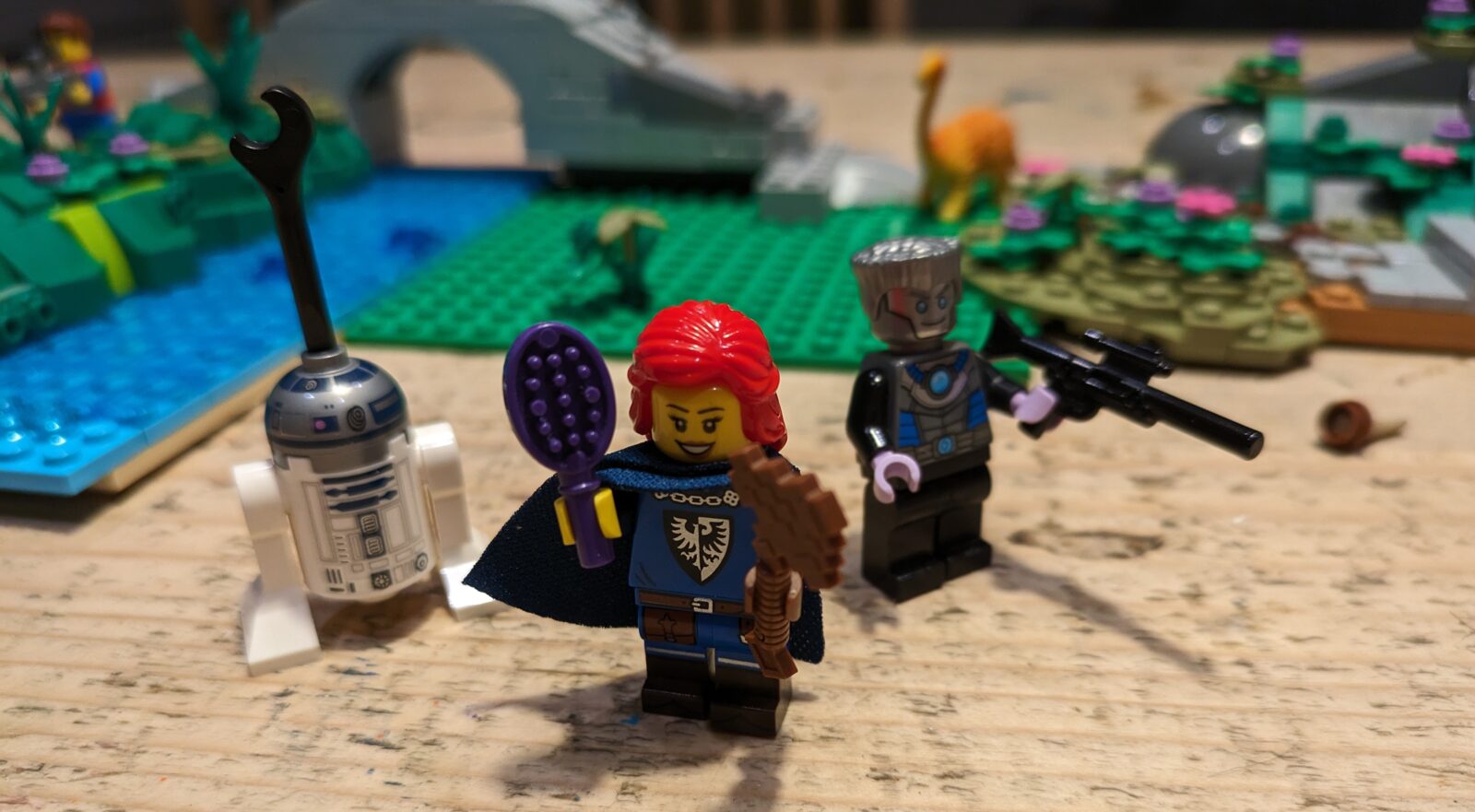
On the opposing side was Chris; doctor, game reviewer, and general non-hostage-taker. His team of mechanically minded minifigs had been hanging out in their Robocamp when the terrible news of Mr Brickhead’s abduction had arrived.
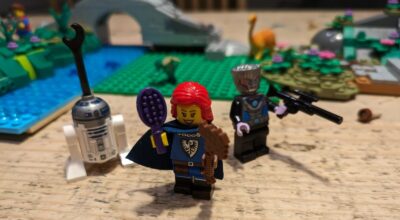
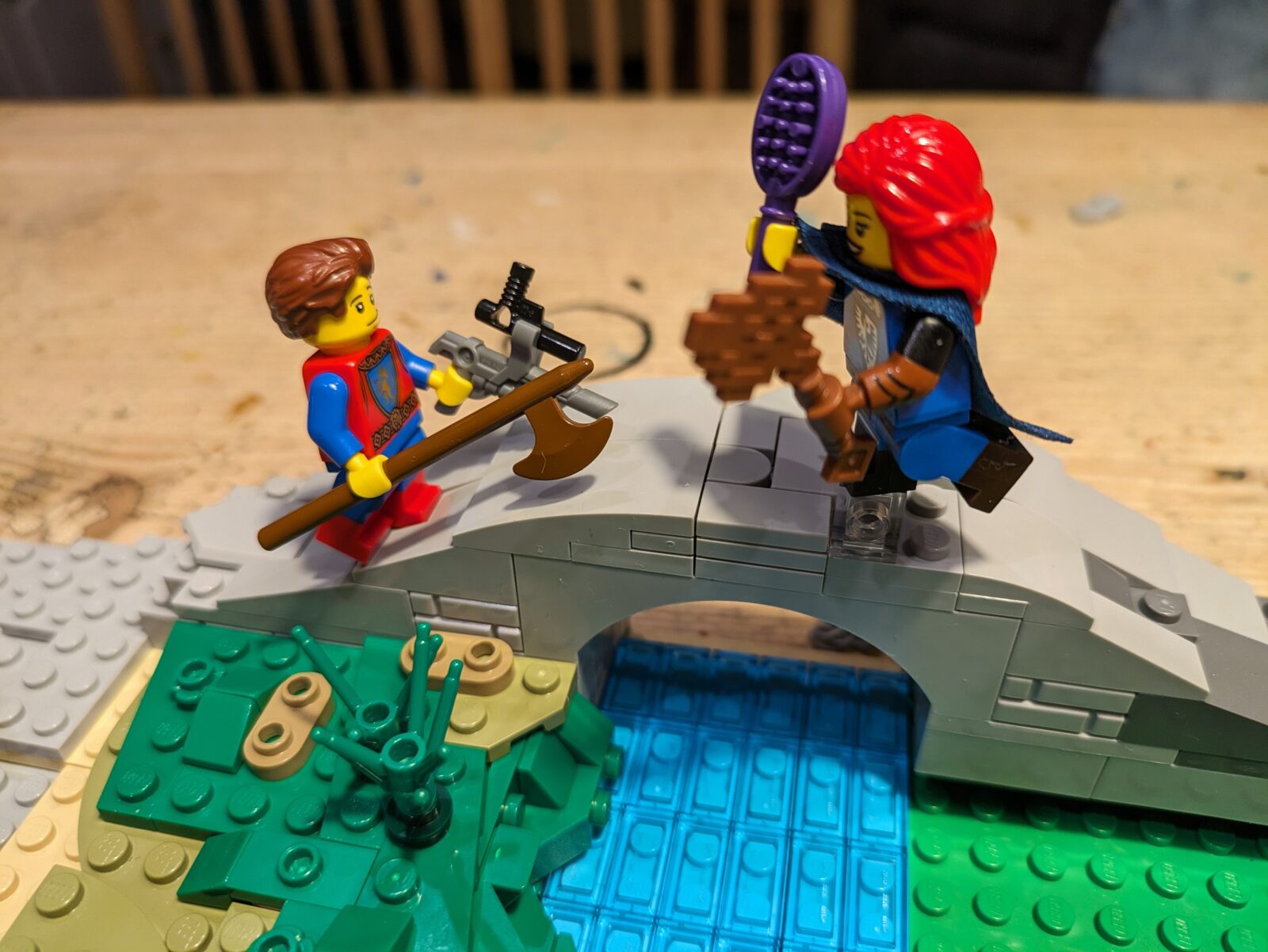
The Roboheroes were led, of course, by their noble heroine Princess Redhair. As ever she was armed with her famously magic hairbrush and an axe that probably came from a Minecraft kit at some point and ended up in the box with all the rest of the Lego. Her hair glowed like the embers of a dying sun, and thus our hearts did too.

Silver-headed sharpshooter Shootytron 2000 was backing her up with a sniper rifle, whilst logistical support was being provided by R3-D3, a familiar-sounding-but-definitely-not-copyright-infringing robot with a spanner attached to its head. (Technically yes, it’s an R2-D2 from an Official StarWars Lego kit, but this one is called R3-D3).

Turn One – The Roboheroes

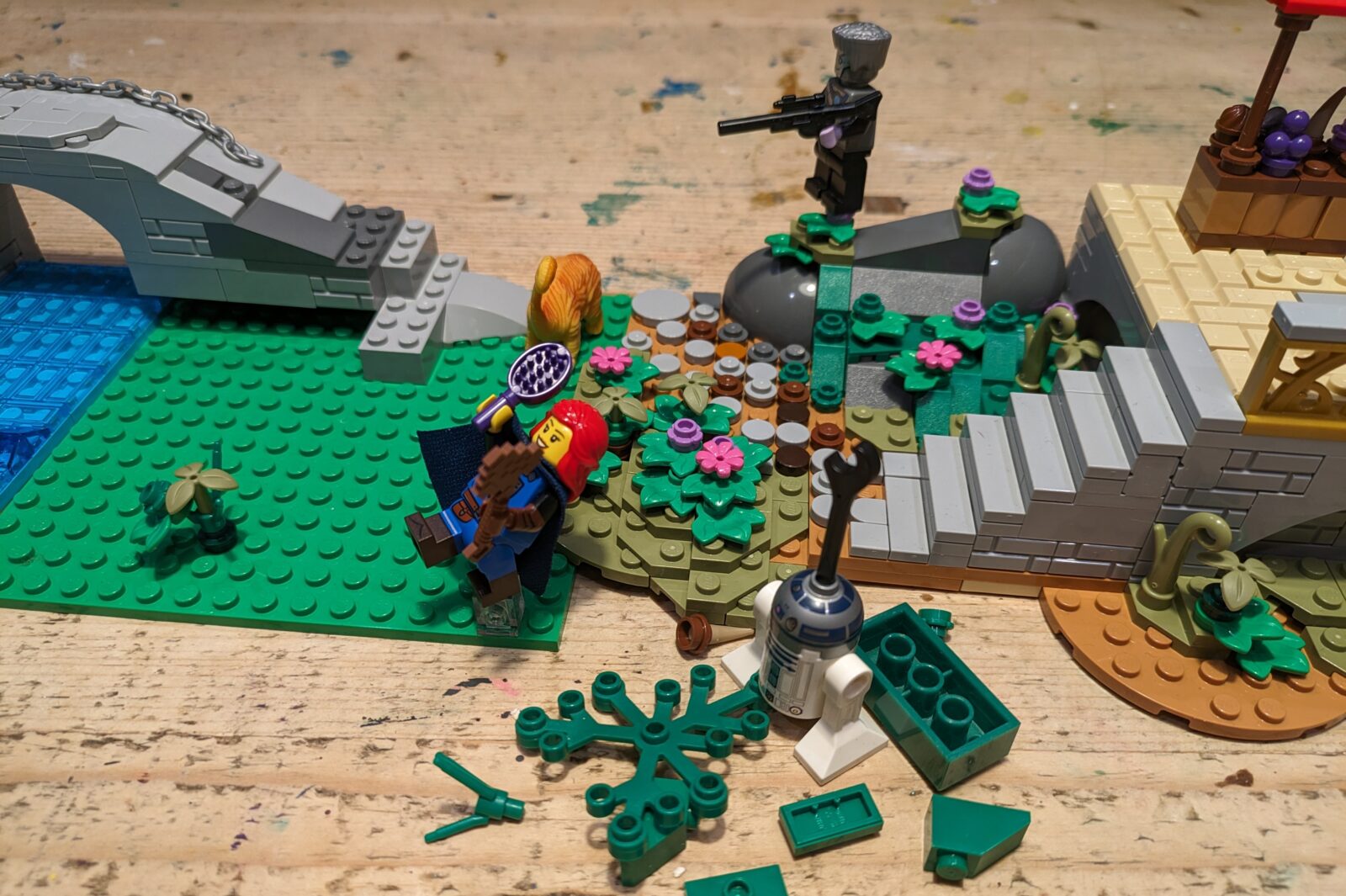
First turn dice-off went in Chris’ favour; he sent his crack troops scrambling towards the miscreants. Princess Redhair started with a successful ninja-somersault, doubling her normal movement range, and heading towards the bridge that guarded the outlaws hideout.
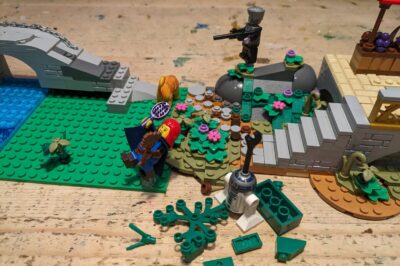
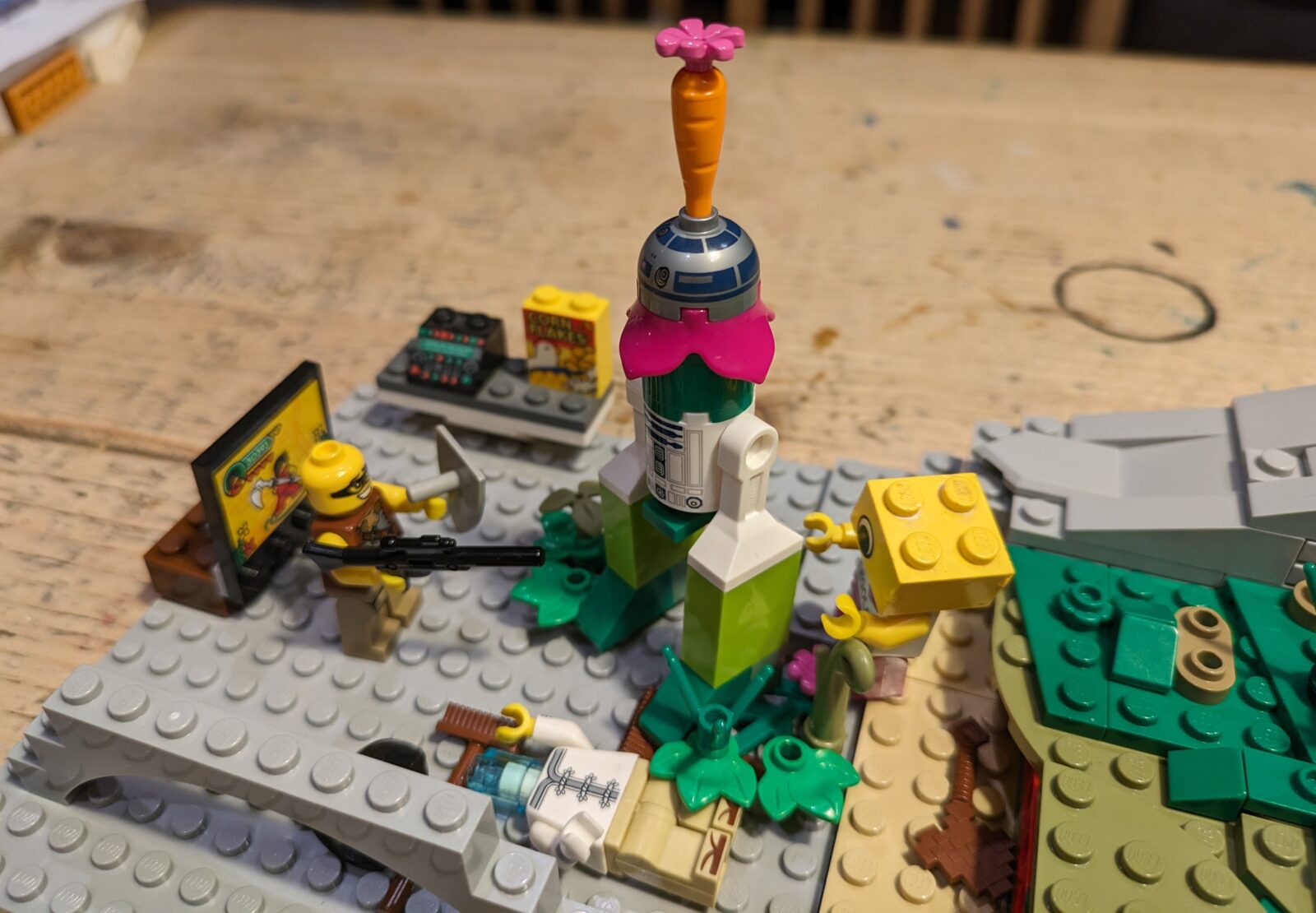
Behind her, R3-D3 headed into a pile of scrap bricks, and engaged its “Mechanic” ability. Chris rolled a 7 for this, meaning he would be able to build things on the Richard’s turn using all the scrap laying in a seven inch radius around R3-D3.

Finally, taking a long blast with the sniper rifle, Shootytron 2000 got a lucky shot on Glass Head, rolling a 6 for damage, and taking the faceless outlaw out of the battle. His body lay there, brooms akimbo, with a glassy expression on his lifeless blue glassy-head-brick.

Turn Two – The Cornflake Gang

Moving onto Richard’s turn, the normally docile legal-man snarled as he whipped the Cornflake Gang into a frenzy. Hans-Solo Jones made for the bridge, attempting to gain the high ground and head off Princess Redhair at the pass. He fired from the hip as he ran, missing completely, but shooting tiles off on the bridge paving in a very impressive array of explosive sparks.
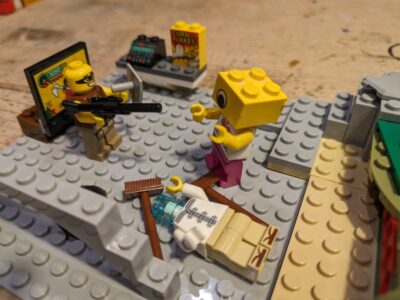
Moved to rage by the unfortunate death of Glass Head, Baldy McSmiley gave a savage grin, and fired their laser cannon, point blank, at the hostage. The laser hit Mr Brickhead, but glanced harmlessly off his smooth, shiny, bricky sort of head-brick.

The round ended quickly – partly intentionally on Richard’s part, to limit the time Chris had to scrub together parts with R3-D3.

Turn Three – The Roboheroes

During the preceeding turn, Chris had been hard at work, building a new bio-engineered behemoth. R3-D3 had transformed itself into… Green3-Carrot3 – a mech-flower-hybrid! Complete with carrot antennae – “For detecting nearby carrots”, Chris explained – and a towering new height advantage, Green3-Carrot3 had also gained the power of teleportation!

Chris rolled for this, thankfully succeeding; since rolling a 1 would have caused the carrot at the heart of the machine to detonate.
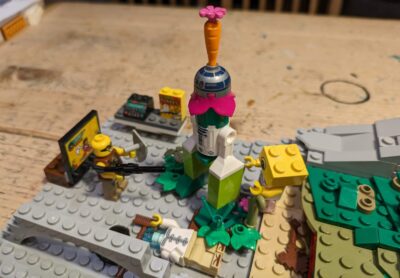
The organic beast ended its action by appearing in the heart of the Cornflake base, allowing Mr Brickhead to hide behind it.

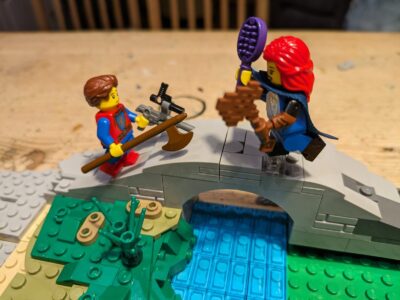
Princess Redhair finished sprinting to the bridge, swinging her axe, onto to see it parried by the pike of Hans-Solo Jones. A duel developed, gun vs hairbrush in melee combat – but neither was able to gain the upper hand, and the turn ended with the heroes gripped in a bitter scrimmage.
Turn Four – The Cornflake Gang

Richard’s turn began immediately. Not wasting a moment, Hans-Solo Jones shot his pistol directly at the Princess, sending the Minecraft axe flying out of her reach. It looked as if his victory was inevitable, until, with a steel-eyed flick of her perfect locks, the Princess snatched the pike from his grip… and impaled him upon it!
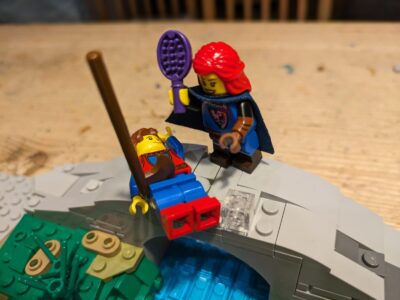
Hans-Solo Jones feebly flailed to grab the magic hairbrush; too late, since unfortunately for Richard, devastation had come to the Cornflakes. The dying hero dropped his gun, and stared at the Princess. His last words, before speaking no longer; “Your… hair… it is… glorious!…”

Seeing the death of his hero, Baldy McSmiley gave a cheerful grimace, and laid down his weapons. The Roboheroes had saved the day!

Closing Thoughts

How did our players find the game? Is the matter settled? Do they feel that justice was had, or is revenge and retribution on the cards?
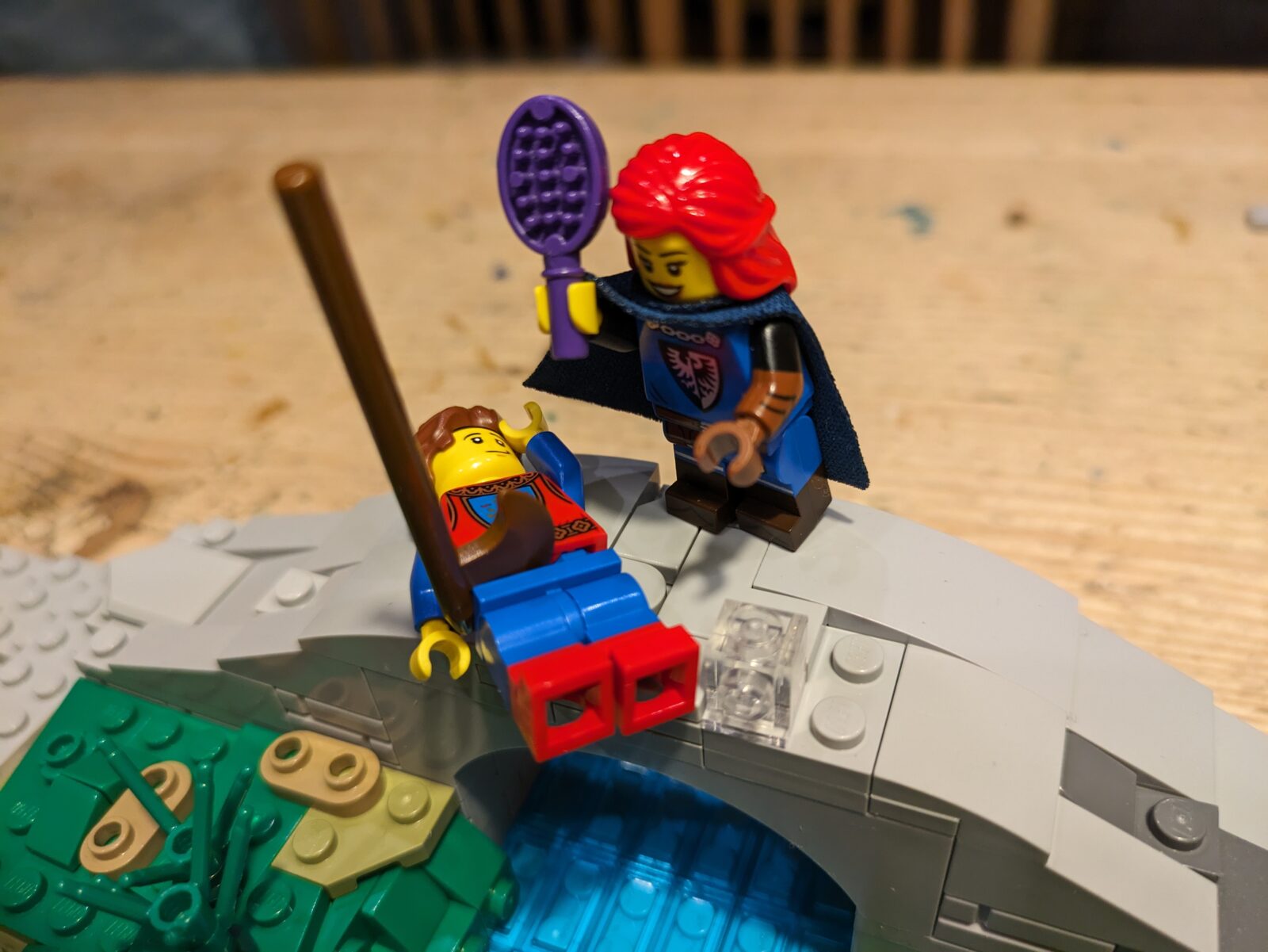
Chris: “BrikWars is an unpredictable beast. I was really happy with the changes I’d made to R3-D3, but I got a bit distracted building stuff, and I’d focused so much on the carrot I forgot to actually fit it with any weapons. I’m not sure I’d have been able to do much about Baldy if things had carried on. Thankfully the Princess managed to finish the battle pretty neatly for me, or the tide might have turned.”

Richard: “Frankly, the Cornflake Gang were robbed. If we’d been allowed to start with a bloomin’ magic hairbrush, pretty sure we’d have won too. As for stupid flower-robots, well, I’d rather eat a bowl of breakfast cereal than a salad, any day. Next time, I’m bringing a magic hairdryer. Then you’ll see. You’ll all see!”