My wife’s answer to this question would be “Unquestionably too many”.
The real answer is nebulous; according to my boardgamegeek database, I own 182 games – but that’s definitely a wild underestimation, since I’m rubbish at updating it. Certainly the nature of reviewing games means you have lots of new titles that cycle through your collection; the “hmm, will I keep this?” pile is always tall enough to be unstable. It doesn’t help that I keep that pile on top of a tall cupboard, making it extra dangerous.
What is your earliest game purchase that’s still in your collection?
In terms of age, there’s a battered 1970s version of Monopoly, and a replica copy of the Royal Game of Ur, which is an ancient Mesapetomian relic from around 2400BC.
However the first “real” game I picked up was probably Level 7:Escape. In 2012 I’d been on my way to a pub with some mates, and asked for something “full of flavour” from Marquee Models in Harlow (shout out to them, they’re still going strong!). They handed me this creepy looking box that intriguingly claimed to be a “semi-cooperative survival horror game”. It’s still a big personal favourite, certainly introducing my kids to it was a joy.
When did you first start properly collecting tabletop games?
The bug kicked in pretty badly after that first exposure to Level 7. It coincided with the time I finished five long years of university and finally had some disposable income. Then, in 2015, I spent a year doing medical mission work in a bush hospital in South Africa; tons of game companies sent me free games to use for English teaching and community work. Playing Cheapass Games’ Pears with a bedbound teenager, bluffing and laughing despite an impenetrable language barrier? It convinced me there is something incomparibly human about this hobby.
Do you have a particular system when it comes to organizing your games?
No. I’d love one, but space efficiency takes priority. I’ve reluctantly accepted that I’m limited to two full height bookcases and a sideboard. Realistically this is not actually enough space; thus anywhere a game will cram in is where it goes. The only nod to organisation is one large box for small games, and another for card games.
If I had unlimited space, I’d probably go for the personal autobiographical system that Rob uses in the film High Fidelity for his record collection – everything in order of how or why I gained it, cross referenced by notable wins and particularly miserable defeats.
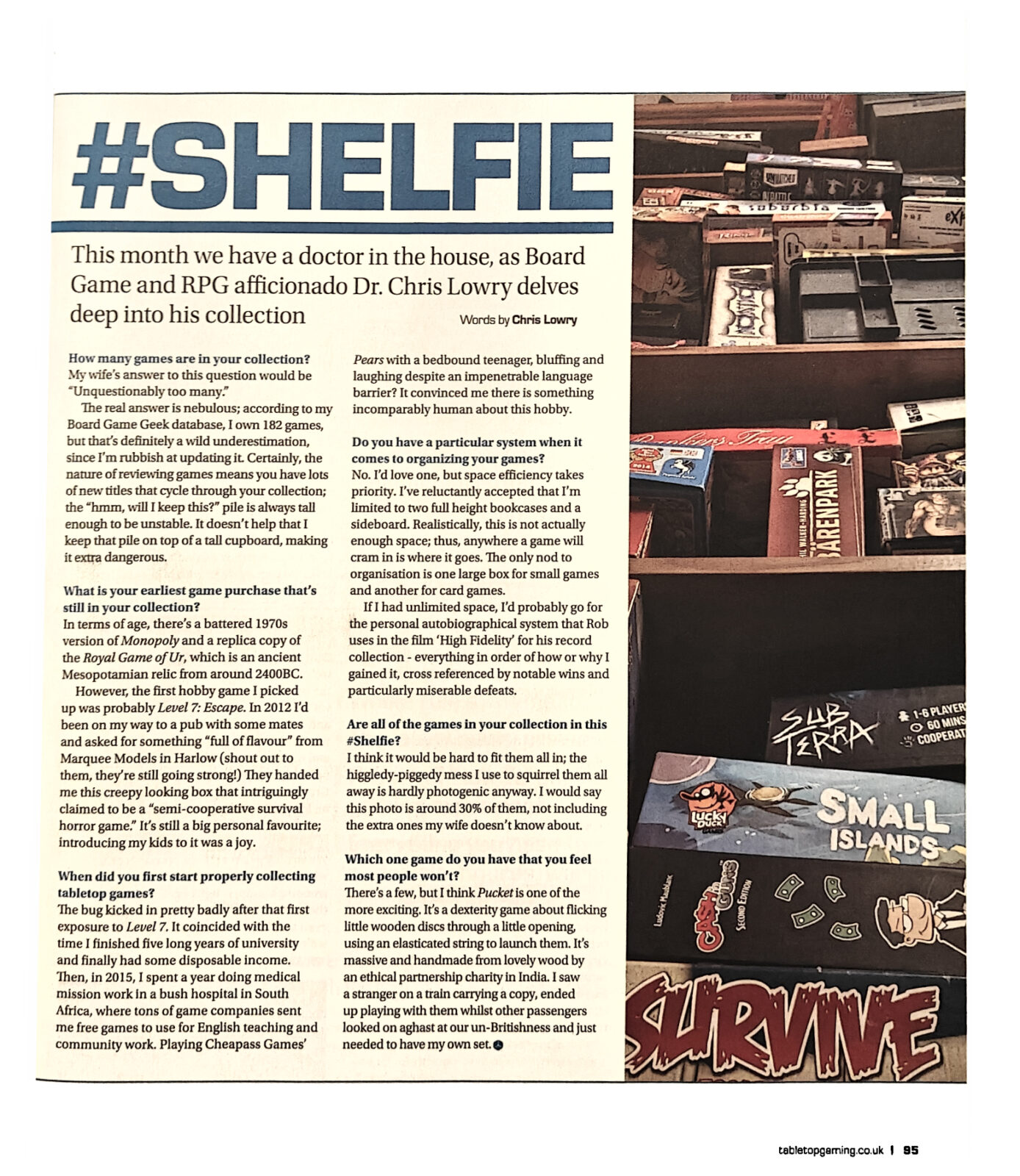
Are all of the games in your collection in this #Shelfie? I think it would be hard to fit them all in, and the higgledy-piggedy mess I use to squirrel them all away is hardly photogenic anyway. I would say this photo is around 30% of them. Not including the extra ones my wife doesn’t know about.
Which one game do you have that you feel most people won’t?
There’s a few, but I think Pucket is one of the more exciting. It’s a dexterity game about flicking little wooden discs through a little opening, using an elasticated string to launch them. It’s massive, and handmade from lovely wood by an ethical partnership charity in India. I saw a stranger on a train carrying a copy, and ended up playing with them whilst other passengers looked on aghast at our un-Britishness.
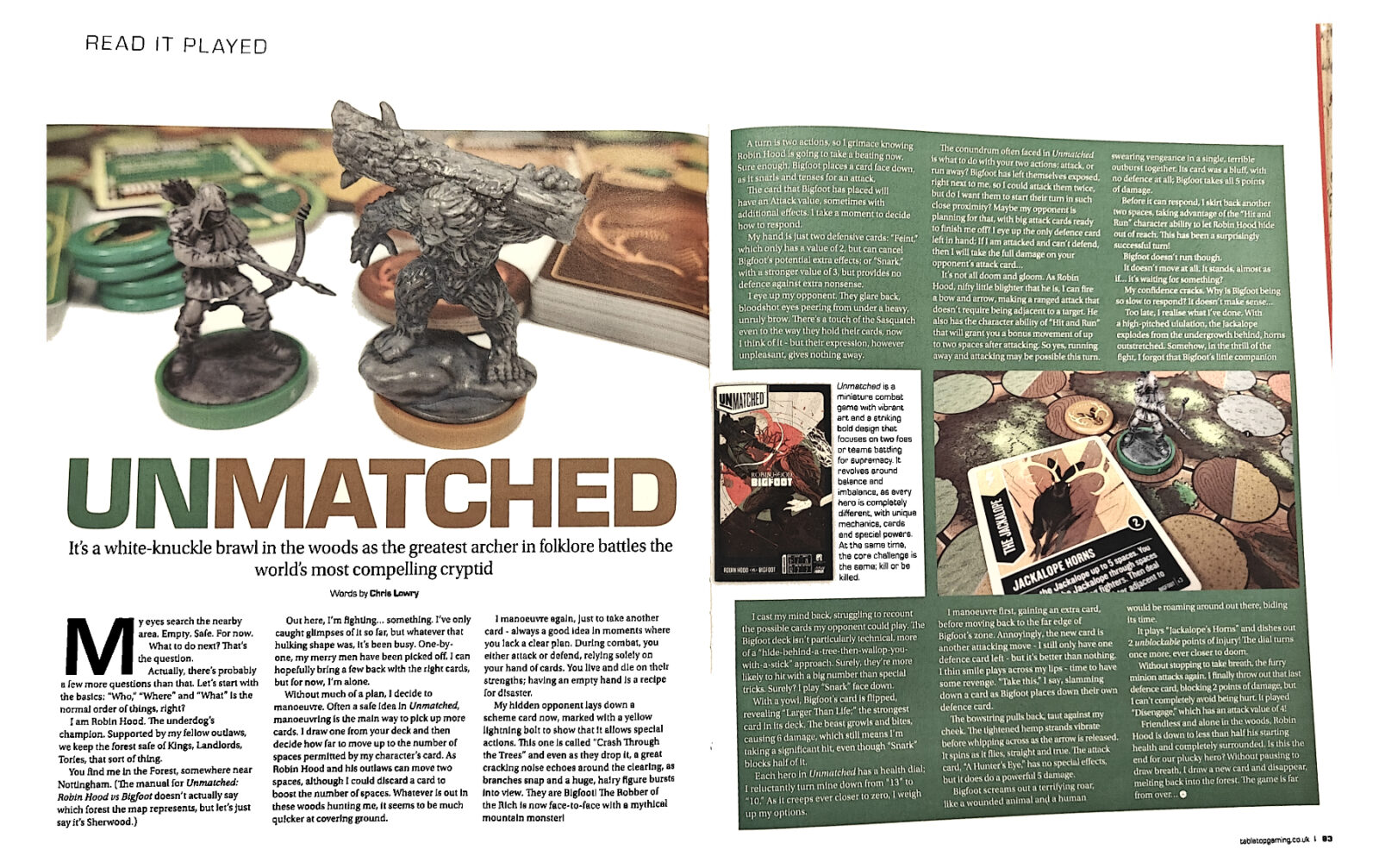
Unmatched is a one-on-one combat game with vibrant art and a striking bold design. It revolves around balance and imbalance. Every hero is completely different, with unique mechanics, cards and special powers. At the same time, the core challenge is the same; kill without being killed.
//copy
You see the space around you.
Empty. Safe… for now.
What to do next? That’s the question.
Actually, there’s probably a few more questions than that. Let’s start with the basics: “Who”, “where” and “what” is the normal order of things, right?
“Who?” You are Robin Hood. The underdog’s champion. Supported by your outlaws, you keep the forest safe of Kings, Landlords, Tories, that sort of thing.
“Where?” You are in the Forest, somewhere near Nottingham. (The Unmatched: Robin Hood vs Bigfoot manual doesn’t actually say which forest is on the map, but let’s just say its Sherwood).
“What?” You are fighting… something. You’ve only caught a glimpse of it so far, but whatever that hulking shape was, it’s been busy. One-by-one all of your outlaws have been picked off. You can bring a few back, with the right cards, but still; you are all alone.
Without much of a plan, you decide to Manoeuvre. Often a safe idea in Unmatched, Manoeuvring is the main way to pick up more cards. You draw one from your deck, and then you decide if you want to move up to the number of spaces on your characters card. As Robin Hood, you and your outlaws can move two spaces, although you can discard a card to boost the number of spaces. Whatever is out in these woods hunting you, seems to be much quicker than you at covering ground.
You Manoeuvre again, just to take another card – always a good idea in moments where you lack a clear plan. During combat, you either Attack or Defend, relying solely on your hand of cards. You live and die on their strengths: having an empty hand is a recipe for disaster.
Your hidden opponent lays down a Scheme card now, marked with a yellow lightning bolt to show that it allows special actions. This one is called “Crash Through the Trees” and even as they drop it, a great cracking noise echoes around the clearing, as branches snap and a huge, hairy figure bursts into view. They are Bigfoot! You are face-to-face with a mythical mountain monster!
A turn is two actions, so you know Robin Hood is going to take a beating now. Sure enough, Big Foot places a card face down, as it snarls and tenses for an attack.
The card that Bigfoot has placed will have an Attack value, and sometimes additional effects. You need to decide how to respond.
You look at your hand. Just two defensive cards: “Feint”, which only has a value of 2, but cancels Bigfoot’s potential extra effects; or “Snark”, with a stronger value of 3, but provides no defence against extra nonsense.
You eye up your opponent. They glare back, bloodshot eyes peering at you under from a heavy, unruly brow. There’s a touch of the Sasquatch even to the way they hold their cards, now you think of it – but their expression, however unpleasant, gives nothing away.
As far as you remember, the Bigfoot deck isn’t particularly technical, more of a hide-behind-a-tree-then-wallop-you-with-a-stick approach. They’re more likely to hit you with a big number than special tricks, surely? You select “Snark” and place it down.
With a yowl, Bigfoot’s card is flipped, revealing “Larger Than Life”; the strongest card in its deck. The beast growls and bites you, causing 6 damage, which still means you take significant damage, even though “Snark” blocks half of it.
Each hero in Unmatched has a health dial; you reluctantly turn yours down from “13” to “10”. If it reaches “0”, Robin Hood is dead. It’s now your turn to respond.
The conundrum often faced in Unmatched is what to do with your two actions; attack or run away? Bigfoot has left themselves exposed, right next to you, you could attack them twice; but do you want them to start their turn in close proximity to you? Maybe your opponent is planning for that, with big attack cards ready to finish you? Don’t forget – you’ve only got one defence card left. If you are attacked and can’t defend then you take the full damage on your opponent’s attack card…
It’s not all doom and gloom here. Don’t forget that Robin Hood, nifty little blighter that you are, can fire a bow and arrow; you can make a ranged attack that doesn’t require being adjacent to a target. You also have the character ability of “Hit and Run”; after attacking you get a bonus movement of up to two spaces. So yes, running away and attacking may be possible this turn.
You Manoeuvre first, gaining an extra card, and moving back to the far edge of Bigfoot’s zone. Annoyingly your new card is another attacking move – you still have only one defence card left – but better than nothing. Now you smile – time to have your revenge. “Take this,” you say, slamming down a card as Bigfoot places down their own defence card.
The bowstring pulls back, taut against your cheek. The tightened hemp strands vibrate before whipping you as you release the arrow. The arrow spins as it flies, straight and true. Your card, “A Hunter’s Eye”, has no special effects, but it does do a powerful 5 damage.
Bigfoot screams out, a terrifying roar, like a wounded animal and a human swearing vengeance; in one terrible outburst together. Its card was a bluff, it has no defence at all. Bigfoot takes all 5 points of damage.
Before it can respond, you skip daintily back another two spaces, your “Hit and Run” character ability giving you the option of hiding out of reach. This has been a surprising successful turn!
Bigfoot doesn’t run though.
It doesn’t move at all. It stands, almost as if… it’s waiting for something?
Too late, you think a little more. Your confidence cracks. Why is Bigfoot being so slow to respond? It doesn’t make sense…
With a high pitch ululation, the Jackalope explodes from the undergrowth behind you, horns outstretched. Someone, in the thrill of the fight, you forgot that Bigfoot’s little companion would be roaming around out there, biding its turn.
It plays “Jackalope’s Horns”, and you take 2 – unblockable – points of injury! Your dial drops to 8, weakening you further.
Without stopping to take breath, the furry minion attacks again. You respond with your last defence card, blocking 2 points of damage, but you can’t completely avoid hurt. It played “Disengage”, which has an attack value of 4!
Friendless and alone in Nottingham Forest, Robin Hood is down to just 6 points of health, and completely surrounded. Is this the end for your plucky hero? Without pausing to draw breath, you draw a card, and melt into the forest. The game is far from over…
// When diving into a dungeon costs you all your teeth.
Growing up isn’t really a thing you do in Galgenbeck. At best you sort of congeal. Get harder, dirtier. You do what you need to, to hang on, to eke out a bit more life, and you try not to think about the things you have to do to survive.
Or the people you step on on the way.
Personally speaking? I’m just gutterborn scum, and I’ll happily gut you for thruppence. Or treasure!
So, where do you find treasure? Dungeons, that’s where! The problem being; where do you also find goblins and horrors and grisly, forsaken deaths? Aye, that’d be dungeons too.
We stood before a spiked pit.
“There’s a single log balanced over the top of it. Recklessly”, said Dave, with a grin. He was our GM, and he’d invited the three of us over to play MÖRK BORG, knowing we couldn’t resist its grim charms. I was playing as “Gert”, Sam as “Grint”, and Celion had taken on the role of “Svind”.
“It’s obviously a trap”, whistled Grint, spitting through fragile, flaking teeth. He’s some sort of murk-priest, but he’s been utterly useless today. He carries scrolls, but when he tried to use one earlier he fumbled and rolled a 1. The next thing all his teeth fell out, and fingernails grew in their place. Repulsive.
“Of course it’s a trap, you utter imbecile”. I pointed to the hand carved sign on the edge of the precipice. It read “THIS IS A TRAP”, jagged words scarred into the wood.
“Could… could we jump over it?”, quavered Svind, nervously. They’re always nervous. They used to be a noble, I think? Some flavour of wretched royalty. Then there was, like, a a bloody coup or something? – I didn’t care to listen when they went on and on about it. Now they’ve found this world isn’t the place they were raised for. Too cruel, and frankly they ain’t ready for it; they startle at nothing.
I looked at the gap. Between us and the next ledge was a crumbling rift in the earth, at least 12 feet wide. I couldn’t really make out the bottom, but the shimmer of hammered iron gleamed down there.
Out of game, I ask “So, what’s the chance a player survives a fall down there…?”
Dave shook his head and smiled.
“Fine. I throw a rock onto the log, I’m trying to test it”, I say.
“Roll Presence”, says Dave.
I roll a d20. It bounced to a stop on 15, which – given my Presence ability is “-3” – gave a total of 12.
The rock flew through the air and smacked into the log. Nothing else happens.
“Don’t look like a trap to me”, said Grint. One of his splintered teeth cracked, and bounced off my cheek. As I was about to retort, a loud creak and resonant crunch came from behind us: the log snapped in two.
I spun back, raising one eyebrow as the wood crashed into the pit behind me. Grint had the good grace to look sheepish.
What to do next? Well, I generally keep a decent length of mildewed rope wrapped around my waist. I tied a noose in the end, and peered at the cavern ceiling. Was that a rusty hook nailed into up there?
“Any of you know how to throw?”, I asked.
Svind looked blank for a moment, and then their eyes lit up, “I mean, me… yes, me of course!”. They stepped forward, smiling with an uncharacteristic confidence, “I was Papa’s… I mean.. the King’s champion at quoits during summer fayre!”
No idea what on dark earth “quoits” was, but I assumed it was the kind of hyper-privileged life-wasting that the rich frittered with whilst I spent my childhood sucking stones because I couldn’t even afford soil to eat.
“I want to throw the rope!”, said Svind, excitedly.
“That’ll be Presence again”, said Dave.
“Here goes!”, Svind calls out, working the rope into a lively spin before casting it off towards the ceiling.
We stared at the rope, for a moment, before I coughed to break the ice.
“So, Svind…?”, I started.
“Yes?” they responded, still looking at the rope.
“You didn’t think to, you know, hold on to one end or anything, did you?
The rope hung, one end perfectly caught onto the rusty meat hook in the cave roof. The other end trailed down into the pit, a solid 8 feet away from us. Celion had rolled a 10, adding 1 from their Presence to give 11; a single point short of success. The rope was in the right position… but we weren’t.
Svind stammered, “We could probably j…jump that, r…right?”
As I reluctantly considered a foolish leap over the skewer-lined chasm, events transpired to accelerate my decision making.
“BLuuurGGHaaart!!!” roared from behind us, as a berserker thundered through the archway we’d just entered. Between its snarls and the blood specked spittle running down its cheeks, I made out its less-than-subtle intent: “Moore Bloodd Fowr Myy Thirst!”
Underlining this manifesto for murder, the crazed killer held a huge, near-herculean warhammer aloft. I knew my chances in combat were slim at best – the warhammer can do d10 points of damage, whilst my character Gert had just 3 hit points remaining.
“Run for it!”, I yelled, sprinting to the edge and launching myself into the air. A roll of 13, with my Dexterity of “2” added, was enough to land me safely on the other side. Well, “land” being a gentler way to say “plummet into a crumpled heap” and taking 1 point of damage.
Next to me, floating down with an enigmatic flourish, was Grint. He’d used the Lucy-Fires Levitation scroll – successfully this time – and rolled an 18 for an exemplary landing.
Squinting around in the mirk, I realised we were still a person down. “Where is Svind?”
A metallic clang, back across the chasm, alerted me. The bezerker had swung his massive hammer at Svind. Rolling a 15 for Agility, they’d narrowly ducked out of the way; the hammer had collided with the wall.
“Gotta get out of there Svind!”, I yelled across the void.
“I’m going… I’m going to jump it!”, they yelped, and began sprinting.
Behind, the red eyed bezerker screamed in rage and hurled the warhammer after Svind, requiring another Agility roll to dodge.
19! Svind neatly side-stepped, hammer crashing noisily but harmlessly past them.
Reaching the edge of the pit, Svind looked up, one last time, the whites of their eyes locked on to me. I wish they hadn’t. I wouldn’t have seen their expression change from hope, to shock, to terror; they rolled a “1” for their second Agility roll. All too fast, and like it took a hundred agonising years at the same time, Svind fell into the pit. There was a palpable “crunch” of bone and flesh on spikes; then absolute silence.
I turned to the rest, and shrugged, “We best be gettin’ a move on, eh?”.
We shuffled through the doorway, into the next cavern.
No one looked in the pit. There was no point.
//Info Box
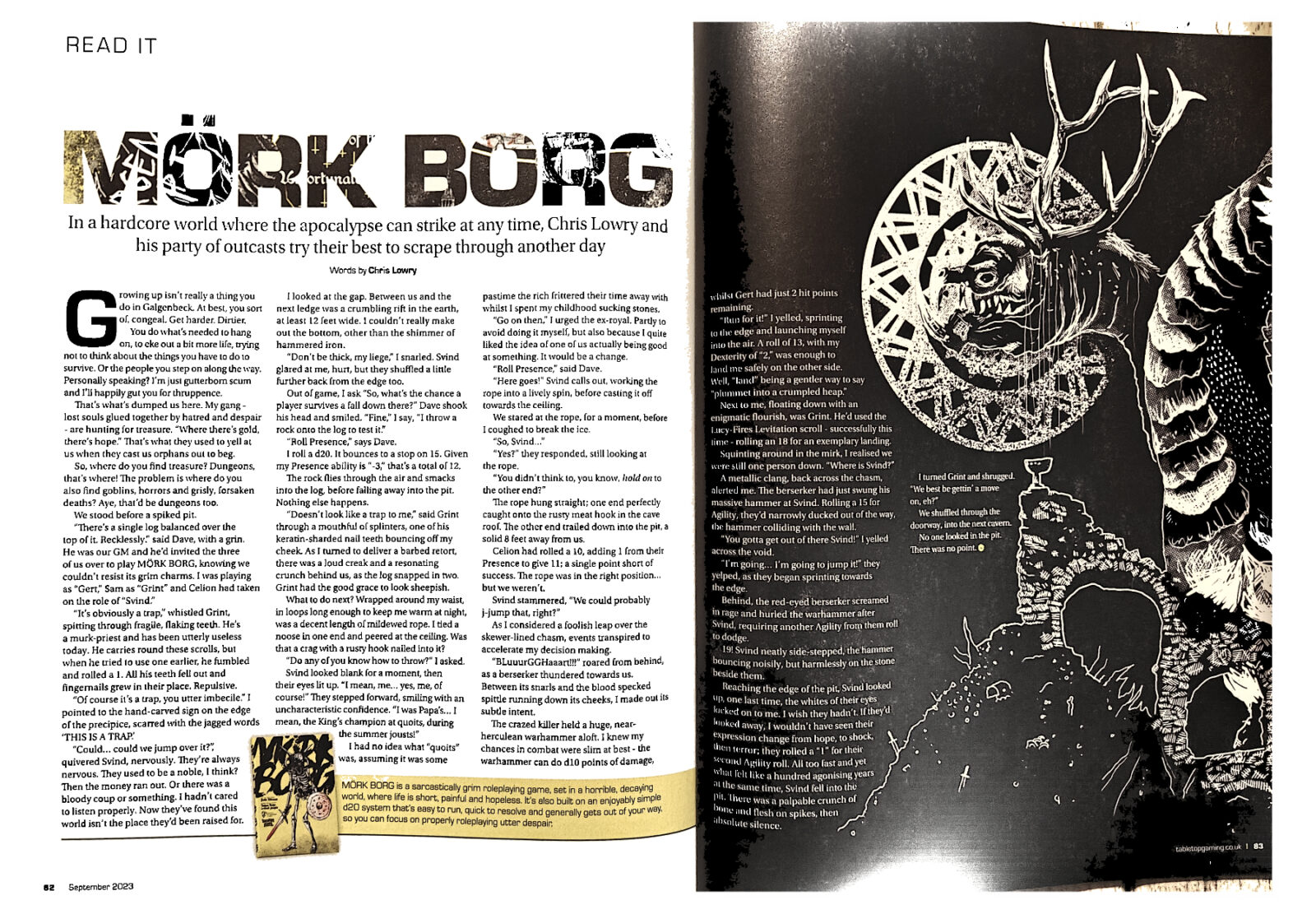
MÖRK BORG is a sarcastically grim role play game, set in a horrible, decaying world, where life is short, painful and hopeless. It’s also built on a enjoyably simple d20 system, that’s easy to run, quick to resolve, and generally gets out of your way so you can focus on properly roleplaying utter despair.
Facing me across the table were my sparring partners; Mirka, shaven headed, with barcoded net-tats on her cheeks; Rret, tousle haired with cold, calculating eyes; and Evryt, tall and crooked with age.
They stared at me. Might I actually have the personal connections that I claim? They had no way to be sure.
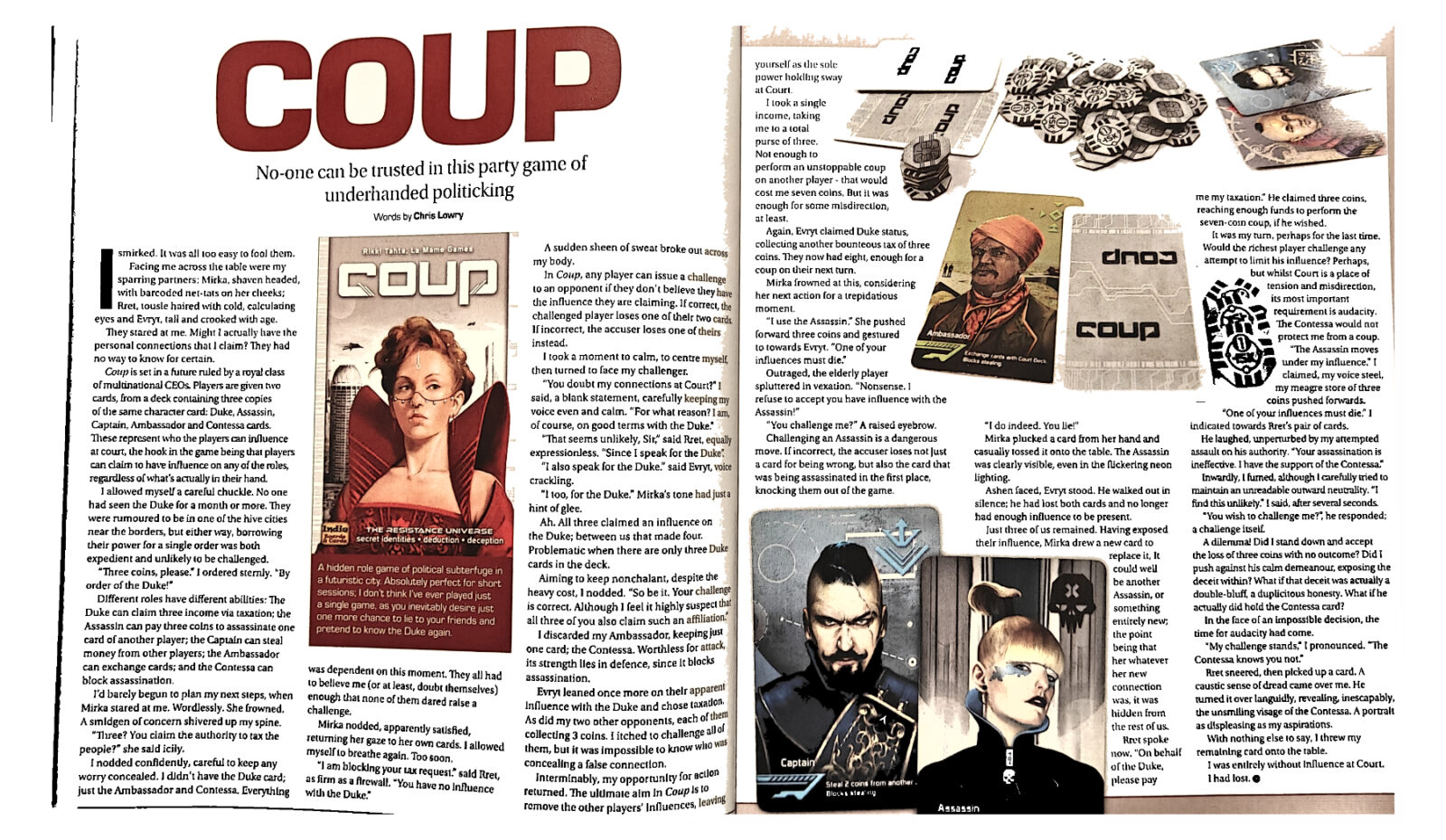
Coup is set in a future ruled by a royal class of multinational CEOs. Players are given two cards, from a pool of three each of Duke, Assassin, Captain, Ambassador and Contessa cards. These represent who the Players can influence at Court. The hook in the game, however, is that Players can claim to have influence on any of the roles, regardless of what’s actually in their hand.
I allowed myself a careful chuckle. No one had seen the Duke for a month or more. They were rumoured to be in one of the hive cities near the borders, but either way, borrowing their power for a single order was both expedient and unlikely to be challenged.
“Three coins please”, I ordered, sternly. “By order of the Duke!”
Different roles have different abilities. The Duke can claim 3 income via taxation; the Assassin can pay 3 coins to assassinate one card of another player; the Captain can steal money from other players; the Ambassador can exchange cards and the Contessa can block assassination.
I’d barely begun to plan my next steps, when Mirka stared at me. Wordlessly. She frowned. A smidgen of concern shivered up my spine.
“Three? You claim the authority to tax the people?”, she said, icily.
I nodded confidently, careful to keep any worry concealed. I didn’t have the Duke card; just the Ambassador and Contessa. Everything was dependent on this moment; they all had to believe me, or, at least, doubt themselves enough that they didn’t dare raise a challenge.
Mirka nodded, apparently satisfied, and returned her gaze to her cards. I allowed myself to breathe again. Too soon.
“I am blocking your tax request.” Rret. As firm as a firewall. “You have no influence with the Duke”.
A sudden sheen of sweat broke out across my body.
In Coup, any other player can issue a challenge to any other player if they don’t believe they have the influence they are claiming. If correct, the challenged player loses one of their two cards. If incorrect, the accuser loses one of their remaining cards.
I took a moment to calm; to centre myself, then turned to face my challenger.
“You doubt my connections at Court”, I said, a blank statement, carefully keeping my voice even and calm. “For what reason? I am, of course, on good terms with the Duke”.
Rret, equally expressionless. “That seems unlikely, Sir, since I speak for the Duke”.
“I also speak for the Duke”, Evryt’s cracked voice.
“I too; the Duke”. Mirka’s tone had just a hint of glee.
Ah. All three claimed an influence on the Duke; between us that made four. Problematic when there are only three Duke cards in the deck.
Aiming to keep nonchalant, despite the heavy cost, I nodded. “So be it. Your challenge is correct. Although I feel it highly suspect that all three of you also claim such an affiliation”.
I discarded my Ambassador, keeping just one card; the Contessa. Worthless for attack, its strength lies in defence, since it blocks Assassination.
Evryt leaned once more on their apparent influence with the Duke and chose taxation. As did my two other opponents; each of them collecting 3 coins. I itched to challenge all of them, but it was impossible to know who concealed an untruth.
Interminably, my opportunity for action returned. The ultimate aim in Coup is to remove the other players’ influences, leaving yourself as the sole power holding sway at Court.
I took a single income, 1 coin, taking me to a total purse of 3. Not enough to perform an unstoppable Coup on another player – that would cost me 7 coins, but enough for some misdirection, at least.
Again Evryt claimed Duke status, collecting tax and a further 3 coins. They now had 8, enough for a coup on their next turn.
Mirka frowned at this, and considered her next action for a trepidatious moment.
“I use the Assassin”. She pushed forward 3 coins, and gestured to the just-played Evryt, “One of your influences must die”.
Outraged, the elderly player spluttered in vexation. “Nonsense. I refuse to accept you have influence with the Assassin”.
“You challenge me?”. A raised eyebrow.
Challenging an Assassin is a dangerous move. If incorrect, the accuser loses not just a card for being wrong, but also the card that was being assassinated in the first place; knocking them out of the game.
“I do indeed. You lie.”
Mirka plucked a card from her hand, and casually tossed it onto the table. The Assassin was clearly visible, even in the flickering neon lighting.
Ashen faced, Evryt stood. He walked out in silence; he had lost both cards and no longer had enough influence to be present. Just three of us remained. Mirka drew another card; it could well be another Assassin – or not – the point being that her revealed card be replaced with a hidden one
Rret spoke now. “On behalf of the Duke, please pay me my taxation”. He claimed 3 coins, reaching enough funds to perform a 7 coin Coup if he wished.
It was my turn. Perhaps for the last time. Would the richest player challenge any attempt to limit his influence? Perhaps, but whilst Court is a place of tension and misdirection, its most important requirement is audacity. The Contessa would not protect me from a Coup.
“The Assassin moves under my influence”, I claimed, my voice steel, my meagre store of three coins pushed forwards. “One of your influences must die”, I said, indicating Rret’s hand of cards.
He laughed, unperturbed by my attempted assault on his authority. “Your assassination is ineffective. I have the support of the Contessa”.
Inwardly I fumed, although I carefully tried to maintain an unreadable outward neutrality. “I find this unlikely”, I said, after several seconds.
“You wish to challenge me?”, he responded; a challenge itself.
A dilemma! Did I stand down and accept the loss of three coins with no outcome? Did I push against his calm demeanour, exposing the deceit within? What if that deceit was actually a bluff, a duplicitous honesty, and he actually did hold **the Contessa card?
An impossible decision; the time for audacity had come.
“My challenge stands”, I pronounced. “The Contessa knows you not”.
Rret sneered, and picked up a card. A caustic sense of dread came over me. He turned it languidly, revealing, inescapably, the unsmiling visage of the Contessa. A portrait as displeasing as my aspirations.
With nothing else to say, I threw my remaining card onto the table.
I was entirely without influence at Court.
I had lost.
//Info Box
Coup
is a tiny hidden role game of political subterfuge in a futuristic city. It’s absolutely perfect for short sessions; in fact, I don’t think I’ve ever played just a single game, as you inevitably desire just one more chance to lie to your friends and pretend to control the Duke again.
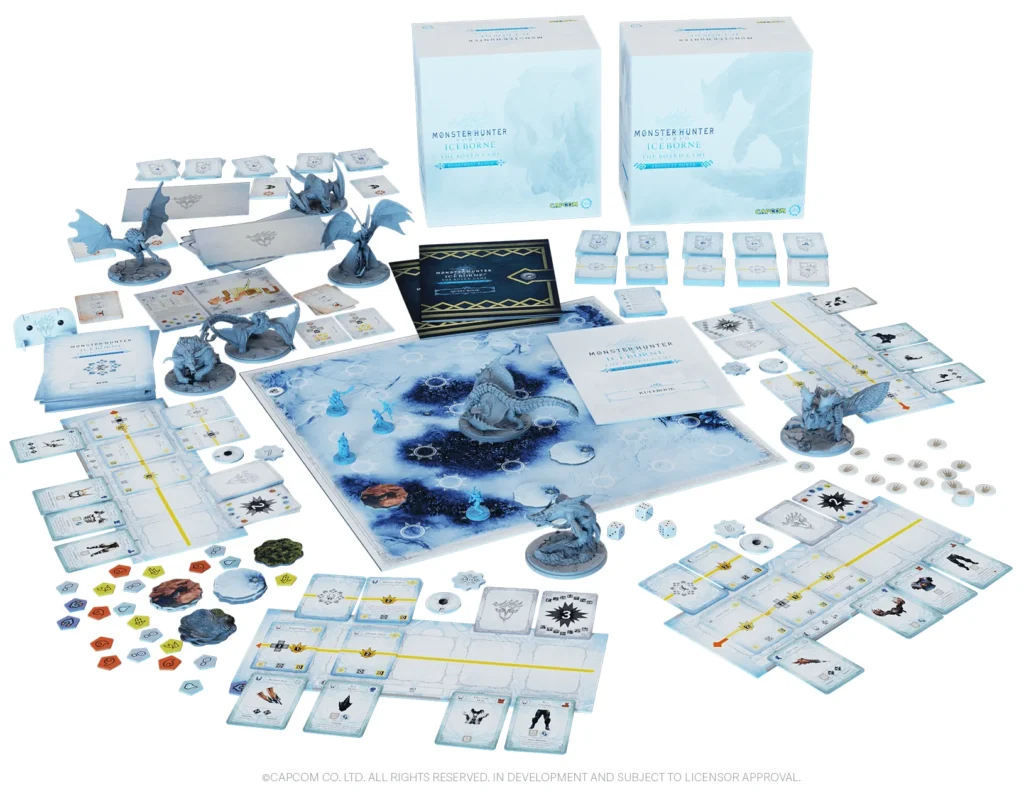
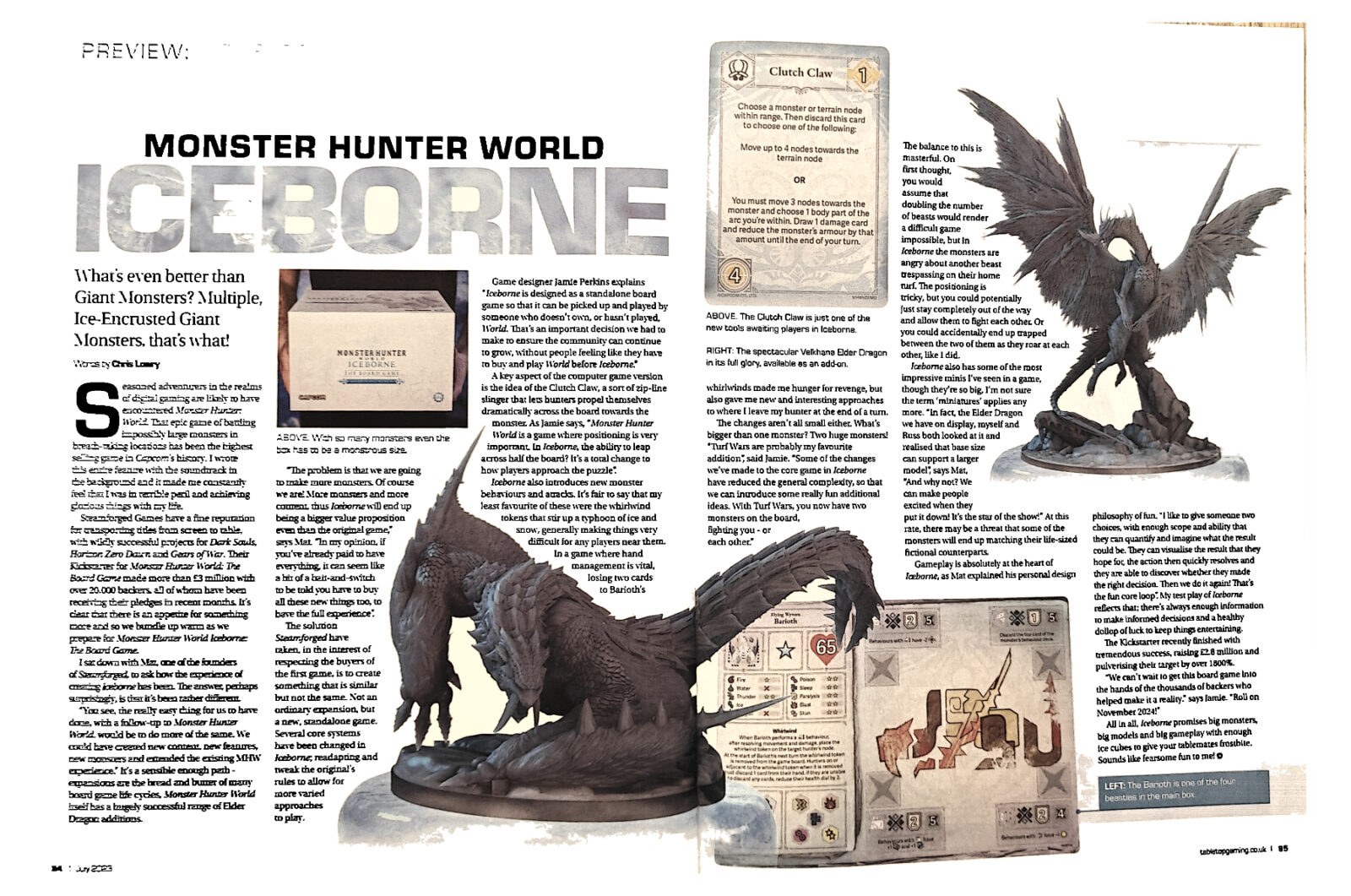
Seasoned adventurers in the realms of digital gaming are likely to have encountered Monster Hunter: World. That epic game of battling impossibly large monsters in breath-taking locations has been the highest selling game in Capcom’s history. Yes, that’s right, Capcom. The company who created Street Fighter and Resident Evil managed to beat their own records? As for the game itself; let’s just say that I composed this entire feature with the soundtrack in the background, and it made me constantly feel I was in terrible peril and achieving glorious things with my life.
Steamforged Games have a fine reputation for transporting titles from the screen to the table, with wildly successful projects for Dark Souls, Horizon Zero Dawn and Gears of War. Their Kickstarter for Monster Hunter World: The Board Game made more than £3 million, with over 20,000 backers, all of whom have been receiving their pledges in recent months. It’s clear that there is an appetite for something more; and it’s certainly coming – Monster Hunter World Iceborne: The Board Game arrives on Kickstarter on May 18th.
I sat down with Mat, one of the founders of Steamforged, to ask how the experience of creating Iceborne has been. The answer, perhaps surprisingly, is that it’s been rather different.
“You see, the really easy thing for us to have done, with a follow-up to Monster Hunter World, would be to do more of the same. We could have created new content, new features, new monsters and extended the existing MHW experience”. It’s a sensible enough path – expansions are the bread and butter of many board game life cycles. Monster Hunter World itself has a hugely successful range of Elder Dragon additions.
“The problem is that we are going to make more monsters. Of course we are! More monsters and more content, and thus Iceborne will end up being a bigger value proposition even than the original game. In my opinion, if you’ve already paid to have everything, it can seem like a bit of a bait-and-switch to be told you have to buy all these new things too, to have the full experience”.
The solution Steamforged have taken, in the interest of respecting the buyers of the first game, is to create something that is similar but not the same. Several core systems have been changed in Iceborne; not throwing out the old ideas completely, but adapted, to allow for varied approaches to play.
A key aspect of the computer game is the idea of the Clutch Claw, a sort of zip-line slinger that lets hunters propel themselves dramatically across the board towards the monster. Game designer Jamie Perkins explains more “Monster Hunter World is a game where positioning is very important. In Iceborne, the ability to leap across half the board? It’s a total change to how players approach the puzzle”.
Iceborne also introduces new monster behaviours and attacks. It’s fair to say that my least favourite of these were the whirlwind tokens that stir up a typhoon of ice and snow and generally make things very difficult for players anywhere near them. In a game where hand management is vital, losing two cards to Barioth’s whirlwinds made me hunger for revenge; but also gave me new and interesting approaches to where I leave my hunter at the end of a turn.
The changes aren’t all small either. What’s bigger than one vast monster? Two huge monsters! “Turf wars are probably my favourite addition”, said Jamie. “Some of the changes we’ve made to the core game in Iceborne have reduced the general complexity – so that we can introduce some really fun additional ideas. With turf wars, you now have two monsters on the board, fighting you – or each other”. The balance to this is masterful. On first thought, you would assume that doubling the number of beasts would render a difficult game impossible, but in Iceborne the monsters are angry about another beast trespassing on their home turf. The positioning is tricky, but you could potentially just stay completely out of the way and allow them to fight each other. Or, if you are me, you could accidentally end up trapped between the two of them as they roar at each other.
Not that being trapped between them is a bad thing, aesthetically speaking. Iceborne has some of the most impressive minis I’ve seen in a game – and they are big enough that I’m not sure the term ‘miniatures’ really applies any more. “In fact, the Elder Dragon we have on display, myself and Russ both looked at it and realised that base size can support a larger model”, says Mat, “And why not? We can make people excited when they put it down! It’s the star of the show!” At this rate, there may be a threat that some of the monsters will end up matching their life sized fictional counterparts.
Now, models can be very visually appealing – a huge dragon certainly adds a sense of occasion to the table – but they also have their critics. Some feel that big box, miniatures-laden board games focus so much on beautiful sculpts that gameplay is left feeling like an afterthought. Not so here, as Mat explains; “People say to me ‘Well, why should I play this?’”. He points out, rightly, that there are many people who don’t engage with computer games, who aren’t automatically sold on the concept just because lots of people enjoyed playing a version of it online. “If we don’t have a good answer for why you should play this board game instead of playing the video game, then we do not greenlight a project”.
Gameplay is absolutely at the heart of Iceborne, as Mat explained his personal design philosophy of fun; “I like to give someone two choices, with enough scope and ability that they can quantify and imagine what the result could be. They can visualise the result that they hope for; the action then quickly resolves, and they are able to discover whether they made a good decision or a bad decision. Then we do it again! That’s the fun loop”. My test play of Iceborne reflects that, with enough information to make informed decisions, and a healthy dollop of luck to keep things entertaining.
All in all, Iceborne promises big monsters, big models and big gameplay, all swished around with enough ice cubes to give your tablemates frostbite. Sounds like fearsome fun.
Monster Hunter World Iceborne: The Board Game goes live on Kickstarter on the 18th May.
I’m a big fan of fantasy sport boardgames. I’ve made my own custom board for Blitz Bowl, I’ve painted up 6+ Blood Bowl teams and I got my son Mantic’s Dreadball for Christmas. In fact, there’s one interesting link between all three of those games: James Hewitt of Needy Cat games has been heavily involved in all of them.
So when I heard that he’d made a new alternate reality sports board game with Blacklist Games? Well, my interest was piqued.
Fantasy sports with loads of miniatures. You get 5 double-teams, big enough for 10 teams in Myth & Goal, or you can use the models for full Blood Bowl teams too. Gameplay-wise its shorter, less swingy and more tactical than Blood Bowl, but more crunchy than Blitz Bowl.
The campaign is going pretty decently, at 172% funded so far, with lots of extra unlocked stretch goals, including a Dwarf riding some kind of Murder Ram – which I’ve very happy with as it will make an excellent proxy model for the insanely expensive GW Dwarf Deathroller (At £48, its the cost of two Blood Bowl teams, and is 60% of the cost of the Myth & Goal box, which contains 87 miniatures… and an entire game!).
What’s it play like?
One thing that has changed a lot since I last bought a big game on Kickstarter is the widespread use of Tabletop Simulator. Thanks to that, I was able to load up a virtual demo game of Myth & Goal, and spend an enjoyable evening hammering it out with my pal James.
Our game of Myth & Goal on Tabletop Simulator
Following that time spent, I have some thoughts:
Granular control
Unlike similar games I’ve played, there is a unique level of focus on tactics as a team and unique states for each individual player on the pitch. Player types generally share a skill, but quickly are differentiated by their Fatigue and Infractions; Shaggura on the left will be exhausted by a single further action, whereas Rutgrot risks a penalty if the coach rolls an infraction on the Gambit die.
On top of this, Tactics cards will synergise with player Special Rules and Team Focus cards. This means your squad is much more granular than in other games, and yet, by only having five on the pitch, totally within your ability to mentally grasp and strategize with.
Understanding balance is hard on a single play, but a quick look through the deck shows that a stronger Team Focus card generally unlocks weaker Tactics cards and vice versa.
Interesting decisions
I love the Infractions and Fatigue rules (as they play, anyway, as they could be more clearly explained in the draft rulebook). You never consider, in Blitz Bowl, the idea that a player might be knackered from doing all the work whilst everyone else just stands around. Or in Blood Bowl, the idea that a player might catch the eye of the ref and be progressively more likely to be sent off.
Fatigue immediately makes itself known; its a limitation of actions before your player becomes exhausted and loses their Special Rule. Bridgitte above is at her maximum fatigue – if she takes one more than the orange 3 on her card, she will flip to the exhausted side like Lars. It feels tight-but-right, constantly limiting your options and making difficult decisions the order of the day.
Infractions are perfect, the push-your-luck element that gets adrenaline pumping. You can add a Gambit die to any roll, increasing your chance at success, but with a risk of rolling an Infraction. One gets you a warning, two a penalty, three a permanent sending off of the player. At first, both James and myself felt like the Gambit die didn’t work, it was too easy, you might as well use it on every single roll. And then we rolled an Infraction. And another one. And then suddenly, the Gambit die felt like an addictive precious resource. It might give you the edge in a strongly opposed action; or it might lose you a player. Very quickly, every use of the Gambit is an interesting decision all by itself.
Scoring options
I’ve played a lot of Blitz Bowl recently – mostly because its so much shorter than Blood Bowl. One of the interesting aspects is that game scoring touchdowns is actually less important than scoring Challenge Cards; for things like successful passes, particularly effective tackles, running with the ball. Initially I found myself missing these additional Challenge Cards points, but I think the scoring options are broad enough to be interesting in Myth & Goal.
You can score two points with a Score On Goal – basically throwing a ball through the hoop – or 5 points with a Breach the Bastion – somewhat like a traditional touchdown in a more limited space. Already this provides two very different approaches, and its layered with the fact that play doesn’t stop – the ball is immediately released in the Gate of the player that was just scored against. In effect this means that you have to be very careful when scoring that you don’t leave yourself open for an immediate counterattack.
The tightness of actions makes it even more interesting – unlike Blood Bowl, you don’t have options for your whole team to set up a careful defensive line and connect an attack, nor do you have the post-touchdown reset to prep yourself. It keeps things fast and tight.
Overall
I’m excited about Myth & Goal.
It seems reasonable to say that you can feel James Hewitt under the hood here; for example I see a lot of ideas from Blitz Bowl coming through – the score board is basically identical, the lack of reset post-goal is very familiar – but Myth & Goal is definitely its own game. I’m looking forwards to playing it and I am confident it will be providing tons of tight, interesting, fun decisions.
The Kickstarter also looks to be insanely good value, frankly for the models alone. If you play Blood Bowl or Blitz Bowl, you are getting Dwarf, Orc, Human, Elf and Lizardman teams for those games too – plus Star Players and it looks like a Rats team will also be fully unlocked – and you are getting an extremely interesting game in its own right! One of the things I love about Blitz Bowl is that it uses models you already have. This does more of the same, and I’m sure there will be unofficial team and player cards for other common teams after it drops.
This week my lovely wife and I took a our first ever trip to Edinburgh. Alongside running up Arthur’s Seat every day, I had a goal: to find the best coffee shop in the city!
We relied on an incredibly well thought-out methodology. It included:
Vaguely looking at some lists and reviews online.
Typing “coffee” into Google Maps a few times.
Wandering into any Café that seemed nice as we ambled round the city.
Drinking lots of coffee.
Coffee Shop Reviews
We were there for 3 days, so obviously we didn’t actually compile an exhaustive review of every coffee house in the city, but we did our best! Keep scrolling down to read a review of each coffee shop in the order we visited them, or you can click below to read them by their overall score.
Fortuna was the first café we visited, having just stumbled off a 3 hour train from Warrington. After a bag laden hour, wandering the streets of the New Town, we were in need of sustenance and a sit down.
Walking into Fortuna (via some decidedly non-accessible steps) you are met with a welcoming ambience. The music was a perfect volume to chat without worrying about being overheard. Mostly bluesy instrumental stuff, but a long way from elevator jazz.
We sat by a cosy little window booth, which – cuteness aside – Katherine found “less comfortable than the train”. The service was prompt and polite, if not overwhelmingly friendly.
[rl_gallery id=”5263″]
Katherine had excellent, strong tea, with tea leaves in a pot. My coffee was delicious, with rich, complex tones in a sensibly sized cup (so you can actually taste the coffee). Good foam art too. My only criticism would be of a slight bitterness that might put off the non-coffee-converts.
We also had some food, which was delicious, and also more than a little on the pricey side. Scrambled egg on a single piece of toast for £5.50 – mine also had avocado for £8. The cakes looked a little “bought in”, but still had a good range and looked appetising.
The WiFi was easily available, with a visible password next to the counter, and a downspeed of 53 Mbit, upspeed of 43Mbit (!) – good enough to do anything you could possibly want. A few sockets were scattered around too. All in all, I could definitely see myself managing a morning drinking lovely coffee and getting some writing done here.
Fortuna Coffee Bar Scorecard
Drink
Really good coffee and nice tea. 4.5/5
Food
Delicious savoury food and good range of cakes. 4/5
Ambience
A nice setting. Shame about the pretty-but-uncomfortable window seats. 3.5/5
Price
Most expensive cafe we visited: two drinks + two eggs on toast for £18.50. 2/5
Overall
A nice cafe, with great coffee. May be cheaper to eat lunch before you visit… 3.5/5
Our next coffee stop was on Cockburn Street. It was instantly clear that we’d found the hipster heart of Edinburgh, with several million boutique coffee shops, an analog still photography studio, and enough beards to braid an organic collar for your cockapoo. As we strolled down the steep cobbles, Southern Cross caught our eye, and ushered us inside
Immediately upon walking in there was a totally different vibe to Fortuna. Much visually busier, bustling and louder, it felt like a place you could be noisy with friends. The music was punchy with a folky latin flavour, enough to set a tone, but still not enough to be disruptive.
The cakes immediately caught my eye, and we ordered some drinks, fries and cake. Everything came very quickly, although actually placing our order took five different episodes of eye contact with the waiter. We also asked if we could sit upstairs, but were told we had to sit downstairs as it was too much effort to carry drinks up there, apparently?
[rl_gallery id=”5281″]
There are a mix of interesting seating areas, including outside, a mezzanine upper floor and a basement. It’s warm and cosy, although a little dark, possibly a bit cramped in places. For laptop users there were a few sockets around, and WiFi was faster down than up (90 Mbit down, 0.9 Mbit up), which is great for downloading, but might cause you some issues sending video in a webchat.
My coffee was smooth and very drinkable. Not particularly dramatic, but sometimes that’s what you want. I would use this sort of taste as a starting point for someone unsure about coffee. The foam art was a bit sloppy – although still better than I can manage – and let’s face it, its the flavour that matters.
The cake, however? We tried two, and both were disappointing. A bit dry, not enough sweetness or flavour going on. As Katherine worded it “Looked the part, didn’t taste it”.
We didn’t feel particularly satisfied by our experience – maybe if we’d been allowed to sit upstairs – but it definitely wasn’t terrible. I think I was disappointed to have expended so many calories on cake that wasn’t yummy.
Southern Cross Cafe Scorecard
Drink
Smooth, drinkable coffee, not much complexity. 4/5
Food
Fast service, nice fries, but the cakes let the side down. 2.5/5
Ambience
Eclectic and inviting. But maybe let punters sit where they want to sit? 3/5
Price
Two drinks + two cakes + chips for £17. Not terrible. 3.5/5
Overall
An interesting setting, with easy to drink coffee, but we didn’t love it here. 3.3/5
On day two of our trip, we took a long guided bus ride round the coastal perimeter of the city. We stopped off to see the Britannia Yacht, which thankfully was closed (boring old boats are boring), and made our way back through The Shore, which I’d heard was a fairly chic part of town.
We didn’t find quite as many artisan cafés as I’d hoped there, but it was a gloriously sunny day by the water, so we popped into pretty little Café Truva. With a scattering of tables outside, extremely clean windows (Katherine noticed this, not me, obviously) and a lovely view of the river, it seemed a great choice.
It has a genuinely Turkish atmosphere inside, with Turkish pastries and a traditional Ottoman sand coffee machine. They also have a proper espresso machine, for those of us who prefer coffee less akin to burnt treacle in its consistency and flavour.
Even so, my cappuccino was intense and pretty bitter, rather than rich and complex. I suspect they use the same ultra strong blend for everything. The milk was also froth rather than microfoam. It was definitely not the best cup of char I had during our time in Scotland! Katherine’s tea was nice.
[rl_gallery id=”5293″]
The food was fairly basic, and not even particularly cheap. More of a greasy spoon level of food, rather than riverside bistro. My halloumi bap was in a supermarket bap, and Katherine’s eggs were undercooked. Value-wise, given the quality, it was overpriced.
They did have WiFi, with a downspeed of 12 Mbit and upspeed of 9Mbit. Not rocket fuel, but acceptable – no sockets though.
Despite the negatives, they were friendly, smiled and made us feel welcome. My chair was comfortable, the view outside was beautiful, and the whole vibe was peaceful. I’m not a total coffee snob – I’d rather have adequate coffee in a nice place than amazing coffee in a miserable setting.
All in all, we enjoyed our brief stay here, and I could definitely see it as an inspirational place to write.
Café Truva Scorecard
Drink
Bitter coffee, over-aerated milk. Not barista quality. Tea was fine. 2.5/5
Food
Simple tastes, inadequately executed. 2/5
Ambience
A friendly, thematic riverside retreat. 5/5
Price
Two drinks + two savoury choices for £17. Didn’t reflect the quality. 3/5
Overall
We appreciated the setting more than the refreshments. 3.1/5
On our way back to the centre, we found ourselves walking along the interminably long Leith Walk – which is a straight road several miles long. It was a hot day, our bag was heavy, we hadn’t slept well thanks to our horror show of an Airbnb… we needed perking up.
A quick scan of Google Maps and my general research into good coffee points led us to OQO. With a perky sign over the door “Your Coffee Nook”, it provided us a retreat from the road works and unseasonable sun – seriously, we are in Scotland, why do I need suntan lotion?!
The owner was friendly, chatty and non intrusive. I effortlessly fell into the best café conversation I had in Edinburgh, talking about dialling in shots, and tasting the espresso at the beginning, middle and end of a pull to see the different tones. Fun (ie. Katherine rolling her eyes) stuff.
[rl_gallery id=”5301″]
The cafe itself is small but varied, with a cosy outside, comfortable inside and a rear room for those wanting to chill with a laptop all day. It was the only place with non conventional (ie. reclaimed-wood-brass-piping-hipster) seating that was actually comfortable, so that was a plus. Non-irritating gentle volumed world jazz was playing whilst we were there.
The middle room actually has a laptop “ban”, which would be annoying if it weren’t for the dedicated work space out back (with loads of sockets!). The WiFi was fine, with 13 Mbit down and only 0.5Mbit up. To be fair on OQO, everywhere else I tested there were no laptops, whereas they had about 5 other people in the work area at the time. Still, that upload speed should still be enough for very nearly all your needs.
And then, finally, we get onto the coffee. The coffee was the best coffee I had in Edinburgh. Light, but rich and interesting. A good foretaste, not bitter, with the best foam art I got in Edinburgh too. Katherine said her tea was nice, if not exceptional. Let’s face it though, tea doesn’t matter – not when the coffee is this good!
We didn’t have food, but the sandwiches looked simple-yet-interesting and were well priced, and the cake appeared inviting.
If we had been there longer I would definitely have visited again. As it is, I will have to return next time I’m in Auld Reekie.
OQO Scorecard
Drink
The best coffee in Edinburgh? Certainly was that week. 5/5
Food
We didn’t try the food, so haven’t given a rating. Suspect it was heading for a 4/5.
Ambience
Comfy, uses the space well. It would feel cramped if full. Has a laptop section! 4/5
Price
We had two drinks for £8. Toasted sandwiches for £4. Reasonable. 4/5
Overall
I’m keen to return, even for the coffee alone! 4.3/5
Our final day involved trips to the National Museum of Scotland and Edinburgh Castle, so we concentrated our café search on the Old Town. As we vaguely hunted for souvenirs/bribes-for-the-grandparents-so-they-agree-to-look-after-the-children-for-a-week-again, we wandered past Deacon’s House.
The site was established in 1788 as a workshop for the Brodie family, one of whom – “Deacon Brodie” – ended up being hung for housebreaking, crimes he often committed using the tools from his workshop. There’s bits of story all around the walls, if you are interested in such things.
The first thing I noticed was an irritatingly glib sign on the wall announcing “We Do Not Have Wifi, We Talk To Each Other!”. Which would be all very well, unless, say, you came to a café to work. Or on your own. Or have anxiety or autism or whatever. Don’t worry though, you can always use your phone as a hotspot. Unless its a 250 year old building with metre thick walls, in which case you’ll have no signal and you can just sit there in silence… No sockets either, but there is a hook on the ceiling for a gas lantern, so, you know, that’s something.
[rl_gallery id=”5310″]
Inside its a little gloomy, although quite spacious – I suspect they’ve taken out some tables for covid – with the extremely old school decor you would expect from a building revelling in its historicity. My chair was a bit hard, and it was the only place I struggled to take photos because of the lighting.
Despite my readiness to dislike this place, it won us over on nearly everything else! The cakes were incredible, the best we had in Edinburgh, with a pistachio orange slice so moist and fragrant I’ve emailed them for the recipe. The tea was the best Katherine tasted in town.
Even the cappuccino had decent foam art, which I wasn’t expecting! The coffee itself was very mild and a bit watery – I let Katherine taste it, and she liked it (she doesn’t like coffee) – so its inoffensive enough to be good coffee for people who don’t like coffee.
It was cheaper than most places, and friendly enough, despite the twee signage. I had expected it to be a one trick “look we are a museum and a café!” and they surprised me with great cake and good drinks. Worth a visit for the cakes!
Deacon’s House Café Scorecard
Drink
Nice tea and adequate coffee. Your nan would love it. 3.5/5
Food
Mouthwatering cakes? Yes please! 5/5
Ambience
A bit gloomy with hard chairs, but there’s a history lesson in it for you… 3/5
Price
Two drinks and two cakes £12. Pretty good. 4/5
Overall
Pleasantly surprised. Might be the best value on the Royal Mile! 3.9/5
Our last café needed to be near the station, so we could catch our train. This took us back to Cockburn Street – yes, the same irritatingly hipster road I mentioned in the Southern Cross review. The Milkman is so cool it has two coffee shops here; one at either end of the street! This surely costs them loads extra in staffing and rent, but its definitely unique.
To win the prize at hipster coffee shop bingo, you need to look for:
Uncomfortable seats made out of chipboard and reclaimed wood.
Prices without decimals or currency markers: £3.80 becomes 3.8.
Liberal use of Helvetica, like they think they invented it.
Punters with inconvenient looking facial hair.
Fast WiFi.
Great coffee.
We didn’t get to shout “Bingo!” at the Milkman, but only because we didn’t see any beards. We got everything else. I struggled to sit and read my book because my back wasn’t the same shape as the bare brick I was leaning against. Prices on the board (in Helvetica) lacked currency or extraneous zeros. The WiFi was the fastest internet I have ever used, with a download speed of 390Mbit(!!) and upload of 50Mbit. You could download a 1Gb HD film in 30 seconds. Insane.
And the coffee was excellent.
My cappuccino was very smooth, as easy to drink as at Southern Cross, but a bit more nuanced; there were hints of complexity at the edges of each mouthful. Katherine had a mocha and didn’t like it very much, because it was very rich, and ultimately she doesn’t like the taste of coffee very much. I enjoyed it! Milkman only lose half a point for the slightly lacking foam art.
[rl_gallery id=”5314″]
The atmosphere was nice enough, with the expected disaffected indie playing in the background, at a thankfully ignorable volume. The server was single-handed and busy when we arrived, but she was very apologetic and tried to give us free stamps to say sorry. The WiFi was the fastest internet I have ever used, with a download speed of 390Mbit(!!) and upload of 50Mbit. You could download a 1Gb HD film in 30 seconds. Insane.
The cakes were very nice, subtle but strong in flavour. I had a caramel slice with the top layer of chocolate the same consistency as the caramel. Different but enjoyable.
I can see why these guys are so popular. It’s where I would go to have a grown up coffee and catch up with a friend, but I might also prefer somewhere with, you know, chairs.
The Milkman Scorecard
Drink
Excellent coffee, would have been a 5 with better presentation. 4.5/5
Food
Tasty cakes, although a lack of other food options. 4/5
Ambience
Very nice, but my backache-after-20-minutes lost you a point. 4/5
Price
Two drinks and two cakes £12. Happy with that. 4/5
Overall
Two for the price of one on the same road. Well worth a visit. 4.1/5