
I smirked. It was all too easy to fool them.
Facing me across the table were my sparring partners; Mirka, shaven headed, with barcoded net-tats on her cheeks; Rret, tousle haired with cold, calculating eyes; and Evryt, tall and crooked with age.
They stared at me. Might I actually have the personal connections that I claim? They had no way to be sure.
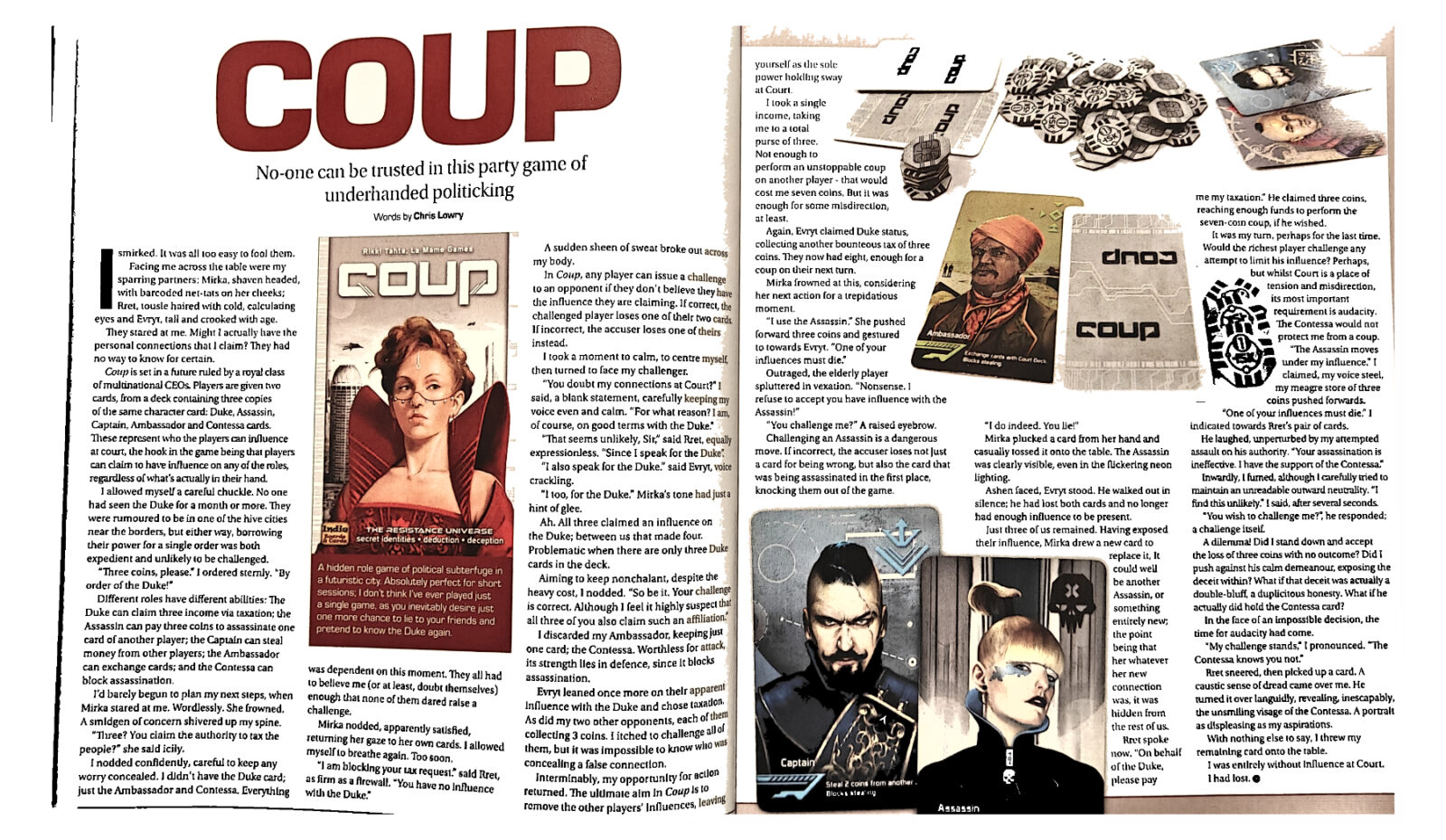
Coup is set in a future ruled by a royal class of multinational CEOs. Players are given two cards, from a pool of three each of Duke, Assassin, Captain, Ambassador and Contessa cards. These represent who the Players can influence at Court. The hook in the game, however, is that Players can claim to have influence on any of the roles, regardless of what’s actually in their hand.
I allowed myself a careful chuckle. No one had seen the Duke for a month or more. They were rumoured to be in one of the hive cities near the borders, but either way, borrowing their power for a single order was both expedient and unlikely to be challenged.
“Three coins please”, I ordered, sternly. “By order of the Duke!”
Different roles have different abilities. The Duke can claim 3 income via taxation; the Assassin can pay 3 coins to assassinate one card of another player; the Captain can steal money from other players; the Ambassador can exchange cards and the Contessa can block assassination.
I’d barely begun to plan my next steps, when Mirka stared at me. Wordlessly. She frowned. A smidgen of concern shivered up my spine.
“Three? You claim the authority to tax the people?”, she said, icily.
I nodded confidently, careful to keep any worry concealed. I didn’t have the Duke card; just the Ambassador and Contessa. Everything was dependent on this moment; they all had to believe me, or, at least, doubt themselves enough that they didn’t dare raise a challenge.
Mirka nodded, apparently satisfied, and returned her gaze to her cards. I allowed myself to breathe again. Too soon.
“I am blocking your tax request.” Rret. As firm as a firewall. “You have no influence with the Duke”.
A sudden sheen of sweat broke out across my body.
In Coup, any other player can issue a challenge to any other player if they don’t believe they have the influence they are claiming. If correct, the challenged player loses one of their two cards. If incorrect, the accuser loses one of their remaining cards.
I took a moment to calm; to centre myself, then turned to face my challenger.
“You doubt my connections at Court”, I said, a blank statement, carefully keeping my voice even and calm. “For what reason? I am, of course, on good terms with the Duke”.
Rret, equally expressionless. “That seems unlikely, Sir, since I speak for the Duke”.
“I also speak for the Duke”, Evryt’s cracked voice.
“I too; the Duke”. Mirka’s tone had just a hint of glee.
Ah. All three claimed an influence on the Duke; between us that made four. Problematic when there are only three Duke cards in the deck.
Aiming to keep nonchalant, despite the heavy cost, I nodded. “So be it. Your challenge is correct. Although I feel it highly suspect that all three of you also claim such an affiliation”.
I discarded my Ambassador, keeping just one card; the Contessa. Worthless for attack, its strength lies in defence, since it blocks Assassination.
Evryt leaned once more on their apparent influence with the Duke and chose taxation. As did my two other opponents; each of them collecting 3 coins. I itched to challenge all of them, but it was impossible to know who concealed an untruth.
Interminably, my opportunity for action returned. The ultimate aim in Coup is to remove the other players’ influences, leaving yourself as the sole power holding sway at Court.
I took a single income, 1 coin, taking me to a total purse of 3. Not enough to perform an unstoppable Coup on another player – that would cost me 7 coins, but enough for some misdirection, at least.
Again Evryt claimed Duke status, collecting tax and a further 3 coins. They now had 8, enough for a coup on their next turn.
Mirka frowned at this, and considered her next action for a trepidatious moment.
“I use the Assassin”. She pushed forward 3 coins, and gestured to the just-played Evryt, “One of your influences must die”.
Outraged, the elderly player spluttered in vexation. “Nonsense. I refuse to accept you have influence with the Assassin”.
“You challenge me?”. A raised eyebrow.
Challenging an Assassin is a dangerous move. If incorrect, the accuser loses not just a card for being wrong, but also the card that was being assassinated in the first place; knocking them out of the game.
“I do indeed. You lie.”
Mirka plucked a card from her hand, and casually tossed it onto the table. The Assassin was clearly visible, even in the flickering neon lighting.
Ashen faced, Evryt stood. He walked out in silence; he had lost both cards and no longer had enough influence to be present. Just three of us remained. Mirka drew another card; it could well be another Assassin – or not – the point being that her revealed card be replaced with a hidden one
Rret spoke now. “On behalf of the Duke, please pay me my taxation”. He claimed 3 coins, reaching enough funds to perform a 7 coin Coup if he wished.
It was my turn. Perhaps for the last time. Would the richest player challenge any attempt to limit his influence? Perhaps, but whilst Court is a place of tension and misdirection, its most important requirement is audacity. The Contessa would not protect me from a Coup.
“The Assassin moves under my influence”, I claimed, my voice steel, my meagre store of three coins pushed forwards. “One of your influences must die”, I said, indicating Rret’s hand of cards.
He laughed, unperturbed by my attempted assault on his authority. “Your assassination is ineffective. I have the support of the Contessa”.
Inwardly I fumed, although I carefully tried to maintain an unreadable outward neutrality. “I find this unlikely”, I said, after several seconds.
“You wish to challenge me?”, he responded; a challenge itself.
A dilemma! Did I stand down and accept the loss of three coins with no outcome? Did I push against his calm demeanour, exposing the deceit within? What if that deceit was actually a bluff, a duplicitous honesty, and he actually did hold **the Contessa card?
An impossible decision; the time for audacity had come.
“My challenge stands”, I pronounced. “The Contessa knows you not”.
Rret sneered, and picked up a card. A caustic sense of dread came over me. He turned it languidly, revealing, inescapably, the unsmiling visage of the Contessa. A portrait as displeasing as my aspirations.
With nothing else to say, I threw my remaining card onto the table.
I was entirely without influence at Court.
I had lost.
//Info Box
Coup
is a tiny hidden role game of political subterfuge in a futuristic city. It’s absolutely perfect for short sessions; in fact, I don’t think I’ve ever played just a single game, as you inevitably desire just one more chance to lie to your friends and pretend to control the Duke again.
A review written for Tabletop Gaming Magazine. Copyright and rights TTG Magazine 2022.