//intro box
Setting up a league can be a great way to take your enjoyment of a game to a different level. It’s also a brilliant opportunity to share new ideas and gameplay styles and to build up a core group of people who want to get stuck into the game just as much as you. Plus… there will be lots of opportunities to make a spreadsheet!
The most important ingredient for a successful league is committed players.
What to Play?
The classic games that lend themselves to tournament are reasonably short, abstract games; things like Backgammon, Go and the obvious classic: Chess, which has been played in tournaments since the first ever in Leeds in 1841!
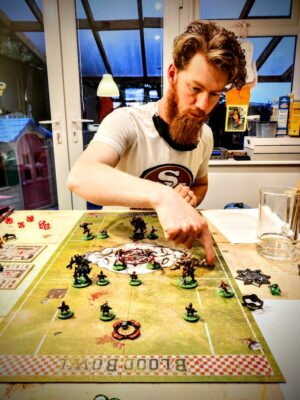
Others that lend themselves thematically and mechanically to long-form competition are “sports” games like Blood Bowl or Heat: Pedal to the Metal. These often have league rules baked in, with things like team skill progression and car upgrades actually adding significantly more depth and choice than the standard one-shot experience.
However, there’s no reason that you can’t use literally any game in your own homebrew league or tournament. From Carcassonne to Cash N’ Guns, the vast majority of what we play is perfectly built for competitive ranking; there are cash-prize at the World Series of Board Games for War of the Ring and 18xx games, after all.
Competition style
The biggest challenge in any homebrew tournament will be getting enough games to actually complete the thing. Think about it; in a standard 8 person round-robin league, you’d need 16 games for everyone to play each other. Scheduling a mate to play just once is hard enough; there’s a reason that most leagues fail. The single most important ingredients for a successful league is committed players.
One approach I’d recommend, to start you off, is a simple knockout tournament.
The reason for this is that the total number of games that you play is significantly lower; with 8 competitors, after one game, you have 4, then 2 facing each other down in the final; a total of 7 games. It also means that there’s a definitive end point – everyone can meet up and watch the final game, cheering and eating crisps.
If you do go with a more standard round-robin league approach, it can be helpful to use a points system that rewards people for playing, even if they lose. I suggest 5 points for a win, 3 for a draw and 1 for a loss; this encourages people to play; even if you lose disastrously, you’ve still scored more points than someone who didn’t play at all.
Where to play
An important aspect to consider is the medium you use for games.
We’ve advanced tremendously on this front in recent years. Whilst I still hugely prefer face-to-face gaming over anything else, it can’t be denied that options like Tabletop Simulator or BoardGameArena provide quick online options for checking off a quick game.
It also opens up your league to players who don’t live geographically close to one another, which enables you to widen up your tournament to a much larger group. It also helps to reduce scheduling conflicts, since bashing together one game quickly online when you have a gap is much easier than reserving an entire evening to play.
What do we win?
Finally, an unnecessary but enjoyable addition for your league? A decent prize.
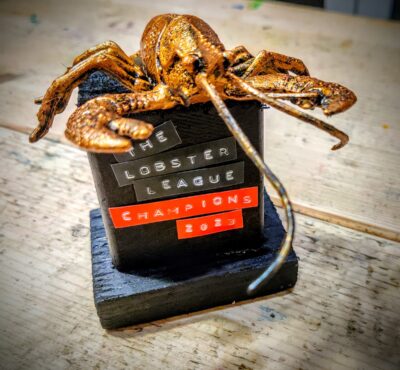
Get everyone to chuck in a few quid and buy a silly trophy. Or, even better, make your own: our recent Bloodbowl tournament had a glorious trophy, made from a plastic lobster nailed to a piece of two-by-four and painted gold. Not just that, but we all contributed some ridiculous lore and a new historical landmark was born into all our gaming worlds. You could do the same!