For those 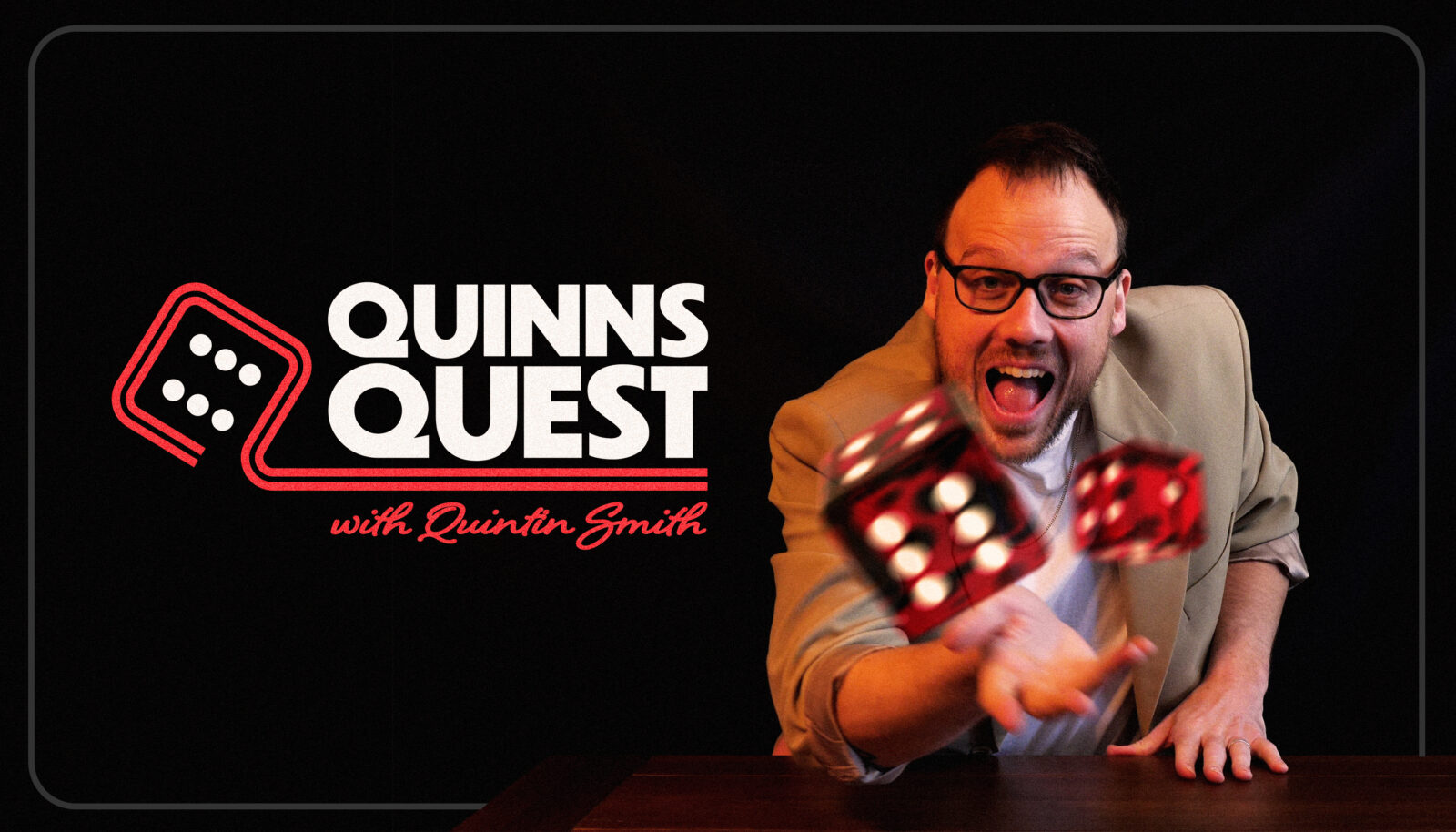 of you who’ve literally been under a YouTube sized rock for the last decade, Shut Up & Sit Down have been one of the foremost voices in the tabletop world for years. In many ways, they’ve grown up with the hobby, starting in it’s scrappier, fly-by-the-seat-of-your-pants years and overseeing a trend towards unimaginably high production quality in our games; but with the commercial expectations and vast conglomerates that goes along with that.
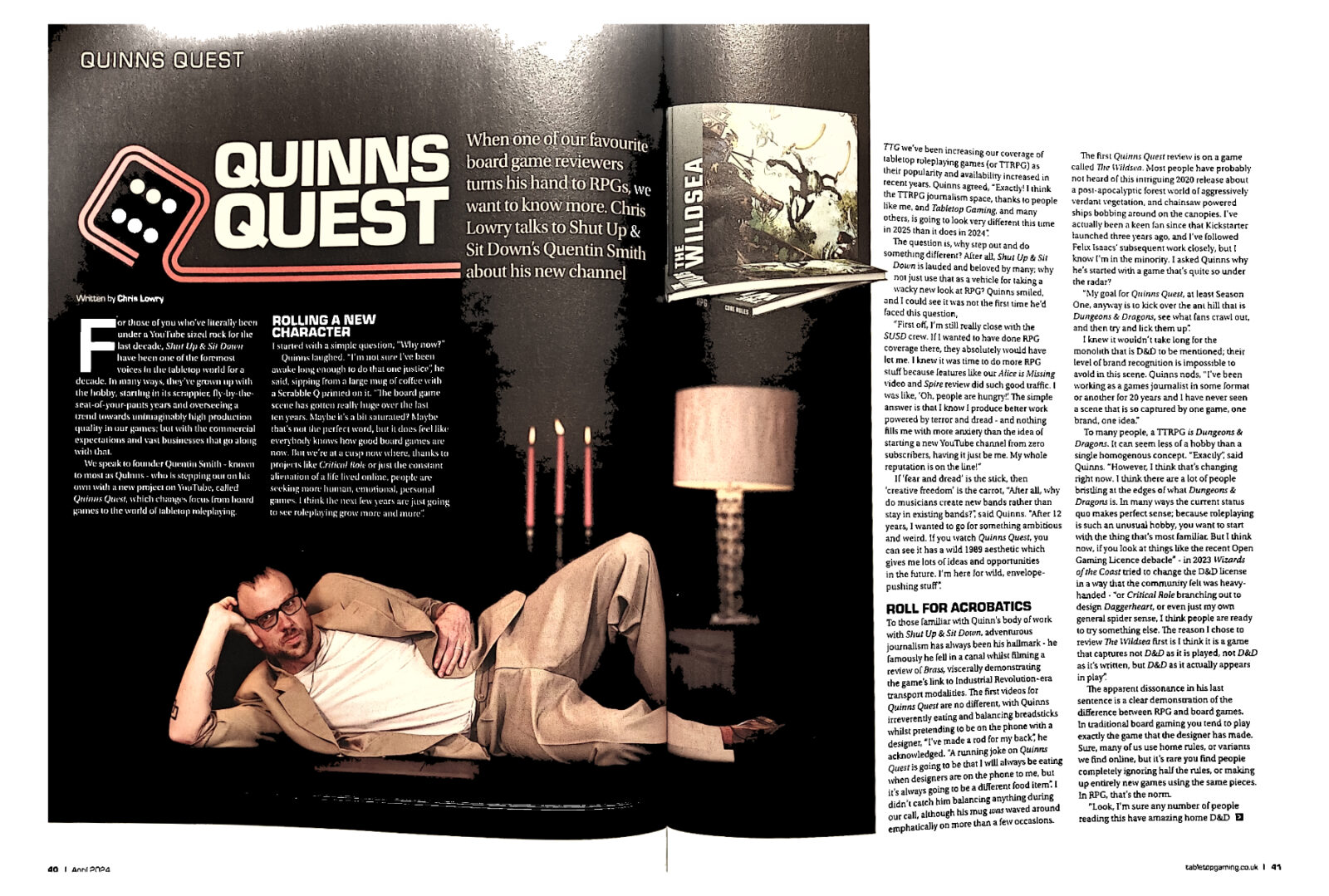
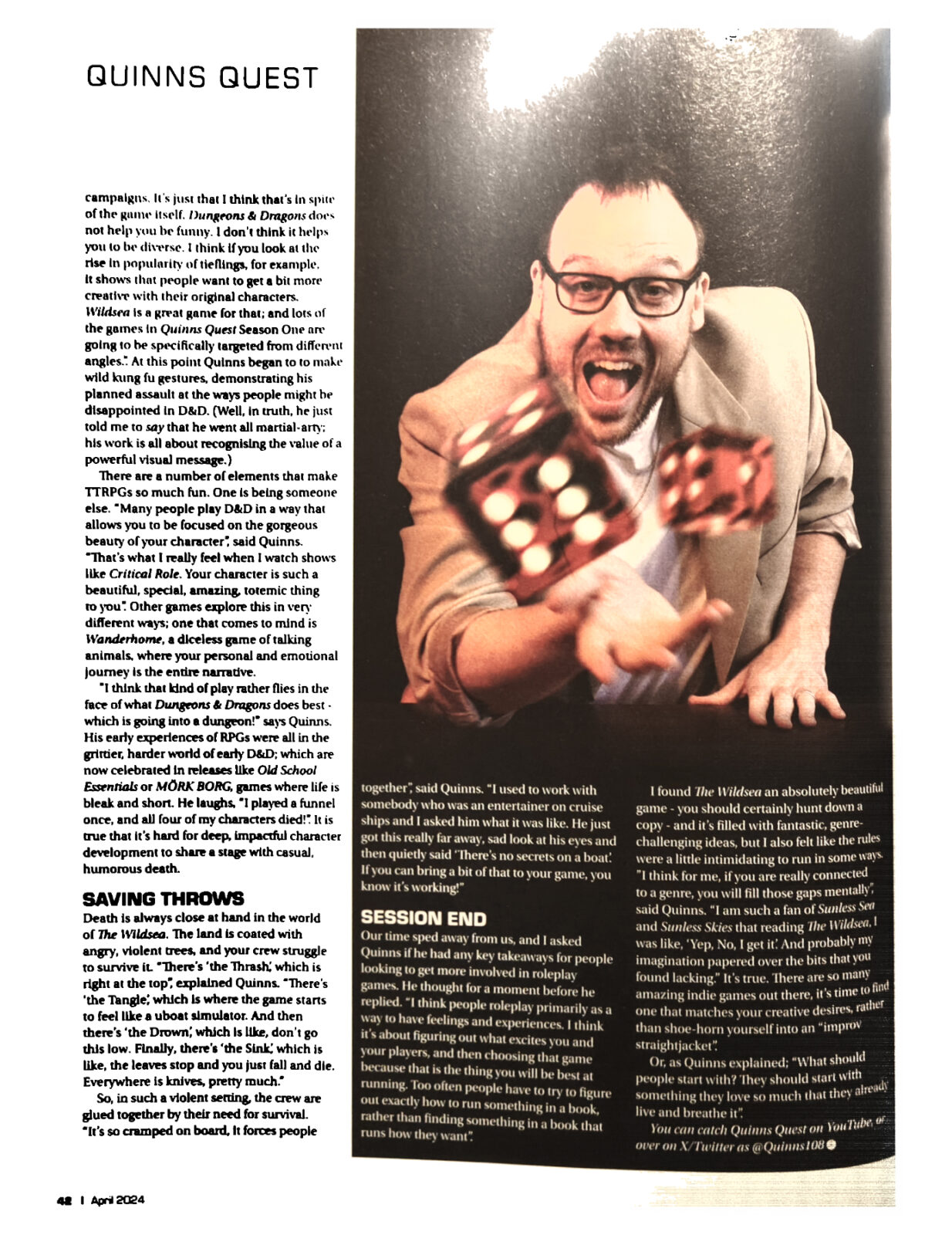
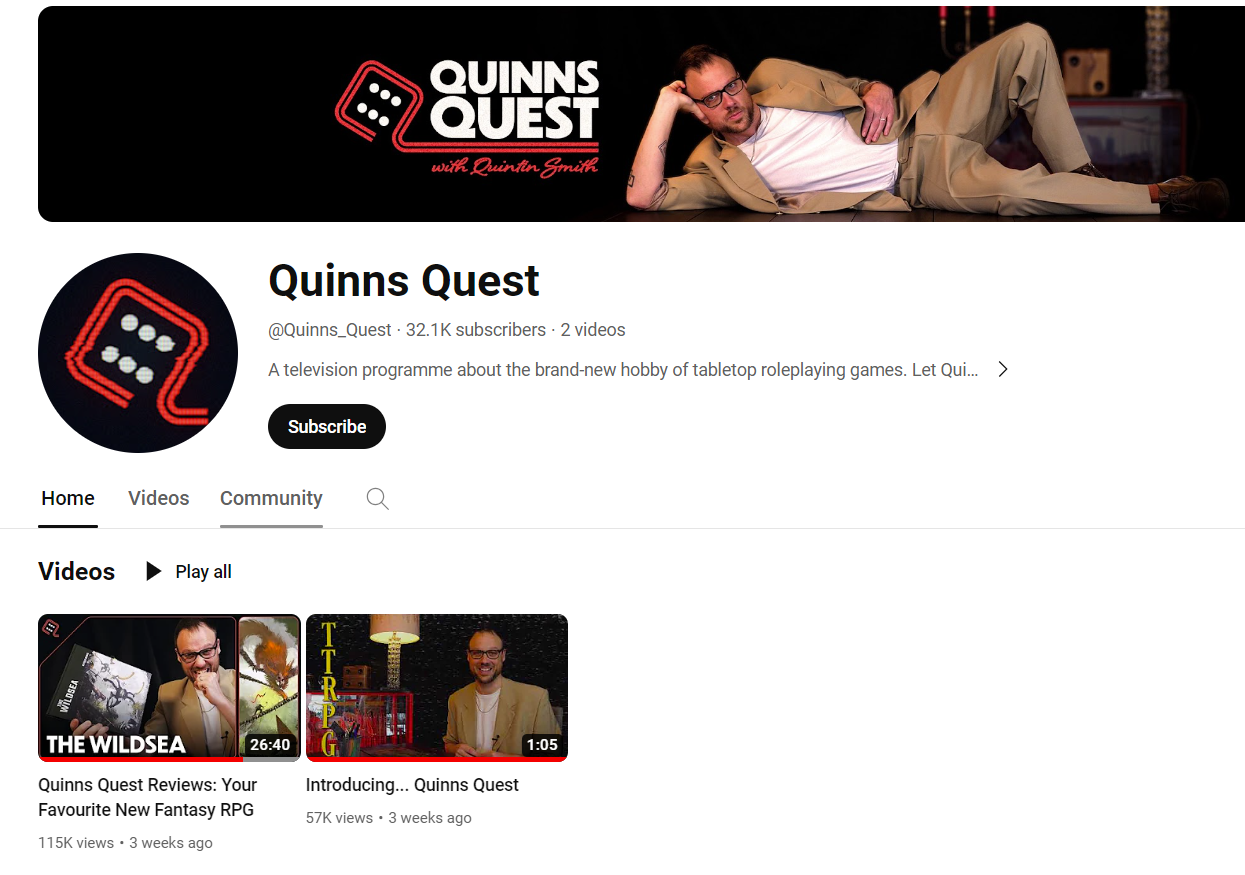
We speak to founder Quentin Smith – known to most as “Quinns” – who is stepping out on his own with a new project, called Quinn’s Quest, which changes focus from board games onto the world of tabletop roleplaying.
 I started with a simple question; “Why now?”
Quinns laughed. “I’ve not sure I’ve been awake long enough to do that one justice”, he said, sipping from a large mug of coffee with a Scrabble Q printed on it. “The board game scene has gotten really huge over the last ten years. Maybe it’s a bit saturated? Maybe that’s not the perfect word, but it does feel like everybody knows how good board games are now. But we’re at a cusp now where, thanks to projects like Critical Role or just the constant alienation of a life lived online, people are seeking more human, emotional, personal games. I think the next few years are just going to see roleplaying grow more and more”.
It’s a trend we’ve noticed – and here at TTG we’ve been significantly increasing our coverage of tabletop roleplaying games (or “TTRPG”) in recent years. Quinns agreed, “Exactly! I think the TTRPG journalism space, thanks to people like me, and Tabletop Gaming, and many others, is going to look very different this time in 2025 than it does in 2024”.
The question is, why step out and do something different? After all, Shut Up & Sit Down is lauded and beloved by many; why not just use that as a vehicle for taking a wacky new look at RPG? Quinns smiled, and I could see it’s not the first time he’s faced this question, “First off, I’m still really close with the SUSD crew. If I wanted to have done RPG coverage there, they absolutely would have let me. I knew it was time to do more RPG stuff because features like our Alice is Missing video and Spire review did such good traffic. I was like, ‘Oh, people are hungry!’. The simple answer is that I know I produce better work powered by terror and dread – and nothing fills me with more anxiety than the idea of starting a new YouTube channel from zero subscribers, having it just be me. My whole reputation is on the line!””
 If ‘fear and dread’ is the stick, then ‘creative freedom’ is the carrot, “After all, why do musicians create new bands rather than stay in existing bands?”, said Quinns. “After 12 years, I wanted to go for something ambitious and weird. If you watch Quinn’s Quest, you can see it has a wild 1989 aesthetic which gives me lots of ideas and opportunities in the future. I’m here for wild, envelope-pushing stuff”.
To those familiar with Quinn’s body of work with Shut Up & Sit Down, adventurous journalism has always been his hallmark – he famously he fell in a canal whilst filming a review of Brass, viscerally demonstrating the game’s link to Industrial Revolution–era transport modalities. The first videos for QQ are no different, with Quinns irreverently eating and balancing breadsticks whilst pretending to be on the phone with a designer, “I’ve made a rod for my back”, he acknowledged. “A running joke on Quinn’s quest is going to be that I will always be eating when designers are on the phone to me, but it’s always going to be a different food item”. I didn’t catch him balancing anything during our call, although his mug was waved around emphatically on more than a few occasions….
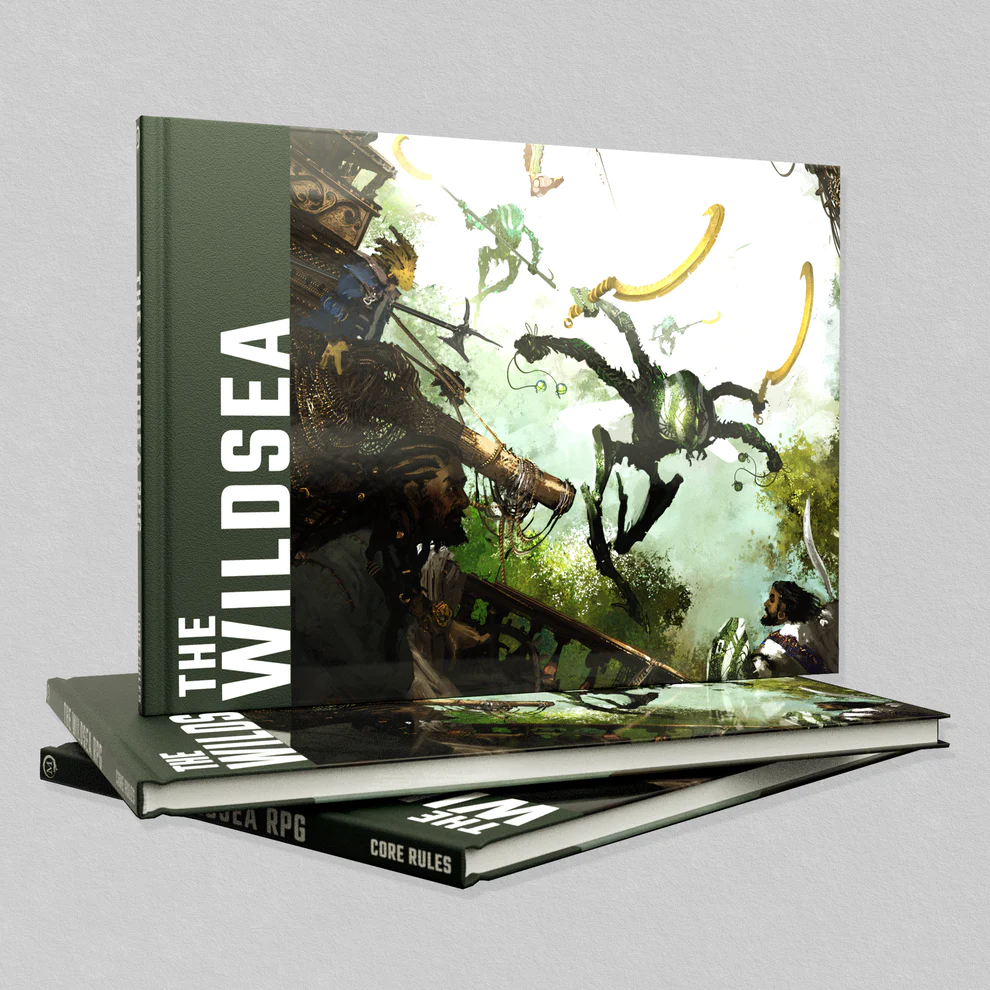
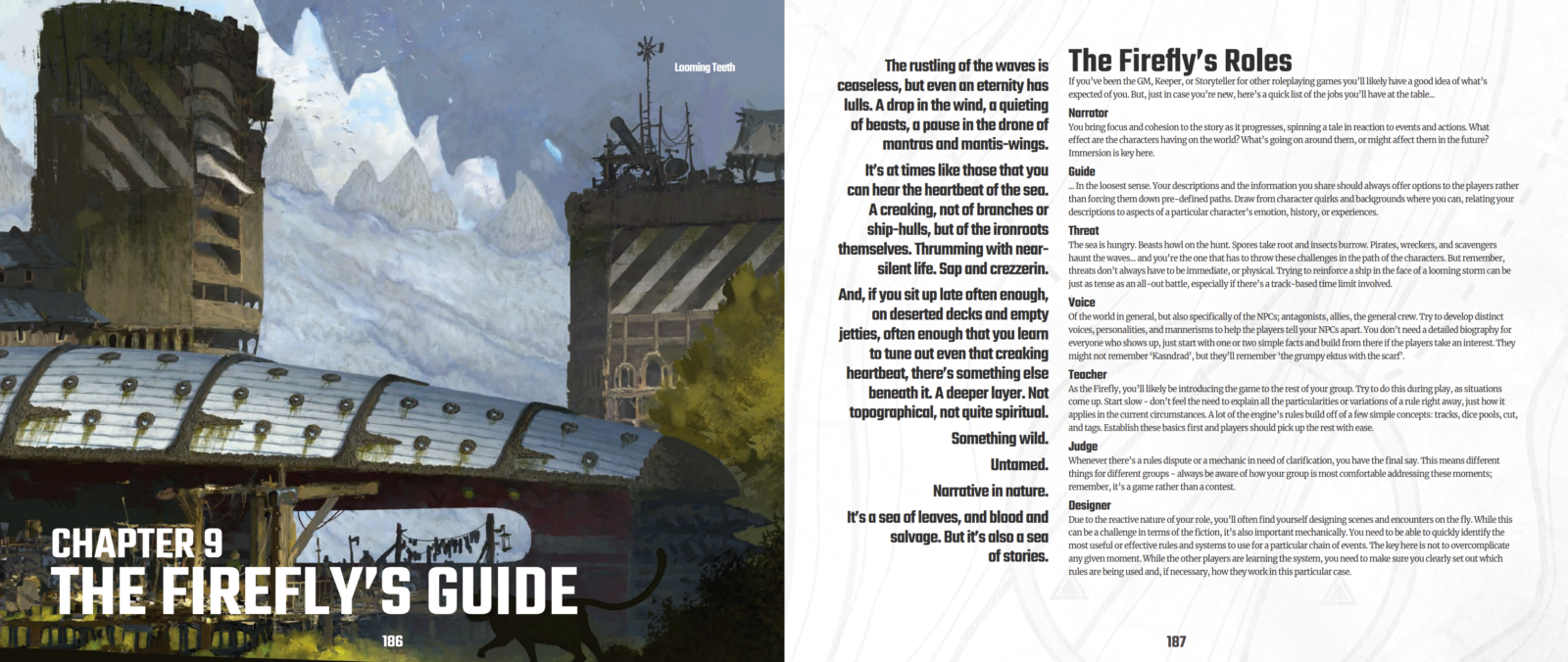
The first Quinn’s Quest review is on a game called The Wildsea. Most people have probably not heard of this intriguing 2020 release about a post-apocalyptic forest world of aggressively verdant vegetation, and chainsaw powered ships bobbing around on the canopies. I’ve actually been a keen fan since that Kickstarter launched three years ago, and I’ve followed Felix Isaacs’ subsequent work closely, but I know I’m in the minority. I asked Quinns why he’s started with a game that’s quite so under the radar?
“My goal for Quinn’s Quest, at least Season One, anyway to kick over the ant hill that is Dungeons and Dragons, see what fans crawl out, and then try and lick them up”. I knew it wouldn’t take long for the monolith that is D&D to be mentioned; their level of brand recognition is impossible to avoid in this scene. Quinns nods, “I’ve been working as a games journalist in some format or another for 20 years and I have never seen a scene that is so captured by one game, one brand, one idea.”
To many people, RPG is Dungeons & Dragons. It can seem less of a hobby than a single homogenous concept. “Exactly”, said Quinns. “However, I think that’s changing right now. I think there are a lot of people bristling at the edges of what Dungeons & Dragons is. In many ways the current status quo makes perfect sense; because role playing is such an unusual hobby, you want to start with the thing that’s most familiar. But I think now, if you look at things like the recent Open Gaming Licence debacle” – in 2023 Wizards of the Coast tried to change the D&D license in a way that the community felt was heavy-handed profiteering – “or Critical Role branching out to design Daggerheart, or even just my own general spider sense, I think people are ready to try something else. The reason I chose to review The Wildsea first is I think it is a game that captures not D&D as it is played, not D&D as it’s written, but D&D as it actually appears in play”.
The apparent dissonance in his last sentence is a clear demonstration of the different between RPG and board games. In traditional board gaming you tend to play exactly the game that the designer has made. Sure, many of us use home rules, or variants we find online, but its rare you find people completely ignoring half the rules, or making up entirely new games using the same pieces. In RPG, that’s the norm.
“Look, I’m sure any number of people reading this have amazing home D&D campaigns. It’s just that I think that’s in spite of the game itself. Dungeons & Dragons does not help you be funny. I don’t think it helps you to be diverse. I think if you look at the rise in popularity of tieflings, for example, it shows that people want to get a bit more creative with their original characters. Wild Sea is a great game for that; and lots of the games in Quinn’s Quest Season One are going to be specifically targeted from different angles.”. At this point Quinns began to to make wild kung fu gestures, demonstrating his planned assault at the ways people might be disappointed in D&D. (Well, in truth, he just told me to say that he went all martial-arty; his work is all about recognising the value of a powerful visual message.)
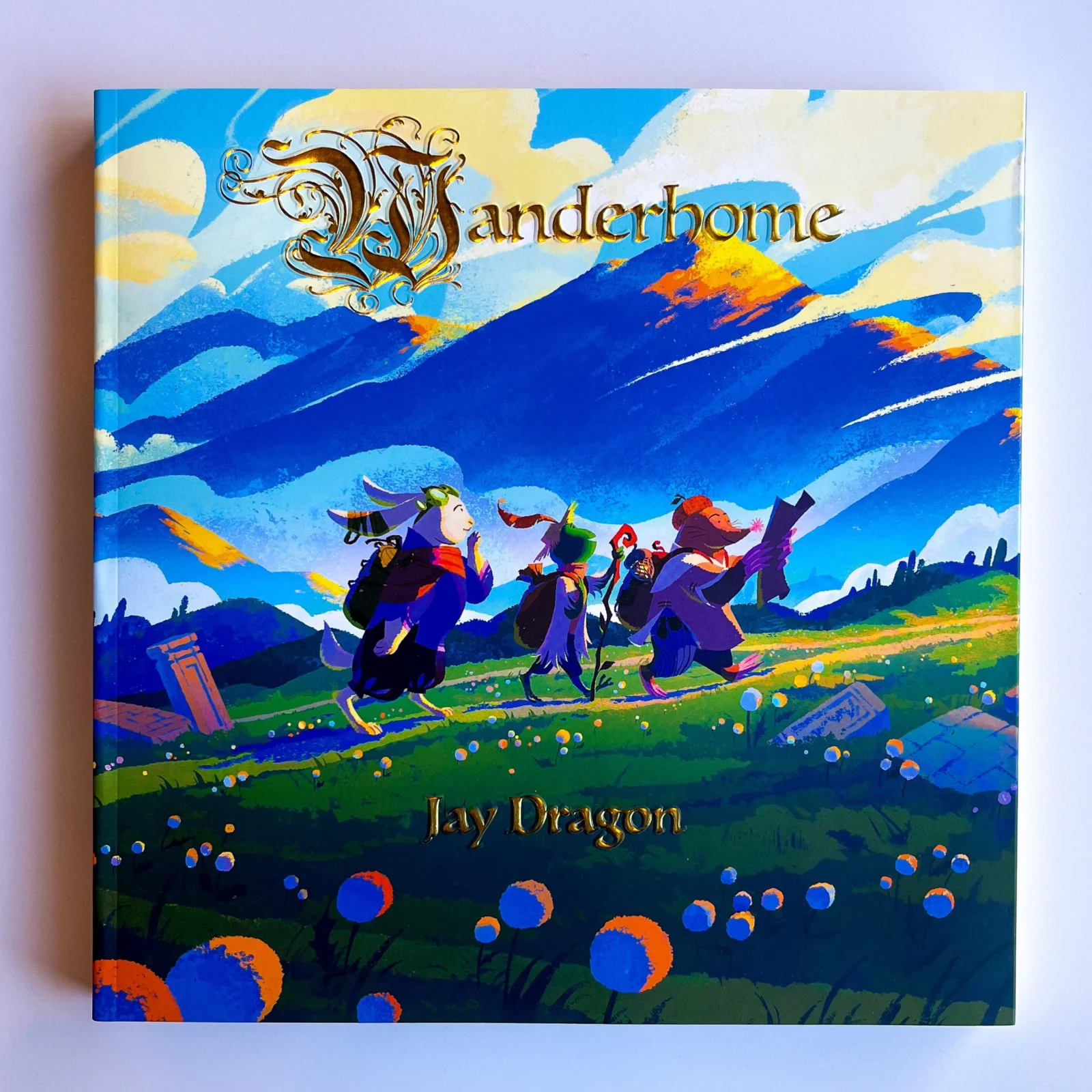
There’s a number of elements that make TTRPG so much fun. One is being someone else. “Many people play D&D in a way that allows you to be focused on the gorgeous beauty of your character”, said Quinns. “That’s what I really feel when I watch shows like Critical Role. Your character is such a beautiful, special, amazing, totemic thing to you”. Other games explore this in very different ways; one that comes to mind is Wanderhome, a diceless game of talking animals, where your personal and emotional journey is the entire narrative.
”I think that kind of play rather flies in the face of what Dungeons & Dragons does best – which is going into a dungeon!” says Quinns. His early experiences of RPG were all in the grittier, harder world of early D&D; which are now celebrated in releases like Old School Essentials or MÖRK BORG, games where life is bleak and short. He laughs*,* “I played a funnel once, and all four of my characters died!”. It is true that it’s hard for deep, impactful character development to share a stage with casual, humorous death*.*
Death is always close at hand in the world of The Wildsea. The land is coated with angry, violent trees, and your crew struggle to survive it. “There’s ‘the Thrash’, which is right at the top”, explained Quinns. “There’s ‘the Tangle’, which is where the game starts to feel like a uboat simulator. And then there’s ‘the Drown’, which is like, don’t go this low. Finally, there’s ‘the Sink’, which is like, the leaves stop and you just fall and die. Everywhere is knives, pretty much.”
So, in such a violent setting, the crew are glued together by their need for survival. “It’s so cramped on board, it forces people together”, said Quinns. “I used to work with somebody who was an entertainer on cruise ships and I asked him what it was like. He just got this really far away, sad look at his eyes and then quietly said ‘There’s no secrets on a boat’. If you can bring a bit of that to your game, you know it’s working!”
Our time sped away from us, and I asked Quinns if he had any key takeaways for people looking to get more involved in roleplay games. He thought for a moment before he replied. “I think people roleplay primarily as a way to have feelings and experiences. I think it’s about figuring out what excites you and your players, and then choosing that game because that is the thing you will be best at running. Too often people have to try to figure out exactly how to run something in a book, rather than finding something in a book that runs how they want”.
I found The Wildsea an absolutely beautiful game – you should certainly hunt down a copy – and it’s filled with fantastic, genre-challenging ideas, but I also felt like the rules were a little intimidating to run in some ways. ”I think for me, if you are really connected to a genre, you will fill those gaps mentally”, said Quinns. “I am such a fan of Sunless Sea and Sunless Skies that reading Wildsea, I was like, ‘Yep, No, I get it’. And probably my imagination papered over the bits that you found lacking.” It’s true. There are so many amazing indie games out there, it’s time to find one that matches your creative desires, rather than shoe-horn yourself into an “improv straightjacket”.
Or, as Quinns explained; “What should people start with? They should start with something they love so much that they already live and breathe it”.
You can catch Quinns Quest on YouTube, or over on twitter as @Quinns108