Go
I’m going to let you in on a secret: you don’t need to buy all the extremely cool games featured in this magazine. Sure, they are fun and colourful and exciting, but you could happily spend the rest of your life getting obsessed by just one beautiful game: Go.
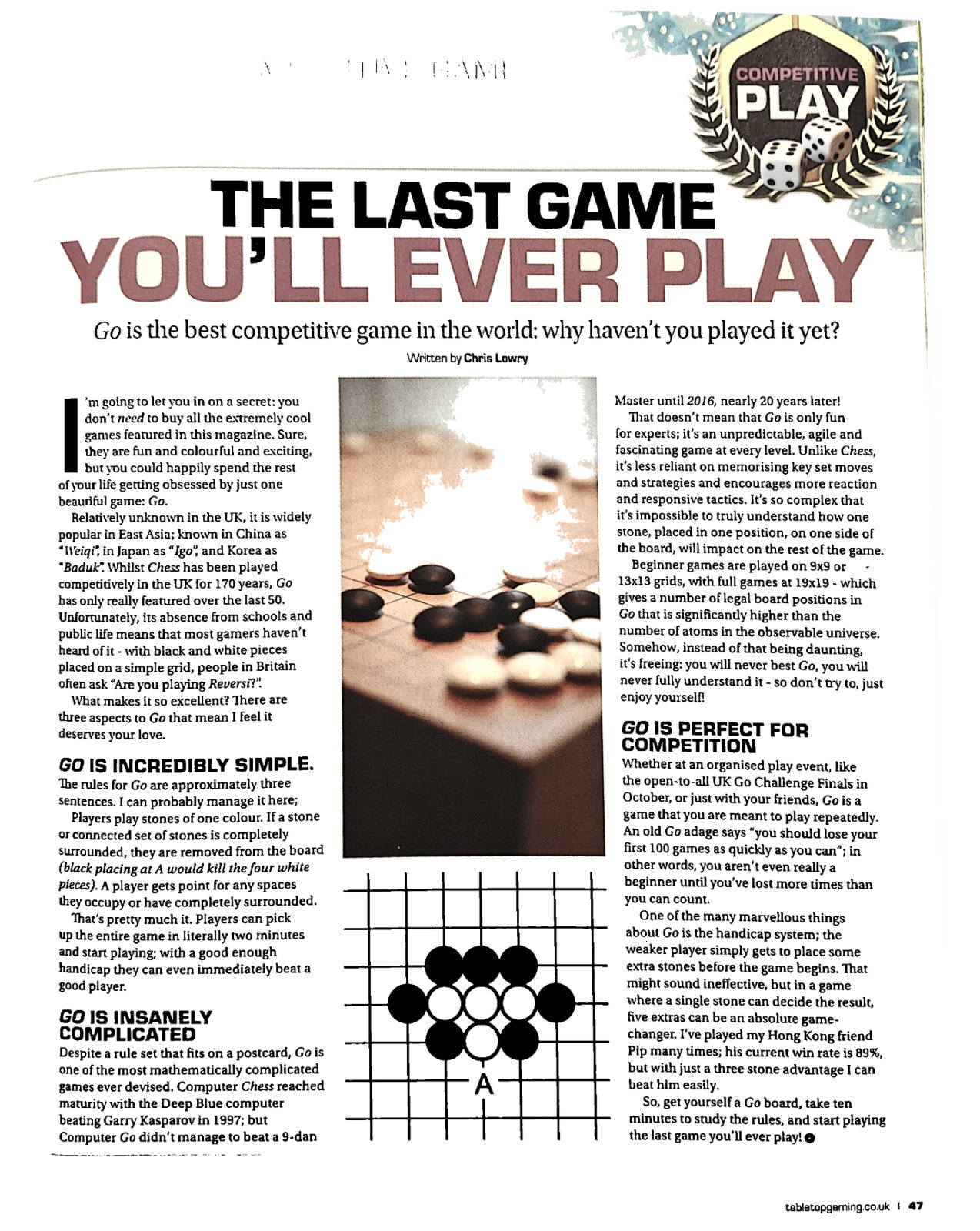
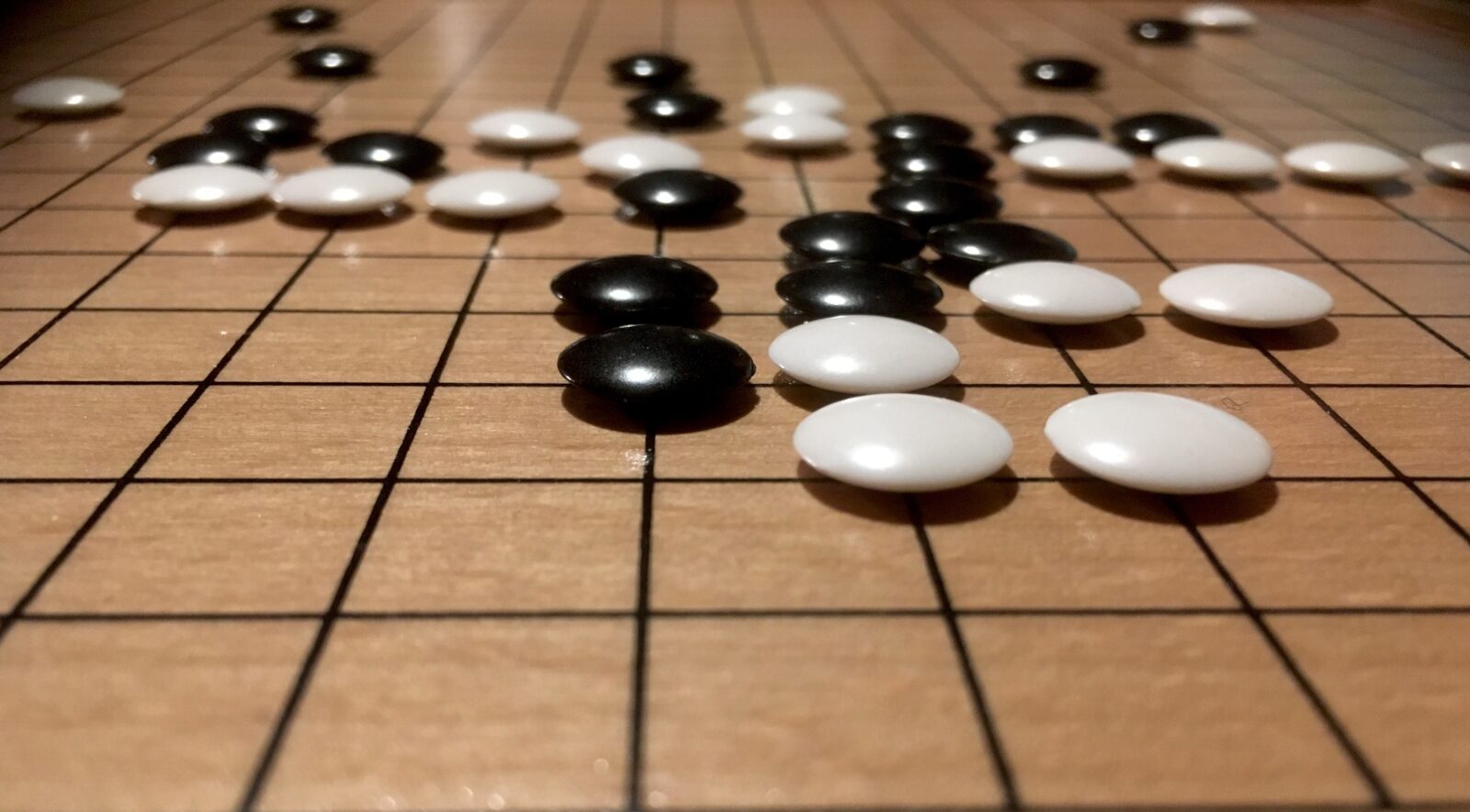
Relatively unknown in the UK, it is widely popular in East Asia; known in China as “Weiqi”, in Japan as “Igo”, and Korea as “Baduk”. Whilst Chess has been played competitively in the UK for 170 years, Go has only really featured over the last 50. Unfortunately, its absence from schools and public life means that most gamers haven’t heard of it – with black and white pieces placed on a simple grid, people in Britain often ask “Are you playing Reversi?”.
What makes it so excellent? There are three aspects to Go that mean I feel it deserves your love.
Go is incredible simple.
The rules for Go are approximately 3 sentences. I can probably manage it here;
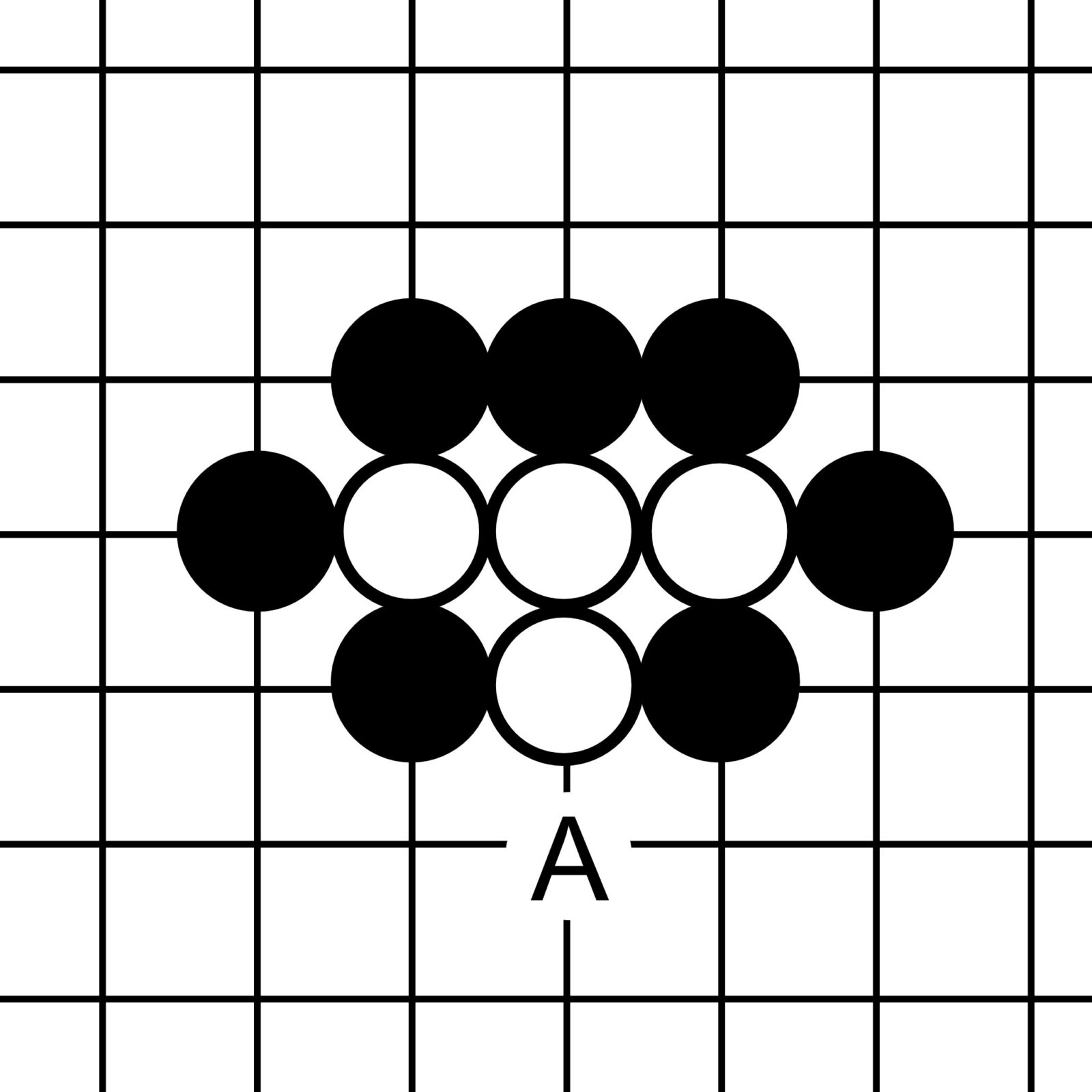
Players play stones of one colour. If a stone or connected set of stones is completely surrounded, they are removed from the board (black placing at A would kill the four white pieces). A player gets point for any spaces they occupy or have completely surrounded.
That’s pretty much it. Players can pick up the entire game in literally two minutes and start playing; with a good enough handicap they can even immediately beat a good player.
Go is insanely complicated
Despite a rule set that fits on a postcard, Go is one of the most mathematically complicated games ever devised. Computer Chess reached maturity with the Deep Blue computer beating Garry Kasparov in 1997; but Computer Go didn’t manage to beat a 9-dan Master until 2016, nearly 20 years later!
That doesn’t mean that Go is only fun for experts; its an unpredictable, agile and fascinating game at every level. Unlike Chess, it’s less reliant on memorising key set moves and strategies, and encourages more reaction and responsive tactics. It’s so complex that it’s impossible to truly understand how one stone, placed in one position, on one side of the board, will impact on the rest of the game.
Beginner games are played on 9×9 or 13×13 grids, with full games at 19×19 – which gives a number of legal board positions in Go that is significantly higher than the number of atoms in the observable universe. Somehow, instead of that being daunting, it’s freeing: you will never best Go, you will never fully understand it – so don’t try to, just enjoy yourself!
Go is perfect for competition
Whether at an organised play event, like the open-to-all UK Go Challenge Finals in October, or just with your friends, Go is a game that you are meant to play repeatedly. An old Go adage says “you should lose your first 100 games as quickly as you can”; in other words, you aren’t even really a beginner until you’ve lost more times than you can count.
One of the many marvellous things about Go is the handicap system; the weaker player simply gets to place some extra stones before the game begins. That might sound ineffective, but in a game where a single stone can decide the result, five extras can be an absolute game-changer. I’ve played my Hong Kong friend Pip many times; his current win rate is 89%, but with just a three stone advantage I can beat him easily.

My friend Pip, after his 16th win. His badge says “Cheats at Go” in Cantonese.
So, get yourself a Go board, take ten minutes to study the rules, and start playing the last game you’ll ever play!