
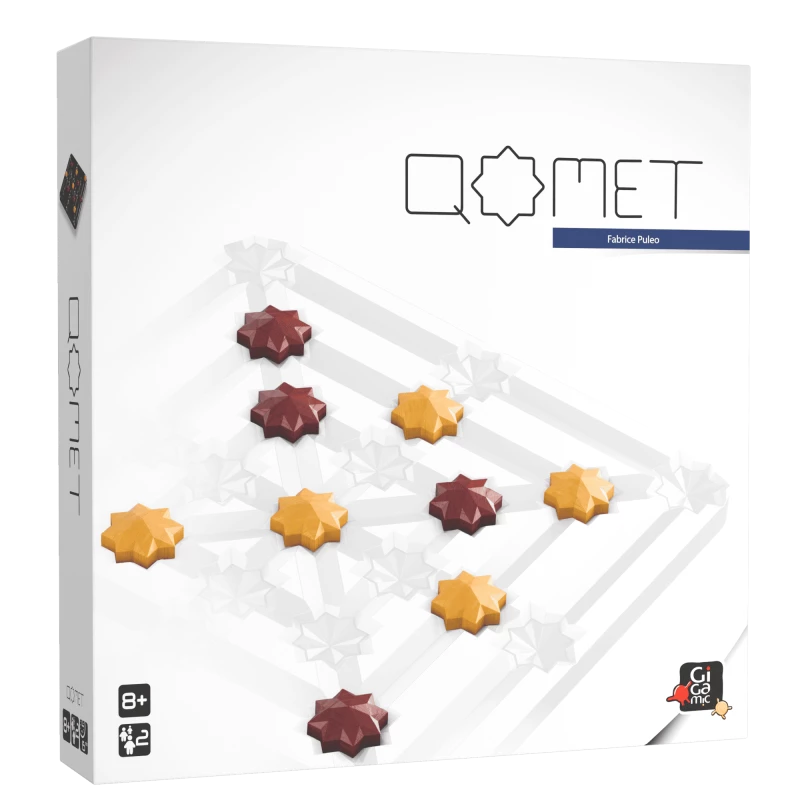
 I love abstract games. Don’t get me wrong, I enjoy a game with a beautiful engaging theme too, but there’s something about a geometric board and some simple, purely strategic gameplay that gets me going. Now, theres many classic games in this category, such as Draughts, Go and Chess, but amongst the newer titles in the field, Gigamic have made a real name for themselves with their Q range; Quorridor, Quarto, Quwale and several others. Qomet is their newest entry, another 15 minute tactical puzzler for two players.
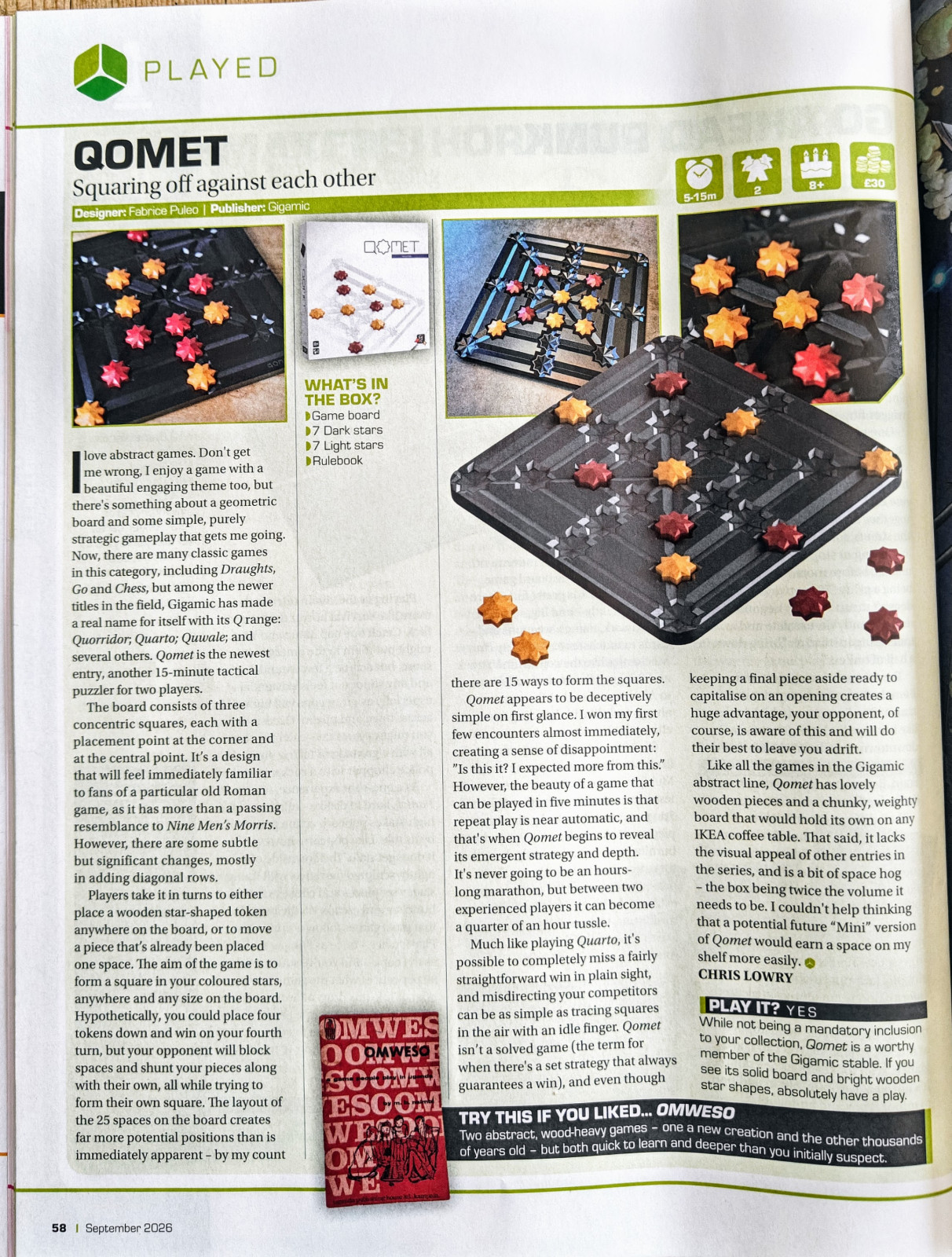
The board consists of three concentric squares, each with a placement point at the corner and at the central point. It’s a design that will feel immediately familiar to any fans of a particular old Roman game—it has more than a passing resemblance to Nine Men’s Morris, although there are some subtle but significant changes, mostly in adding diagonal rows.
Each player takes one colour of wooden star-shaped tokens, and then take it in turns to either place one anywhere on the board, or to move an already placed piece one space. The aim of the game is to form a square in your coloured stars, anywhere on the board. Hypothetically, you could just place four tokens down and win on your fourth turn; but your opponent will be blocking spaces and shunting your pieces along with their own, all whilst trying to form their own squares. The layout of the twenty-five spaces on the board means there are far more potential positions than is immediately apparent—by my count there are fifteen ways to form a square.
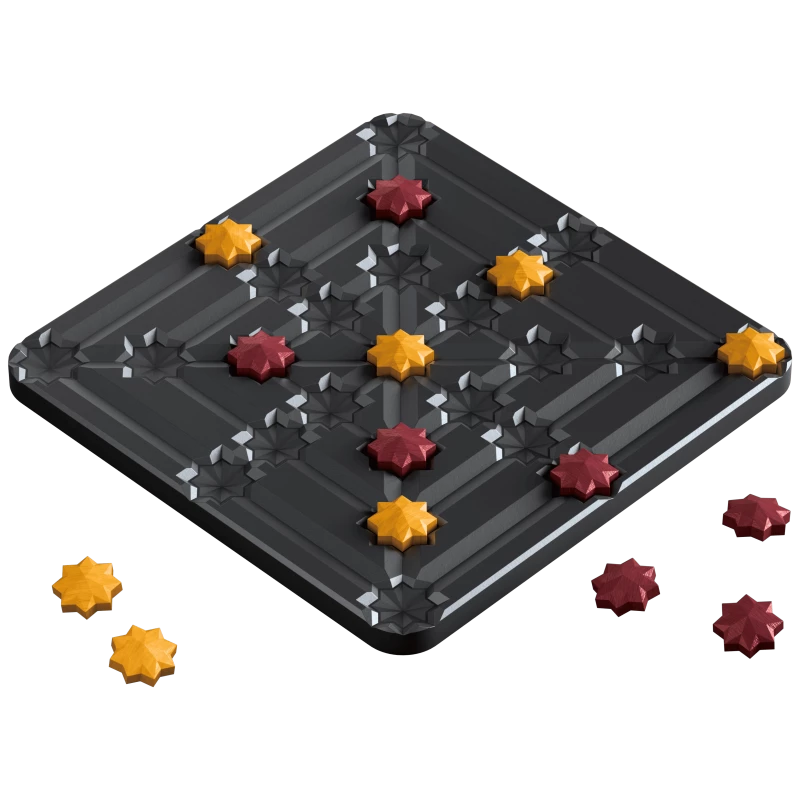 Qomet appears to be deceptively simple. My first few encounters I won almost immediately, and felt a sense of disappointment—”Is this it? I expected more from this”. However, the beauty of a game-length of 5 minutes is that repeat play is near automatic, and it’s at this point Qomet reveals its emergent strategy and depth. It’s never going to be an hours-long marathon, but between experienced players it can certainly become a quarter of an hour tussle.
Much like Quarto, it’s very possible to somehow completely miss a completely straightforward win in plain sight, and it’s misdirecting your competitors can be as simple as tracing squares in the air with an idle finger. It’s not a solved game (the term for when there’s a set strategy that always guarantees a win), and even though there’s a huge advantage in keeping a final piece aside ready to capitalise on an opening, your opponent, of course, also knows this and will do their best to leave you adrift
Like all the Gigamic abstract line, Qomet has lovely wooden pieces and a chunky, weighty board that would hold its own on any IKEA coffee table. That said, it’s not quite got the visual appeal of the rest of the series, and feels like a bit of space hog—the box is twice the volume it needs to be. In debating whether to have this as part of my collection, I couldn’t help thinking that a potential future “Mini” version would earn Qomet a space on your shelf much better. Ultimately Qomet stands up on its own as a worthy member of the Gigamic stable, but I’m not sure it’s quite good enough to rate mandatory inclusion to your set.
PLAY IT? YES
If you see this sleek board and bright wooden star shapes on a coffee table, absolutely have a play, but it’s also not something you need to seek out unless those sort of games really grab you.
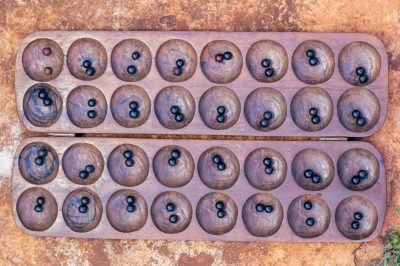 TRY THIS IF YOU liked Omweso…
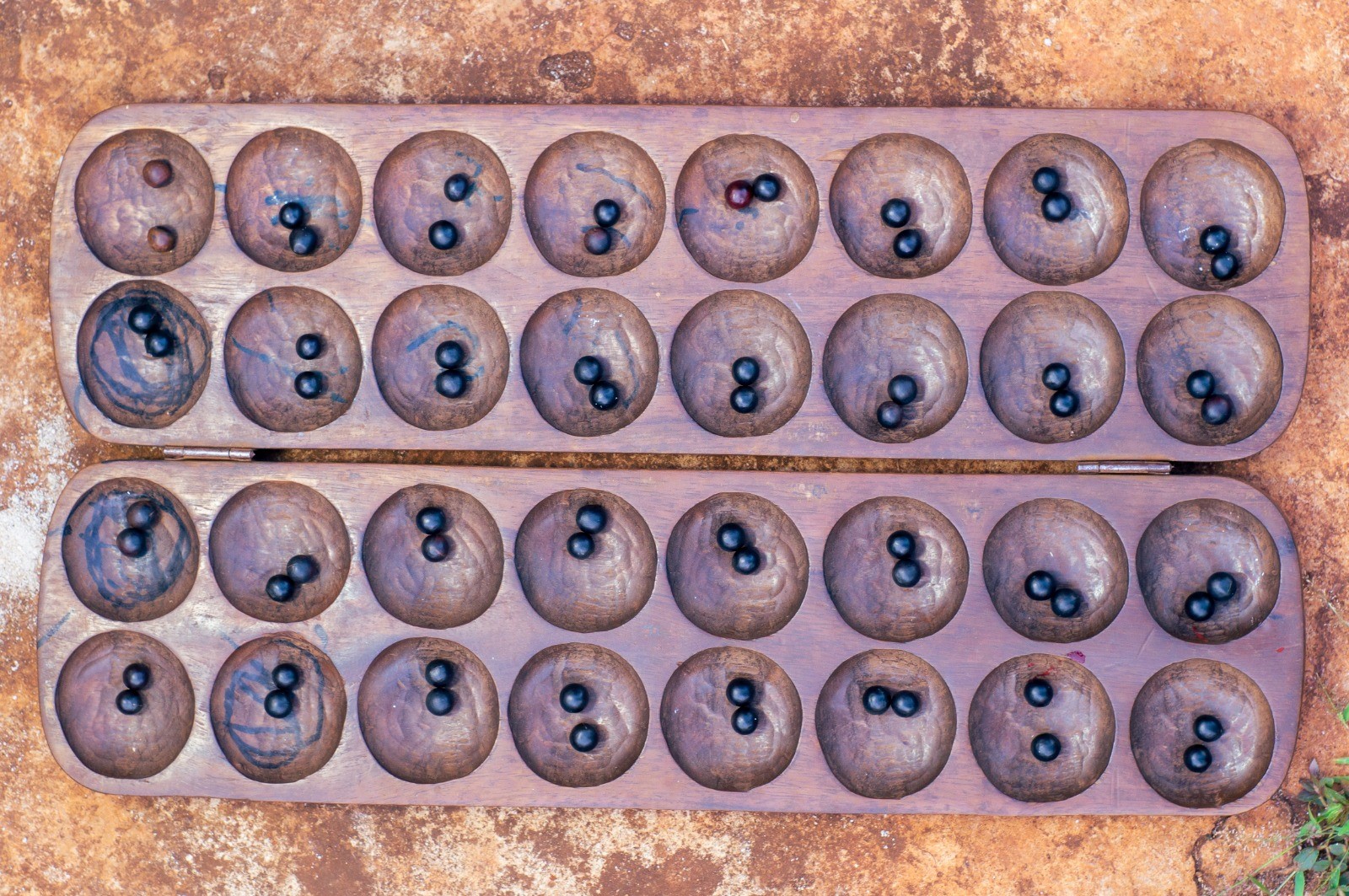
…Two abstract wood-heavy games, one a new creation and the other thousands of years old. Omweso might be an East African variant from the traditonal Mancala family, but both Omweso and Qomet are quick to learn and deeper than you initially suspect.
| About QOMET | |
|---|---|
| Designer | Fabrice Puleo |
| Publisher | Gigamic |
| Playcount | 2 players |
| Age | 8+ |
| Price | £30 |
| Contents | - 7 Dark stars - 7 Light stars - Board - Rulebook |
| Rating | Yes |
A review written for Tabletop Gaming Magazine. Magazine page copyright to TTG Magazine 2026.