
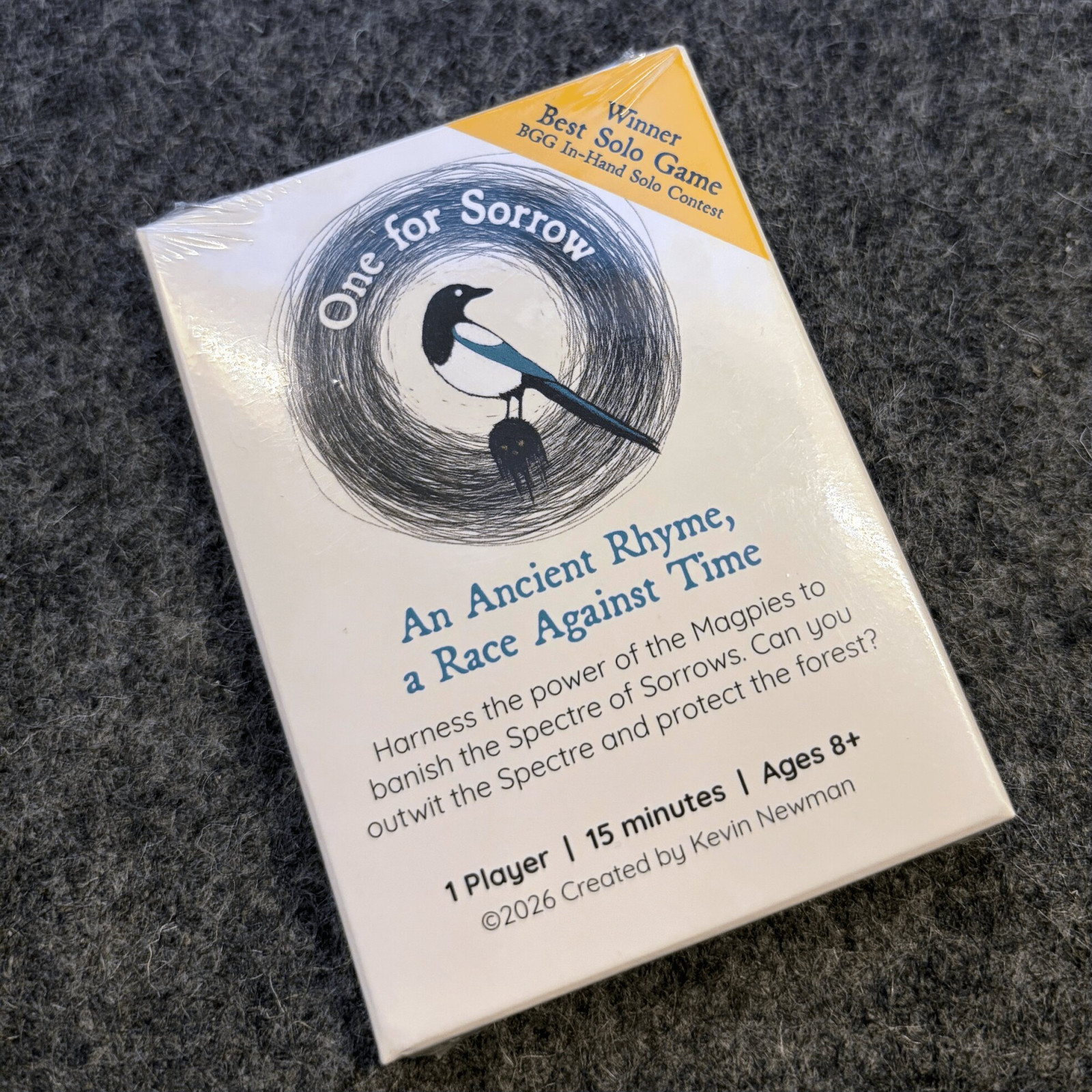
 There’s an old nursery rhyme about magpies and superstition. There are many variants, but the most common goes “One for sorrow, Two for joy, Three for a girl, Four for a boy…”, and was used to predict fortune and favour—as well as potential future child gender, apparently.
One For Sorrow the game lightly retreads the theme here, adding all the numbers to reach the even more spine-curdling heights of thirteen—”Thirteen beware, it’s the devil himself”. The aim is simple; rearrange the birds in number order before the Spectre of Sorrows can destroy the forest (and, if the rhyme is to be believed, possibly before birds can definitively impact on embryonic sex chromosomes, although the rulebook doesn’t cover that).
Setup involves putting the cards in random order. Alongside the numbered magpie cards there are four tree cards, and the red Spectre of Sorrows card which goes on the bottom. All cards are rotated or flipped until they have a black triangle visible in the top right corner, which is a neat visual marker that makes setup a breeze.
You play by flipping over the first bird, and deciding whether to use its “ability”. That might be “Flip a card over” or “Rearrange the bottom four cards of the deck”. Choosing to use the card involves rotating it 180 degrees. The bird cards are vertically mirrored, with a few minor changes; the swapped edge might have a different ability. It also takes away one of your star points from the end of the game, so ideally you win whilst using as few abilities as possible.
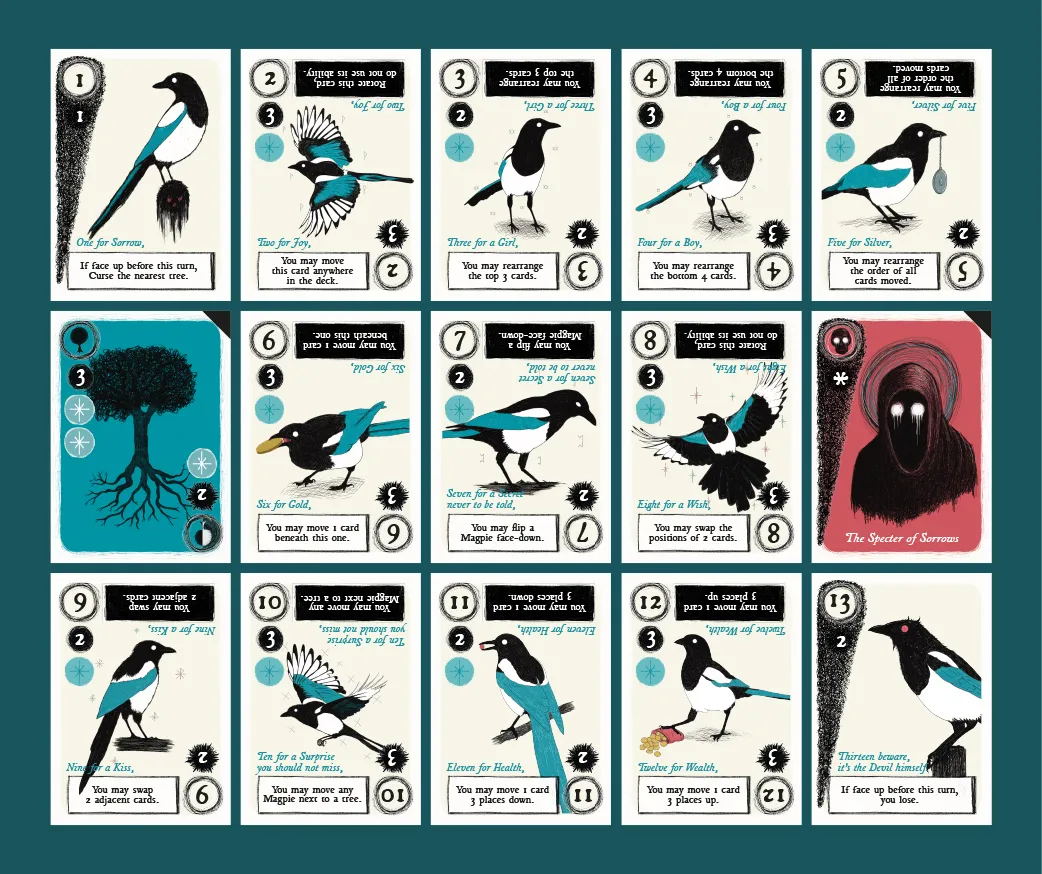
Where One for Sorrow really stands out is that it’s an entirely deck-in-hand game. You don’t lay anything out on a table, but hold the deck in your palm and slowly flip through it. Once you’ve used an ability, you move a number of cards through to the bottom of the pile, based on the “fly number” written on the top card or the one below it.
If the Spectre of Sorrows ever reaches the top of the deck, it curses the nearest tree, turning it first upside down, then the next time flipping it over. If all four trees end up fully flipped over, the forest is dead and you have lost the game. If you can get all thirteen magpies in order, you’ve instantly won; add up the remaining visible stars for your score.
One for Sorrow is thus a game of hand management and careful card manipulation. With so few cards it’s possible to keep a close eye on where the Spectre card is, and to take every opportunity to move it back down the deck. You quickly become familiar with abilities: some you dread, whilst others arrive just in time to be your saviour.
The game comes in a slim paper wallet, and consists of just eighteen cards, and yet I don’t think I’ve played a card game this innovative or moreish for quite a while. There’s something so incredibly portable about such a tricky little game needing no table space at all, and given that the monthly Button Shy wallet games are the same eighteen card size, it’s quite remarkable for Kevin Newman to be producing something that still manages to be so mechanically unique.
You may not want to replay One for Sorrow indefinitely, but it’s devilishly difficult, so you will definitely want to revisit it several times. The artwork and typography is simple and evocative, creating an experience of play that is a joy.
PLAY IT? YES
Not every game has to be a behemoth; One for Sorrow is a tiny, tatisfying brain tease, and it’ll reward you with far more fun than its size suggests.
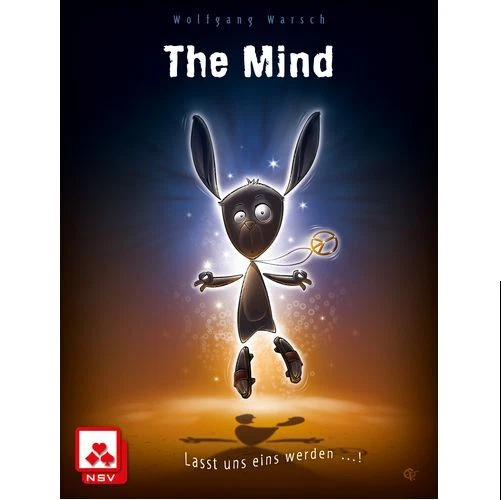 TRY THIS IF YOU liked The Mind…
…Very different games, but if esoteric game design and numerical order are your sort of thing, then there’s plenty of shared DNA between the two.
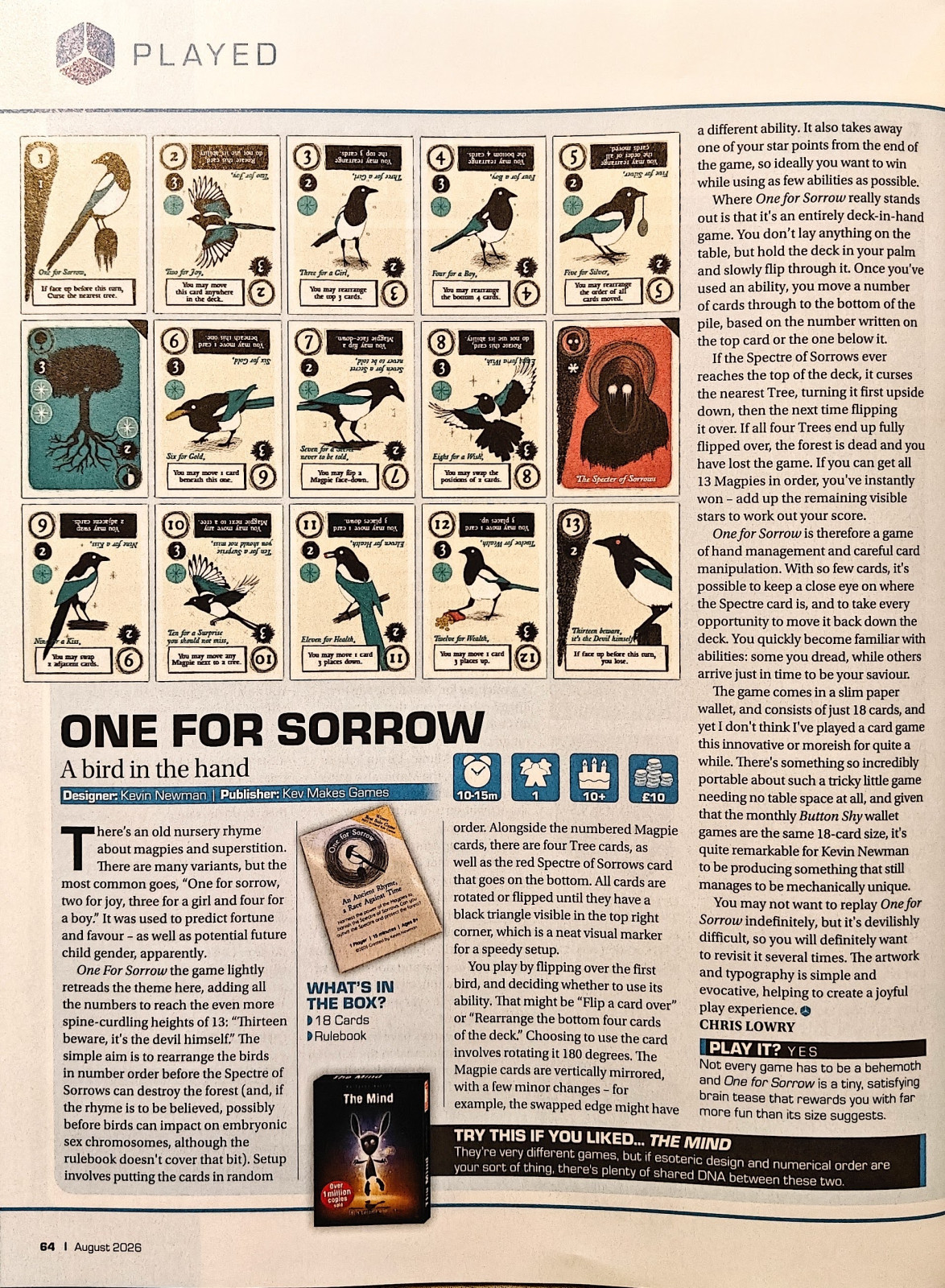
| About One for Sorrow | |
|---|---|
| Designer | Kevin Newman |
| Publisher | Kev Makes Games |
| Playcount | 1 |
| Age | 10+ |
| Price | £10 |
| Contents |
|
| Rating | Yes |
A review written for Tabletop Gaming Magazine. Magazine page copyright to TTG Magazine 2026.