
Power Plants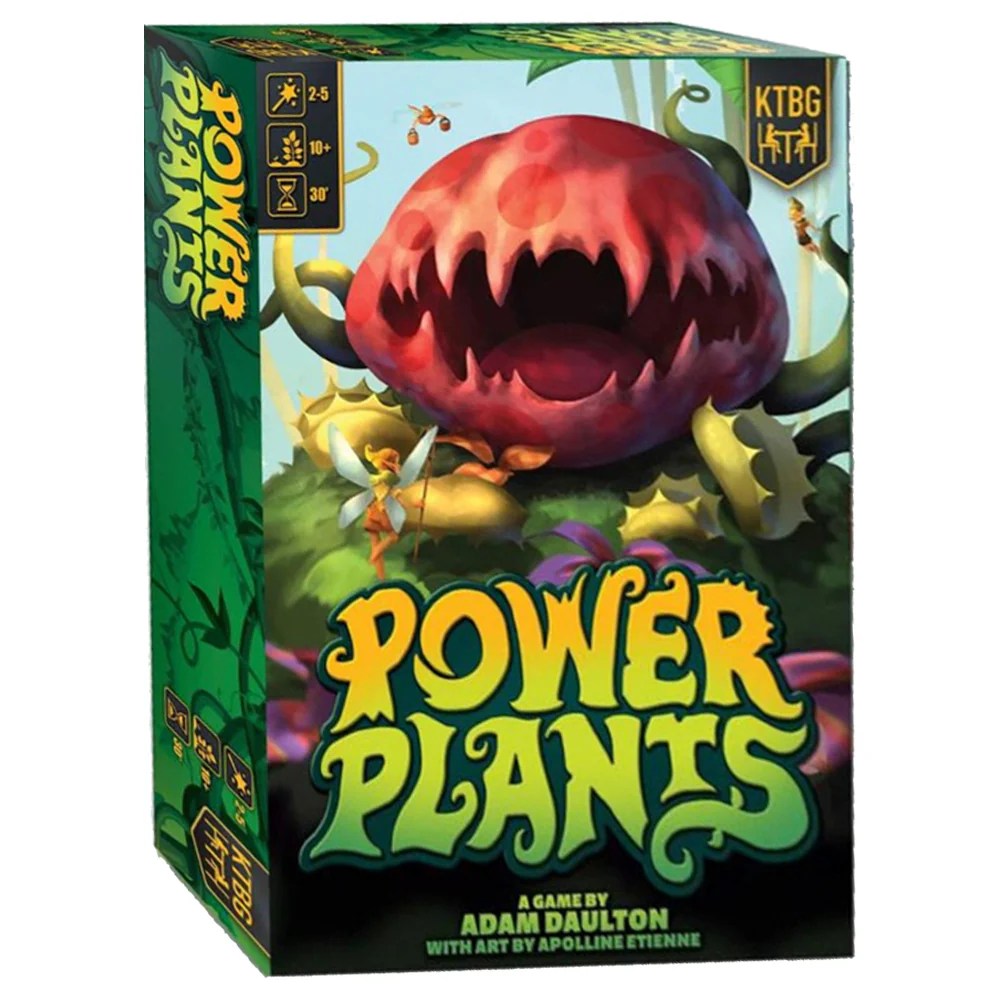
I’m not particularly green fingered, if I’m honest. My last concerted attempt to grow anything involved chilli plants, and, well, let’s just say that after spending £50 on the project and most of a year’s hard work, there were less than fifty grams of chillies to show for my effort. And they weren’t even very spicy!
I’m much more excited about fictitious plant life. Especially when it comes bedded into such a beautiful package. Power Plants is one of those games that reminds you why the invention of wooden playing pieces was such a game changer.
The core of the game involves laying brightly coloured patch tiles onto the table. These tiles could easily just have been hexagons – that would have been perfectly understandable – but instead these are just slightly curved and pointed, creating a very appealing visual flourish, one that still tesselates beautifully whilst gaining an organic overtone. There is a non-deluxe version of the game available, with cardboard patches. Don’t do it to yourself! Always go for chunky and satisfying, at least when it comes to wooden playing pieces.
After laying a patch, each player moves the wizard token on top, and then chooses whether to Sprout the placed patch, or to Grow the patches adjacent to it. The Sprout powers are typically stronger; for example, Sprout might allow players to add two sprites to a patch, whereas Grow would only add one. However, the advantage of Grow is that you activate multiple patches in turn, using the less strong powers, but using two, three or even four of them.
Players take turns to place a new patch and activate patches, slowly building fields of matching patches. When the last patch leaves the dark green draw bag, every player takes one final turn, then field points are awarded.
One element I really enjoy in Power Plants is in how places are awarded for fields. You win a field based on the number of individual patches you have sprites on, rather than the total number of sprites. So one player might have pushed to have four sprites on a patch, only to see another player sneak just one onto two different patches, winning the field. Ties are settled by who has the lowest numbered patch. It gives players only a fragile grasp of territory, and doesn’t necessarily reward the effort in stockpiling lots of sprites in one position. It reminded me a little of Marrrakesh; but in that carpet-laying classic I feel one’s hold is too tenuous – ownership of the entire board can seemingly change over a single round – whereas Power Plants managed more to make it so that you can never be truly confident you’ve conquered a field.
To nit-pick, with some games we did wonder if going last lends too strong an advantage – although finished players are given a gem bonus for each of their sprites removed after their last turn. Also, having introduced a number of new players to the game, the activate-one-tile-or-those-touching-it concept is one that takes some time for people to get their head around. My wife said to me, on her third game, “I still don’t actually get it”. It’s more a feature of novel ideas than innate complexity though; my six year old picked up the concept almost immediately.
The box includes eight patch types, with alternate plant types for each. Given that a maximum of five are used per game, sixteen options gives nearly infinite variability, and also allows tailoring for more aggressive take-that interaction levels if your gaming group is that way inclined. Admittedly the deluxe version is a little pricey, but personally I think the nicer components are worth the extra expense, and the game is likely to last you.
PLAY IT? YES
Massive amount of replayability alongside a plant-salad approach to point scoring. The component quality elevates a fun, thematic game into the realm of tactile treat.
TRY THIS IF YOU liked Explorers…
…both have an endless amount of variability, and fit reliably into a 20-30 minute play time. There’s a lot to be said for games that don’t outstay their welcome. I think Power Plants is stronger, but both have just enough crunch to be satisfying.
| About Power Plants | |
|---|---|
| Designer | Adam E. Daulton |
| Publisher | Kids Table Board Games |
| Playcount | 1-5 Players |
| Age | Age 8+ |
| Price | £53 |
| Contents |
|
| Rating | Yes |
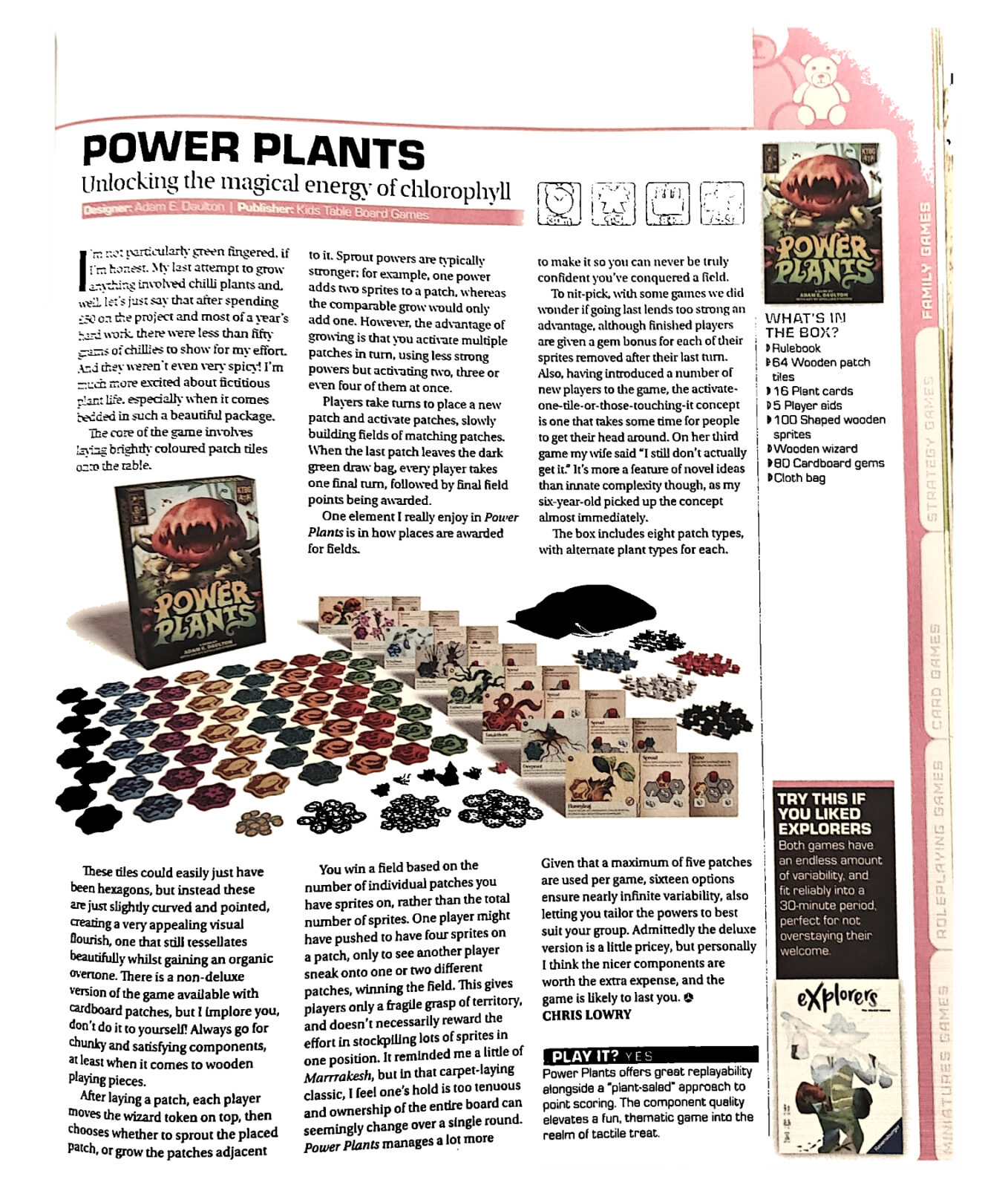
A review written for Tabletop Gaming Magazine. Magazine page copyright to TTG Magazine 2021.