
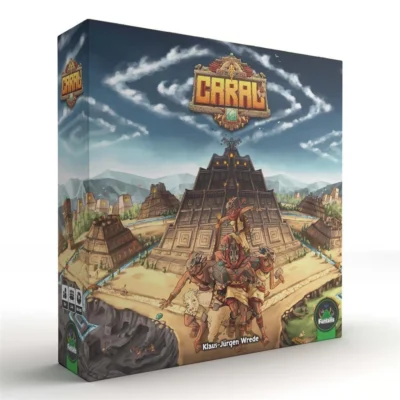
Building pyramids is hard work. Doing it whilst also having to prep for an annual sacrifice to the Gods? Exhausting. The final straw for me is the relentless race to build these triangular edifices faster than all my opponents. It’s just too much, really.
Caral – as I think will not surprise you now – is a game about building pyramids faster than everyone else, whilst also fixing for frustratingly frequent annual ceremonies. It’s designed by Klaus-Jürgen Wrede – yes, that Klaus-Jürgen Wrede – creator of Carcassonne. That provides it with a near-automatic approval, but also a lot to live up to.
The core mechanic is unique and compelling. Players compete as fame-hungry master builders, trying to build pyramids as they work in a spiral path around the board. Each controls an alpaca-powered sled, filling them with stone blocks at quarries and dragging them to building sites. Action spaces around the board allow you to add workers to quarries and building sites, get more alpacas (the alpaca meeples are pretty awesome) and pick up cards.
The mysterious Architect moves in an unpredictable shuffle behind the players, circling down the spiral and preventing any actions further out. This means players must choose between building in the outer rings, or rushing ahead to the inner areas. Moving quickly lets you reach the central pyramid first, and take first shot at choosing a sacrifice for the annual ceremony; but it also means you’ve spent less time actually, you know, building pyramids in a game all about building pyramids.
The annual ceremony requires each player to make a sacrifice of cards; either fish, bricks, stone or clay. Each type can only be sacrificed once; so going fourth in a four player game leaves you with only one option. No suitable cards? Lose a fame point.
Acceptable sacrifices get their player a bonus point, and the best sacrifice takes extra points on top of that, and gets control of the Architect’s dice in the following year-round. As the central pyramid rises in height, bonus fame for the best sacrifice ramps up, creating exactly the right sort of tension; just as you need to focus on building pyramids for the end-game, you are also having to worry even more about stockpiling cards for the annual ceremony. The fact that burning cards gives bonuses to building tightens the challenge even further.
This clash is almost perfect balanced, and allows for lots of experimentation. It’s absolutely not possible to win without building pyramids, but I’m not convinced you can take the top spot without a little bouncing straight to the ceremony either too.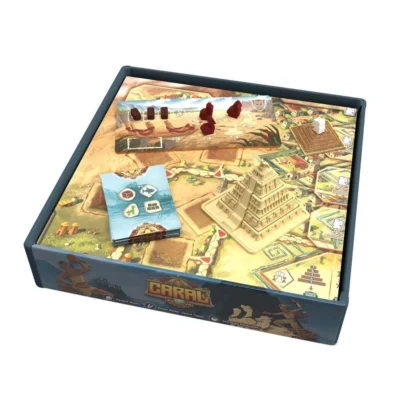
There is one aspect to Caral I absolutely love; it includes a huge bunch of quality expansion modules in the box. Some are tiny, adding little twists and turns: Status Cards are one-off bonuses awarded to first achievements; Whim of the Gods makes the annual ceremony more complex, requiring collaborative planning between players; The Anaconda blocks an action tile – and eats alpacas! Others are more substantial: the Emissaries board adds a whole new area for competition and meeple placement, but all in a manner that immediately makes sense within the familiar framework of the core game.
If you enjoy Caral, the additional modules are masterful, frankly. They add long range planning, swinginess or just general variety; enough to increase the longevity of a game you love. So many games, especially Kickstarters, shoehorn terrible “exclusive” expansions that only serve to spoil an otherwise great game (glaring directly at you, Domination). That’s absolutely not the case here.
On the downside? Well, the rulebook is reasonable, but still somehow weightier and less clear than it could be. Our first game took much too long, as we thought the end goal was for each player to complete seven pyramids; rather than building seven between us. This led to us running out of pieces and having about 5 rounds longer than the game is designed for. On the one hand, that’s our error; on the other, I’m a professional board game reviewer and still missed that point – how will less experienced gamers fare?
This game also takes up A LOT of table, and I’m not sure it respects the area it demands. The action tiles, for some reason, are off-centred on the spiral track, meaning that we all regularly got confused about which ring we were on. Why aren’t they centred? There doesn’t seem any real artistic reason, but it does hurt useability. There’s lots of blank area too; I played the non-deluxe version, with cardboard pyramids, and would have preferred a board literally half the size. If it had been littered with the deluxe version’s epic 3D plastic edifices, then yes, a board nine metres wide would have been reasonable, but Caral’s board is slightly shoddy design and a wasted opportunity
Should you play Caral? Definitely. Should you buy it? Harder to say. If the theme speaks to you, or if you enjoy something a little dry [unintentional desert pun] but with a unique mechanic that will be challenge to fully master; Caral is the game for you.
PLAY IT? YES
I’m not sure I’ve ever played anything quite like it before, and there’s something quite more-ish about the bite-sized expansions. “Let’s just play it once more, but let’s add in the Anaconda this time…”
TRY THIS IF YOU liked Welcome To…
…A completely different genre and game, but Welcome To offers the ability to build a little kingdom with your choices absolutely curtailed by events outside your control. Caral’s constantly constricting Architect evokes similar emotions in me.
| About Caral | |
|---|---|
| Designer | Klaus-Jürgen Wrede |
| Publisher | Funtails |
| Playcount | 2-4 Players |
| Age | Age 12+ |
| Price | £65 |
| Contents |
|
| Rating | Yes |
A review written for Tabletop Gaming Magazine. Magazine page copyright to TTG Magazine 2021.