
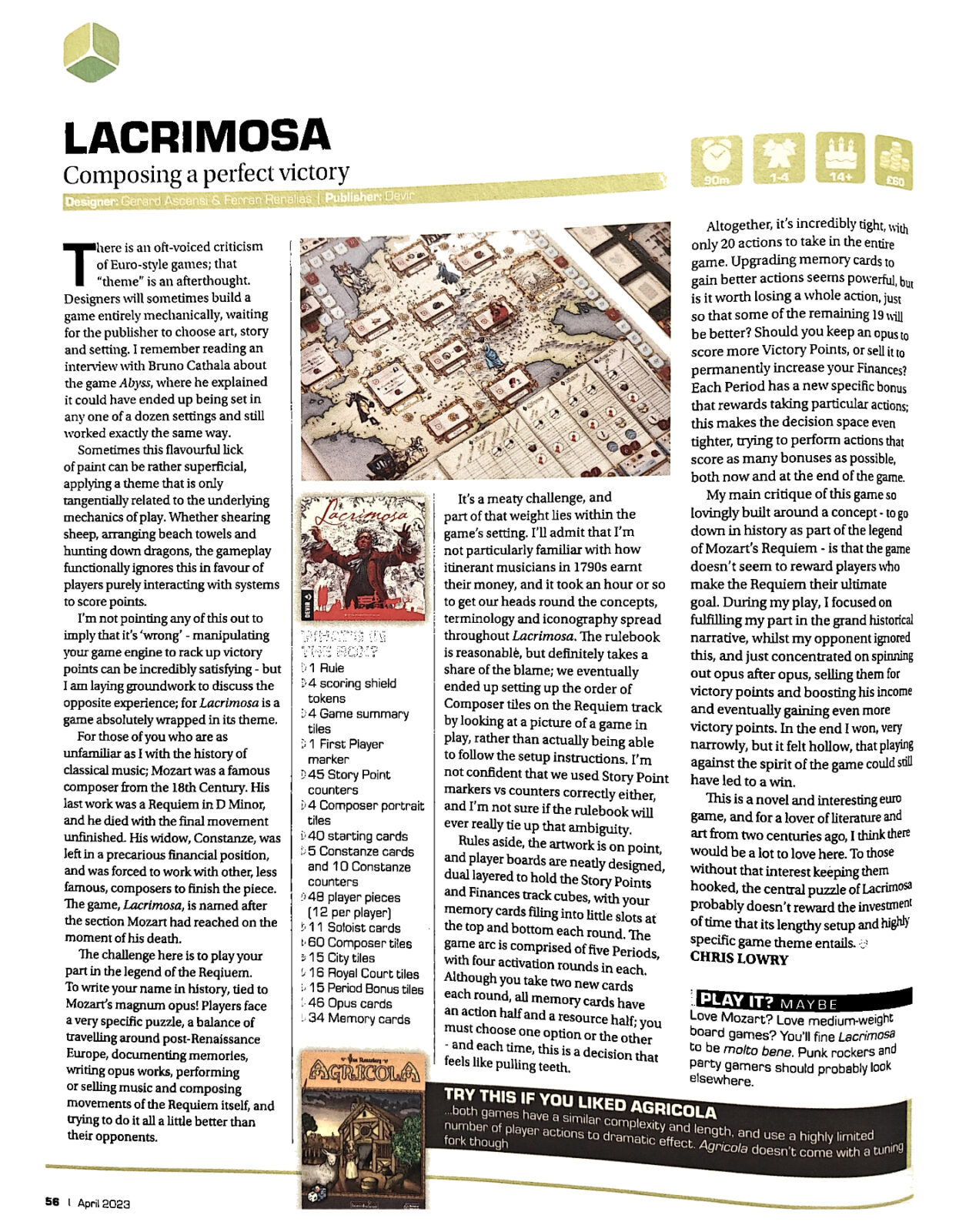
There is an oft-voiced criticism of Euro-style games; that “theme” is an afterthought. Designers will sometimes build a game entirely mechanically, waiting for the publisher to choose art, story and setting. I remember reading an interview with Bruno Cathala about the game Abyss, where he explained it could have ended up being set in any one of a dozen settings and still worked exactly the same way.
Sometimes this flavourful lick of paint can be rather superficial, applying a theme that is only tangentially related to the underlying mechanics of play. Whether shearing sheep, arranging beach towels and hunting down dragons, the gameplay functionally ignores this in favour of players purely interacting with systems to score points.
I’m not pointing any of this out to imply that it’s ‘wrong’ – manipulating your game engine to rack up victory points can be incredibly satisfying – but I am laying groundwork to discuss the opposite experience; for Lacrimosa is a game absolutely wrapped in its theme.
For those of you who are as unfamiliar as I with the history of classical music; Mozart was a famous composer from the 18th Century. His last work was a Requiem in D Minor, and he died with the final movement unfinished. His widow, Constanze, was left in a precarious financial position, and was forced to work with other, less famous, composers to finish the piece. The game, Lacrimosa, is named after the section Mozart had reached on the moment of his death.
The challenge here is to play your part in the legend of the Reqiuem. To write your name in history, tied to Mozart’s magnum opus! Players face a very specific puzzle, a balance of travelling around post-Renaissance Europe, documenting memories, writing opus works, performing or selling music and composing movements of the Requiem itself, and trying to do it all a little better than their opponents.
It’s a meaty challenge, and part of that weight lies within the game’s setting. I’ll admit that I’m not particularly familiar with how itinerant musicians in 1790s earnt their money, and it took an hour or so to get our heads round the concepts, terminology and iconography spread throughout Lacrimosa. The rulebook is reasonable, but definitely takes a share of the blame; we eventually ended up setting up the order of Composer tiles on the Requiem track by looking at a picture of a game in play, rather than actually being able to follow the setup instructions. I’m not confident that we used Story Point markers vs counters correctly either, and I’m not sure if the rulebook will ever really tie up that ambiguity.
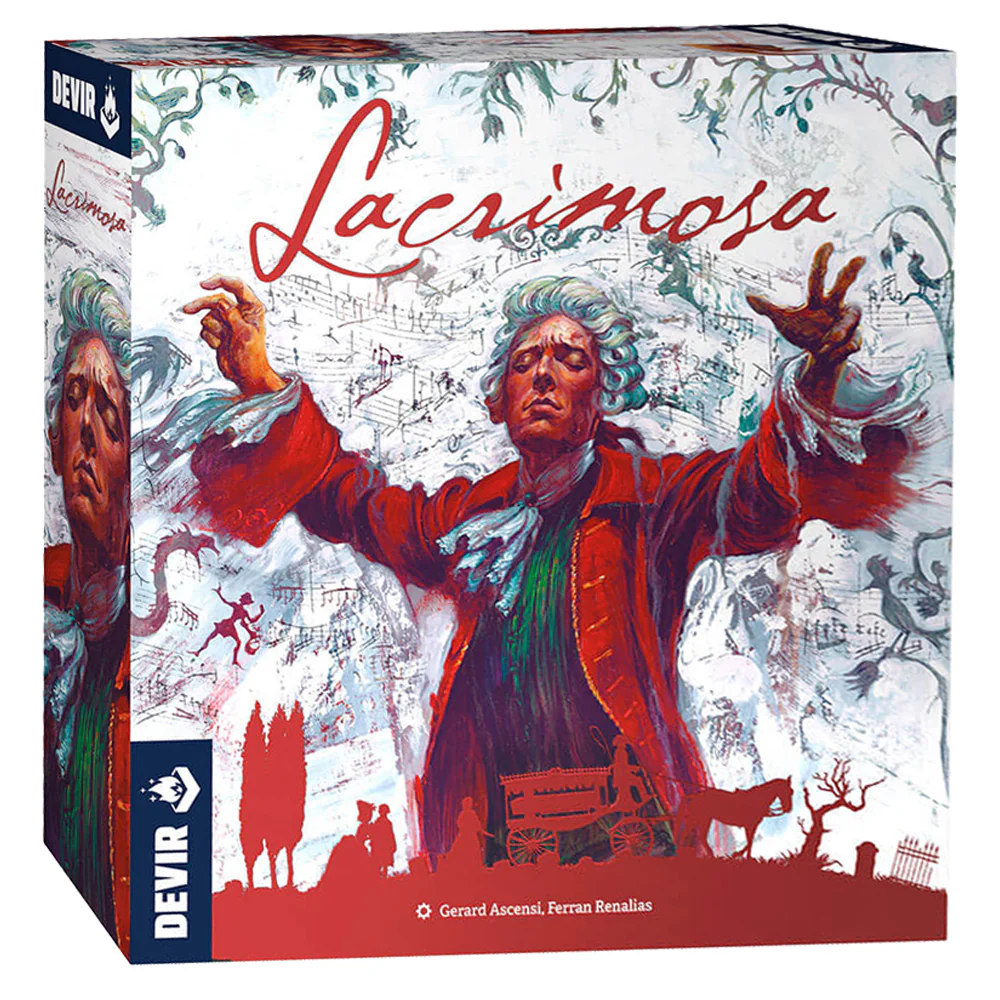
Rules aside, the artwork is on point, and player boards are neatly designed, dual layered to hold the Story Points and Finances track cubes, with your memory cards filing into little slots at the top and bottom each round. The game arc is comprised of five Periods, with four activation rounds in each. Although you take two new cards each round, all memory cards have an action half and a resource half; you must choose one option or the other – and each time, this is a decision that feels like pulling teeth.
Altogether, it’s incredibly tight, with only 20 actions to take in the entire game. Upgrading memory cards to gain better actions seems powerful, but is it worth losing a whole action, just so that some of the remaining 19 will be better? Should you keep an opus to score more Victory Points, or sell it to permanently increase your Finances? Each Period has a new specific bonus that rewards taking particular actions; this makes the decision space even tighter, trying to perform actions that score as many bonuses as possible, both now and at the end of the game.
My main critique of this game so lovingly built around a concept – to go down in history as part of the legend of Mozart’s Requiem – is that the game doesn’t seem to reward players who make the Requiem their ultimate goal. During my play, I focused on fulfilling my part in the grand historical narrative, whilst my opponent ignored this, and just concentrated on spinning out opus after opus, selling them for victory points and boosting his income and eventually gaining even more victory points. In the end I won, very narrowly, but it felt hollow, that playing against the spirit of the game could still have led to a win.
This is a novel and interesting euro game, and for a lover of literature and art from two centuries ago, I think there would be a lot to love here. To those without that interest keeping them hooked, the central puzzle of Lacrimosa probably doesn’t reward the investment of time that its lengthy setup and highly specific game theme entails.
PLAY IT? MAYBE
Love Mozart? Love medium-weight board games? You’ll fine Lacrimosa to be molto bene. Punk rockers and party gamers should probably look elsewhere.
TRY THIS IF YOU liked Agricola…
…both games have a similar complexity and length, and use a highly limited number of player actions to dramatic effect. Agricola doesn’t come with a tuning fork though.
| About Lacrimosa | |
|---|---|
| Designer | Gerard Ascensi & Ferran Renalias |
| Publisher | Devir |
| Playcount | 1-4 Players |
| Age | Age 14+ |
| Price | £60 |
| Contents |
|
| Rating | Must Play |
A review written for Tabletop Gaming Magazine. Magazine page copyright to TTG Magazine 2021.