
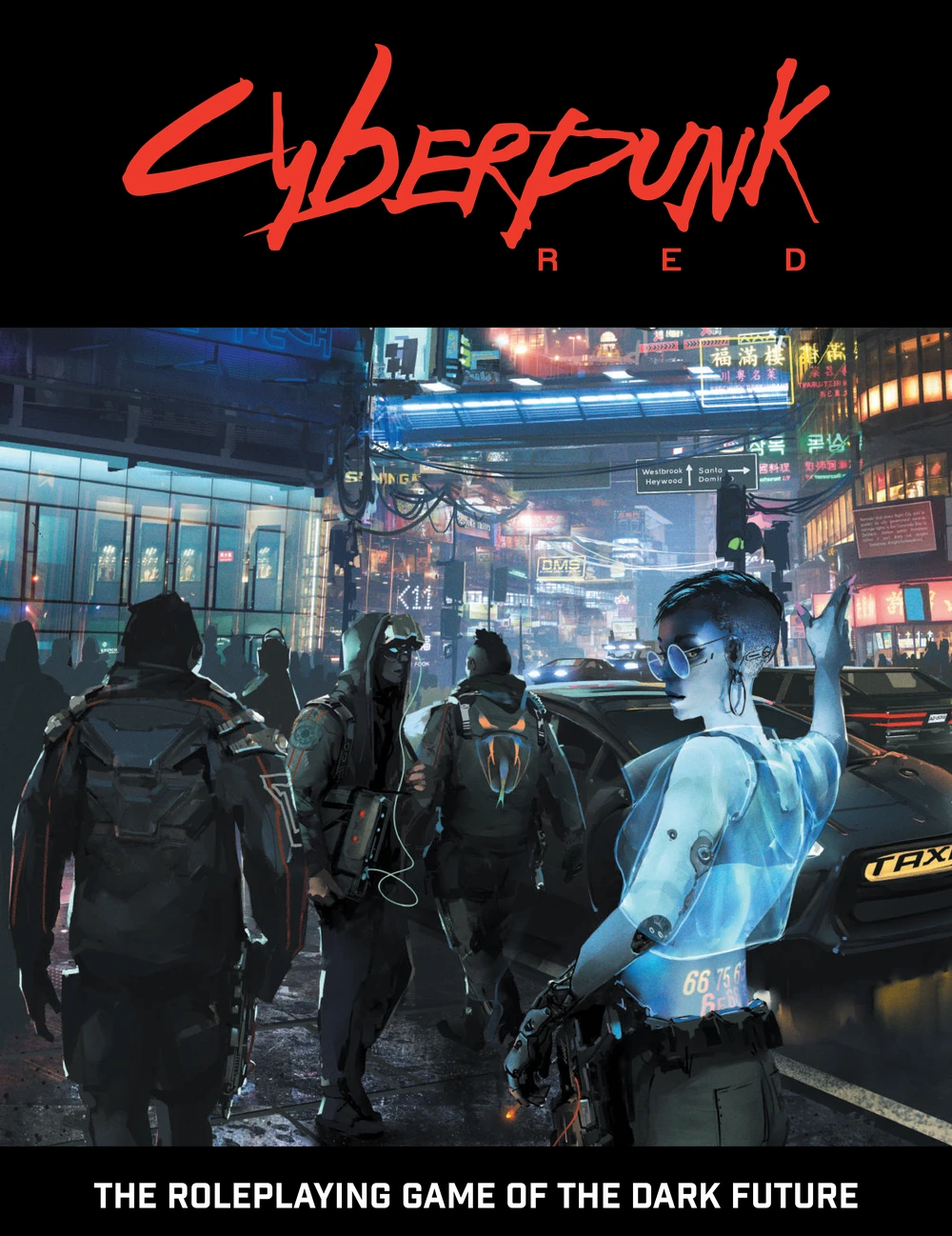
The history of the Cyberpunk series is an interesting one. Cyberpunk RED is technically the fourth edition, following releases in 1988, 1990 and 2005. There are a number of reasons for this, but an amusing one is that the series has always been set in a far-but-not-too-far near future that keeps catching up with reality. So the first edition set the world in 2013; then 2020; then 2030. RED updates this to 2045, giving us twenty more years to invent Aerodyne flying cars and neural interfaces (I think Elon Musk claims to be getting there on both fronts).
The aim of this edition is also to tie in between the events of Cyberpunk 2020 and the timeline of the Cyberpunk 2077 video game. The “RED” comes from the red skies common to the time period as an aftereffect of the 4th Corporate War. The book opens with some excellent writing, setting readers in place with a possibly familiar protagonist; Johnny Silverhand. It immediately sets out a challenge for getting on board with the roleplaying here: try out this sample dialogue, “Look, Rocker. You want to guilt-loop, or you want to get your girl back?”. A spread on Street Slang early on helps to decipher this; and if players get on board you’ll find the table transformed immediately into 2045. Someone’s dead? Now they’re “flatlined”. A boyfriend? Now they’re an “output”. The opposite is true as well though; falling into the lingo might feel like a scary challenge to the less confident.
Matching this are three rules for characters to live by: “Style over substance”, “Attitude is everything” and “Live on the edge”. Character creation uses a full life path system, akin to games like Traveller; and the level of detail is spot on for me. It’s full of hooks, but without being horribly weighty. It also manages to immediately create a character who feels lived in: asking “What’s your workplace like?”, a reply such as “A booth in a local bar” or “An otherwise abandoned building” dollops some flavour without becoming taxing for those who struggle at spontaneity. You also choose a role, such as a Netrunner or a Fixer, which adds style and direction, whilst also granting you a specific role ability. Some of these are pretty fun, like the Lawman role, which lets you call in a backup squad when things go south.
Mechanically, all characters use ten stats, thematically fitting with the d10 system. These are all relatively predictable; TECHnique is used for manipulating tools or instruments, BODY is your physical toughness, DEX for dexterity, and so on. My favourite of these is definitely COOL, which would probably be called charisma in other systems, but here represents just how well you pull off that fluorescent green mohawk. These are also the foundation for skills such as “First Aid”, based on TECH, and “Persuasion”, based on COOL. I found the derivative stats pretty intuitive, which is good, partly because that means they’ve been thought out well, but also nothing in the book puts them all into a single alphabetical order list, making reference slow and a little annoying. Building stats and skills has three options, all the way from a single roll for assigning a pre-generated set to manually picking all the numbers one-by-one. Choosing directly is weirdly specific—players get 82 points for skills and 62 for stats—and this is not only time Cyberpunk RED insists on unusual numbers you’ll never remember without a reference.
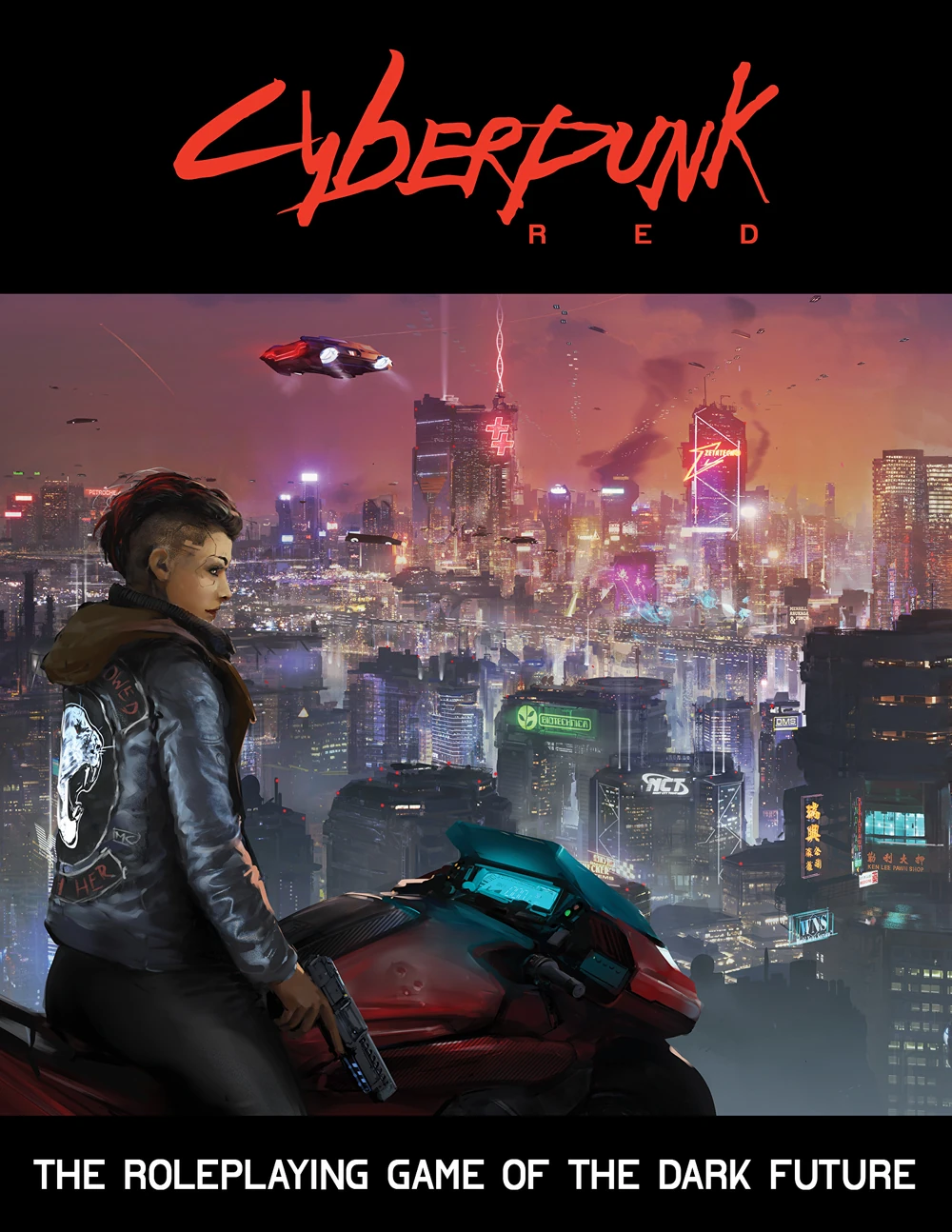 Most checks follow a pleasingly simple formula: Stat + Skill + 1d10. Whether this score meets a Difficulty Value (DV) determines success. Now, players familiar with Cyberpunk 2020 acknowledge that it was “of its time” (ie. a bit tediously crunchy), and RED has made huge strides towards simplicity, although it still loses itself in the weeds at points. For example, anyone with a REF (reflex) score of 8 or more can attempt to dodge an incoming exploding grenade, but lower than that they… don’t get to try? Why? Isn’t that the purpose of having a stat, that the people who have it lower can try, but just be much less likely to succeed? Or to grapple, “no Character can make use of a weapon that requires them to use two hands, even if they have more than two hands”. Why? Isn’t that a reason for exactly why you’d want a character with an additional cybernetic arm?! RED also has a rate of fire (ROF) for melee combat, allowing two hits with most weapons. I like the realism of this, less so the way it slows down the back-and-forth of the apparently lightning fast combat it’s trying to emulate. Ranged combat pretty much demands miniatures on a map and open books, since the work involved in memorising that the DV for an assault rifle aiming from 5 metres away is 17, rather than the 13 it would be from 26 metres requires more investment than I’m willing to make. Thankfully ranged combat ROF has been highly simplified from earlier editions*—*at least you no longer roll for each individual bullet in a spray of autofire.
Another significant change from 2020 is the approach taken to hacking, or “Netrunning”. In older versions, teams of PCs would often be separate, with one character in a basement three miles away hacking into a server whilst the rest infiltrated a building. Due to changes in Core Net Infrastructure during the war, all networks are now delocalised; which means RED characters have to physically jack in to buildings where servers are located. This is great because it gives a believable reason to keep parties together—GMing a server hack is hard enough without also splitting the party! The Netrunning itself will feel very familiar to players of Android Netrunner, with the Netrunner using their Interface role ability alongside an array of their own programs that they “rez” to activate. The goal is to hack through servers containing different Black ICE programs—and to complete the Android vibe there’s even a deck of Cyberpunk RED Netrunning cards you can buy to help visualise server runs.
The GM section is explicit that “Cyberpunk is a challenge even for an experienced Gamemaster”. Just because something is hard doesn’t mean its not worthwhile, and this chapter acknowledges the task ahead and attempts to equip you for it. There are great pieces of advice on scripting the game with “Beat Charts”, tips for building PC teams to more naturally respond to events and even individual Player Quizzes to help the GM understand what playstyles they should be catering for. It’s a thoroughly modern approach that understands that an RPG adventure “isn’t GM Storytime, but a collaborative effort that everyone contributes to”.
The Cyberpunk RED corebook isn’t perfect; the index was particularly bad; preparing this review I tried to look up Interface, explosives, checks, servers, ROF, grappling—all of which were inexcusably absent. For a game with so many little twists and specific rulings, the core book needs to be a solid reference manual first and foremost. However, the pre-built adventure seeds were ideal, and the Tales Of The RED Street Stories expansion book provides some real investigative adventures deeply rooted in the world. If you’re looking to jack your games into a system built from the ground up to be cyberpunk, you definitely should give this a try.
PLAY IT? YES
A modern re-imagining of the system that gave us one of the definitive views of what cyberpunk is. Cyberpunk RED is a little clunky at points, but it makes up for it with a sheen of cool ideas, cool haircuts, and experimental interfaces that plug directly into your spinal cord.
 TRY THIS IF YOU liked CY_BORG…

…The two are take different approaches; you may need to decide between the speed and ease of play of CY_BORG, or the deeper character immersion of RED. The best route is probably taking inspiration form one when you play the other.
| About Cyberpunk RED | |
|---|---|
| Designer | David Ackerman & Mike Pondsmith |
| Publisher | R. Talsorian Games |
| Playcount | 2+ Players |
| Age | Age 14+ |
| Price | £45 |
| Contents |
|
| Rating | Yes |
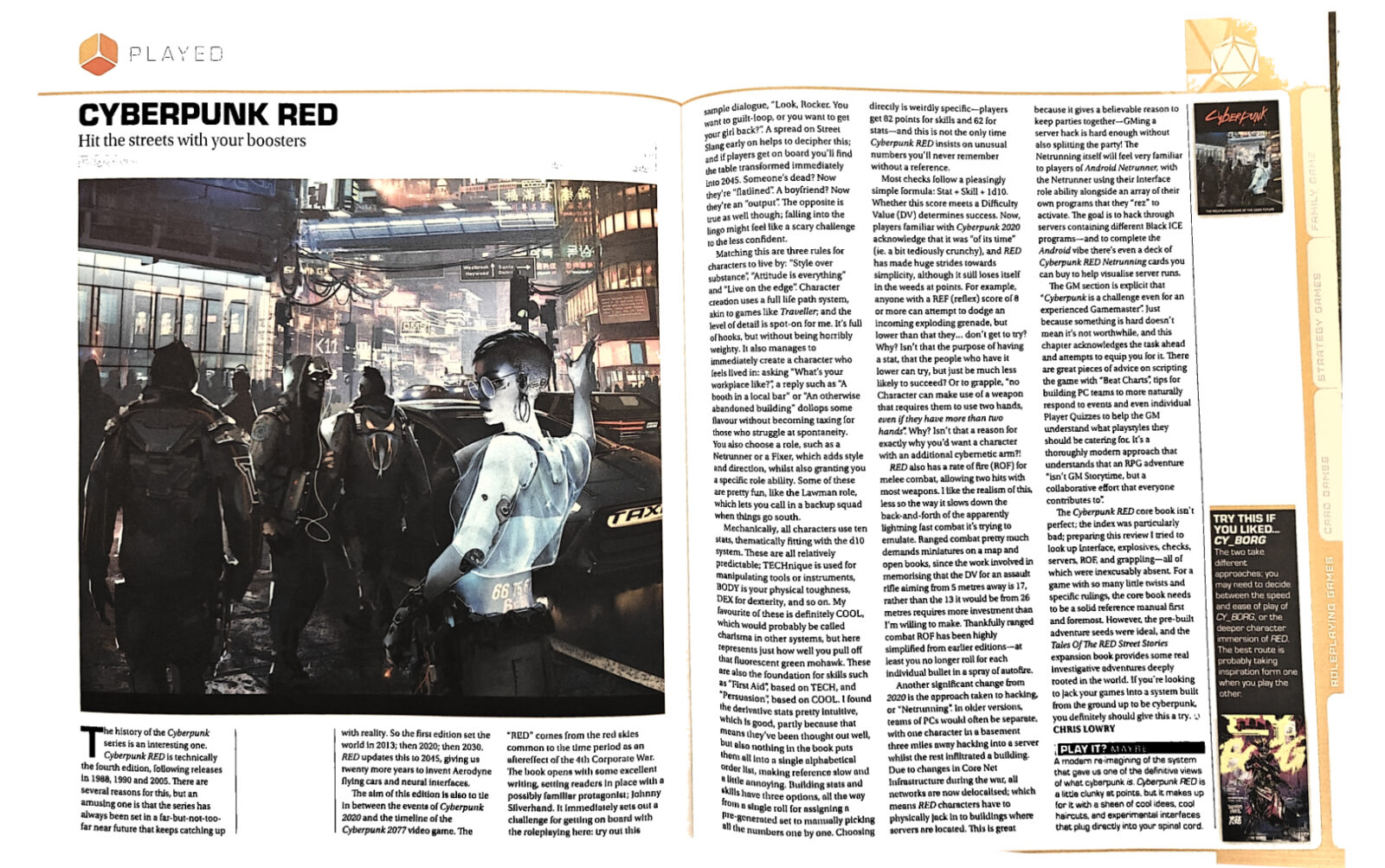
A review written for Tabletop Gaming Magazine. Magazine page copyright to TTG Magazine 2024.