
Depressingly, I’m old enough to remember the 90s. Not brilliantly well, but my early teens were a world of dial-up internet, calling friends from phone boxes and hanging around in parks. If that aimless existence had included DIY laser grenades and hacked-together hover boards, I’d have been absolutely involved. Slugblaster is a roleplay game set in that psychedelic future-past that never happened.
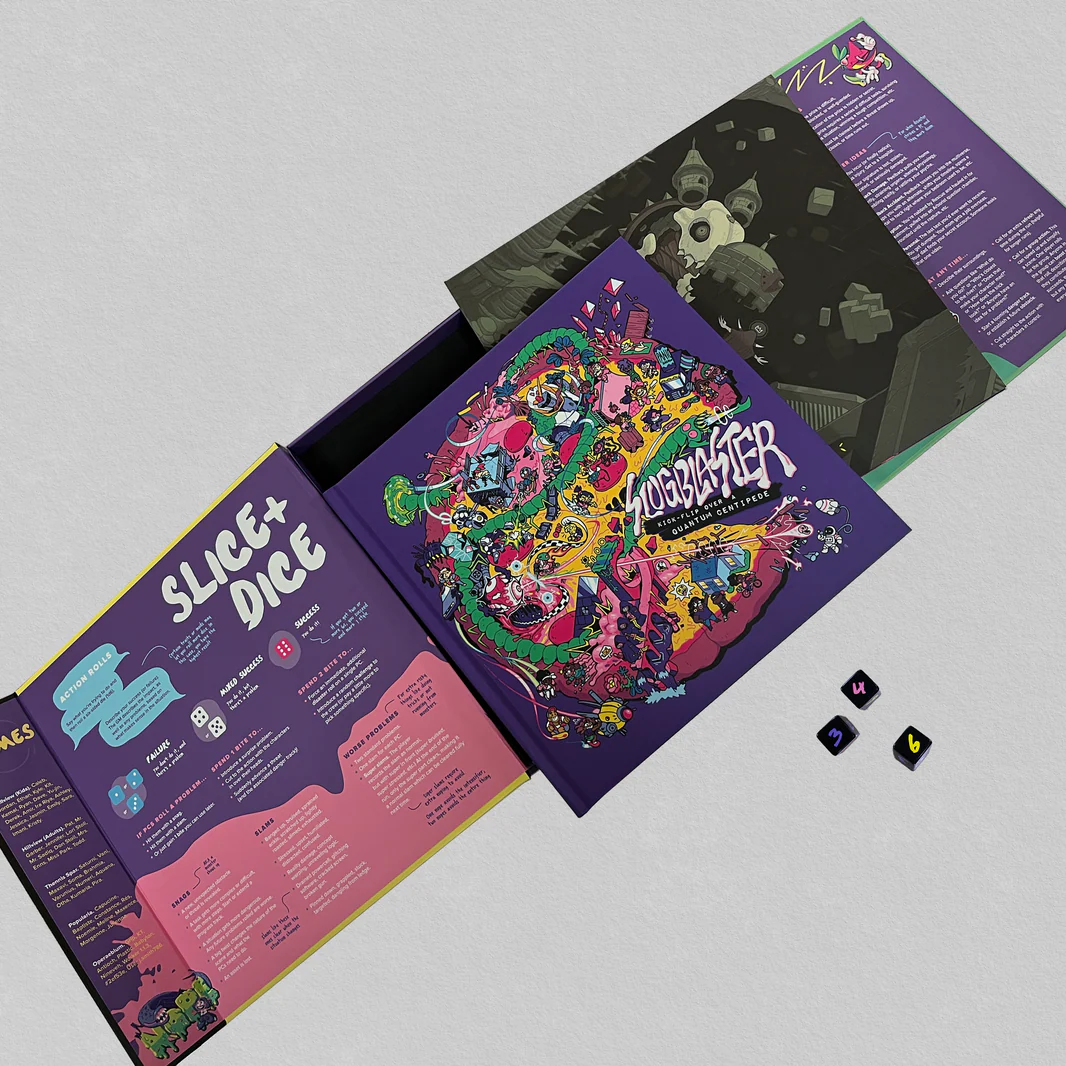
The firm thing that grabs your attention is the unusual shape and wacky colouring of this beautiful game. Square books lay flat on a table much better than A5, and this 9” by 9” colourfeast flops into in the hand perfectly too. The layout, artwork and typography is spot on, hitting hip, wacky and fun without ever landing on cheesy or try-hard; the pieces by Scott A Ford are some of the best illustrations I’ve seen this decade. Every page jumps out at you and works at gravitating you in. I guarantee that if you put this in the hands of literally anyone, they’ll comment on its enticing appearance.
Packaging matters; the visual experience half-teaches you the setting before you read a word. A full page illustration of a teen sneaking in through a window, tentacles climbing the tree behind them, with arm-crossed parents waiting inside? You already know you are going to be dimension-diving one minute and then grounded the next. Slugblaster is very deliberately set in the awkward teenage middle-years – as Mikey Hamm words it, “that time in between, when anything feels possible, everything feels important and nothing feels quite right”. It does it well too, hitting a brighter note than Tales From The Loop, whilst providing a weirder, more full-featured universe to explore than Kids On Bikes.
I loved Tales From The Loop, but I felt that it was a little closed off, storywise. Some may find Slugblaster the opposite; you are dimension-hopping across an endless multiverse; alien ruins, cyberpunk towercities and galactic forest prisons are all equally possible. The book provides plenty of starting ideas for the GM, with adventure hooks, locations, problems and checkpoints for a deep dive or a single visit, plus explanation of how to create new worlds on the fly. At the same time, having to return home in time to finish that college essay in, or to put the bins out like you promised your step-mum, keeps the game very grounded, in a way everything-including-the-kitchen-sink settings like Rift’s Megaverse often fail to do.
The ruleset, appropriately enough, is a hacked version of Blades in the Dark by John Happer. It’s been modded a bit, much like that pair of LED cybershorts in your backpack. The rebuild means the game can mechanically reward the cool ‘style’ of doing a hoverboard handstand as you exit the Headteacher’s office window, and allows it to crash you heavily down to earth with chores, weekend jobs and homework during the ‘downtime’ between adventure ‘runs’.
The rules are pretty straightforward, although they’ll require a little mental fluidity to those of you used to rolling a d20 every time your PC does anything. The focus here is more on building a narrative together, rolling when it adds drama to the story, and adding flair or tension by building the risk – and resulting pay-off – for your characters. Using a six sided dice pool, your characters succeed on a 6, gain a mixed success on 4-5 and fail on a 1-3; but what that means exactly will be decided by the GM.
Free to download, the character guides and cheat-sheet PDFs cover any heavy lifting involved in running the game; with a rules reference that fits on a single A4 sheet. It’s done well, and the book sensibly portions off advanced and optional aspects for those that want them. The ‘Running The Game’ section is particularly good, simply and logically explaining concepts like tone and pacing in a manner that demonstrates a capable understanding of the system – and of how those pesky real-life humans will interact with it.
Most importantly, there’s a party generator inside for that illegal rave your friend told you about that’s happening on Saturday night. It made me feel 20 years younger and a thousand years old at the same time. My only niggle here is that I wish the somewhat flimsy cover was printed on thicker stock – but I am absolutely nit-picking; Slugblaster is a whale of a time; a unique, intriguing idea delivered with a visual flair that adds to the experience tremendously.
PLAY IT? MUST PLAY
We all wish we’d been different people in high school. If you’d like to do it again with a ray gun, atomic shoelaces and somehow still have to work a thursday night job in your local video rental store? Well, Slugblaster is the one for you.
TRY THIS IF YOU liked Spire…
…Rowan Rook and Decard’s Spire uses the Resistance system, which brings out a similar style of narrative play, although it trades Slugblaster’s secondary school antics for bleak existence of aelfir revolutionaries. Adrian Stone’s artwork is stunning too.
| About Slugblaster RPG | |
|---|---|
| Designer | Mikey Hamm |
| Publisher | Wilkie’s Candy Lab |
| Playcount | 2+ Players |
| Age | Age 14+ |
| Price | £40 |
| Contents |
|
| Rating | Must Play |
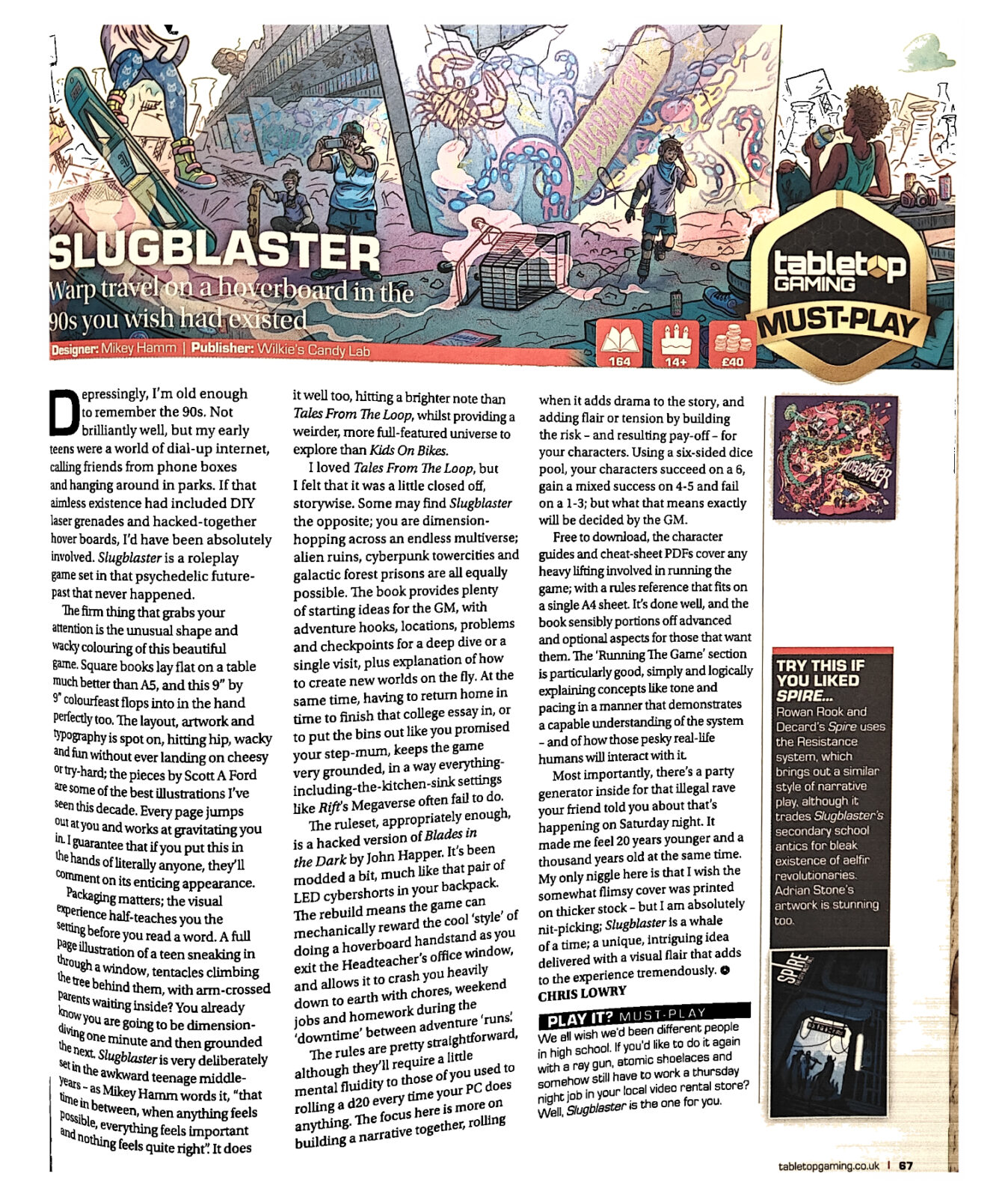
A review written for Tabletop Gaming Magazine. Magazine page copyright to TTG Magazine 2021.