
Sometimes it can seem like roleplay games always come down to dungeons filled with dwarves and goblins hacking at each other with swords. Just studying t-shirts at a gaming con tends to imply a homogenity of wizards and clerics and elvish d20 dice. That’s why encountering something truly fresh—both in form and function—is a real joy.
The Wildsea casts you in adrift in a world full of vast trees. You’ll form a tenacious crew of esoteric biological beings, steering massive chainsaw driven ships across the rustling waves.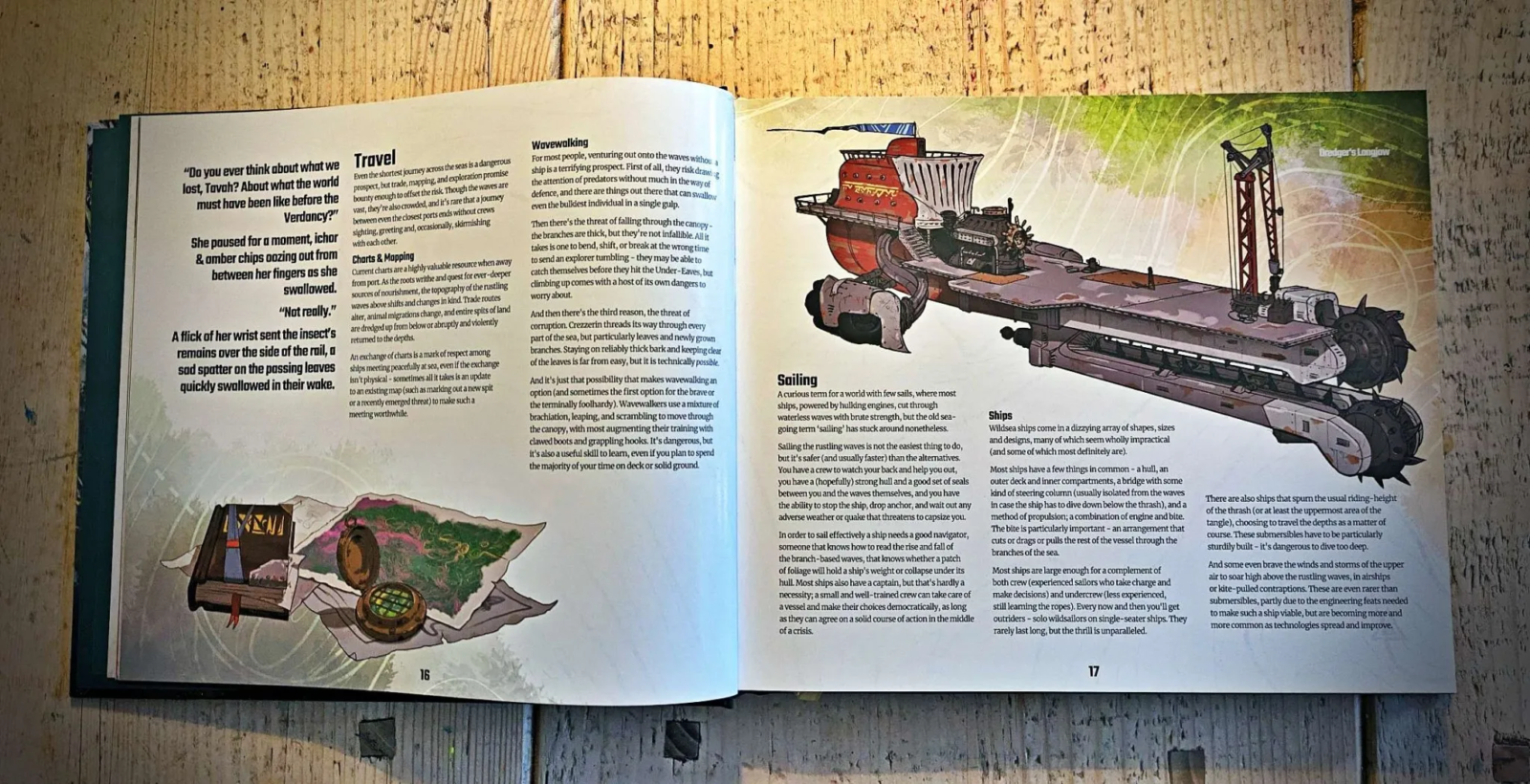
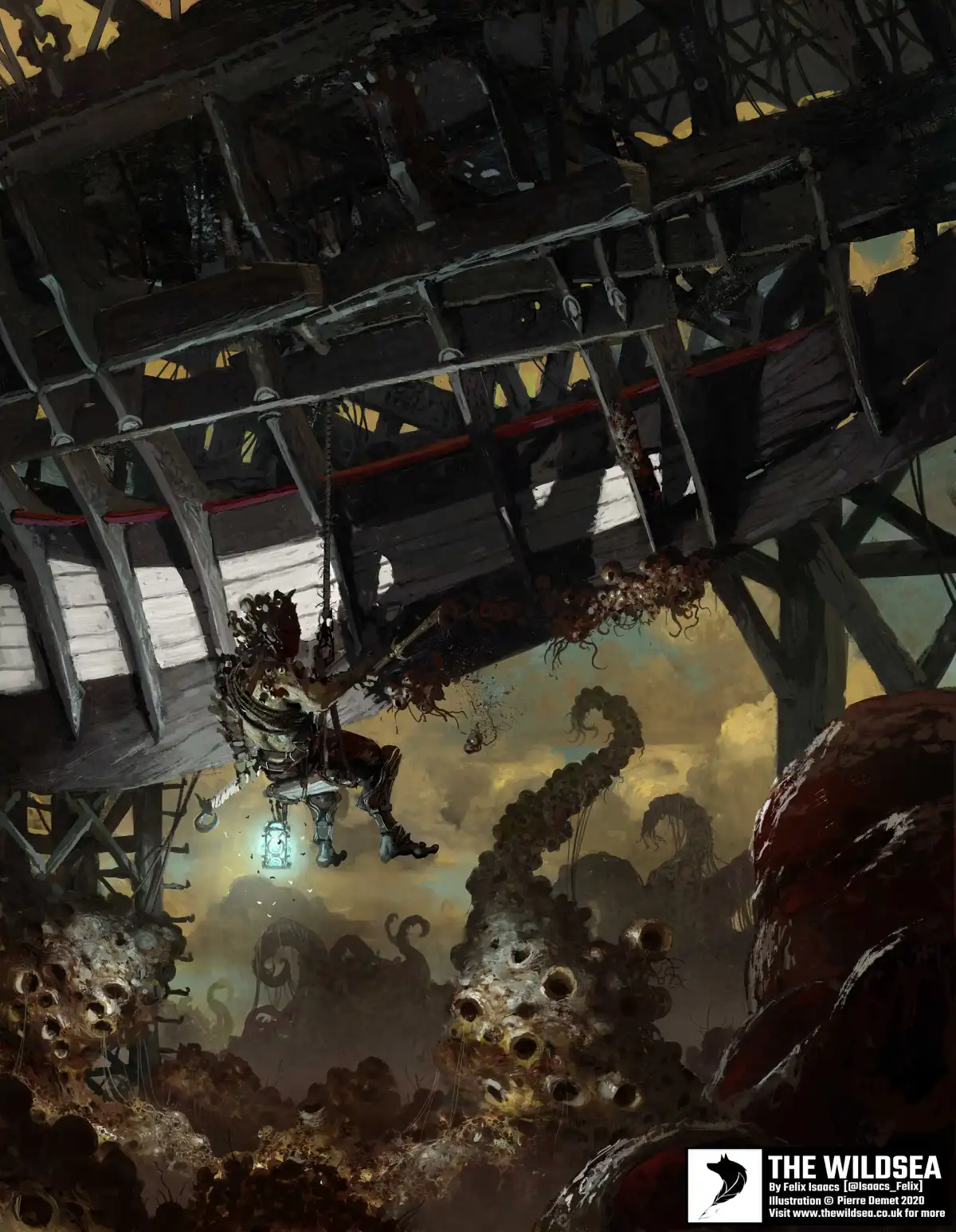
The setting here is both simple and deeply realised. The world of the wildsea is a post-apocalyptic forest, with the mutagenic chemical crezzerin corrupting anything it touches. A period called the Verdancy transformed trees into violent behemoths that smothered the land beneath it. Survivors sail accross the surface, with some particularly intrepid explorers cutting down beneath the top layers—”The Thrash”—into the thicker regions known as “The Tangle” and “The Sink”.
The book is filled with the best writing I’ve encountered this decade, with elegant layout to highlight this. I’ve been a fan of The Wildsea since I got the PDF in the 2020 Kickstarter, but it really comes to life in the delicious horizontal, cloth-bound book, illustrated on every page. The organisation of information here is remarkable; often a large paragraph will give you a rock solid impression of the content of a page, with headings providing further detail and then the text itself only there for those that need further clarification. It’s wonderfully easy to pull information out of quickly without limiting detail.
 The game play in The Wildsea is extremely narrative driven. There are a number of adapted or familiar mechanics here from games, such as tracks, which be familiar to users of clocks in Powered by the Apocalypse games. Fundamentally though, this game is not a traditional RPG, where you might give your character some hit points and a weapon of known prowess and send them off into the world. An action doesn’t last 6 sessions, it lasts “long enough to give a player time to make their character shine”. Characters don’t even have hit points; instead, they take damage to their “Aspect” tracks. For example, you may have a “Half-clogged Firearm”, with four tracks. When the huge spider whips at you with it’s talons, you might mark a point of damage to the gun, and now it takes longer to reload. This is hugely versatile, but also creatively demanding: how do you narratively represent, say, two points of damage, to “Endless Golden Age”, your amber-imbued immortality?
Felix Isaacs has explicitly said that the Wild Words engine is built to share the joy of story-telling with the whole group, intentionally handing control of some narrative parts to everyone—not just the Firefly (GM). I think it pulls it off superbly, but also requires a deal of maturity and shared created vision amongst players. Min-maxers need to look elsewhere. I think The Wildsea could be run in a way that doesn’t ask too much of players; for example, the Firefly can choose to publically name narrative tracks, such as “The Upcoming Rootquake”. I’m not convinced every group is quite mature enough to consider the event that’s being signposted out-of-character whilst also inhabiting a scene. I always find that track-mechanics to guide the flow of heavily narrative games are interesting—literally adding a railroad to a game style that naturally leans quite far away from that? Thankfully, much of this is addressed in a (mostly) easy to navigate Firefly’s Guide, and optional alternate GM styles that share or constrict narrative responsibility as required.
Character creation is dense, wide-open and, frankly, exciting. Players select a “Bloodline”, “Origin” and “Post”, defining their species, upbringing and life-choices that have led them to a ship braving the scraggly, murderous, seas-of-tree. The range of choices is so broad and tantalising specific that there’s no possibility of characters seeming identical or mundane. Maybe you’re a nine foot Ektus (cactus-person), raised onboard a ship and trained as a hacker-routefinder, guiding ships to new paths? Or perhaps a Ketra (mutant-human), who is partly gelatinous and a tall-shank tree-dweller, now working at the ship’s Char-cook?
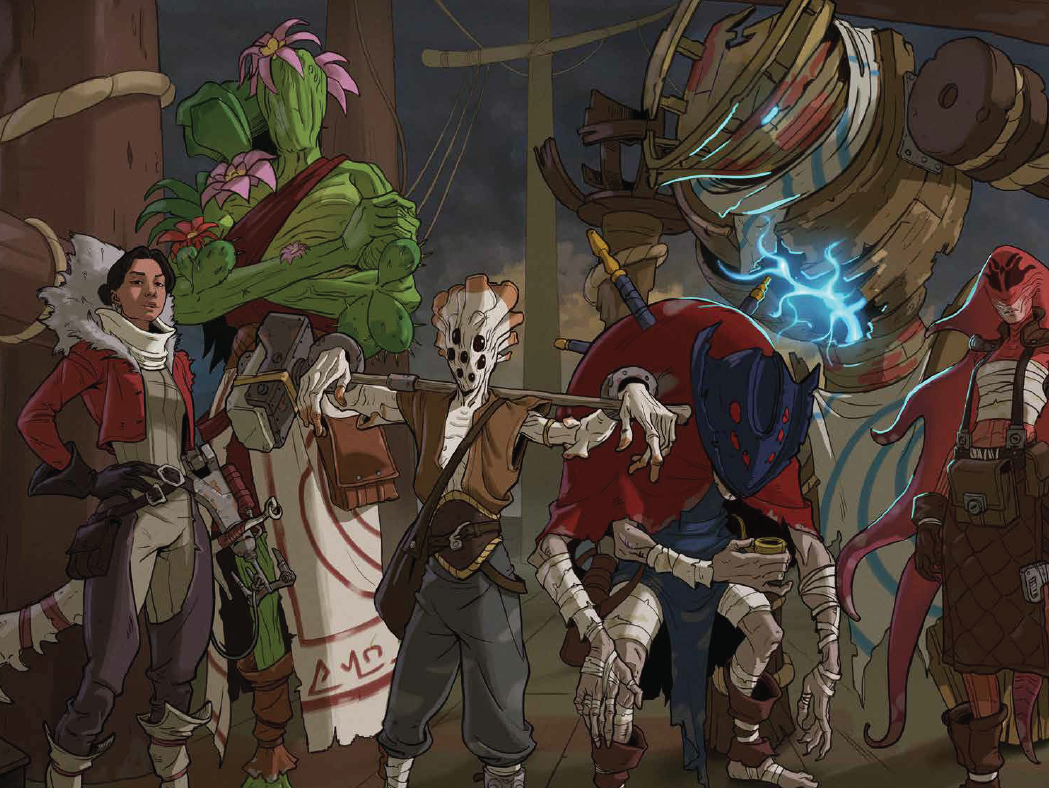 It’s not possible to cover everything The Wildsea offers, even in a two page review, but I have to say that it’s very good. There’s setting ideas like “Whispers”; single use hint-magic that you can shout out to increase their power; to “Crawler” ships, which move through the waves using vast finger-like mechanisms. Then there are narrative-mechanics like “Focus Tracks” for the Firefly in a scene, where each player gets a tick mark when they’ve had focus in a scene, to keep everyone getting a fair amount of spotlight; and “Twists”, where rolling a double in an action allows everyone at the table to suggest unexpected consequences to the action attempted.
Even better than sprinklings of delicious lore are the purposeful blank spaces Isaacs has left in this excellent tome. Going down below the “Sink” takes ships to the “Drown”, where branches thin and light dies. But lower even than that is the “Darkness-Under-Eaves”. What’s there? We don’t know. What caused the Verdancy? We don’t know. Where do the vast leviathan monsters come from? We don’t know. I find these gaps exciting and intriguing; in a game about a small community of outcasts exploring an ever-changing world, I want us to leave our mark on it—a blank canvas invites you to grab the poster paints and get to work.
Are there problems here? Perhaps a few. For one, I personally don’t love modelling languages in games. In The Wildsea, a PC’s knowledge of languages is tied to areas of lore; so the cactus Ektus people speak “Saprekk”, and also have an understanding of deserts, heat and winds; whilst “Highvin” is a pre-verdant language, that also brings knowledge of ancient times. That’s great, but roleplaying an NPC and a PC who have only a smattering of made-up words in common? That gets old fast. I’m also not convinced by the “You’ll never die before you are ready” rule. Damage is so abstract in The Wildsea that I preferred the tension of “if all your tracks are marked, this is the end”. But that’s fine; the opening page of the rules makes it clear you can take out or twist any elements you want to.
For a creative group who are ready to commit to life on the waves, there’s simply nothing out there even remotely like The Wildsea. As a reading experience alone, it is inspiring and invigorating; as a manual for roleplay, every element on every page has been sculpted to immerse your group in the sights, sounds and smells of the overwhelmingly arboreal landscape you’ll be wrestling with.
PLAY IT? MUST PLAY
The Wildsea combines an evocative and terrifying world with a cast of deeply believable characters. I’m confident that any creative group will have an absolutely amazing time inhabiting the land within, and this beautiful book gives everyone the tools to do it, in the way they want.
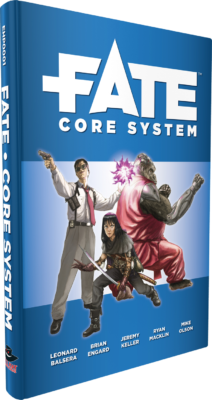 TRY THIS IF YOU liked FATE…
…There are many things different between the two games, but both share narrative tension around the table well, and use tracks to note progression. FATE lets the GM build any setting you desire, whilst The Wildsea provides a fully realised biosphere for players to run around in.
| About The Wildsea | |
|---|---|
| Designer | Felix Isaacs |
| Publisher | Mythworks |
| Playcount | 3-6 Players |
| Age | Age 14+ |
| Price | £50 |
| Rating | Must Play |
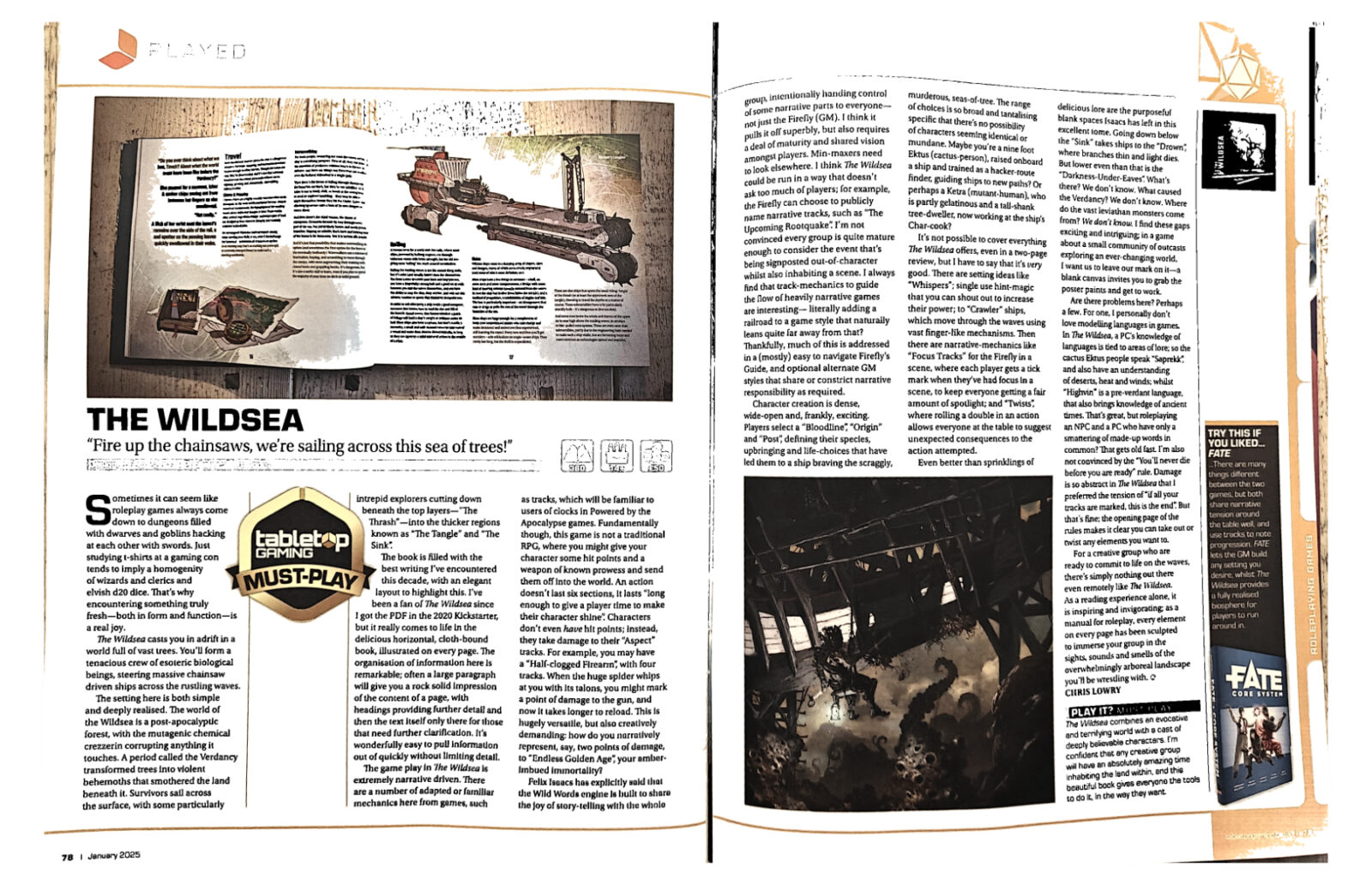
A review written for Tabletop Gaming Magazine. Magazine page copyright to TTG Magazine 2024.