
 Stealing Stories For The Devil is a boxed game RPG about reality-shifting time travellers. It makes the rather bold claim that it requires “zero prep”; always a dangerous promise. The problem with the concept of zero prep is that it leads to potential players thinking they can turn up at a game night, tear off the cellophane and immediately start playing. The reality, with Stealing Stories For The Devil, is that actually the Games Master needs to read three books and Players need to read a full one themselves before the game night. Then, once a very specific setting and a somewhat simpler system are fresh in their brains? I’ll accept that the game could potentially be run with minimal prep.
So, what’s actually going on here? Travellers on a generation ship from a near perfect future have returned to Earth to fix some weird “anomalous zones” that have appeared. Threaded through is a deeply “Yes and…” approach to GMing here since Player Characters can literally “lie” to the world. That’s right, lie. Need a door? Lie to the game and create a door. There are not limits to this, although Players roll stress for the likelihood and size of the lie. “Oh, there’s cheese in the fridge”, is very doable, whilst “Oh, there’s a gun in the fridge” causes a little more stress. “Oh, there’s a doorway portal into the bank vault in the back of the fridge” is probably so difficult it might kill you.
Aside from lying, the rest of a PC’s actions are taken by rolling a die sized by their skill, aiming for a difficulty target: Yarnik is Good at Machine Repair, and so rolls a d8 when trying to get the rusted car to start running. The engine is a corroded mess, since its been stationary and abandoned for so many years – it will take a Hard roll of more than 6 to get that motor revving.
Players get to pick between two Character types; “Scions” and “Sleepers”. All have the lying ability, – Sleepers are individuals from the beginning of a generation ship’s journey, and can “lie” through the unimaginably high tech of their future. The Scions, on the other hands, are the degenerate irradiated humans who fell out of hypersleep and bred for generations, developing a lying mutation. Oddly though, since both have the same skills & traits to choose from, their backgrounds didn’t tend to end up particularly impactful in our play.
Liars also come in types, which affect the narrative sphere of effect for the PC’s lies. There are Planners who lie to objects and places, Plotters who lie to the past and Schemers who lie to people. So a Planner might steal a car by saying it’s old and easy to hotwire, whilst the Plotter would tweak reality so the owner forgot to take the keys out.
The idea is that PCs will take on missions, each of which is a heist situation to steal back mysterious objects causing the anomalous zones to occur. Characters are dispatched on each mission by a mysterious Stranger… and I’ll stop short of spoiling his identity here; even though the game’s title already does it. In fact, its a little ridiculous how the included campaign assumes that players won’t immediately connect the dots.
Overall Stealing Stories For The Devil has a very strong and unusual theme; although its one that requires a certain amount of buy in, and I’m not sure the rulebooks do a good enough job at selling the concept to you immediately. For example, sample characters are given before any explanation of character creation, skills, detriments and liar types. The third rulebook “The Stories They Steal” isn’t a set of extra mission ideas, but a set of loose tips and ideas that would probably be better suited in the main GM manual, called “The Devil”. For a game spread obtusely across three rulebooks to not have an index? Shoddy.
If you can get past its flaws, there are many ideas in Stealing Stories that seem familiar yet that I’ve never seen used quite like this. For example, dice rolls don’t determine success or failure – it’s assumed that player characters are basically competent and excellent at everything. A failed dice roll thus means that the situation itself failed; a shield blocked a gunshot, or a bluff works too effectively. In fact, the rulebook makes it clear that the GM should ensure that PCs are “always epic”; they are James Bond, Harry Houdini and Black Widow combined. Over informed and extra prepared; very little is a surprise to them in a situation: they rarely “roll to search”, but simply dictate what they find; they don’t roll to see if they know what the ticking bomb is, they roll to see how successfully they karate chop it in just the right place to disable it.
Scenes are set with a back-and-forth between players and GM. “The object is hidden in the cockpit of a helicopter at the airport”, say the players. “Yes”, says the GM, “An airport with a permanent guard on site and roving security dogs”. “Okay, and the hanger has three huge skylights”, counter the players. “With ultra bright security lights…”. Another rule makes it clear that “Lies always work”; granting a power to Players unlike any other game I’ve encountered. Of course, the flip side is that this relies on a high degree of trust within your gaming group
Each mission is set up to have three Acts, The Setup, The Action, The Climax. The second Act always ends with the Turn, a GM picked narrative twist. “A firestorm explodes over the town”; “The computer hack was a trap; the electrical locks all slam shut”. It’s one of the ways that many parts of Stealing Stories For The Devil feels similar to Bully Pulpit’s Fiasco, although the addition of a GM adds the possibilities of story that can be hidden from Players and slowly revealed.
Injury is probably my favourite mechanic. Fail an event that could cause injury? Gain an injury dice – from the set of custom D10s in the box. Now roll an injury dice every time you do anything, if the injury dice rolls an X, your PC fails the event (and potentially gains more injury). So the injury is less about reducing hit points, and more about increasing the chance you will fail in the scene. Bodily harm is modelled – reaching 5 injury dice knocks a player unconscious, and rolling to survive – but the focus is always on the narrative.
I don’t agree with every decision in Stealing Stories; a section on setting difficulty for tests was so confusingly phrased that it left me unclear whether increasing the die size or making Players roll twice is the more appropriate action. I loved the custom dice in the box, and the general visual presentation is lovely; but the information organisation is terrible; I just tried to look up “Injury” and it took me nearly a minute, and I had to look through two of the books. There are some maps included for the campaign, albeit on disappointingly thin paper. What this box absolutely needs is a GM cheat sheet. Replacing the third book with a well planned GM screen would be a welcome decision.
Ultimately, whether Stealing Stories For The Devil succeeds or fails is absolutely dependent on your group. Have you got a power gamer who just wants to win? Someone lacking the self awareness to mould their narrative to that of the rest of the group? This game will be unusually sensitive to disruption from delicate imbalances within your dynamic. If you can pull together a group of sharp-edged improv-wielders though, this might be the best game of your year.
PLAY IT? YES
…IF your group has the maturity to pull it off. Want to play out crazy future-heists in a world you get to control? Stealing Stories is one-of-a-kind. For those tired of the mechanical constraints of The Dragon Game, welcome to the deep end of the creative swimming pool!
TRY THIS IF YOU liked Fiasco…
…For a heist storyline shaped by everyone at the table, Fiasco has no equal. That said, I do like the idea of granting responsbility for creative direction to one person; Stealing Stories For The Devil does that whilst barely limiting the players in any other way.
| About Stealing Stories For The Devil | |
|---|---|
| Designer | Monte Cook |
| Publisher | Monte Cook Games |
| Playcount | 2-5 Players |
| Age | Age 14+ |
| Price | £65 |
| Contents |
|
| Rating | Yes |
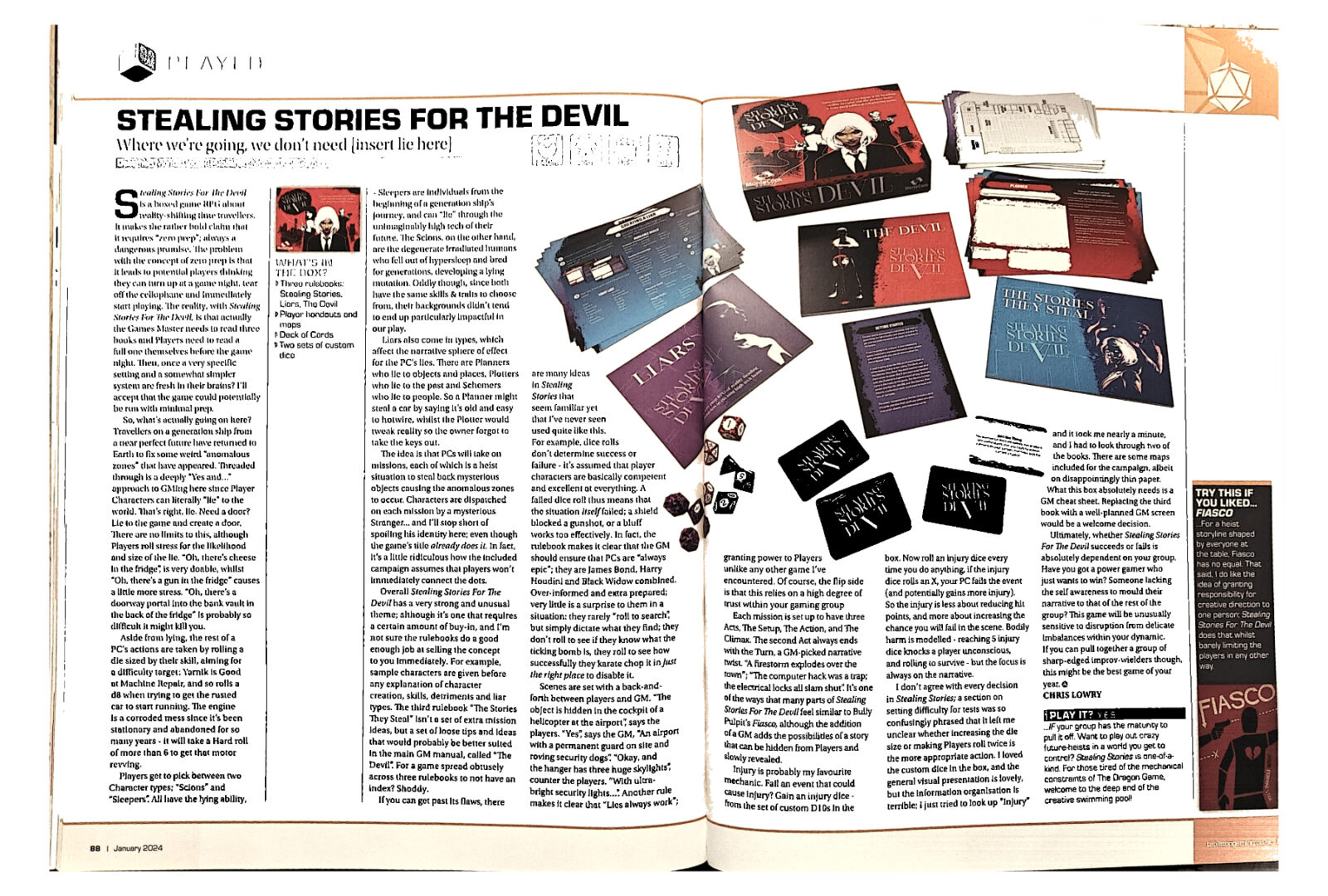
A review written for Tabletop Gaming Magazine. Magazine page copyright to TTG Magazine 2022.