
Shiver Core Rulebook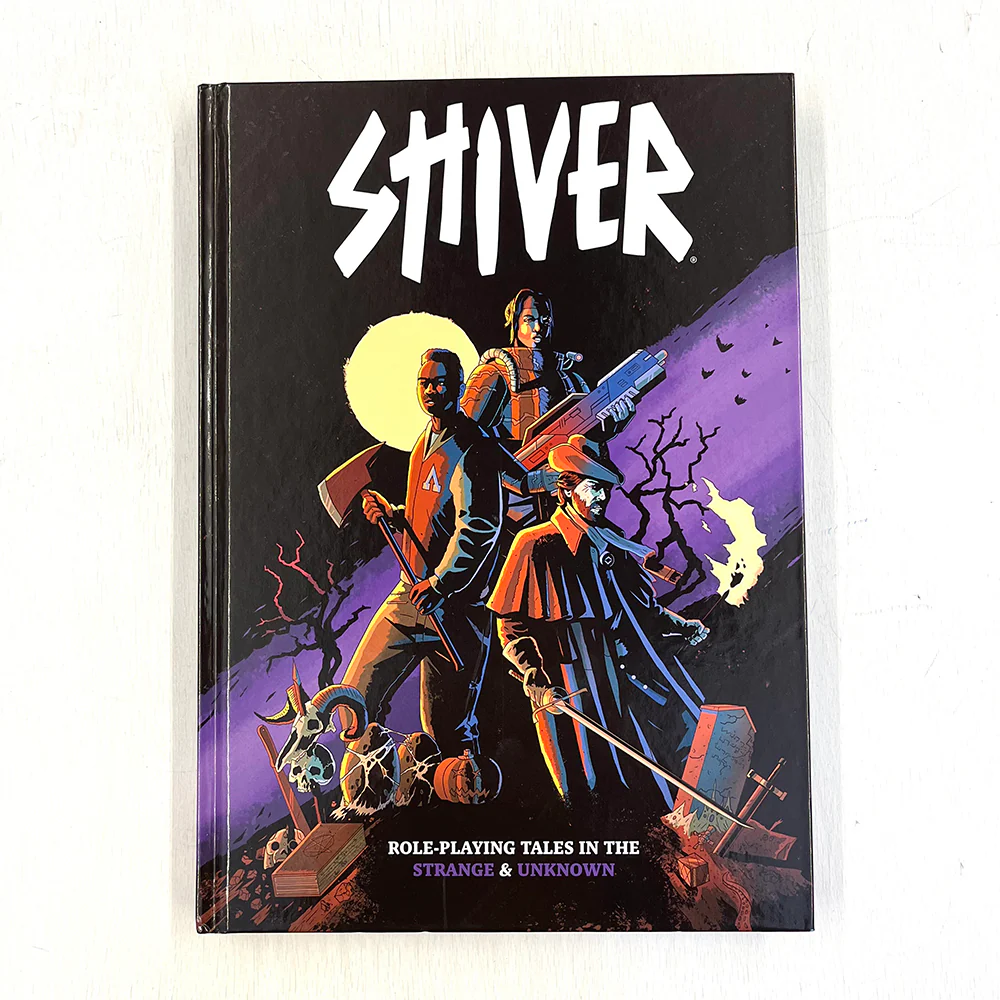
Horror is an interesting genre. For some it is too much; too “on the nose”, too difficult or triggering to engage with; others find it hilarious, a mirror to life that is absurd enough to be stress relieving. I’m not sure where I land, a little of one, a little of the other, I suspect. Wherever you are, I think its unlikely you’ll find a game in the genre that manages to be quite so approachable as Shiver.
Shiver sets itself up as an RPG system that allows you to “play out your very own horror movie with your friends”. Unlike many games out there, Shiver doesn’t use numbered dice, but instead uses custom dice with thematic sides. You are not rolling the normal one-sixe; here you are rolling custom moulded dice with symbols such as hearts, four leafed clover and a wyrd eye. These correlate to the in game stats of Grit, Wit, Smarts, Heart, Luck and Strange. A conversion table is provided for using normal, numbered dice, but picking up the custom ones is much more fun!
The symbolic Core Skill dice speed up the process of rolling, and also add some agility to the story. For example, you attempt to barge a door open with a Grit roll, but don’t roll enough Grit symbols; but you do manage lots of Wit symbols, maybe you fall and hurt yourself, but see a metal hook on the floor and use it to jimmy the lock. Rather than rolling additional times for outcomes, the symbols can flavour the direction of the story – in both good and bad ways. It makes things an awful lot easier to run for the GM – in Shiver referred to as The Director – and generates automatic prompts for collaborative theatre-of-the-mind.
There are also eight sided Talent dice which represent additional expertise or skills the characters have; but also have additional “Strange” symbols on them. “Strange” adds a welcome opportunity for the plot to become drenched in more weird, twisted darkness.
As a good horror RPG, fear plays an integral role to the story, with characters growing in fear, becoming afraid, or terrified. These cause temporary reductions in core skills. Each character has a specific fear, such as arachnophobia, which the Director can use to cater the adventure to individual flavours. The book includes a bundle of archetypes for Player Characters, with specific strengths, deficiencies and abilities. The “Cockroach” and “Fool” paths are my favourites. I absolutely love the skill tree concept Shiver uses, allowing players to choose character’s in an innovative but immediately understandable progression. You can dual wield these sort-of-classes here, but each archetype has subpaths in the skill tree too – become a “Socialite”, and you have the option of choosing between “Charmer”, “Companion” or “Provoker” pathways. The nature of the tree splits means you can go all-in on of one of those splits, or more evenly select between options.
Half of the book is an intelligently written Director’s guide including a Bestiary and comprehensive sample adventure. Each session is built around a Doom Clock. Most of us with RPG experience will have used clocks, but the Shiver RPG explanation for this is one of the best I’ve read. Building it into the structure of sessions is a great way to help new Directors become familiar with the practicalities. A crescendo of dread is planned, with an in-game event at four points on the clock. This matches the content and tempo often seen in horror movies, with suspense falling off sudden cliffs; unexpectedly the power fails; you discover the doors have been all locked from the outside; the caretaker is missing, but there’s a bloody, gory mess in the hallway…
An example of how Shiver is both thoughtfully put together and crunchily thematic is the section on “Grave Introductions”. A common challenge in RPG is “How do we get the party together?”; what has happened to forge these diverse and independent individuals into one cohesive group? Shiver offers the concept of using death as a central point for the characters’ meeting, whether at the graveside, at a funeral or perhaps even by the shared discovery of a body. Common ground, but covered in a way that fits the tone of a horror RPG superbly.
My only real criticism is that I would have liked a more detailed index, as there were a fair few concepts I struggled to hunt down even though I recalled having already read them. If you like RPG and if you like creating scary adventures with interesting characters – and fun dice – you should check out Shiver!
PLAY IT? MUST PLAY
An approachable Horror RPG for all, with probably my favourite character progression framework in any game.
TRY THIS IF YOU liked Dread…
…There’s no Jenga tower here, but the custom dice and the Doom clock bring a a sense of time-running out to a system that incorporates its theme into its mechanics.
| About Shiver Core Rulebook | |
|---|---|
| Designer | Charlie Menzies & Barry Menzies |
| Publisher | Parable Games |
| Playcount | 2-5 Players |
| Age | Age 14+ |
| Price | £40 |
| Contents |
|
| Rating | Must Play |
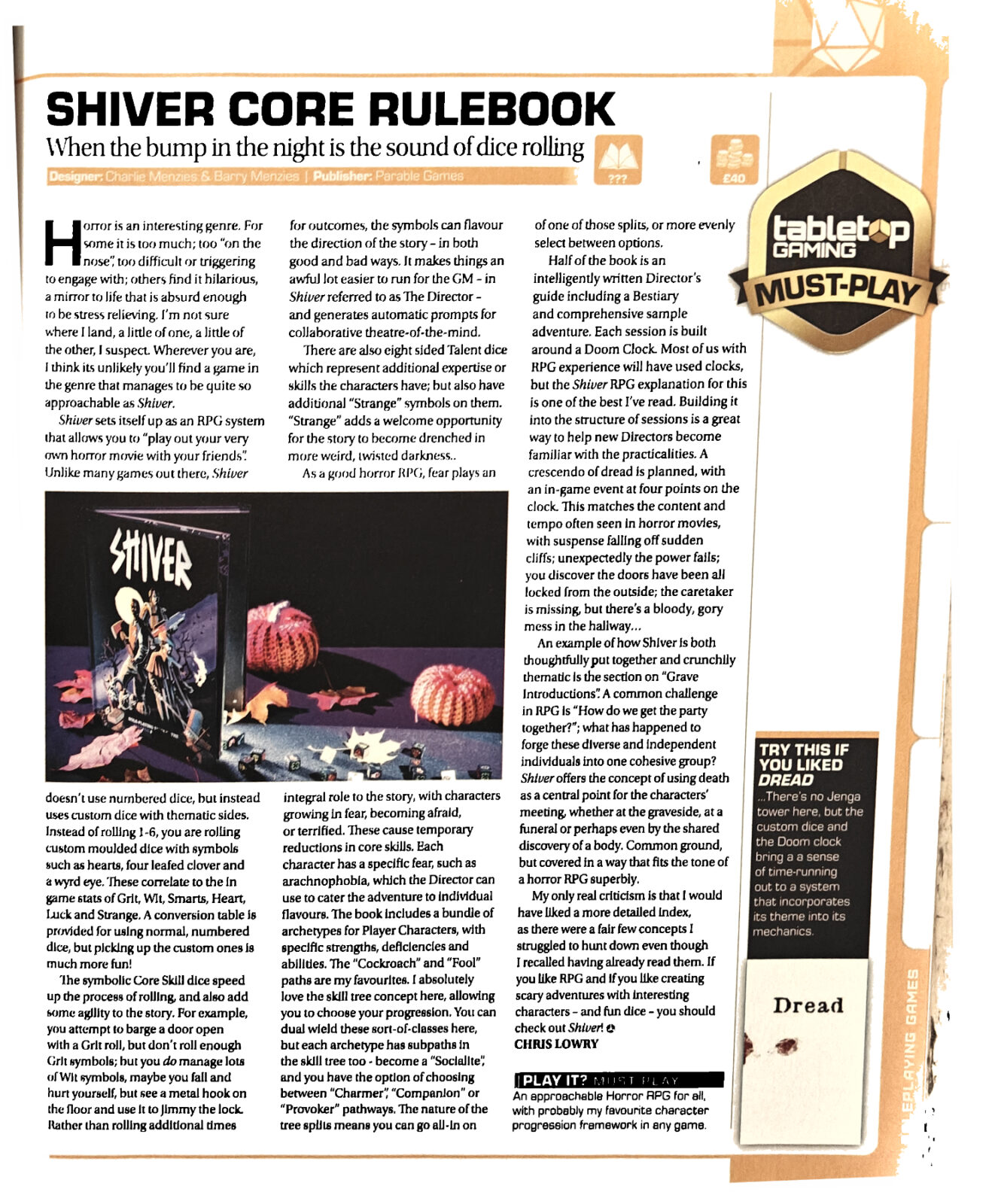
A review written for Tabletop Gaming Magazine. Magazine page copyright to TTG Magazine 2021.