
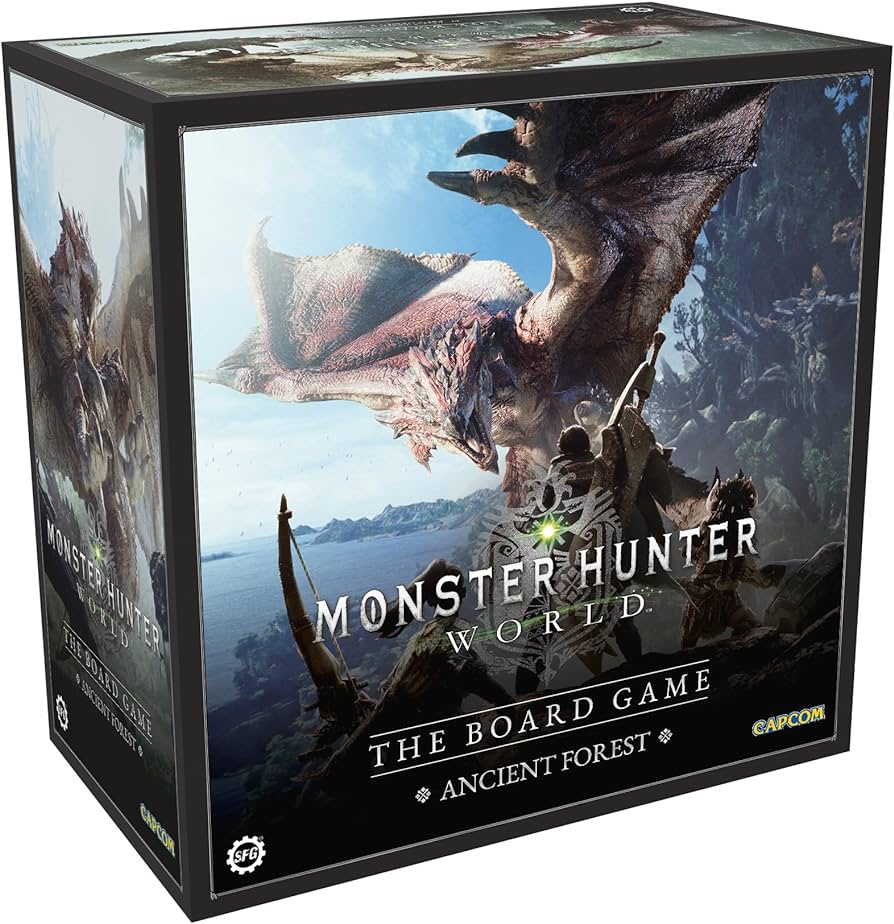
Monster Hunter World: Ancient Forest is a game about plucky heroes, hunting unrealistically large monsters. It’s based on the popular computer game series of the same name.
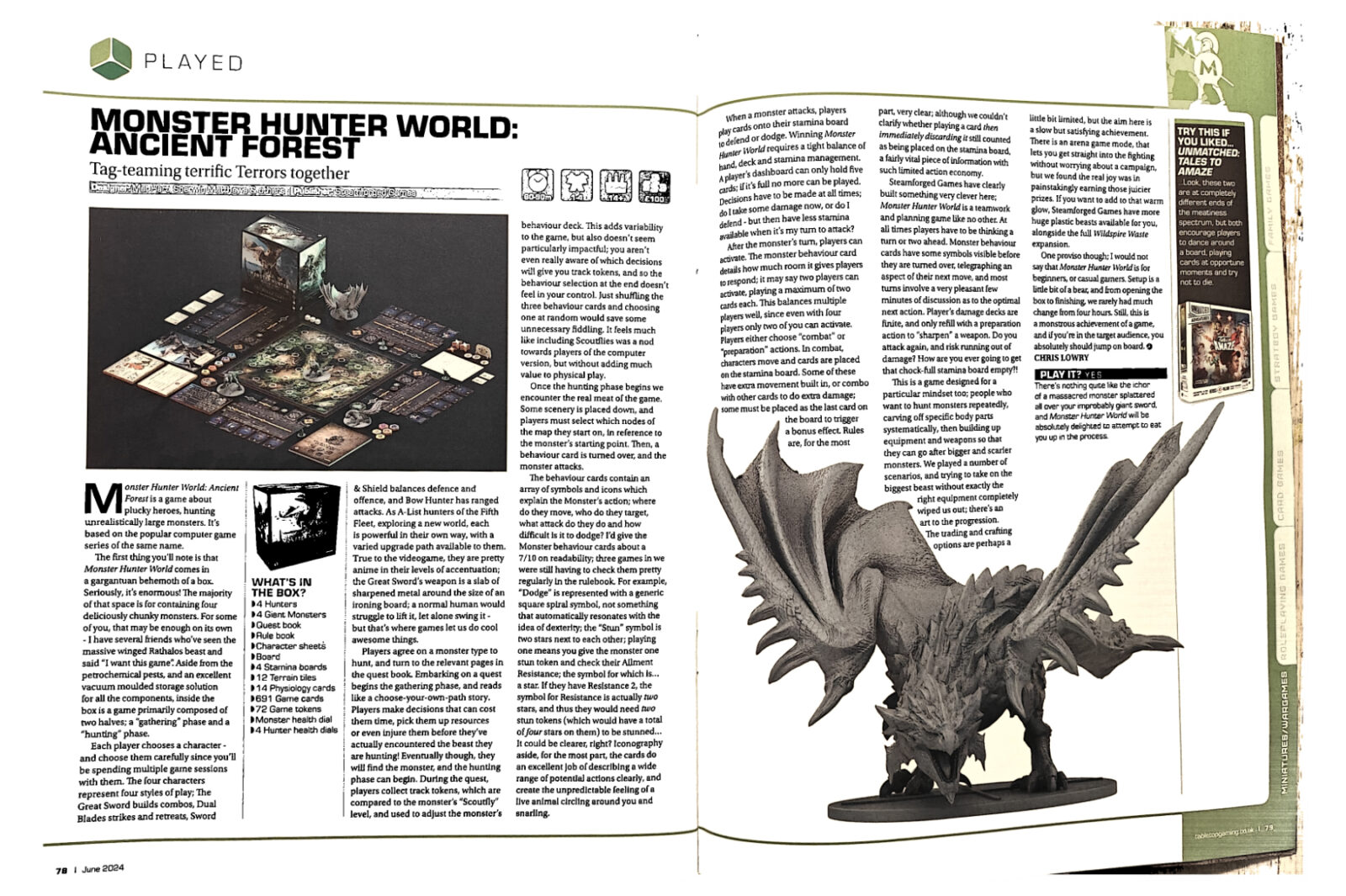
The first thing you’ll note is that Monster Hunter World comes in a gargantuan behemoth of a box. Seriously, it’s enormous! The majority of that space is for containing four deliciously chunky monsters. For some of you, that may be enough on its own – I have several friends who’ve seen the massive winged Rathalos beast and said “I want this game”. Aside from the petrochemical pests, and an excellent vacuum moulded storage solution for all the components, inside the box is a game primarily composed of two halves; a “gathering” phase and a “hunting” phase.
Each player chooses a character – and choose them carefully, since you’ll be spending multiple game sessions with them. The four characters represent four styles of play; The Great Sword builds combos, Dual Blades strikes and retreats, Sword & Shield balances defence and offence, and Bow Hunter has ranged attacks. As A-List hunters of the Fifth Fleet, exploring a new world, each is powerful in their own way, with a varied upgrade path available to them. True to the videogame, they are pretty anime in their levels of accentuation; the Great Sword’s weapon is a slab of sharpened metal around the size of an ironing board; a normal human would struggle to lift it, let alone swing it – but that’s where games let us do cool awesome things!
Players agree on a monster type to hunt, and turn to the relevant pages in the quest book. Embarking on a quest begins the gathering phase, and reads like a choose-your-own-adventure story. Players make decisions that can cost them time, pick them up resources or even injure them before they’ve actually encountered the beast they are hunting! Eventually though, they will find the monster, and the hunting phase can begin. During the quest, players collect track tokens, which are compared to the monster’s “Scoutfly” level, and used to adjust the monster’s behaviour deck. This adds variability to the game, but also didn’t seem particularly impactful; you aren’t even really aware of which decisions will give you track tokens, and so the behaviour selection at the end doesn’t feel in your control. Just shuffling the three behaviour cards and choosing one at random would save some unnecessary fiddling. It feels much like including Scoutflies was a nod towards players of the computer version, but without adding much of value to physical play.
Once the hunting phase begins we encounter the real meat of the game. Some scenery is placed down, and players must select which nodes of the map they start on, in reference to the monster’s starting point. Then, a behaviour card is turned over, and the monster attacks!
The behaviour cards contain an array of symbols and icons which explain the Monster’s action; where do they move, who do they target, what attack do they do and how difficult is it to dodge? I’d give the Monster behaviour cards about a 7/10 on readability; three games in we were still having to check them pretty regularly in the rulebook. For example, “Dodge” is represented with a generic square spiral symbol, not something that automatically resonates with the idea of dexterity; the “Stun” symbol is two stars next to each other; playing one means you give the monster one “Stun” token and check their Ailment Resistance; the symbol for which is… a star. If they have Resistance 2, the symbol for Resistance is actually two stars, and thus they would need two stun tokens (which would have a total of four stars on them) to be stunned… It could be clearer, right? Iconography aside, for the most part, the cards do an excellent job of describing a wide range of potential actions clearly, and create the unpredictable feeling of a live animal circling round you and snarling.
When a monster attacks, players play cards onto their stamina board to defend or dodge. Winning Monster Hunter World requires a tight balance of hand, deck and stamina management. A player’s dashboard can only hold 5 cards; if it’s full no more can be played. Decisions have to be made at all times; do I take some damage now, or do I defend – but then have less stamina available when it’s my turn to attack?
After the monster’s turn, players can activate. The monster behaviour card details how much room it gives players to respond; it may say two players can activate, playing a maximum of two cards each. This balances multiple players well, since even with four players only two of you can activate. Players either choose “combat” or “preparation” actions. In combat, characters move and cards are placed on the stamina board. Some of these have extra movement built in, or combo with other cards to do extra damage; some must be placed as the last card on the board to trigger a bonus effect. Rules are, for the most part, very clear; although we couldn’t clarify whether playing a card then immediately discarding it still counted as being placed on the stamina board, a fairly vital piece of information with such limited action economy.
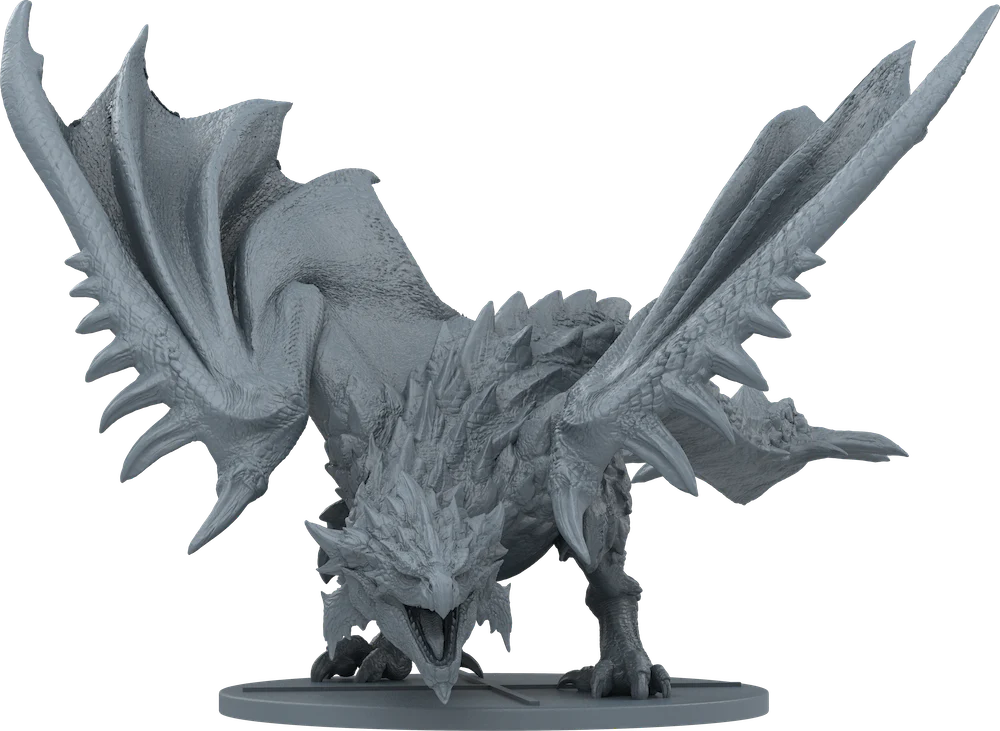
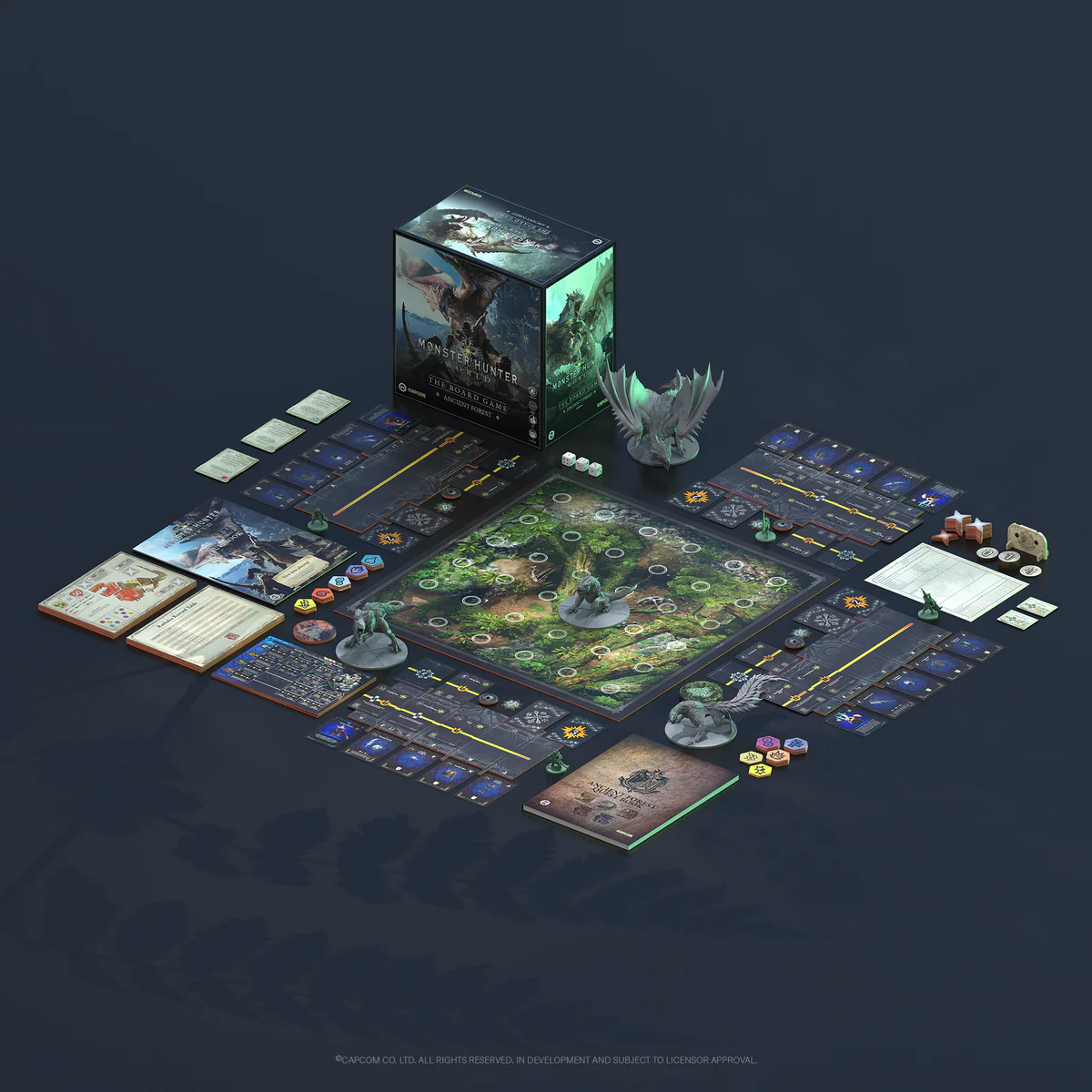
Steamforged have clearly built something very clever here; Monster Hunter World is a teamwork and a planning game like no other. At all times players have to be thinking a turn or two ahead. Monster behaviour cards have some symbols visible before they are turned over, telegraphing an aspect of their next move, and most turns involve a very pleasant few minutes of discussion as to the optimal next action. Player’s damage decks are finite, and only refill with a preparation action to “sharpen” a weapon. Do you attack again, and risk running out of damage? How are you ever going to get that chock-full stamina board empty?!
This is a game designed for a particular mindset too; people who want to hunt monsters repeatedly, carving off specific body parts systematically, then building up equipment and weapons so that you can go after bigger and scarier monsters. We played a number of scenarios, and trying to take on the biggest beast without exactly the right equipment completely wiped us out; there’s an art to the progression. The trading and crafting options are perhaps a little bit limited, but the aim here is a slow but satisfying achievement. There is an arena game mode, that let’s you get straight into the fighting without worrying about a campaign, but we found the real joy was in painstakingly earning those juicier prizes. If you want to add to that warm glow, Steamforged have more huge plastic beasts available for you, alongside the full Wildspire Waste expansion.
One proviso though; I would not say that Monster Hunter World is for beginners, or casual gamers. Setup is a little bit of a bear, and from opening the box to finishing, we rarely had much change from four hours. Still, this is a monstrous achievement of a game, and if you’re in the target audience, you absolutely should jump on board.
PLAY IT? YES
There’s nothing quite like the ichor of a massacred monster splattered all over your improbably giant sword, and Monster Hunter World will be absolutely delighted to attempt to eat you up in the process.
 TRY THIS IF YOU liked Unmatched: Tales to Amaze…
…Look, these two are at completely different ends of the meatiness spectrum, but both encourage players to dance around a board, playing cards at opportune moments and try not to die.
| About Monster Hunter World: Ancient Forest | |
|---|---|
| Designer | Mat Hart, Sherwin Matthews & others. |
| Publisher | Steamforged Games |
| Playcount | 1-4 Players |
| Age | Age 14+ |
| Price | £100 |
| Contents |
|
| Rating | Yes |
A review written for Tabletop Gaming Magazine. Magazine page copyright to TTG Magazine 2023.