
Deal With The Devil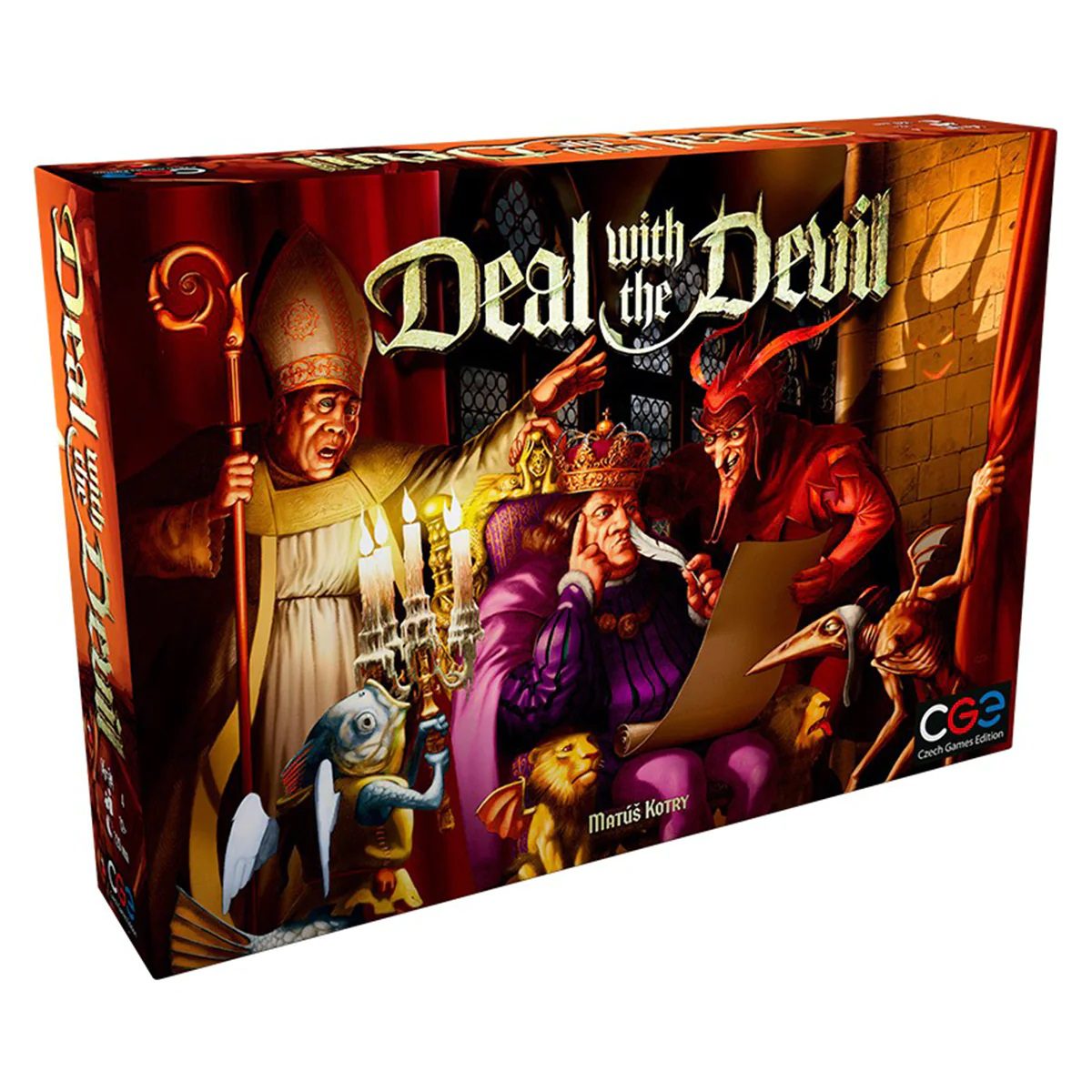
I don’t think I’ve ever played anything quite like Deal with the Devil. It’s certainly the only game I’ve seen with a player count of “4 Exactly” on the box. That’s correct; you can play with four people, and… that’s it. No solo mode, no duels, just four of you. And an app. I know, an app. I was fearful too, but it was much less intrusive than I feared.
The core concept: each of you runs a kingdom in the Dark Ages. Two of you are puny mortals, one is a cultist and the other is The Devil. Everyone has the same goal, to build the biggest and best kingdom, but the methods vary, as the Devil starts with more money and a secondary aim to steal as many pieces of soul as possible.
The game takes place through five rounds, each including the opportunity to gain resources, build buildings and make deals. The resources and buildings involve the kind of engine-building victory-point-hunting seen in many Euro games such as Race for the Galaxy or Dominations. The deals are where the souls comes in… and the app.
Players each have a cardboard chest that they can fill with goods, and clearly mark with a price. So you might put in two wood tokens, a glass and a stone, and then label it with a price of “6 coins”. If you are the Devil, you might put a seductively vast hoard of items, but at a cost of one or two pieces of soul – mortal players can choose to give up pieces of their soul, if the rewards are high enough.
The players close their chests, put them in a well-shuffled pile and then use a phone to scan the QR codes on the outside. The app distributes the chests between players, ensuring that everyone gets to see two different deals without knowing who it came from, and that a particular order of reveals occurs. Once everyone has had the option to take or ignore two deals, the app directs each chest back to its owner. This is the only use of an app in the game; secretly passing deals around the table. It would probably be possible with some kind of complicated series of cards and codes, but the app manages the job quickly and relatively painlessly.
So, some secret deals happen. Why does that matter? The dreaded and twice-per-game Inquisition phase is the reason.
Firstly players have the opportunity to place secret bribes in their chests, whilst the Devil reveals how many pieces of soul he has collected. The more souls; the more resources he gains and the more Inquisitors are revealed. Then, bribes are paid, potentially paying off Inquisitors. Every player must then reveal a piece of soul to appease each Inquisitor, or pay a hefty penalty. This is the hook that prevents you from selling all your soul pieces for plentiful rewards. If there are 3 Inquisitors, and you only have 1 piece of soul? Things get dicey.
So that’s the main flow of Deal with the Devil. There are a few other elements, including a reputation track, that allows players to gain angel wings (or devil wings), which provide additional help (or punishment) in the Inquisition phase, but in essence players build stuff, trade stuff and then see who has earnt the most points at the end.
The question is: does it work? The answer is a half-hearted “Sort of…?”.
The rulebook is decent enough – Czech Games Edition write some of the best in the business, and we felt we understood the flow and mechanics of play. What it failed to do, however, is clearly lay out the tactical mindset one needs to play. Why am I making a cursed deal today? Why would I want to?
Ultimately our experience was the gimmick of the soul trading in Deal with the Devil may not actually impact on play enough to change anything.
A potentially fatal flaw is that everyone can be too scared of the consequences to give away their souls. The Inquisition rounds worsen the more successful the Devil has been; if the Devil has captured enough souls, it can be possible for there to be six inquisitors, each demanding a new bit of soul or enacting a terrible cost. But, get three players who aren’t sure if this is worth the risk? They won’t sell their soul pieces. So the Devil doesn’t get extra power, and doesn’t gain enough resources to tempt players to sell more soul, and doesn’t make the Inquisition worse. Our first game, in the final terrifying showdown, we faced… one Inquisitor. And everyone still had enough soul pieces to easily appease him.
Now add in the non-negligible anxiety inducement of maintaining secrecy for three to four hours. All of us felt a constant concern that we might accidentally reveal our identity, drop the box and have our tokens fall out, that things we said would give the game away. Not that that’s not a common issue with hidden identity games, but here’s the kicker; in a game of Werewolf, you aren’t also trying to strategize your way through a moderately complex Euro game.
All in all, sadly, the Deal with the Devil experience fell a little flat. With the right group of exactly four players, you might find a pleasing challenge in the intrigue and hidden bartering, but there are better games for both deception and empire building.
PLAY IT? NO
To be honest, I was a little disappointed with Deal with the Devil. There are much better hidden role games, and much better Euro games out there.
TRY THIS IF YOU liked Discworld:Ankh–Morpork…
…Discworld:Ankh-Morpork is a somewhat lighter proposition, but is a good example of an asymmetric hidden role game that intrudes on the mechanics of building a shared world. It’s a lot more fun too!
| About Deal With The Devil | |
|---|---|
| Designer | Matúš Kotry |
| Publisher | Czech Games Edition |
| Playcount | 4 Exactly |
| Age | Age 14+ |
| Price | £67 |
| Contents |
|
| Rating | No |
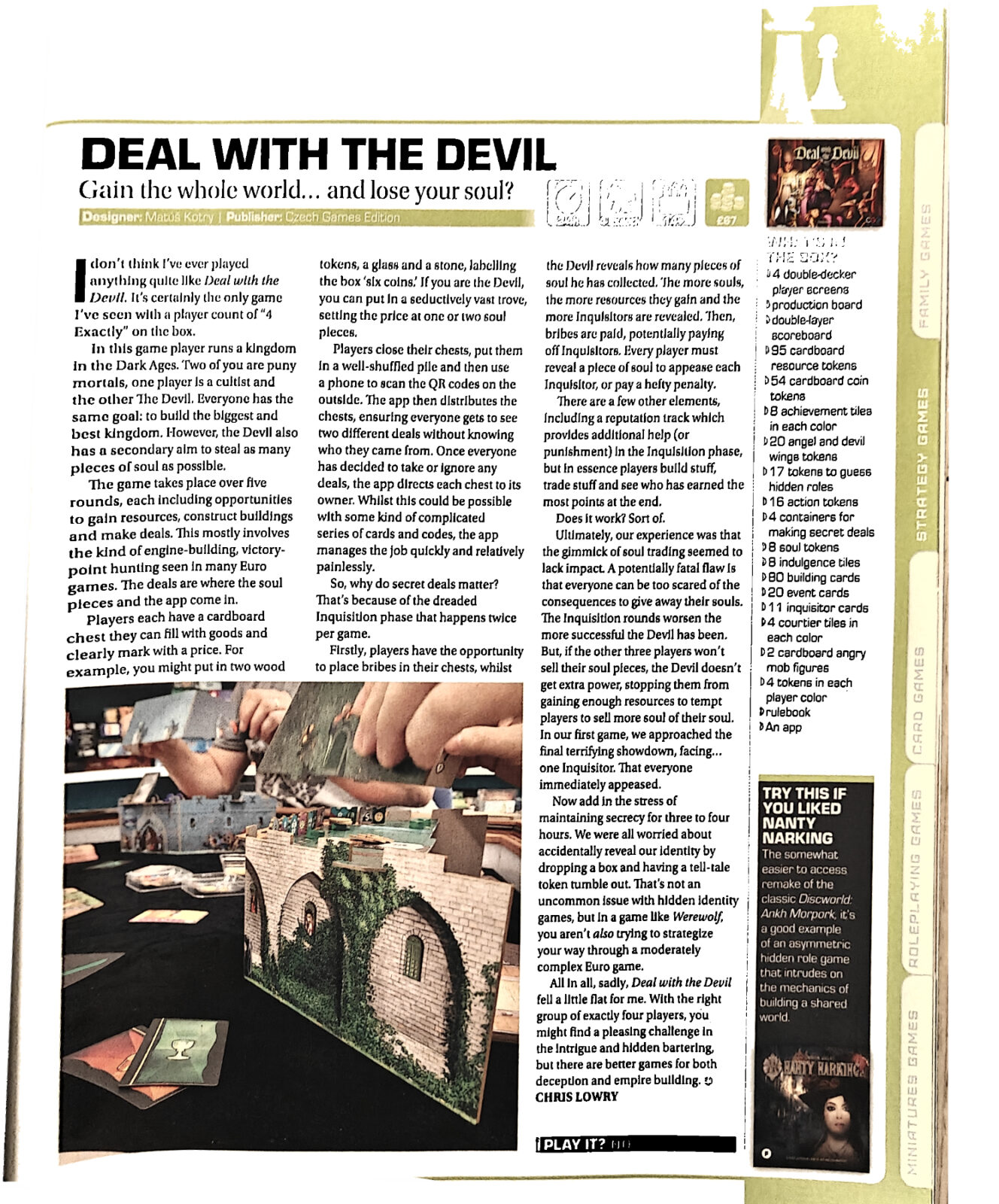
A review written for Tabletop Gaming Magazine. Magazine page copyright to TTG Magazine 2021.