
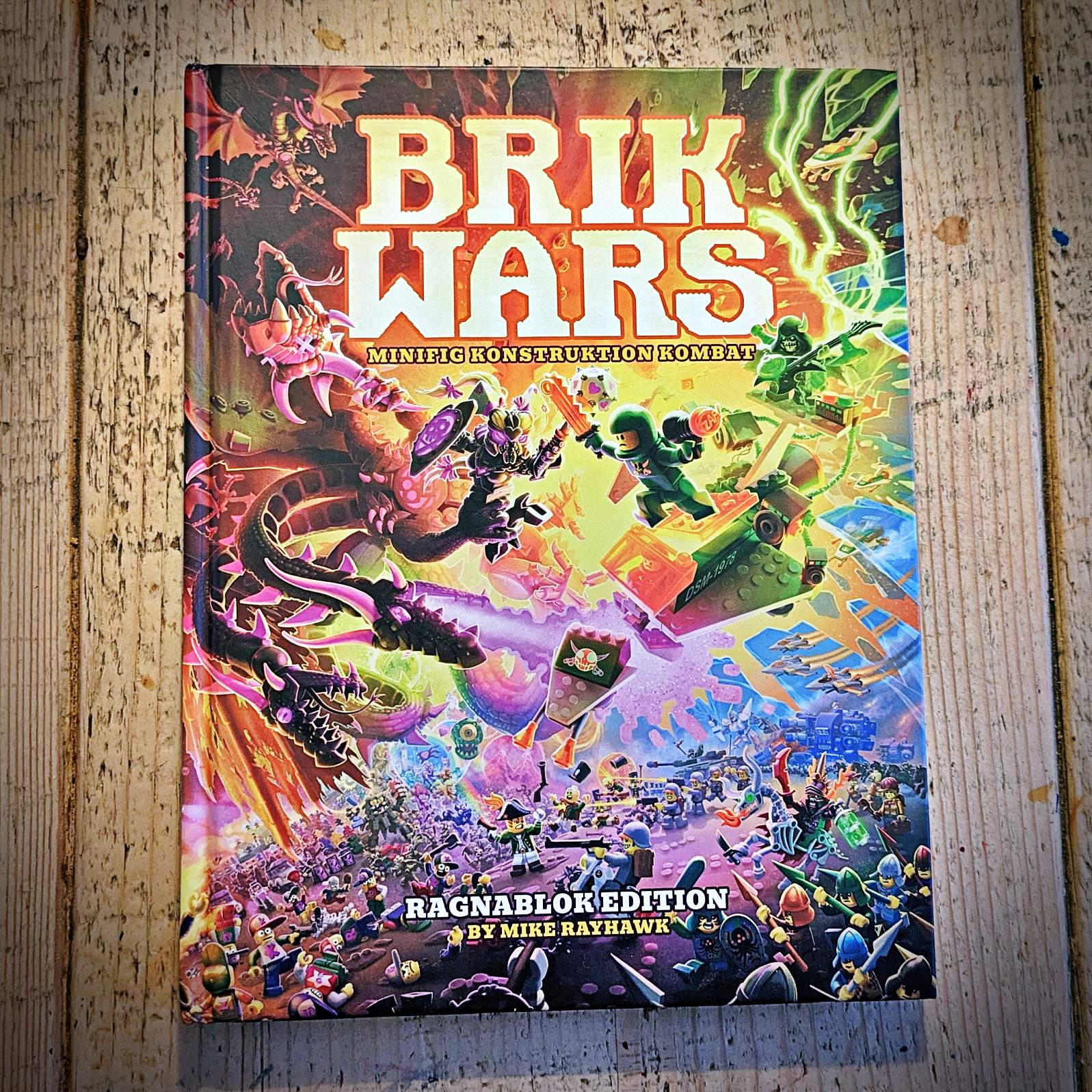
 BrikWars is a very funny book. From the opening words, it takes not taking itself seriously extremely seriously. I’m not really sure where the fourth wall lies here, as it’s crumpled, thrown aside and made a point of fun from the very first page. How silly is BrikWars? Well, the Gameplay section contains a joke about “The Spirit of the Rules sneaking up behind you and hitting you with an axe” next to an photo of two Lego characters playing a game of a (non-existent) Nano-BrikWars. Pretty silly.
Underneath the unhinged narrative voice are the rules of a tabletop miniatures game, and the tale of the online community that birthed it. It’s rather a refreshing read, the organic development of a free-to-own gaming system; it creates a sense of invitation and shared ownership; a game that exists purely to empower your enjoyment.
The introduction warns that BrikWars is built on a proud tradition of “gratuitous everything”; I would say the rulebook delivers on that promise. Battles take place within The BrikVerse; the in-game universe that all living mini figures inhabit. As a setting it’s ridiculous, horrifyingly violent and very silly. Goals are fluid, escalating all the way up to an entire battlefield being destroyed in a cataclysmic fireball – the rulebook notes that this occurrence would be “considered a victory for all sides”.
Underneath all the gung-ho silliness and encouragement to ignore rules is a heartening understanding of the fundamental mindset that tabletop gaming requires. The “What I Say Goes” rule provides an intentional nuclear option; any BrikWars player could declare a neutron bomb that destroys the opponents army, entirely within the rules – the only thing stopping this? Good faith. The golden rule of games is “don’t play with people that can’t play nice”; BrikWars empowers either player to blow up the entire world if this rule is broken.
The initial mechanics are quick and fairly basic; 5 inch movements, one dice per attack, generally using a single D6 with a target number to beat; simplicity that’s here to support narrative rather than supplant it. If you desire more, the complexity scales rapidly; play with just the opening chapters, or add rules for heroes, vehicles, destruction of scenery, monsters, and a near-endless horizon of imagination and chaos.
The examples of play are a treat, both in explaining mechanics, but also for ludicrous scenes of Soccer Mums battling Riot Police, researchers hitting each other with rocks and falling in love, or Viking Vs Ninja Vs Pirate battles. The real magic is how this reveals that the rules only exist to loosely tie together the violently nonsensical story.
Hunting down specific rules is reasonably clear, with a solid index – although you can and should just fudge things to what seems sensible.
The balance between generic concepts that govern crazy-whatevers-made-out-of-bricks and providing clear lines for specific situations is about right. Most scaling is in directly size related – a monster as tall as three minifigures might go up three dice sizes for their actions; a four inch lasergun does two more damage than a two incher; it also has a target number to fire that’s two harder.
The Lego/generic brick game hobby is heavily dependent on personal creativity and initiative. I would say my children and I had almost more fun building and creating stuff before games than actually playing – and that’s absolutely fine. If BrikWars increases my opportunity and enjoyment of games I already own, that’s already worth the entry price. The Specialisms section of the rulebook is very reflective of this aspect of the hobby; these are the minifigures that can build new creations – Mechaniks – or even upgrade already built items – the Engineer. The latter can literally improve anything, but only at a non-negotiatiable cost. Make that flying surfboard more armoured with extra bricks attached? It’s too “comfortable” now and loses an equivalent amount of speed.
If you’re looking for specific crunch, it’s very present: almost unusually so. The BrikWars ruleset – unlike traditional war gaming – has to handle the concept that every rule must be flexible enough to encompass hand built creations. Even generic use-your-own-model systems don’t have players cobbling together new units in the middle of a game, often out of other units they’ve just destroyed. It was common in our games for a vehicle to be destroyed only to see a particularly enjoyable weapon re-mounted moments later on a completely different model – I have no problem withpersonally think R2-D2 is much better with wings and a iceflamethrower.
Alongside this are lots of very genre-appropriate, very silly ideas in here. There’s options to roll to see if missed shots hit allies; to allow RedShirt mini figures to throw themselves in front of their hero whilst screaming “NOOOOOOOO!”; for possessed dice and for motorbike-vs-horse jousting whilst wielding a poo on a stick. Keeping all the rules in your head is impossible – but we never worried that we were playing “wrong” in any way by home-ruling, as the game is explicit in telling you to do so. If I have to choose one particular favourite, it would be the Cannon Fodder specialist, a unit type that has the skill of “Irrelevant”, and the role of running forwards and being cut in half by horses, Heroes, or machine gun fire; anything really. No other miniatures game would have identical characters called Bob who serve only the purpose of comedic bloodshed.
Latter chapters include details on more complex loot, and for building full military scenarios. There’s detailed budgeting for squads, companies – or even entire armies. Alongside this are are troop types; such as snipers, drivers, troopers; and command roles; from Officer all the way up to “The Great Leader”. This last has the specialist skill of “Megalomania”, and can declare one of their own units as ScapeGoats, blaming all their failures on them and sacrificing them for handfuls of bonus dice. It’s the worst of military realities; caricatures and given a competitive ruleset.
It could certainly be argued that the gonzo goes a little too hard here; if you aren’t up for a stupid joke flayed absolutely to death, BrikWars may not be for you; expect columns about “The D Word” (explaining dice terminology) and a section on horses that is named “Chapter H” rather than getting a number. However, if you love bricks, dice and roaring nonsense at each your friends whilst a dragon-riding fireman attempts to catapult cars at the wizard’s pirate ship? You need this game.
My final comment is an honest reflection; ever since we opened up BrikWars, my son has been playing Lego all over the house. It’s frankly inconvenient at points: there was a spaceship balanced on the bannister up the stairs earlier, and I’ve trodden on tiny brick pieces twice today. Yet its also given him – and me – and opportunity to play, and to fall back in love with a toy, an experience, and a mindset that, in truth, I pray we never outgrow.
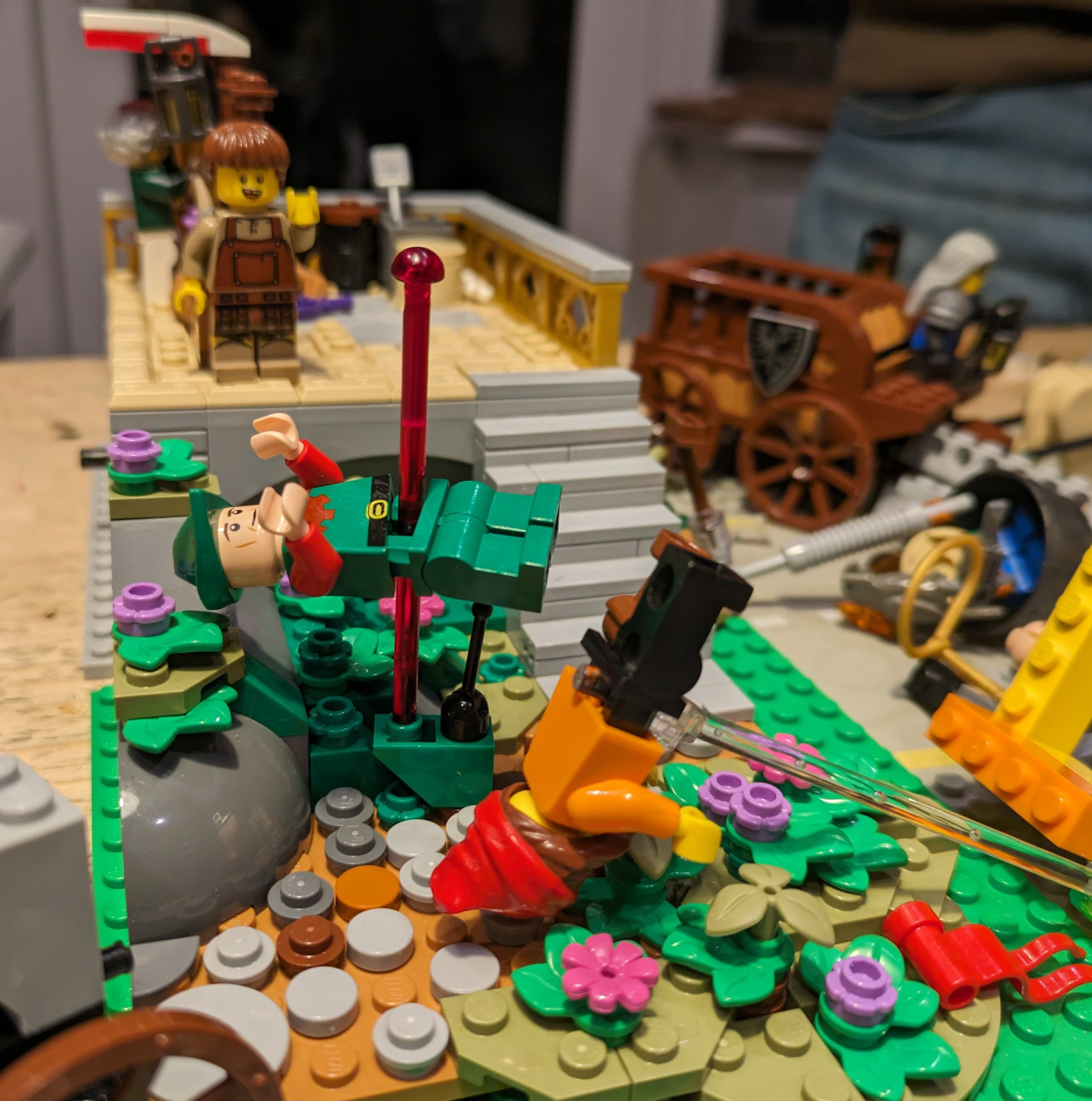
What other game would see Robin Hood attempt a pole vault onto to end up accidentally impaled on a flagpole…
PLAY IT? MUST-PLAY
If, like me, you are still basically just a child inside, BrikWars is the only tabletop wargame you’ll ever need. For everyone else? You need to take a long hard look in the mirror and stop being so serious all the time.
 TRY THIS IF YOU liked Warhammer 40,000…
…but got tired of rulebooks and competitive play and insanely expensive models and painting stuff and opponents saying “well, actually, I have this particular ability you didn’t know about that means I get to stop you having fun”, and just want to drive around a flying submarine with cannons that fire explosive flowers.
| About BrikWars | |
|---|---|
| Designer | Mike Rayhawk |
| Publisher | Modiphius |
| Playcount | 2+ Players |
| Age | 10+ |
| Price | £30 |
| Rating | Must Play |
A review written for Tabletop Gaming Magazine. Magazine page copyright to TTG Magazine 2023.