
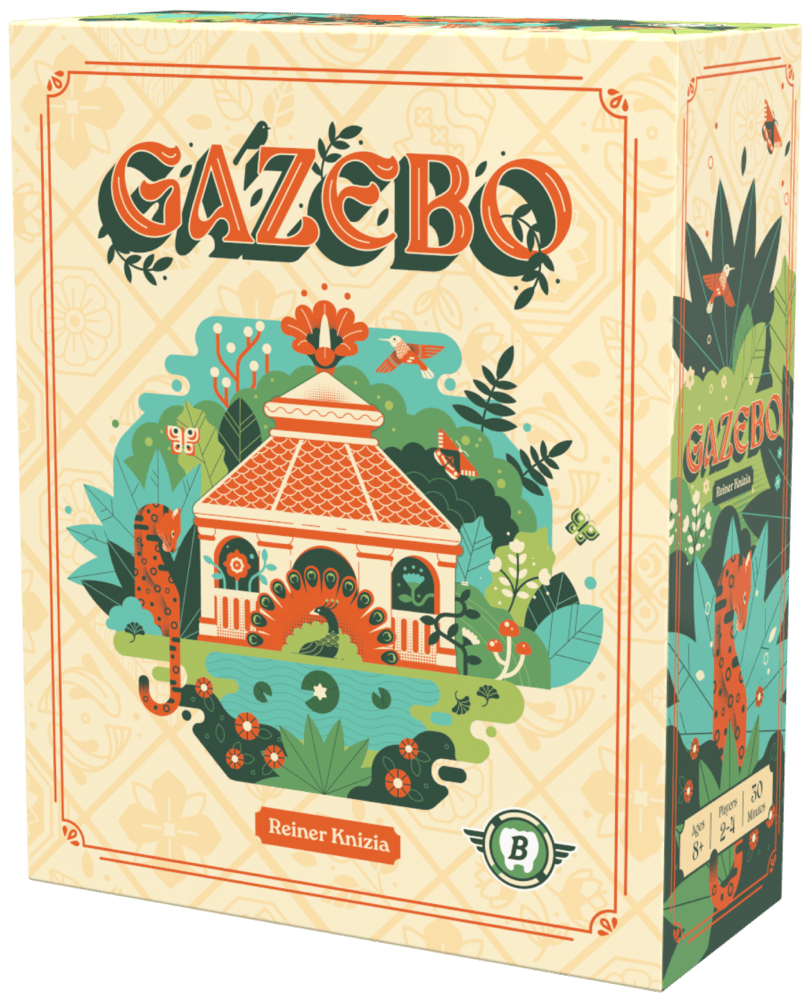
 Reiner Knizia is one of the most prolific board games designers in the world; Industry legend is that he thinks up at least three games whilst brushing his teeth each morning. Such high output unavoidably means that some of his releases are more well known than others; one that few will recall is Qin, a game of conquest using dual coloured dominos. In Gazebo, that design has been revisited by the great Knizia himself, with some of the dangly bits carved off, and with adjustments to reduce the randomness that affected play in the older game.
The core concept of Gazebo is of an elegant botanical garden, filled with beautiful nooks and tastefully scattered gazebos, laid between pristine patios. Players compete to build all of their gazebos before anyone else.
Each player lays a domino tile with at least one end matching an adjacent tile. If an area of two (or more) of the same colours is formed, then a “nook” is formed. The owner places a gazebo token in their colour. If the nook ever grows to five spaces, they add a second gazebo, and if they have more gazebos in nooks adjacent to a patio, they get to claim the patio with a gazebo too.
At the end of a turn you can collect one new double coloured tile; or pick up from your limited selection of five two-of-the-same coloured tiles. Some spaces on the map grant you bonus doubles tiles, and they are surprisingly powerful when used in the right way.
It’s a simple game, and executed beautifully, in a zip close travel case and folding material board. The dominos are just weighty enough to be satisfying, and (unlike the token’s in Gingham-see page #) heavy enough to straighten out the folds in the cloth underneath. The mat is also double-sided, with an alternate play version underneath. Bitewing also currently sell at least one additional double-sided map.
Underneath the veneer of pleasantness, Gazebo is actually a relatively brutal area control game, one that fits the theme of Qin much better than the light-weight elegance of garden architectural mastery. If you can crowd out another player’s gazebos by a patio, their dominance is stolen and claim it. If you can join your larger nook to an opponent’s smaller nook, it’s absorbed, and they must collect their gazebos from the board.
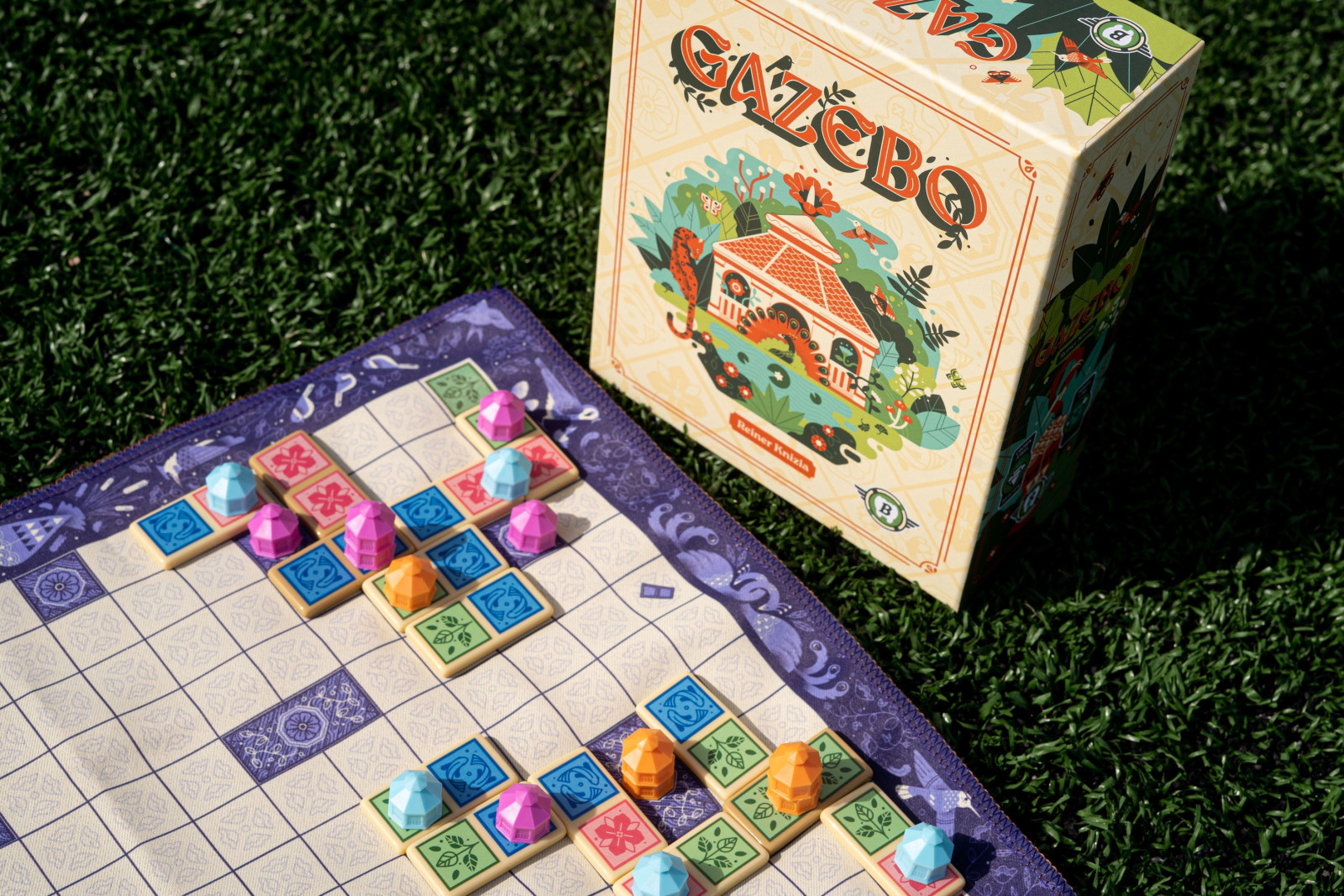
Soon there are monster nooks snaking across the board, presenting interesting dilemmas; do you join all your smaller nooks to them for power, or do you try to keep them separate so that more of your gazebos in total are placed out on the mat. Do you attempt to win over a patio, or simply spread out to claim an uncontested one instead?
There’s very nearly enough here to be a tasty tactical treat, but I think Gazebo falls just short of excellence. It’s fun, and easy to pick up for new players, but it’s also slightly too shallow to really plan much beyond “I’ll probably just put that tile there this turn”. When you successfully take over someone’s patio, there is a tiny burst of satisfaction, but it’s often just as effective to put your head down and spread to less contested areas of the board.
Still, Gazebo is a good introduction to area control, and I’ve returned to it much more often than I really needed to. You’ll likely have a good time in this garden.
CHRIS LOWRY
PLAY IT? YES
Tile-placement? Check. Area control? Check. Gardening? Check. Gazebo is a solid game, that’s worth taking for a spin round the grounds.
 TRY THIS IF YOU liked Renature…

…In Renature you’re using woodland creatures rather than garden buildings, but its otherwise a similar game of dominos and attempting to dominate.
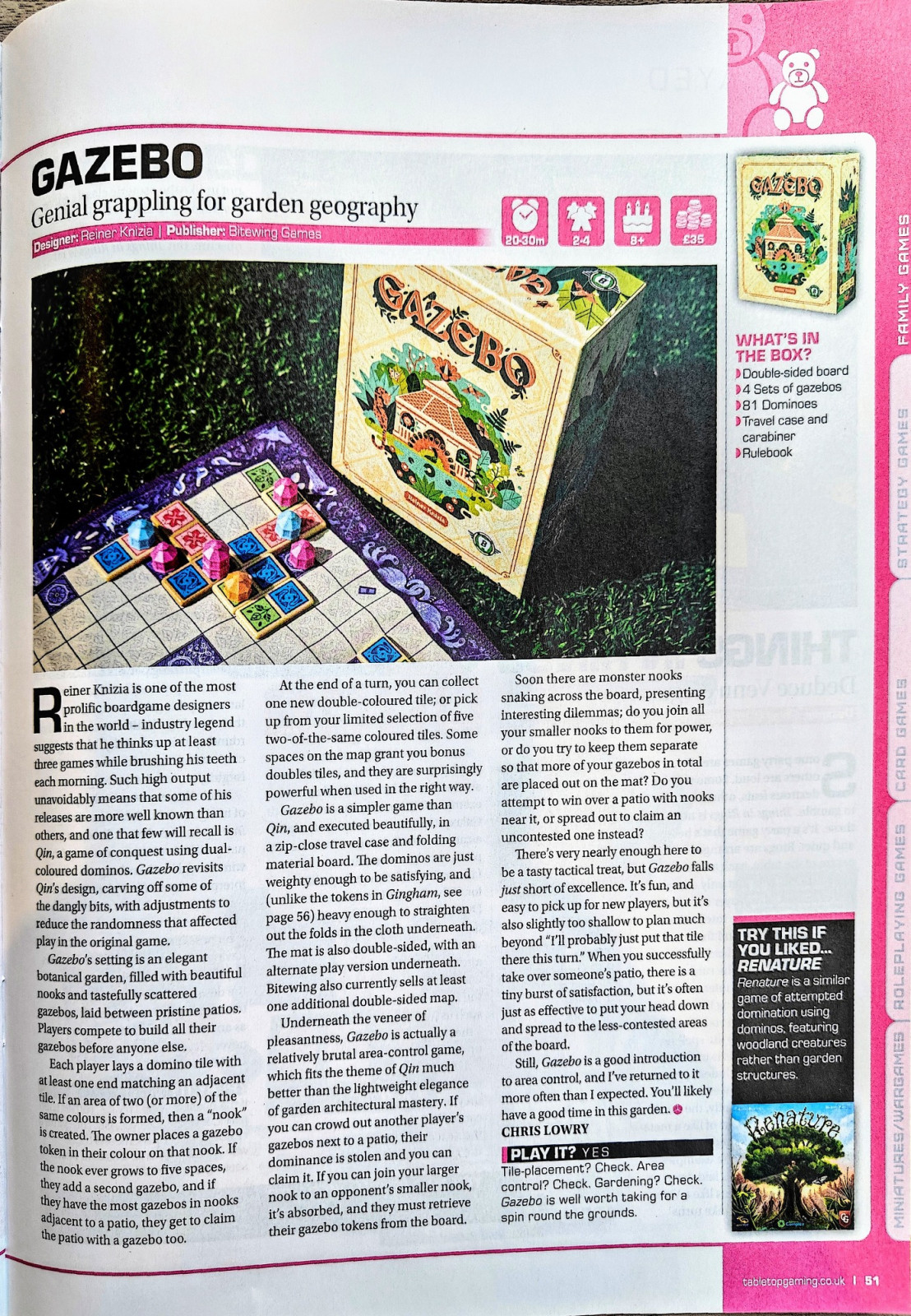
| About Gazebo | |
|---|---|
| Designer | Reiner Knizia |
| Publisher | Bitewing Games |
| Playcount | 2-4 |
| Age | 10+ |
| Price | £35 |
| Contents |
|
| Rating | Yes |
A review written for Tabletop Gaming Magazine. Magazine page copyright to TTG Magazine 2026.