
Mythic Mischief Vol I & Vol II

Sometimes I really fancy playing something a bit like Chess. A game that’s strategic and completely without luck; a two-player puzzle where we can outwit one another. I just want it without the overwhelming complexity and requirement to rote-learn a thousand different openings that Chess requires.
Mythic Mischief aims to fill that space, and does it whilst wrapping the experience into a very more-ish theme. You play as naughty students in the Mythic Manor boarding school, trying to sneak around the library without getting caught by the terrifyingly solemn Tomekeeper. The vibe here has a U-rated Buffy the Vampire Slayer vibe, with teams of Monsters, Wizards, Vampires and Ghosts competing to trick the Tomekeeper into catching their opponents.
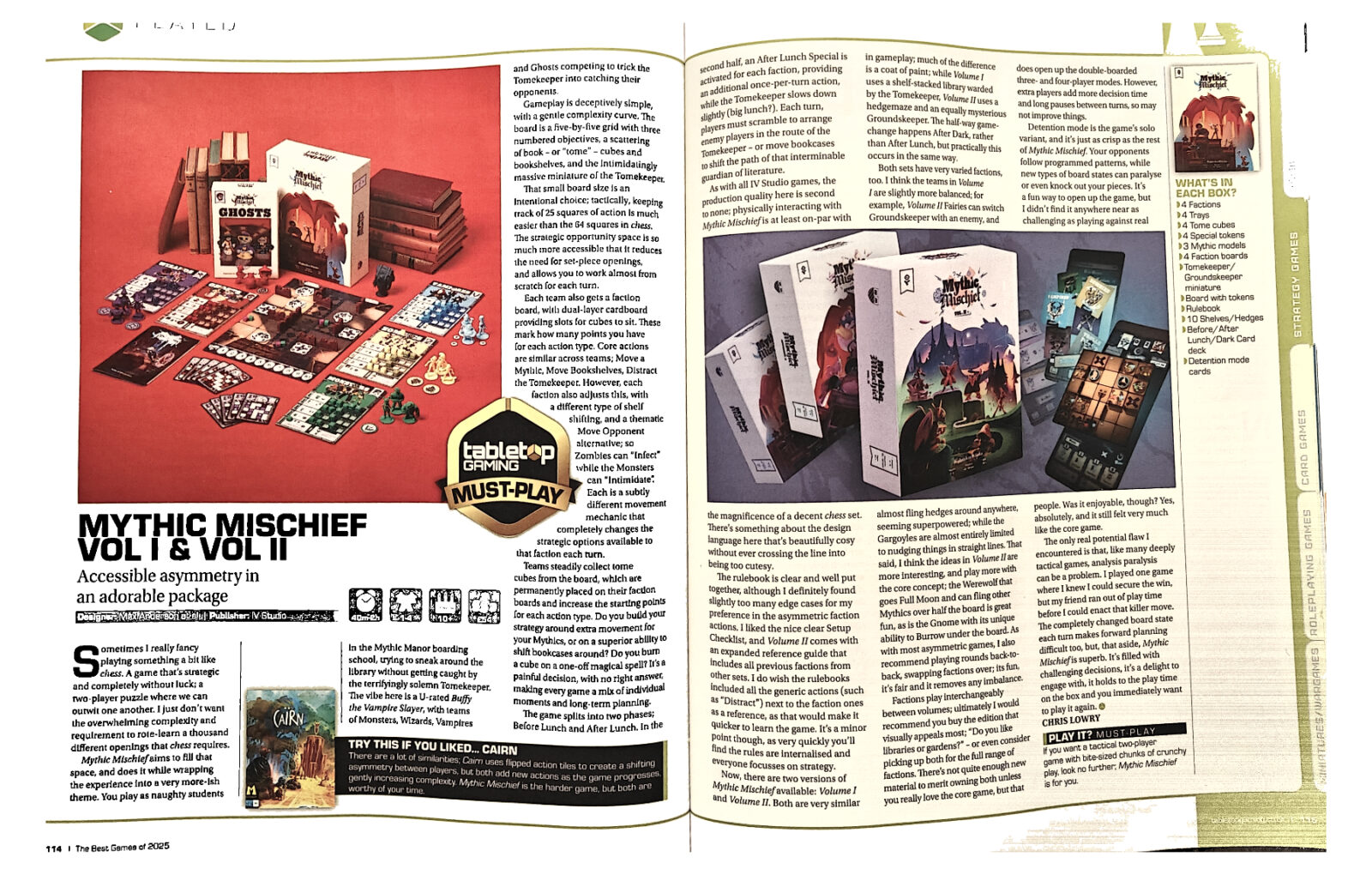
Gameplay is deceptively simple, with a gentle complexity curve throughout the game. The board is a five-by-five grid with three numbered objectives, a scattering of book—or “tome”—cubes and bookshelves, and the intimidatingly massive miniature for the Tomekeeper.
That small board size is an intentional choice; tactically, keeping track of twenty-five squares of action is much easier than Chess’ sixty-four. The strategic opportunity space is so much more accessible that it reduces the need for set piece openings, and allows working almost from scratch for each turn.
Each team also gets a faction board, with dual layer cardboard providing slots for cubes to sit. These mark how many points you have for each action type. Core actions are similar across teams; Move a Mythic, Move Bookshelves, Distract the Tomekeeper. However, each faction also adjusts this, with a different type of shelf shifting, and a thematic Move Opponent alternative; so Zombies can “Infect” whilst the Monsters can “Intimidate”. Each is a subtly different movement mechanic that completely changes the strategic options available to that faction each turn.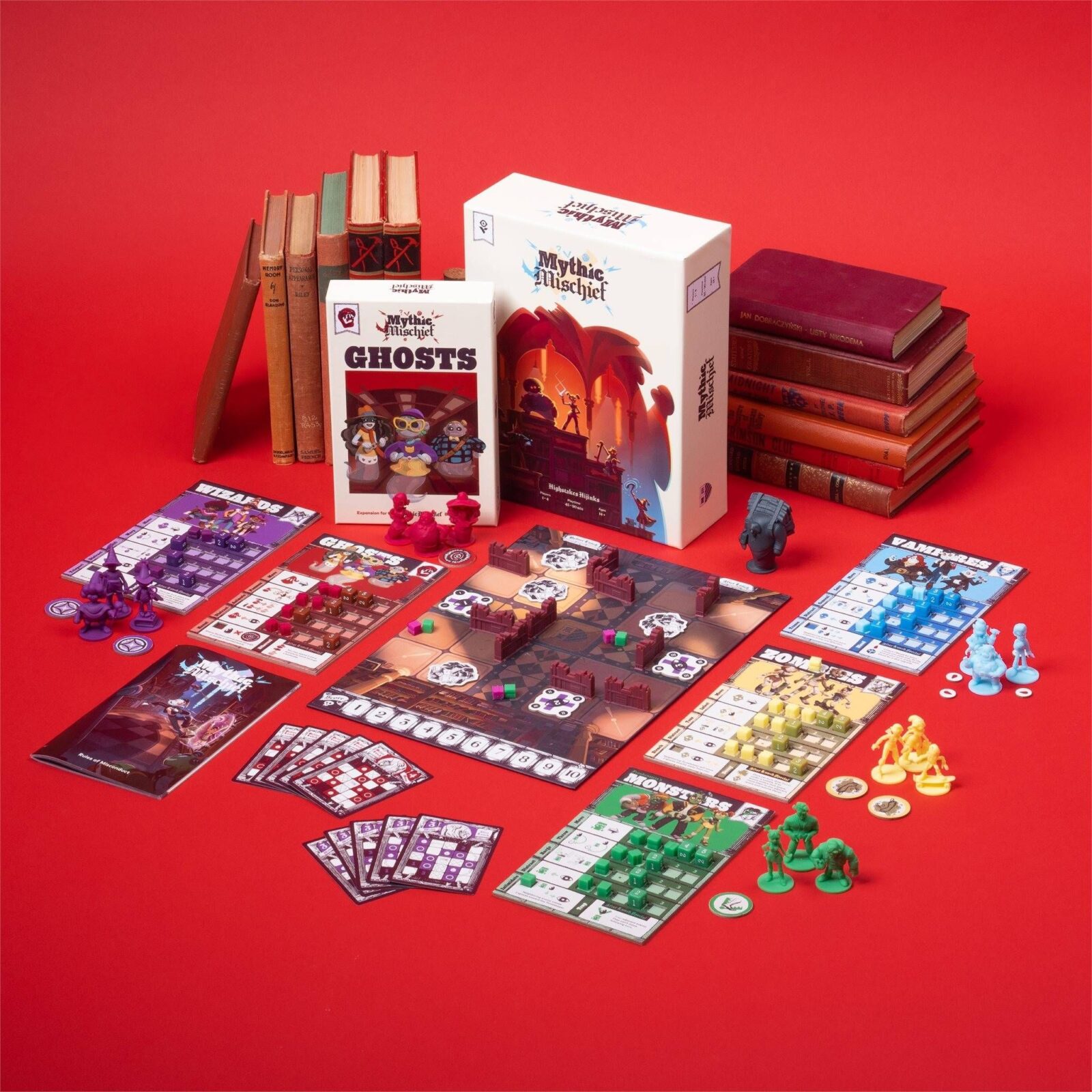
Teams steadily collect tome cubes from the board, which are permanently placed on their faction boards and increase the starting points for each action type. Do you build your strategy around extra movement for your Mythics, or on a superior ability to shift bookcases around? Do you burn a cube on a one-off magical spell? It’s a painful decision, with no right answer, and makes every game a mix of individual moments and pulling off a long term plan.
The game splits into two phases; Before Lunch and After Lunch. In the second half, an After Lunch Special is activated for each faction, providing an additional once-per-turn action, whilst the Tomekeeper slows down slightly. Each turn, players must scramble to arrange enemy players in the route of the Tomekeeper—or move bookcases to shift the path of that interminable guardian of literature.
As with all IV Studio games, the production quality here is next to none; physically interacting with Mythic Mischief is at least on-par with the magnificence of a decent chess set. There’s something about the design language here that’s beautifully cosy without ever crossing the line into being too cutesy.
The rulebook is clear and well put together, although I definitely found slightly too many edge cases for my preference in the asymmetric faction actions. I liked the nice clear Setup Checklist, and Volume II comes with an expanded reference guide that includes all previous factions from other sets. I do wish the rulebooks included all the generic actions such as “Distract” next to the faction ones as a reference, it would make it quicker when learning the game. It’s a minor point though, as very quickly you’ll find the rules are internalised and everyone is just focussed on strategy.
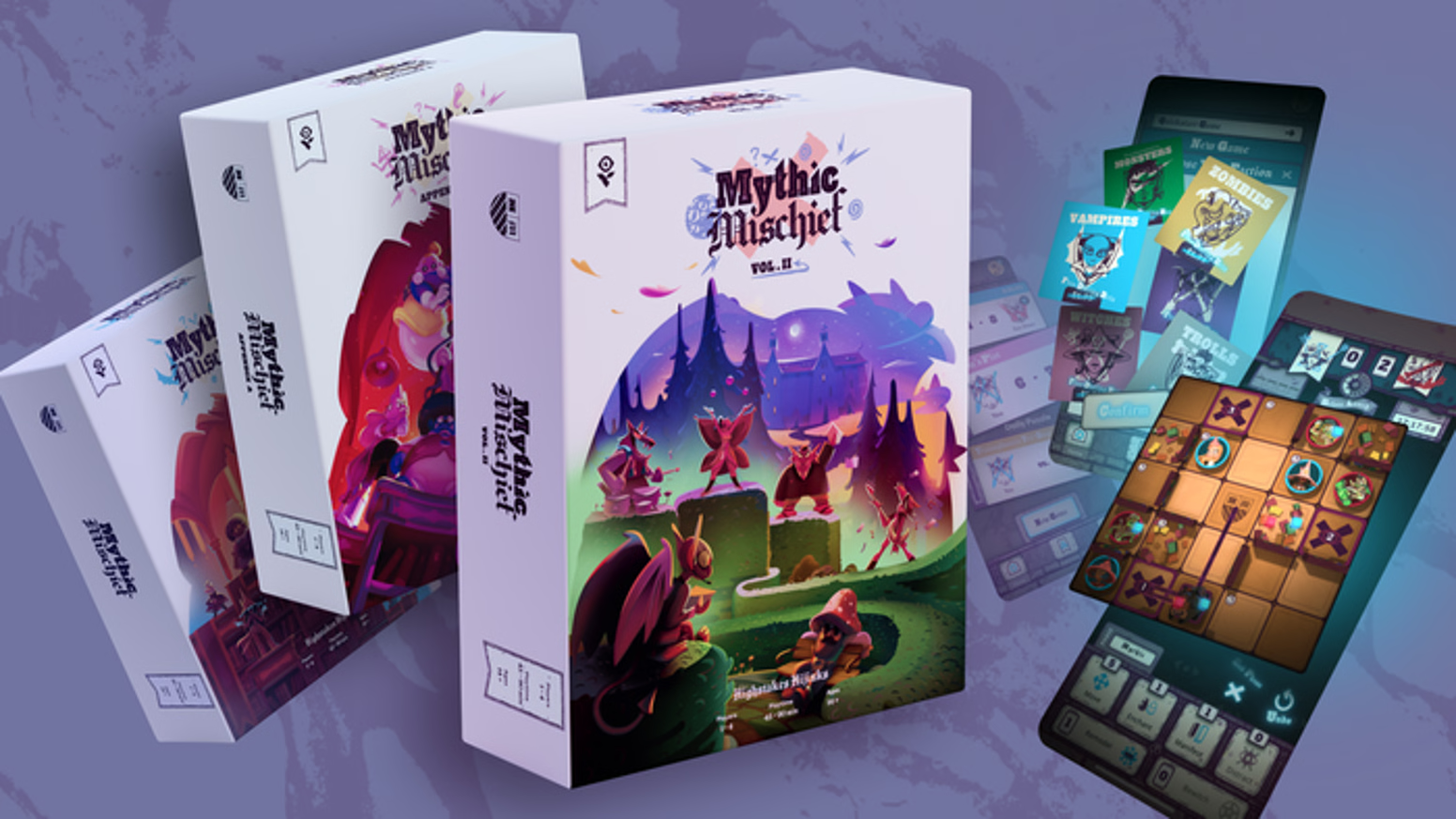
Now, there are two versions of Mythic Mischief available: Volume I and Volume II. Both are very similar in gameplay; much of the difference is a coat of paint; whilst Volume I uses a shelf-stacked library warded by the Tomekeeper, Volume II uses a hedgemaze and an equally mysterious Groundskeeper. The half-way game-change happens After Dark, rather than After Lunch, but practically this happens in the same way.
Both sets have very varied factions too. If I had to make a decision, I think the teams in Volume I are very slightly more balanced; for example,Volume II Fairies can switch Groundskeeper with an enemy, and almost fling hedges around anywhere, seeming superpowered; whilst the Gargoyles are almost entirely limited to nudging things in straight lines. That said, I think the ideas in Volume II are more interesting, and play with the core concept more; the Werewolf that goes Full Moon and can fling other Mythics over half the board is great fun, as is the Gnome with its unique ability to Burrow under the board. As with most asymmetric games, I also recommend playing rounds back-to-back, swapping factions over; its fun, it’s fair, and it removes any imbalance.
Factions play interchangeably between Volumes; ultimately I would recommend you buy the edition that visually appeals most; “Do you like libraries or gardens?”— or even consider picking up both for the full range of factions. I’m not sure there’s quite enough new material to merit owning both unless you really love the core game, although it opens up the double-boarded three- and four-player modes. For me, these add so much extra decision space and long pauses between turns that I’m not convinced they are worth the addition.
Detention mode is the game’s solo variant, and it’s just as crisp as the rest of Mythic Mischief. Your opponents follow programmed patterns, whilst new types of board states can paralyse or even knock out your pieces. It’s a fun way to open up the game, but I didn’t find it anywhere near as challenging as playing against real people. Was it enjoyable though? Yes, absolutely, and it still felt very much like the core game.
The only real potential flaw I encountered is that, like many deeply tactical games, analysis paralysis can be a problem. I played one game where I knew I could win, but it took me slightly too much of my friend’s time for me to place that killer move down. The completely changed board state each turn makes forward planning difficult too, but, that aside, Mythic Mischief is superb. It’s filled with challenging decisions, it’s a delight to engage with, it holds to the play time on the box, and you immediately want to play it again.
The only real potential flaw I encountered is that, like many deeply tactical games, analysis paralysis can be a problem. I played one game where I knew I could win, but it took me slightly too much of my friend’s time for me to place that killer move down. The completely changed board state each turn makes forward planning difficult too, but that aside, Mythic Mischief is superb. It’s filled with challenging decisions, it’s a delight to engage with, it holds to the play time on the box, and you immediately want to play it again.
PLAY IT? MUST PLAY
If you want a tactical two-player game with bite-sized chunks of crunchy play, look no further; Mythic Mischief is for you.
 TRY THIS IF YOU liked Cairn…
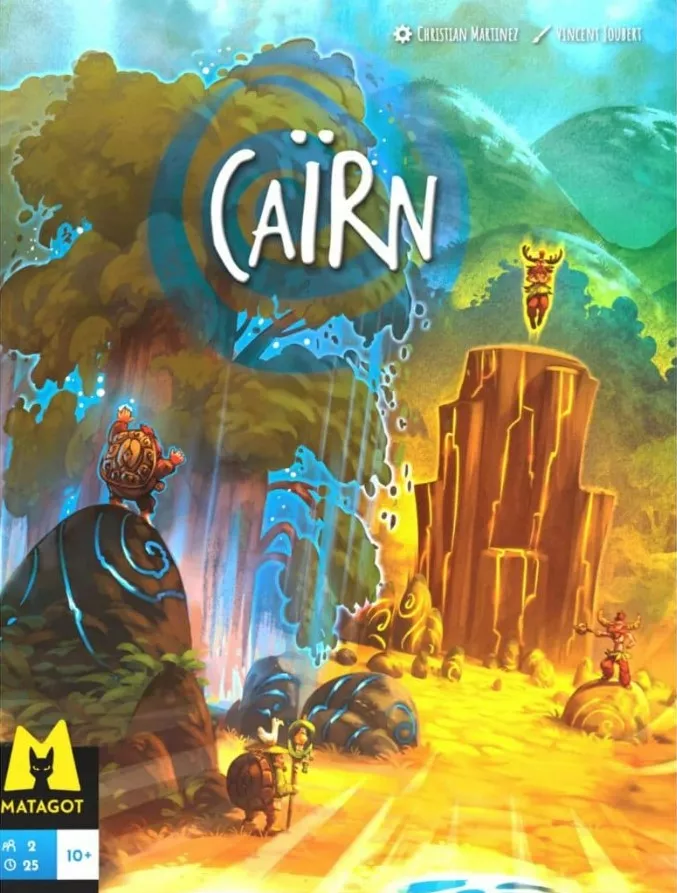
…There are a lot of similarities; Cairn uses flipped action tiles to create a shifting assymetry between players, but both add new actions as the game progresses, gently increasing complexity. Mythic Mischief is the harder game, but both are worthy of your time.
| About Mythic Mischief Vol I & Vol II | |
|---|---|
| Designer | Max Anderson et al. |
| Publisher | IV Studio |
| Playcount | 1-4 Players |
| Age | Age 10+ |
| Price | £54 |
| Contents |
|
| Rating | Must Play |
A review written for Tabletop Gaming Magazine. Magazine page copyright to TTG Magazine 2025.