
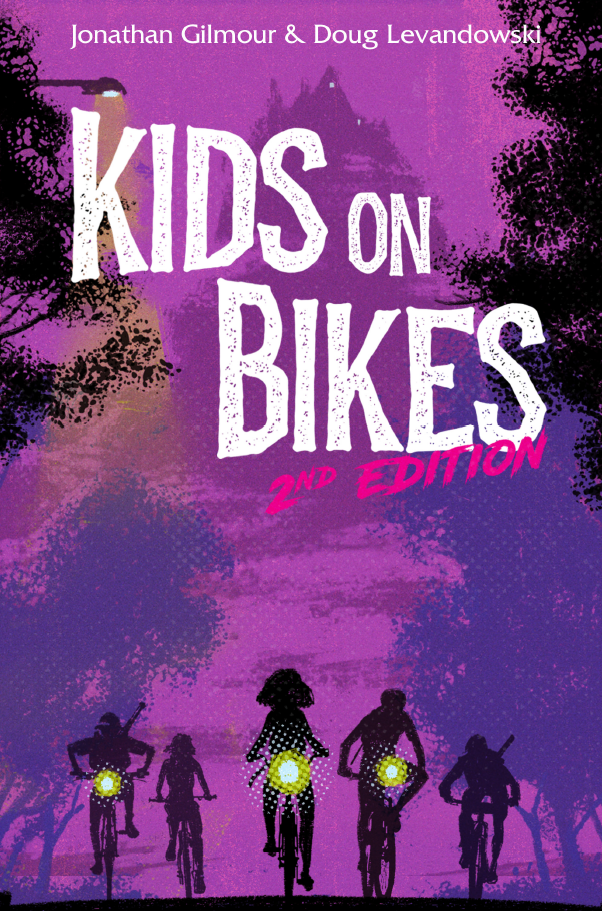
There’s an idyllic point in many of our lives when our bicycle is an enabler of great adventure. My son is 8 and just beginning to whizz around the park with minimal supervision. Then, at some point, we get cars, and we get responsibilities, and the moment is lost. Kids on Bikes aims to keep that snapshot alive and kicking.
Players begin by building a town together. Much of Kids on Bikes is very collaborative, and so the group generate their town together. Little limitation is suggested, although the recommendation is to go for a time before Googling smartphones ruined all the mystery in the world. I liked the checklist of questions provided; “Our town’s main industry is…?”, “A local landmark is…?”, although I felt there could have been more of them. Players then create their characters, assigning a dice from d4 to d20 between “Brains”, “Brawn”, “Fight”, “Flight”, “Charm” and “Grit”, then choosing Motivations, Fear and Obligations. The appendix in the book also provides 23 template characters (called “Tropes”) for quick generation of PCs. The final decision, of course, is what type of bike you want!
The main mechanic of the game is stat checks, aiming to roll over a target difficulty. Kids on Bikes has borrowed from Savage Worlds here, with different size stat dice, and “Lucky breaks”, which happens when you roll the top number on a dice—eg. 4 on a d4, or 8 on a d8. At that point the player rolls an additional dice, meaning it’s possible to get a total much higher than dice size would otherwise allow. Pre-planned checks replace the dice with half the total number; this lets planners know exactly how successful they will be without rolling. It’s also… more boring than rolling. We used advantage rules instead, rolling twice and picking the best.
“Powered” characters are people given a supernatural gifting of some measure. These are usually limited, both in scope, but also because difficult things are harder to achieve, and cause negative effects to the character. Unusually, the Powered character is created by the entire group and controlled by them collaboratively, using a shared pool of Powered Tokens to add d6 to power rolls. It’s a unique approach, especially since sharing a PC is not common in RPG. There are also “Bonded” actions, where two characters share a particular bond like “Working in the Mines together” which allows them to attempt joint tasks, although we found these either too niche to be useful or too artificial to enjoy.
Overall Kids on Bikes has a likeable system, and a few neat touches. Unfortunately, the book itself really lets the whole experience down. The layout is single column for the vast majority, with few pull-out boxes, or varied font highlights to make areas stand out. Examples of play are plentiful, but are mostly written as half page paragraphs with no line breaks, no bold text, no guide to the flow; they are hard to read and enjoy. There is no concise rule summary at the back of the book; even key tables, such as Stat Check Difficulty, are split over two pages, as if no thought has been given at all to how they will be referred to in play.
Adding to this are some strange organisational decisions; the majority of the first twenty pages (an eighth of the book) is dedicated to an incredibly comprehensive safety check list, which would have been better suited to an appendix, whilst most of the key character building tables have been relegated to the appendices. Given that the layout does nothing to help topics jump out, or highlight what is important and what is merely optional, the lack of an index isn’t just an oversight: it’s an unforgiveable omission; once it took me nearly a full minute to reference the mechanic for “Fear”, a key aspect of how characters engage with the world.
The elephant in the room here is that Tales from the Loop and Slugblaster cover the rules-light tweens-around-town ground in vivacious detail, with elegant rules explanations, engaging layout and with a clear consideration of how the GM will interact with the material. Kids on Bikes is worse at every one of these things.
PLAY IT? MAYBE
It’s really a “Maybe… probably not”. If you want to play Kids on Bikes, the system is simple enough to make do with the disorganised rulebook, and there are plenty of good ideas and gorgeous art pieces here; I just can’t really see why anyone shouldn’t go for one of the similar, better options.
 TRY THIS IF YOU liked SAVAGE WORLDS…
…Frankly, I probably prefer the system, but my favourite aspect of that has always been the exploding dice. Kids on Bikes adopts that, and also rewards you with “Adversity Tokens” when you fail, which can boost future rolls!
| About Kids on Bikes Second Edition | |
|---|---|
| Designer | Jonathan Gilmour & Doug Levandowski |
| Publisher | Hunters Entertainment |
| Playcount | 3-6 Players |
| Age | Age 14+ |
| Price | £30 |
| Contents |
|
| Rating | Maybe |
A review written for Tabletop Gaming Magazine. Magazine page copyright to TTG Magazine 2024.