

On opening Mothership’s majestic gold-imprinted box, you are met with the words “Survive. Solve. Save.” It’s a austere epitaph, yet one that hints at immense, hidden depths. This is not an accident; every aspect of the Mothership 1st Edition box set has been engineered to perfectly send that same message—this is a vast-yet-meticulous sandbox of space horror.
Mothership originally launched in 2018 as what is now referred to as the Zero Edition. A hugely successful Kickstarter brought this new First Edition, raising more than $1.4 million; a wild success for a zine-sized engine already available as a free PDF download.
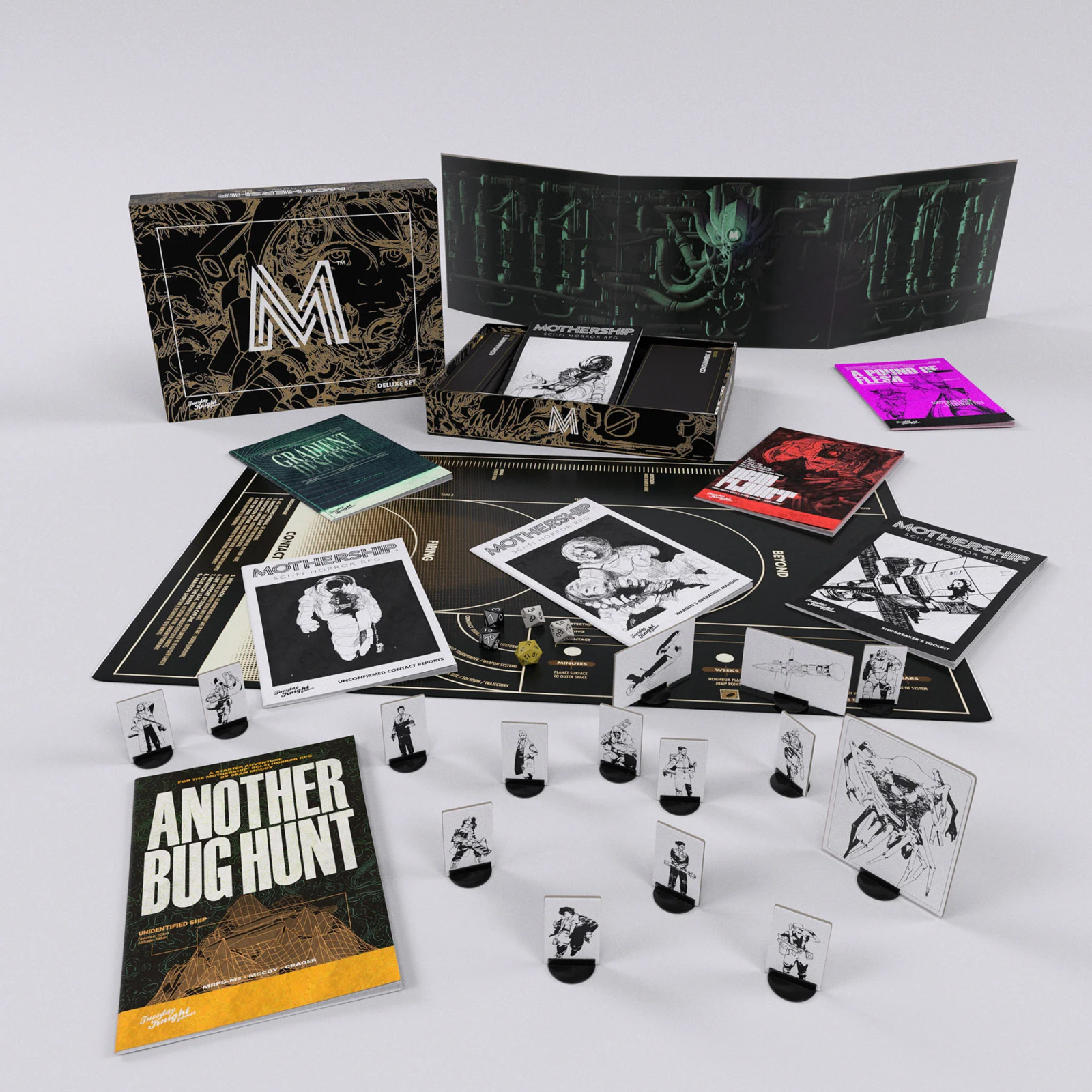
This boxset contains everything needed for new explorers of the game, beginning with the Player’s Survival Guide and the Warden’s Operation Manual. In fact, it probably contains far more than anyone needs, thanks to its inclusion of an expansive Bestiary entitled Unconfirmed Contact Reports, the Shipbreaker’s Toolkit and four excellent adventure modules,
If that seems a bit much, one of the great things about Mothership is that all you really need is the *Player’s Survival Guide:*a single £12 zine, also available as a free PDF download. This covers everything, from playing the game to character creation—although, in keeping with the streamlined design philosophy here—the character sheet itself takes players seamlessly through this process.
 Characters in Mothership are flimsy, fragile things, either with some generalised but low-powered skills such as “Chemistry” or “Athletics”, or more powerful but very niche options such as “Planetology” and “Exobiology”. The system is a roll-under d100 system (a familiar concept if you’ve ever played Call of Cthulhu). That choice was made to allow for wide variances of failure and success, from “missed it by an inch” to “missed it by a mile”. Both games share a similar narrative arc; everything is getting worse, often pretty quickly. Circumstances are set to be particularly tough here; in comparison with CoC, where a character will have a maximum/minimum Intellect of 90/40, in Mothership that range is just 45/27. Skills can boost numbers to a degree, but generally characters will see many failed tests before they die.
At its core, Mothership tells stories about deteriorating horror, with increasing stress and a neat Panic system that increases in severity at the same rate as your chances of success receed. Much as the box warns you, you might get to survive, solve or save the situation—but you’ll only get to pick two. Sean McCoy has been explicit in their design goal here: Mothership may be high lethality, but the aim is for high stakes, for a narrative that absolutely hangs on the tension caused by players and their decisions. I love one piece of advice; “Make every death count”, which advises the Warden to make a big show of pausing and carefully writing the name of dead characters to the Roster in their campaign notebook.
 It has to be acknowledged that Mothership’s form is impossible to separate from its function. If you don’t want a game of inexorably escalating dread, you might have picked up the wrong box of cosmic inhumanity. The GM Guide equivalent here, the Warden’s Operation Manual, extrapolates and demonstrates how the philosophy of play is expressed through the system. Frankly, it’s a superb book, and I think I’ll return to it regularly over the years. In my opinion, the TOMBS system for creating horror arcs is now the guide for building believable tension into scary games.
I also don’t necessarily agree with everything here, and that’s fine too. Aspects that some may consider to be flaws are usually designed in Mothership as a feature—after all, one person’s “minimalism” may be another’s “not enough”. There are no rolls built for social conflict, a decision I personally like, but also know that less extroverted and confident people find roleplaying aspects such as deceit or charisma stressful and unenjoyable. That said, Mothership knows itself to be an OSR game at heart, where your table is yours, where rulings beat rules and the safety and fun of your players is the high priority: Tuesday Knight Games explicitly invite you to hack it and play the way you want to play. My group struggled to explore a meaningful difference between Sanity and Fear rolls a little confusing; so we ditched the Sanity. Again, that approach to systematic adaptation is a feature for me, but perhaps a flaw for you.
There are a few design decisions that I would have liked to have seen that are less philosophical and more practical; for a game with its core set over four rulebooks, an index in each zine seems like a necessity. I also think the weakest booklet is the Shipbreaker’s Toolkit; I loved the 0E ship-building rules, which have been intentionally removed here. I read that “Hull” points are used as ship armour, but almost no other mention is made of them outside of a single paragraph, and even the warship has none? I’m happy to improvise, but I prefer to have slightly firmer foundations to riff off of.
The modules are wide-ranging, from the perfect introductory adventure Another Bug Hunt, which includes superb newbie-Warden hand-holding notes, to Gradient Descent, a 6 floor monstrosity that can be run either as isolated one-shots or a complex inter-connected campaign. They all share a dense crush of information and esoteric random tables that I find thrilling (although, be warned, my ADHD friend described them as “overwhelming”) and a lo-fi high-contrast artistry that sizzles. As in MÖRK BORG, GMs are expected to do a lot with small chunks of specificity: on one page of A Pound Of Flesh, a room transition is described as a “twenty storey climb down sludge-ridden waterfall”. If your brain is eager to turn that single sentence into glorious, glutinous life? Well, you are going to have a lot of fun working with the material stuffed into these colourful booklets.
As a box set, the eight zines included represent around £100 of value on their own, and that’s before you consider the dice, the map, the simple, evocative standees and the Warden’s (GM) screen. The box itself is glorious, overlay printed in gold with ribbon opened “Containment Areas” inside for separating components. The whole package is just an incredibly enticing proposition, promising literally hundreds hours of fun. No one else in the RPG scene has made a box set that comes close to this in terms of value, breadth or uniqueness—and the same can arguably said of the entire Mothership universe.
All in all, Mothership has a magnificent and terrifying clarity, and everyone should take the time to encounter it for themselves. Maybe this game isn’t for every table, but no other system has such a concrete understanding of what it’s trying to achieve, nor equips its players so masterfully with tools to bring that experience into brilliant yet savage realisation.
PLAY IT? MUST PLAY
There are many games that let you die alone in the vastness of space, but none of them do it with quite the panache of Mothership. Surviving, solving and saving are all optional; the real joy is the story that Mothership will weave round you if you give it the chance.
 TRY THIS IF YOU liked 2400 Orbital Decay…
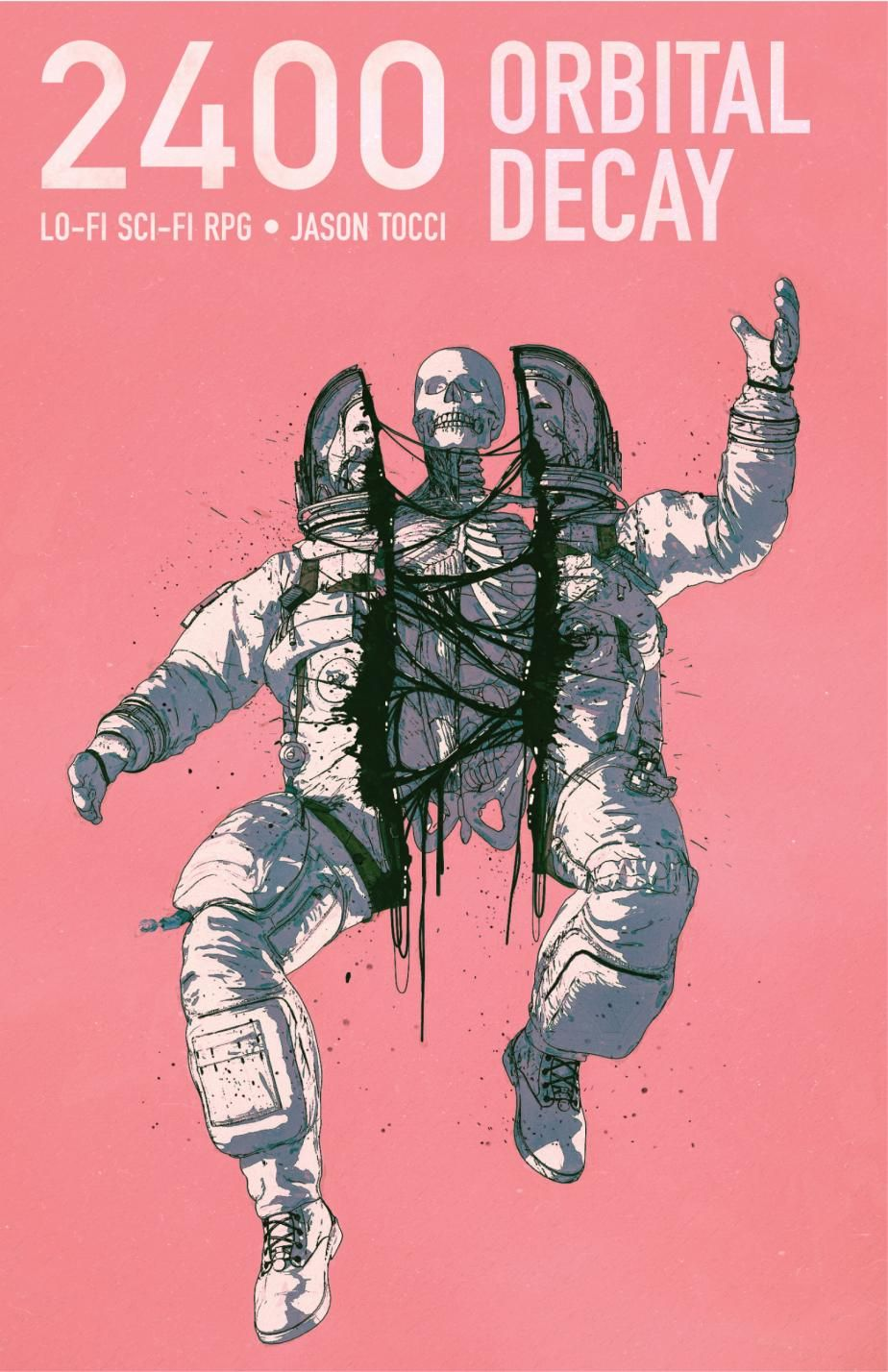
…Jason Tocci’s 24XX system is an even more lightweight approach to the starkness of space, but it will appeal to those who love the minimalism and freedom of Mothership.
| About Mothership Deluxe Set | |
|---|---|
| Designer | Sean McCoy & many others. |
| Publisher | Tuesday Knight Games |
| Playcount | 2+ Players |
| Age | Age 13+ |
| Price | £75 |
| Contents |
|
| Rating | Must Play |
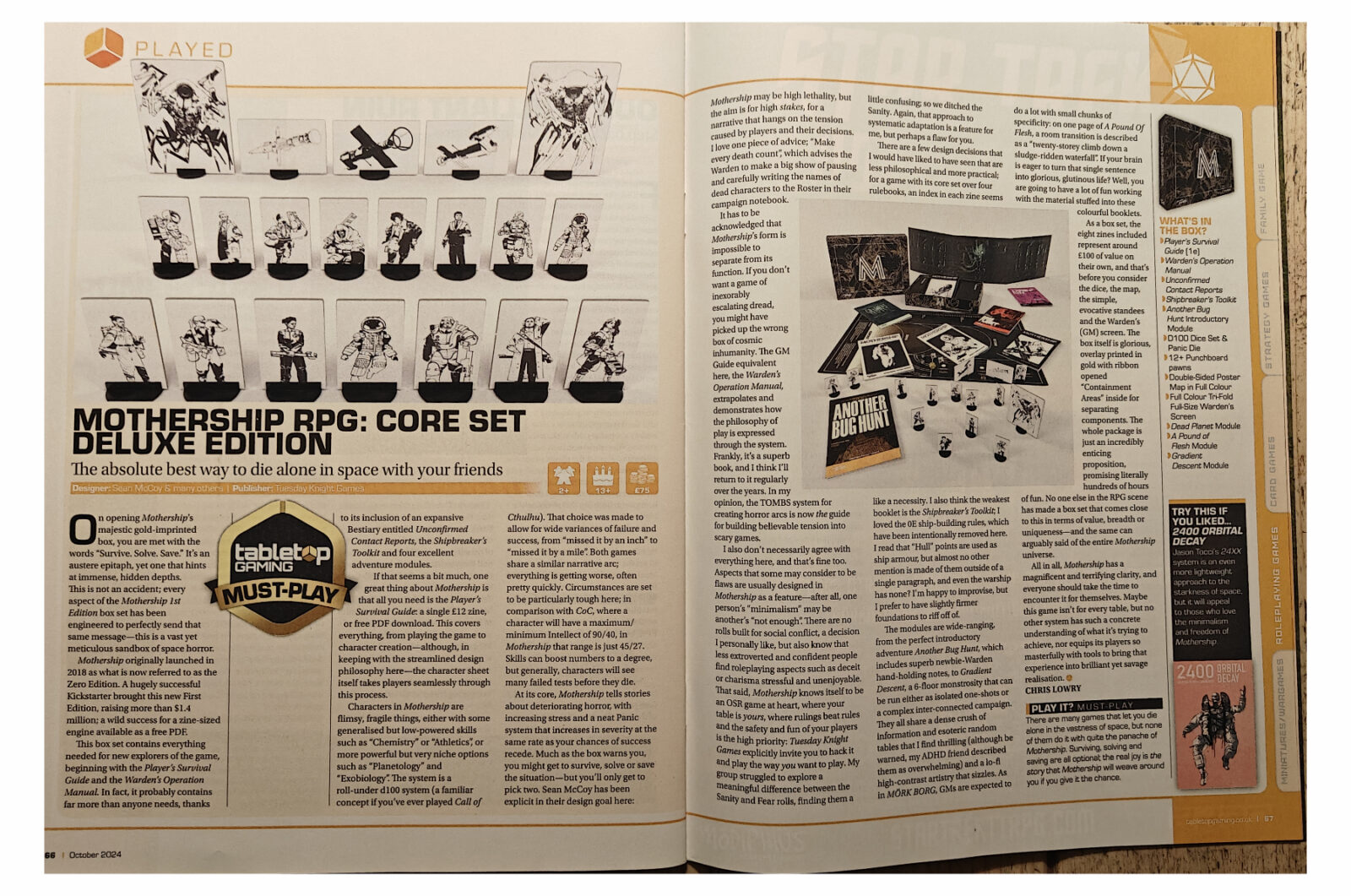
A review written for Tabletop Gaming Magazine. Magazine page copyright to TTG Magazine 2024.