
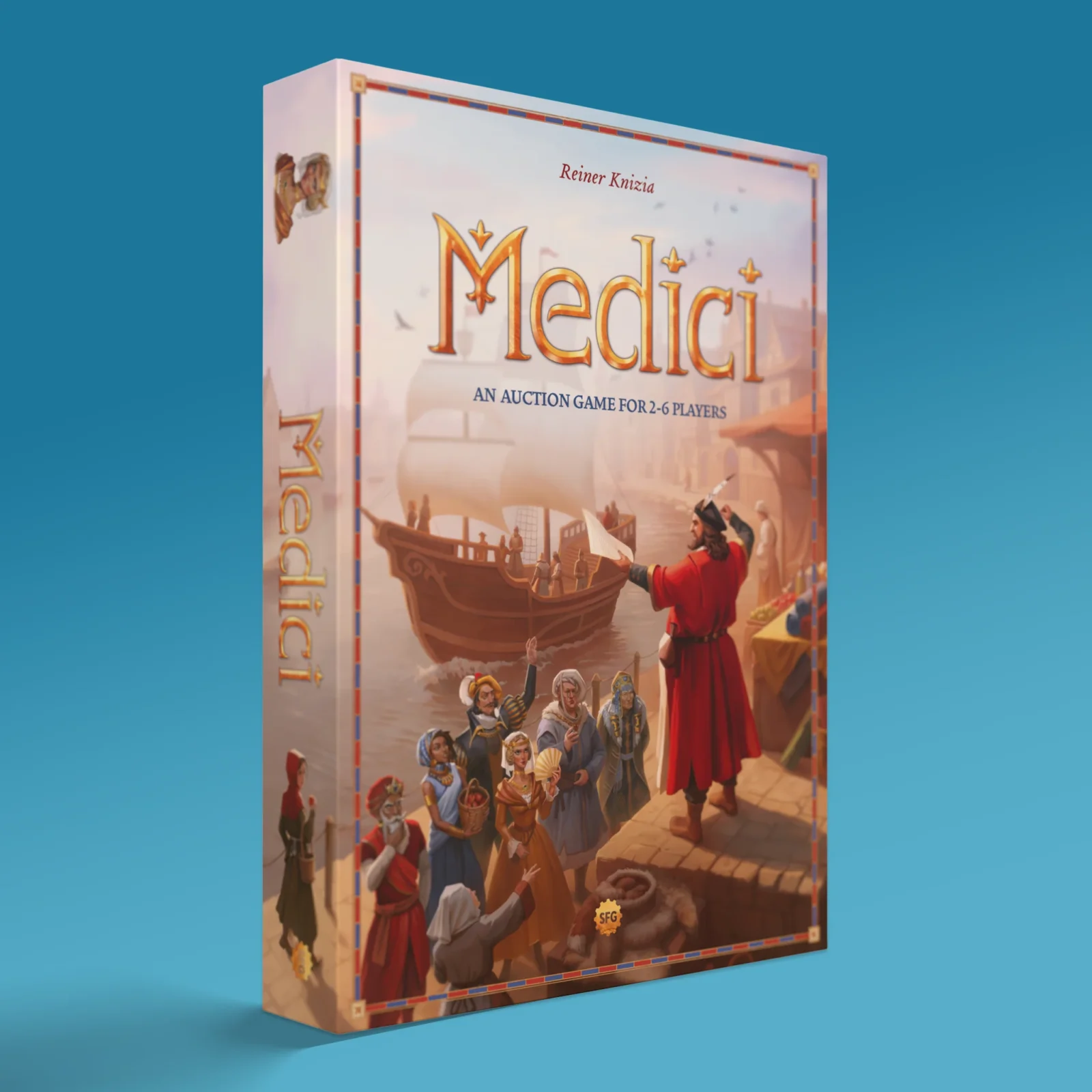
If I’m honest, I’m fairly ignorant to the specifics of Florence’s trading houses during the 16th Century, but I’m reliably informed (by Wikipedia) that the Medici family were the kingpins of Renaissance trade and banking. That ignorance actually translates well to this game of cut-throat auctions, since I never have the right idea about how much to bid for anything either!
In Medici, players compete to buy groups of commodities. They load up their ships and then sell the proceeds, receiving points for the most valuable cargos. Each commodity card also pushes up a player’s stocks in that item; gaining three purple dye cards pushing you three spaces up the dye track. Players then receive points for having the most or second most stock in any one commodity. Then they fill up the ships again, finishing after three rounds; the winner is the player with the most florins.
So, the first thing that makes this game deliciously painful is that every time you make a purchase, you literally spend your victory points. There’s something a little bit terrifying about knowing that, that spending twelve florins to get a tasty new grain card now pushes you back into last place.
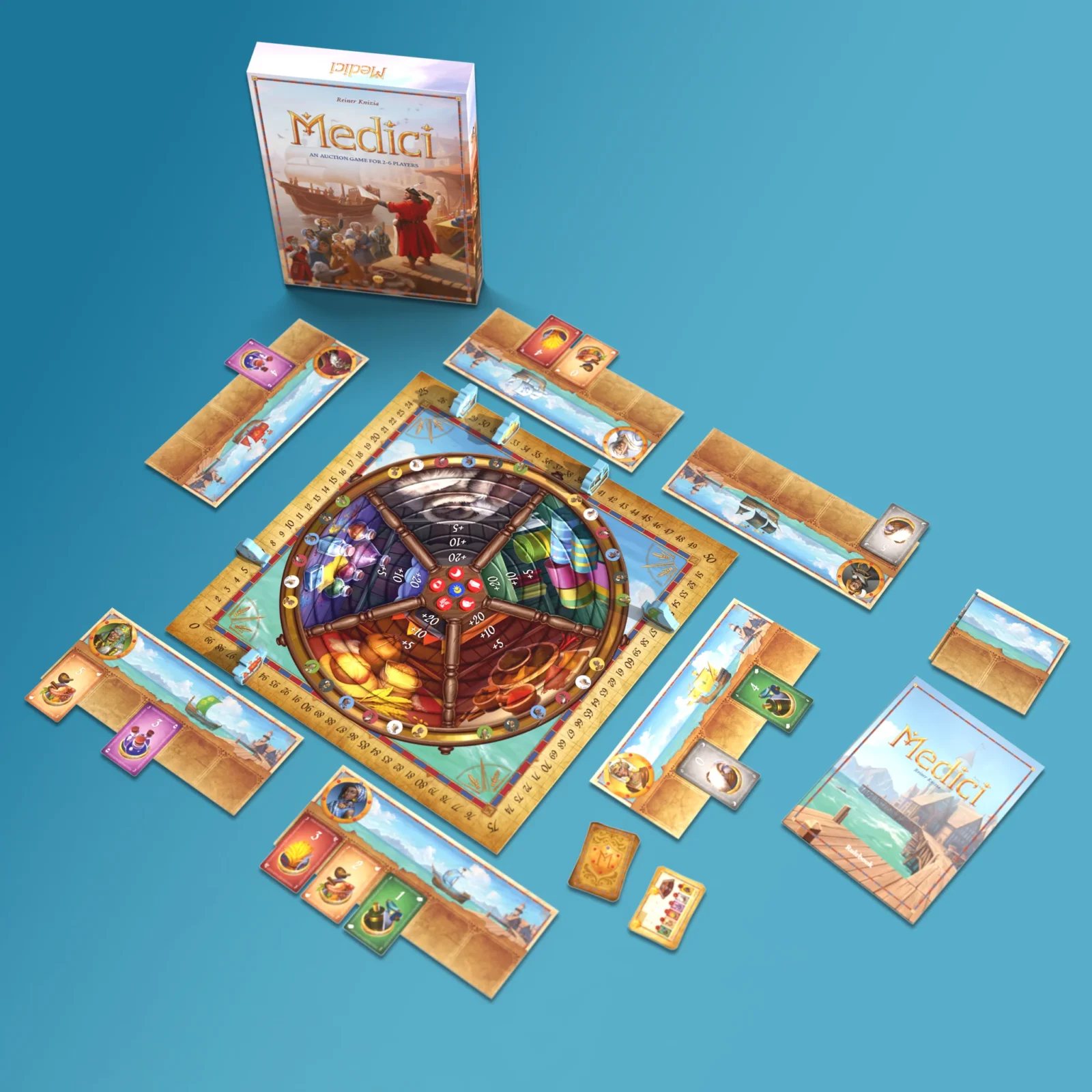 The second piece is the style of Medici’s auction mechanic; it’s a last-and-final system, where you place one bid and one bid only. If you are first in the bidding process you have to try to guess if your opponents will be trying to win the group or not – and, of course, how your bid wiill mpact other’s choices. More than once I’ve won a group I didn’t really want, for more money than I wanted to pay, just because I hadn’t wanted anyone else to get it for cheap.
It’s part of the classic Reiner Knizia “auction trilogy”, alongside Modern Art and Ra. All three are must plays if you enjoying putting your money where your mouth is, mechanically speaking. Like so many Knizia games, the simplicity of the choices is what makes them so powerful. On your turn selecting lots for auction, you can choose between one, two or three cards. This gives you power over who can bid (only those with enough empty slots). Clever manipulation can even ensure that only you get to bid, if everyone else has filled more than you.
Holding off on buying, leaving hold space empty, means you fill your boat for free – but you don’t get any choice about what goods you draw. Is that better than having to spend cold, hard cash? Almost impossible to say.
This version from Steamforged is lovely, but there are a couple of glaring flaws. I’d have liked the lines on the board marking out stock progression levels to have been more obvious, as it can be indistinct when trying to work out where each player is at. Most annoyingly, the grain and spices commodity spaces and cards have very similar colours – it caused us to have to have faffy conversations every single round, trying to differentiate them. It doesn’t ruin the game, but I do wonder what how the nine(!) people credited for art & layout – and the ten for design & development – missed such a basic usability issue. Still, if you want a simple fast game with plenty of satisfying meat on its light-weight bones, Medici is absolutely for you. For a bonus point, it’s equally enjoyable across its entire player count range.
PLAY IT? MUST PLAY
You owe it to yourself to give Medici a try, both because it’s a classic and because it’s really great fun. A perfect gateway game but plenty of punch for seasoned players too.
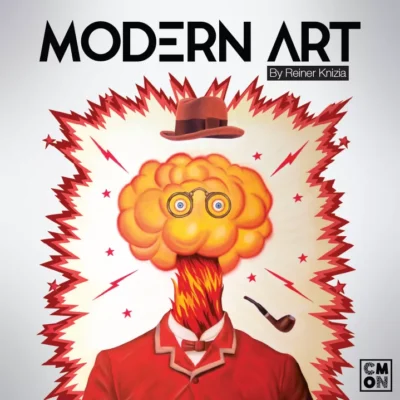 TRY THIS IF YOU liked Modern Art…

…Both revolve around acts for cards, but where Medici is a little more of a traditional “point salad” Eurogame, Modern Art leans much more into trying to mess with other players and mislead them as to your true intentions.
| About Medici | |
|---|---|
| Designer | Reiner Knizia |
| Publisher | Steamforged Games |
| Playcount | 2-6 Players |
| Age | Age 10+ |
| Price | £40 |
| Contents |
|
| Rating | Must Play |
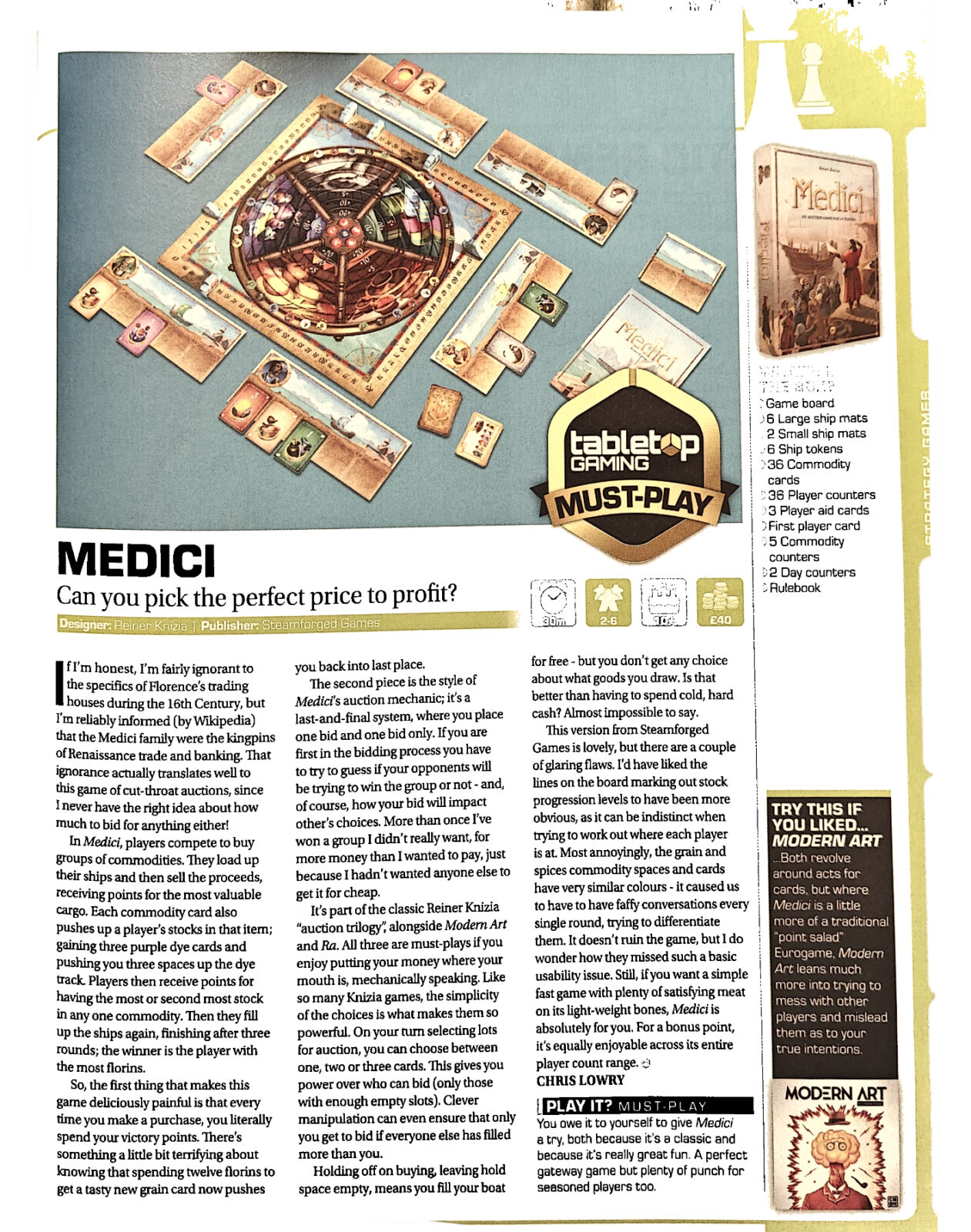
A review written for Tabletop Gaming Magazine. Magazine page copyright to TTG Magazine 2023.