Looming up on us now is “the Summer”, a short period in England marked by approximately four days of moderate sunshine. It’s also a time when people often spend a week or two away, going on holiday with family or friends. This makes it an excellent time to host The Board Game Olympics: a series of competitive events to find out who amongst you is the greatest sportsperson in the whole world! (It should be noted that traditionally, the Lowry Home Olympics are at Christmas; however, a summer season is also well suited to such sportive shenanigans)
Choosing your Competitors
If you are aiming to decide, definitively , once-and-for-all, who is the best at board games; you are going to need some competitors. I would suggest selecting a smallish selection of people in your family or holiday group.
Explain that you are going to play four games over the next few days, and that you need their enthusiasm and participation. I’d also recommend pushing quite hard – my experience is that sometimes it’s Grandma who claimed to be completely uninterested that becomes the most competitive, talking smack about other players and trying to smuggle victory tokens in her handbag.
Holding Your Olympics
I find the best option for timeframe is holding one event a day, with an intro day where everyone gets to play each of the games to familiarise themselves with the rules. Friendly games don’t count towards your score, but they help prevent the seasoned gamers from gaining an automatic success.
For the events themselves, there are any number of options; I’ll give you my simple version. You have four categories, with a game in each, and a fifth ongoing game running throughout the entire Olympics. Awarding gold, silver and bronze medals in each events gives competitors the drive they need to succeed, even if they turn out to be made from tin foil and string.
Event 1: Dexterity
The first fight is based on finger agility. For this, I would suggest something of reasonable length, or otherwise a best-of-five challenge with short games.
Rhino Hero Super Battle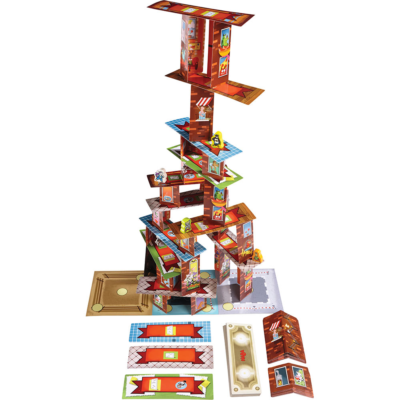
This game is fairly short, but with just enough depth to it to still be considered a “proper” game. Players must build up towers from folded cards, following the special action on the cards, and moving a wooden rhino piece at point, placing it higher up on the preciously wobbly tower. It feels like a more intelligent Jenga, although it still hurts deeply when a tower crumbles away into nothingness and you lose.
Alternate Option: Klask
This feindish game of magnetic torture involves each player laying down their magnets one at a time. Easy enough, except that if you place magnets too close to each other… they snap together, with a “klask!” sort of noise. If that happens, you have to pick them up. This game is lightning fast and infuriating; the best of five will determine a dexterity winner.
Event 2: Strategy
The next category is “Strategy”. Unless you want a full day tournament here, or some complicated points-per-placing rules, I’d suggest a game that will let everyone play at once, or one that’s extremely short. Now, I would recommend staying away from old classics here: you might be tempted to choose Carcassonne or Ticket to Ride; and whilst that’s a great option if none of you have ever played before, there’s just too much advantage to those with prior experience.
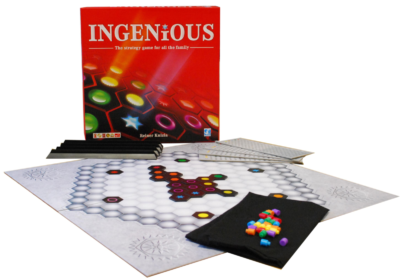 Ingenious
It can be scary buying a new strategy game you’ve never played: Ingenious is a classic that I’ve introduced to tens of people, and everyone has always enjoyed it. Get colours in lines to score points, do it faster than everyone else; if you max out a colour on your scoreboard, shout “INGENIOUS!!” and get an extra go.
Alternate Option: Quarto
Gigamic make lots of equally challenging, deliciously woody strategy games. In Quarto, you try to build four-in-a-row of pieces; four of height, colour, or various shapes. It’s super-fast, so a best of five, feeding into a knockout tournament would be ideal here.
Event 3: Team
Forming your competitors into teams for this one, each gets the opportunity to gain a medal, and to forge victory for whatever arbitrary division you make between them; family name, girls and boys, nerds vs geeks; the options are endless.
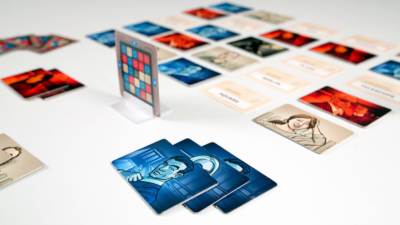 Codenames
I think Vlaada Chvátil’s Codenames is possibly the finest team game for being easy to pick up, but impossible to master. One person must use a single word as a clue to help his teammates select one or more cards from the table. “Snow” might refer to “Mountain”, “St Bernard” and “Clouds” – or it might not! Choose the wrong card and risk helping your opponents, or even instantly losing the game.
Alternate Option: Captain Sonar
For something with a little more crunch to it, Captain Sonar lets your teams hunt each other down in the ocean, firing off torpedoes and attempting to hide from radar. Each player has a specific role, and specific mini-games to complete in order to help the submarine to success. A much higher risk of death than in most Olympic events, but entertaining nonetheless.
Event 4: Card Game
Of all the categories, I think there must be more card games out there than any other type of board game. Again, I would definitely suggest playing something that none of you have played before.
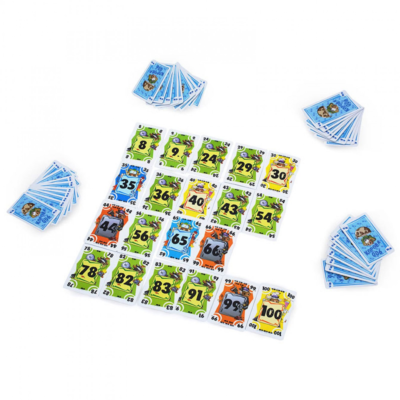 6nimmt!
From the same designer as El Grande, 6 nimmt! means “six takes!” in German, and thus is explained the central conceit of the game. Players try to place their cards, numbered 1-104, in rows, using simple placement rules. However, if they are ever stuck with a card that would make a row have six cards, they pick up the entire row. Trying to guess what cards everyone else will play next is challenging, frustrating and fun. I’d play this in progressive knockouts – all players play, then the loser is knocked out: then play again, until only two are left.
Alternate Option: Villagers
This is a tasty little set collection game where you try to build the most valuable village. Villager cards are claimed and laid down in a tableau, and points awarded in two market phases. You can play Villagers with upto five players, so all together might work. Otherwise, each player has a point score, so you could have two games with different players and compare points for medal rankings.
Event 5: Ongoing
This event takes place throughout The Games, only counting as complete during the final award ceremony.
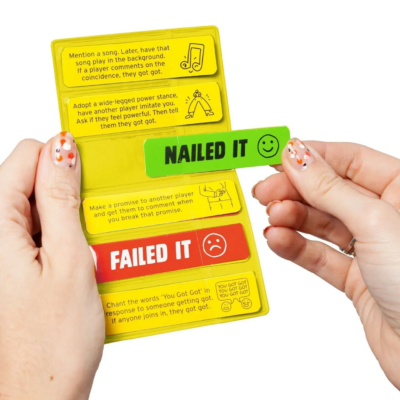 Don’t Get Got
This friendship-ruining game gives every player a wallet of six things they have to achieve, such as “Get someone to hum a tune for you”, or “Make a promise to another player and get them to comment when you break that promise”. For the next few days, every action anyone takes should cause huge suspicion, as you fear the word “You just got got!”. If players finish all their cards, first to win gets gold, otherwise compare progress at the end and award accordingly.
Alternate Option: Yellow Car
Yes, I know, it’s not a board game; you just shout out if you see a yellow car. But still, there’s something about it that gets under your skin, and it adds a continuous element to your competition. There’s no punching each other if you win here, just keep a tally of all the yellow cars, and the highest numbers get medals.