
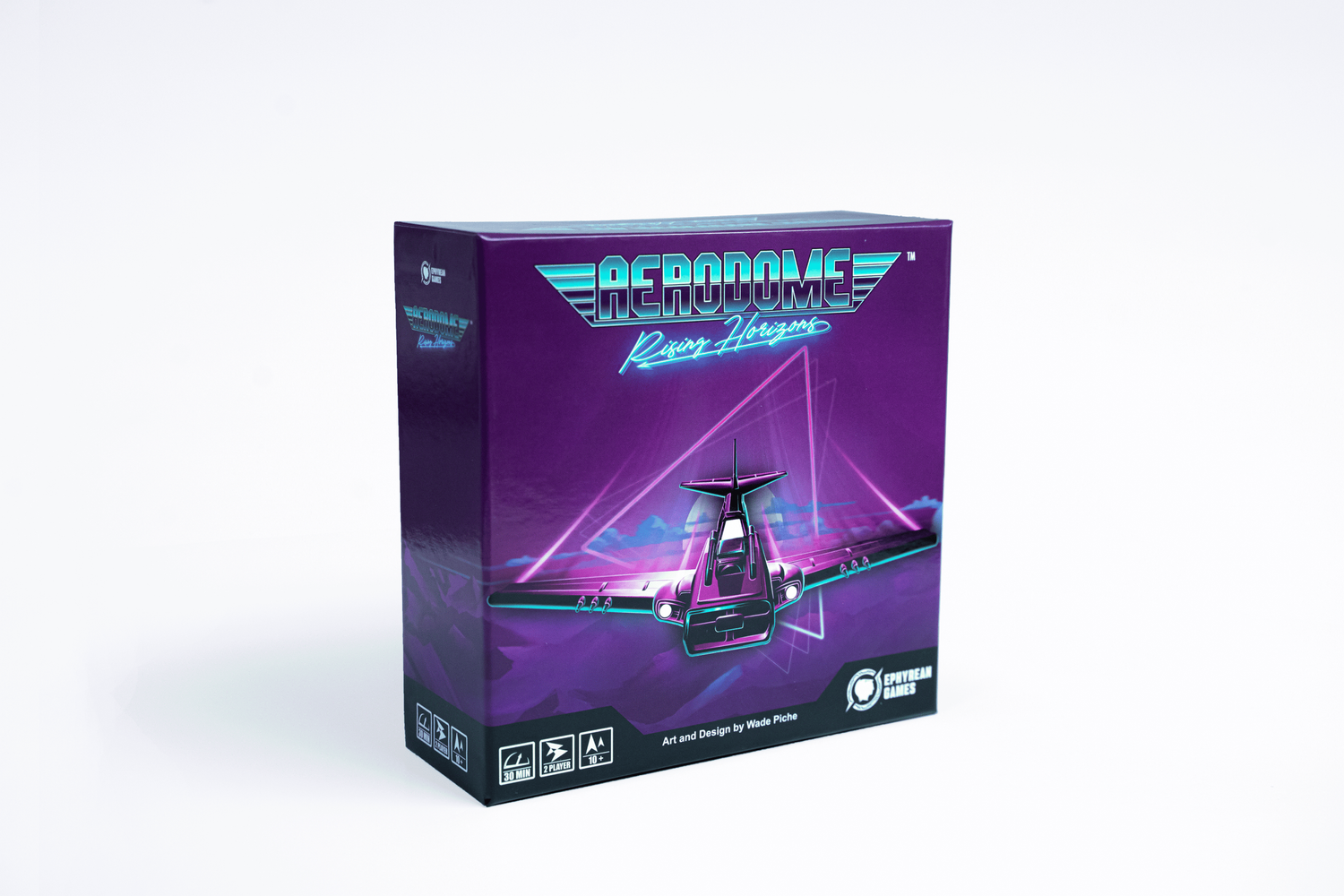
Dogfighting is perhaps the most epic type of duelling. It’s not the only type, obviously. There’s treading the crisp dawn dew as you walk ten steady paces away from your opponent, armed with just your wits and a freshly primed musket – and that might be a more romantic option – but there’s an adrenaline inherent to screaming across the skies that nothing else can match. And yes, my wife did insist on playing the Top Gun soundtrack throughout our games of Aerodome.
Aerodome is a competitive game of aerial combat. Its setting is a universe where WWI biplanes can somehow compete fairly with the laser guided aircraft of the world of Futuria – or with digital creations from a fictional 1979 arcade game called Martaga; a fun theme that doesn’t take itself too seriously. These colourful battles take place in a variety of stadiums; with the last pilot alive taking the prize.
In terms of mechanics, Aerodome occupies an interesting middle ground of card based play, whilst also relying on the position of abstract hexagons on a play mat. Players choose an pilot; selecting cards either from a range of starting decks or using a clearly explained deck builder. Each deck will always have a nine cards, numbered from 1-9, representing the initiative value; higher goes first.
Players then place their hexagonal fighter marker down, and place a single battle card face down. Cards are a hand, not a deck – you can play any card in any order. Players reveal simultaneously, and then the higher initiative goes first. Each battle card has a number of listed actions in its action bar, each of which must be then skipped or performed in order. There are six action types; manoeuvres such as “straight”, “turn”, “rotate”, “roll” and “immelmann” (going forward and then flipping 180° to face the direction you started from); or “attack”, where you shoot your guns.
Manoeuvres manage a lovely combination of being simple and precise, whilst still being irritatingly difficult to predict where you or your opponent will end up. They include a number, such as “Turn 3” or “Straight 4”. Using the templates provided (in this case, three or four inches respectively), the hexagonal fighter markers slot in perfectly, making movement indisputable. Vehicular combat games generally rely on accuracy, and blurred lines are a recipe for arguments and disappointment; Mantic’s Armada is an example of a game getting it right, whilst the somewhat similar Dystopian Wars is horribly woolly. Aerodome’s abstract markers and templates achieve it the honour of being the most precise combat game I’ve ever played; when you hit, you hit; no argument.
Shooting is similar, place down the shot template to show the arc of fire from your fighter. Anything underneath is hit, and then the number of the action determines how many six-sided dice you roll to hit. Any rolls over 5+ cause a point of damage to your opponent; get them down to zero and you’ve won.
The underlying game is thus very easy to pick up and teach. There are some nuances; actions with a padlock can’t be skipped, whilst actions highlighted in black are “reactive”, meaning players can choose to move “1” instead of “3”, for example. Some cards have extra effects like “scorch”, which sets your opponent on fire, or “pierce” which lets you take damage to gain an advantage in your shooting. Many cards also have score such as “dazed 2”, which means they get put to the side with a dice on top turned to 2. Until you’ve played other cards with a “recover” value, you can’t bring the dazed cards back into your hand. This is a neat way of balancing overpowered cards, and from preventing players from performing the same action repeatedly. With some decks you can find yourself with half your cards waiting to be recovered; it feels little like a dance.
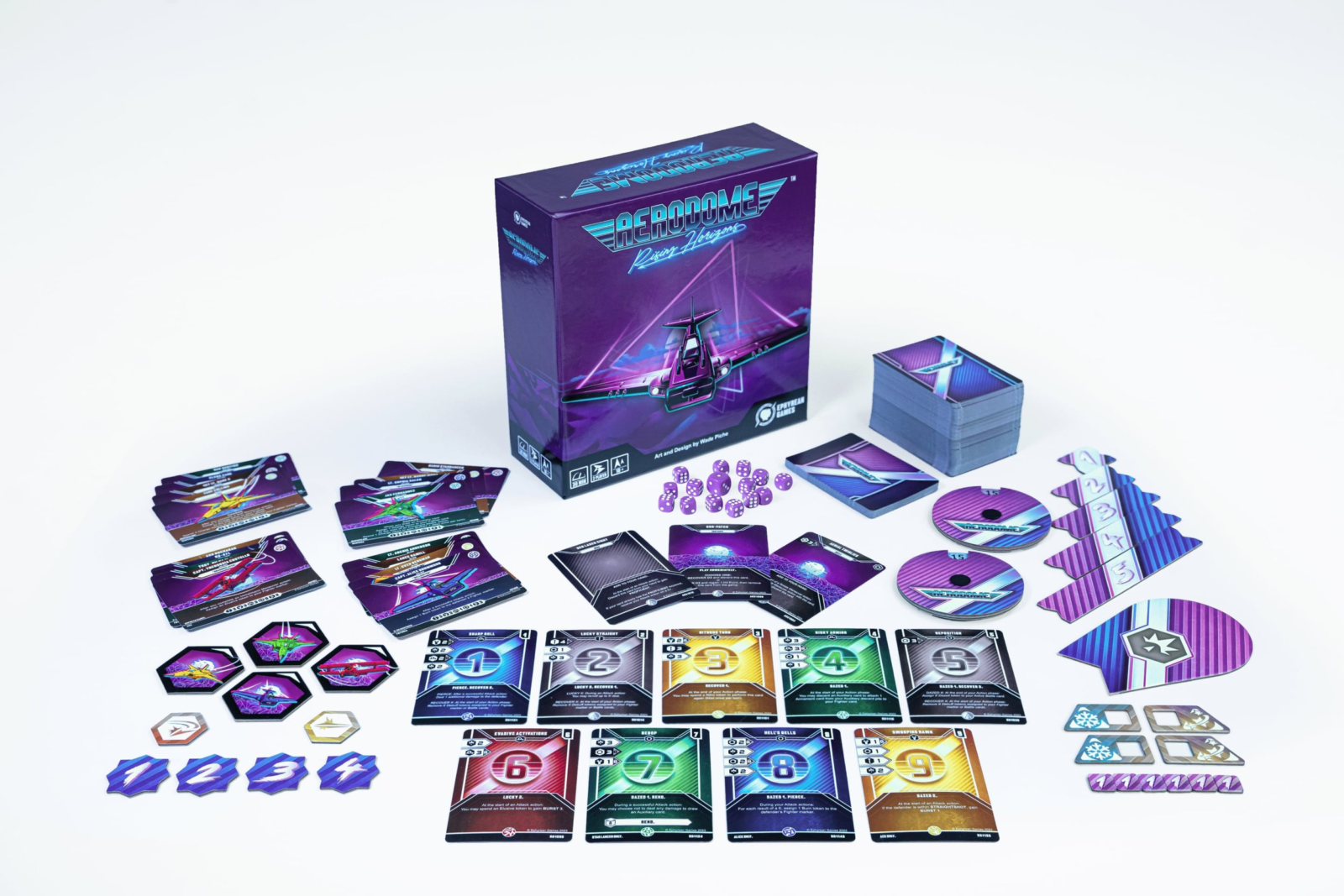 Finally, and as more of an optional add-on, the game introduces Auxiliary cards. These are limited use cards that improve other cards, or that can be equipped and used for additional or altered attacks. They randomly generate each turn, like the loot boxes parachuting to earth in the Worms series of videogames. I found that often these added a layer of complexity that was both a little too swingy for advanced players and too much for beginners to handle.
There’s a lot fun to be had in Aerodrome just whizzing around the mat with the pre-built decks; for the deeper divers, there’s a full deck building mode, complete with an online deck builder which is one of the most intuitive I’ve ever used – impressive considering Aerodome is made by such a small studio. Obviously it’s helped in the restriction to only 9 cards in each hand, but there’s a lot of options here for those that find the game captivating. The pilots are split into four main styles; some having boosts to their shooting, others to speed or initiative. One type, the Daredevils, can choose to take damage in order to slightly adjust mechanics of the game for a turn.
Unfortunately, for a title so clearly designed for replay and deep immersion, there were some significant issues we struggled to get past. The most important was the shooting. In Aerodome, nearly all attacks hit on a 5+. For something so tactical, having such a low hit success makes things feel very swinging and imprecise. I know real life dogfighting consists of large amounts of flying around and not hitting as much as you’d like; in cardboard form that’s just not that fun. You’ve cunningly lined up behind your opponent in a setup that’s taken a couple of turns: you roll 3 dice, and all of them miss. Shooting simply doesn’t feel dangerous enough.
It might seem like I’m getting focused on a weird issue, but having two thirds of shots miss makes the game much longer too. It also stops most Daredevil abilities from being worth using. Why would you take a guaranteed point of damage to let you get in a sneaky shot when even rolling 3 dice you’ll have a 30% chance of hitting nothing at all, compared to a 25% damage of causing more damage than you just took? In the end, we began playing with hits on a 3+, which helped with many of these issues; but at Tabletop Gaming we always review the game as is, not one we’ve tried to fix ourselves.
That’s not the only issue we had with Aerodome. For the most part it was fun and fast, but we did find wording on cards unclear or strangely worded at many points. It took us too long to work out that the “Disorient” card only impacts a plane in the next round, not the current one. We also found that setting planes on fire with the “scorch” action wasn’t nearly as satisfying as it could have been, generally just causing a single point of damage further down the line rather than swelling into something more catastrophic.
I enjoyed my time with Aerodome, even if it does tend to outstay its welcome; thirty minutes of fun that too often takes sixty. The neatness of the movement and combat is very moreish; if that appeals you should strap into the cockpit and take it out for a spin.
PLAY IT? MAYBE
Although Aerodome has some balance issues, if you can look beyond them, there’s a charming little two player combat game with years of replayability in the box.
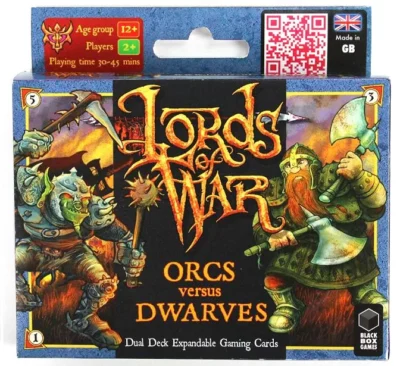 TRY THIS IF YOU liked Lords of War…
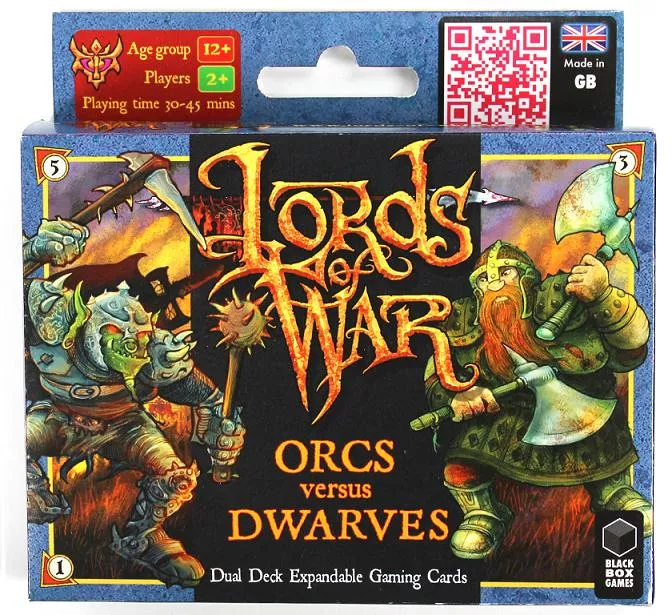
…Both introduce a novel mechanic for dual combat; where Aerodome sends hexagons in well-described loop-the-loops, Lords of War places cards down on a grid almost like chess pieces.
| About Aerodome | |
|---|---|
| Designer | Wade Piche |
| Publisher | Ephyrean Games |
| Playcount | 2 Players |
| Age | Age 10+ |
| Price | £40 |
| Contents |
|
| Rating | Maybe |
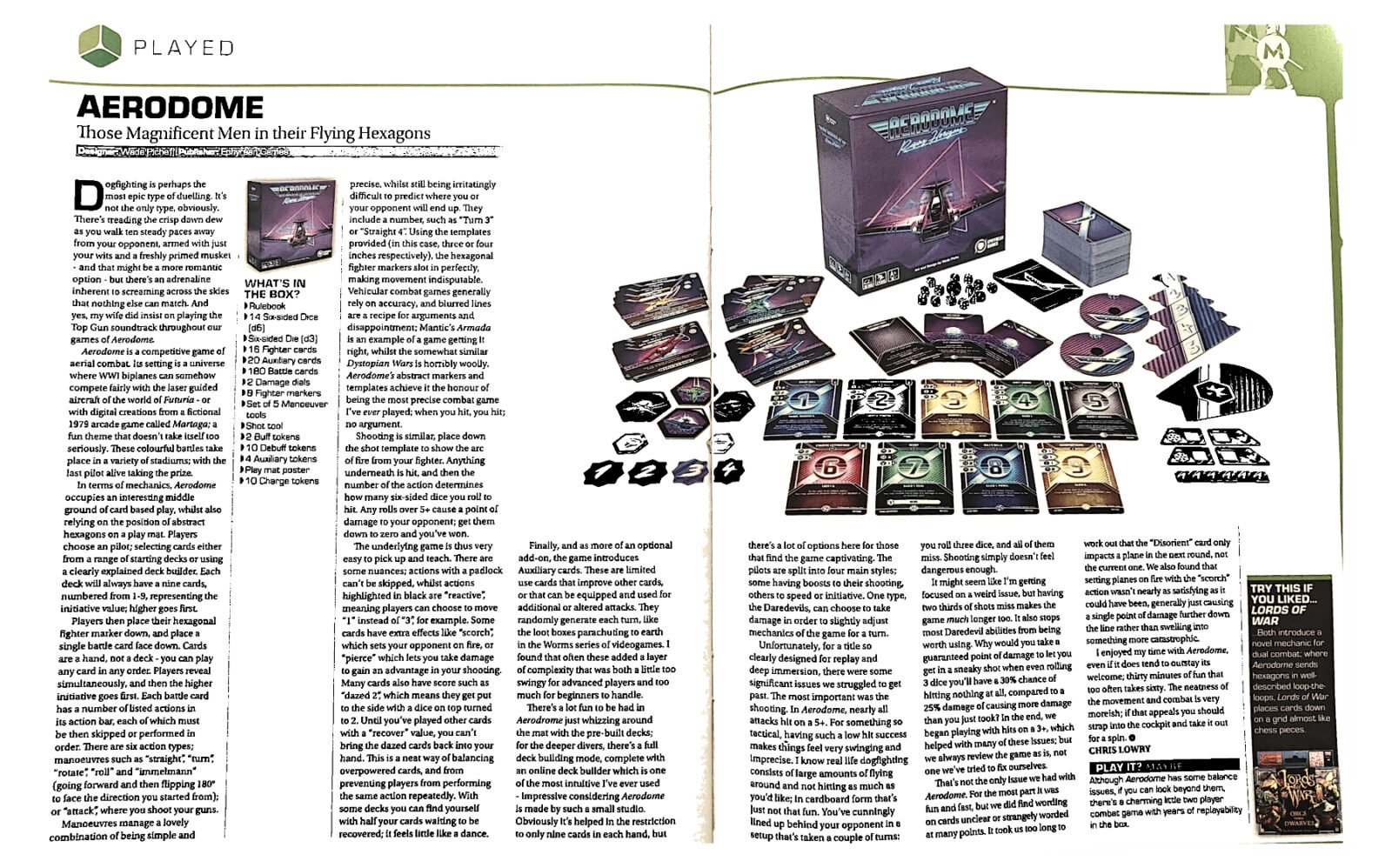
A review written for Tabletop Gaming Magazine. Magazine page copyright to TTG Magazine 2023.