
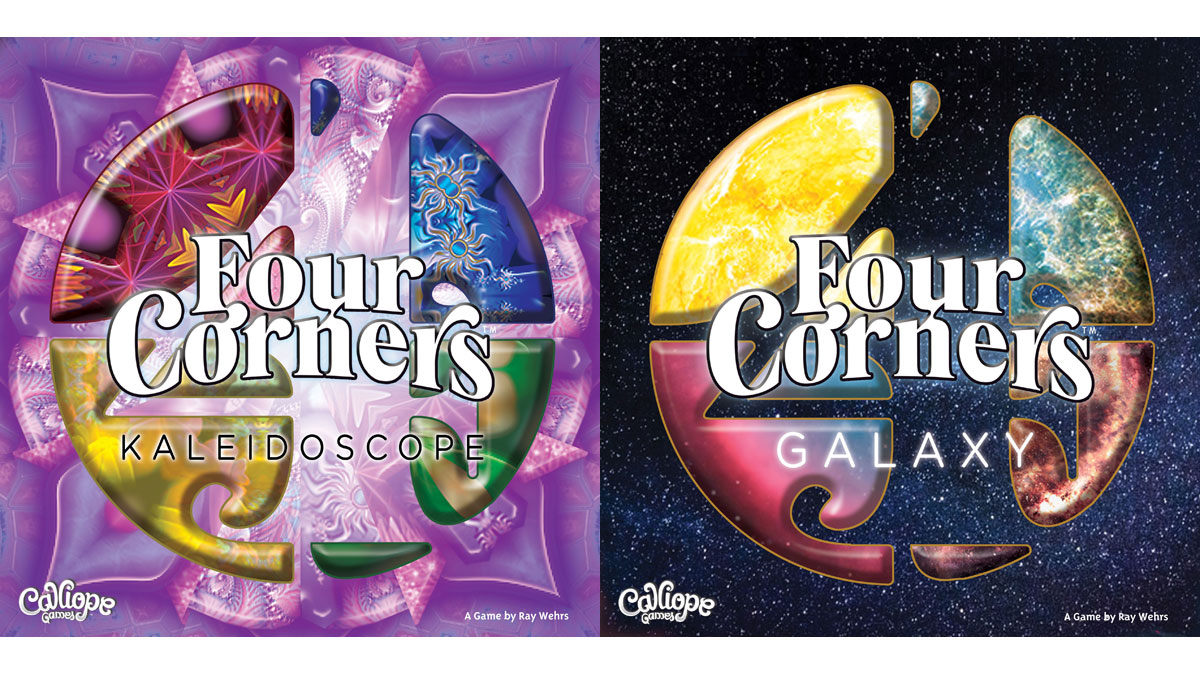
Four Corners is an abstract game of matching corners and forming patterns. It’s actually available in two versions: “Galaxy”, which is planet themed; and “Kaleidoscope”, which uses spectral patterns and neon colours. Both are colourful and attractive, but since the games are mechanically identical this review covers the pair.
The game takes up a surprisingly large amount of table space, with a four piece plastic “Tip-Pivot” board that clicks solidly together – although it does creak a little alarmingly on separation. It’s built to allow tiles to be easily placed and picked up, with gaps underneath each tile corner. It’s more functional than fantastic, but it’s undeniable that picking up tiles repeatedly would be a chore without it.
Players hold a hand of 3 tiles, each with a central image and a quarter of an image in each corner. They also have three secret goal tiles with a single image on each. So in Galaxy, you might have goals of two fiery suns and a blue Earth-like globe, whilst Kaleidoscope would feature several spiky splashes of colour. Scoring points is achieved through matching your goal images in four joined corners – known as a “Four Corners Image” – or making sets of the goal image in a line of tiles that the rulebook calls “An Iconic Sequence”.
Each turn players can place a new tile, rotate other tiles or use some of the occasional special actions. The first to match all three of their goal tiles win.
Sounds simple, right? Well… it is. In fact, Four Corners is disappointingly basic, to the degree that victory comes down almost entirely to the luck of the draw. I kept thinking there must be something more, an advanced mode or hidden strategy; but there’s really very little to this game.
There are some touches I did enjoy – for example, as players score their goal cards they don’t pick up new ones. This mean the leader has less options for their final points, providing a gentle catch-up mechanic for everyone else.
After a goal is scored, the involved tiles all have to be rotated by a certain amount or swapped over; a clever player can arrange this to allow them to chain scoring moves together. This can feel very satisfying – unless you are the loser watching it happen on the other side of the table, anyway.
Overall I felt the entire experience was physically larger than it needed to be, with a huge square paged rulebook much harder to look through than a trifold pamphlet, and a board tabletop requirement of around the same space as four chess boards.
The number of spaces on the board also meant that as games progressed it became tactically impossible to stop other players from scoring literally any image they wanted – with a potential of 24 intersecting corners and only 4 potential images to form, making combinations quickly stops being any kind of challenge. It’s a shame, because at earlier stages players can review everything that’s been laid down and block obvious formations; I kept hoping to keep the game at this cat and mouse whack-a-mole level, but it always sprawled too wide for any player to goalkeep all scoring eventualities.
The solitaire mode was interesting, with only a single pivot board and some tighter limits, although ranking yourself against a maximum score of 5 still doesn’t allow for much longevity.
The highlights, such as they were, weren’t enough to save Four Corners for me. Even my young children found it unexciting – and they think Uno is good!
PLAY IT? NO
An ultra lightweight experience that might appeal to fans of colourful tiles, but for most of us it won’t cut the mustard.
TRY THIS IF YOU liked Connect Four…
…Yes, that’s not a comparison I’ve ever made before, and it’s a jarring note for Four Corners that Connect Four is definitely the better game. But if you do happen to love one of these, then the other will definitely resonate.
| About Four Corners Galaxy | |
|---|---|
| Designer | Ray Wehrs |
| Publisher | Calliope Games |
| Playcount | 1-6 Players |
| Age | Age 8+ |
| Price | £35 |
| Contents |
|
| Rating | No |
A review written for Tabletop Gaming Magazine. Magazine page copyright to TTG Magazine 2022.