
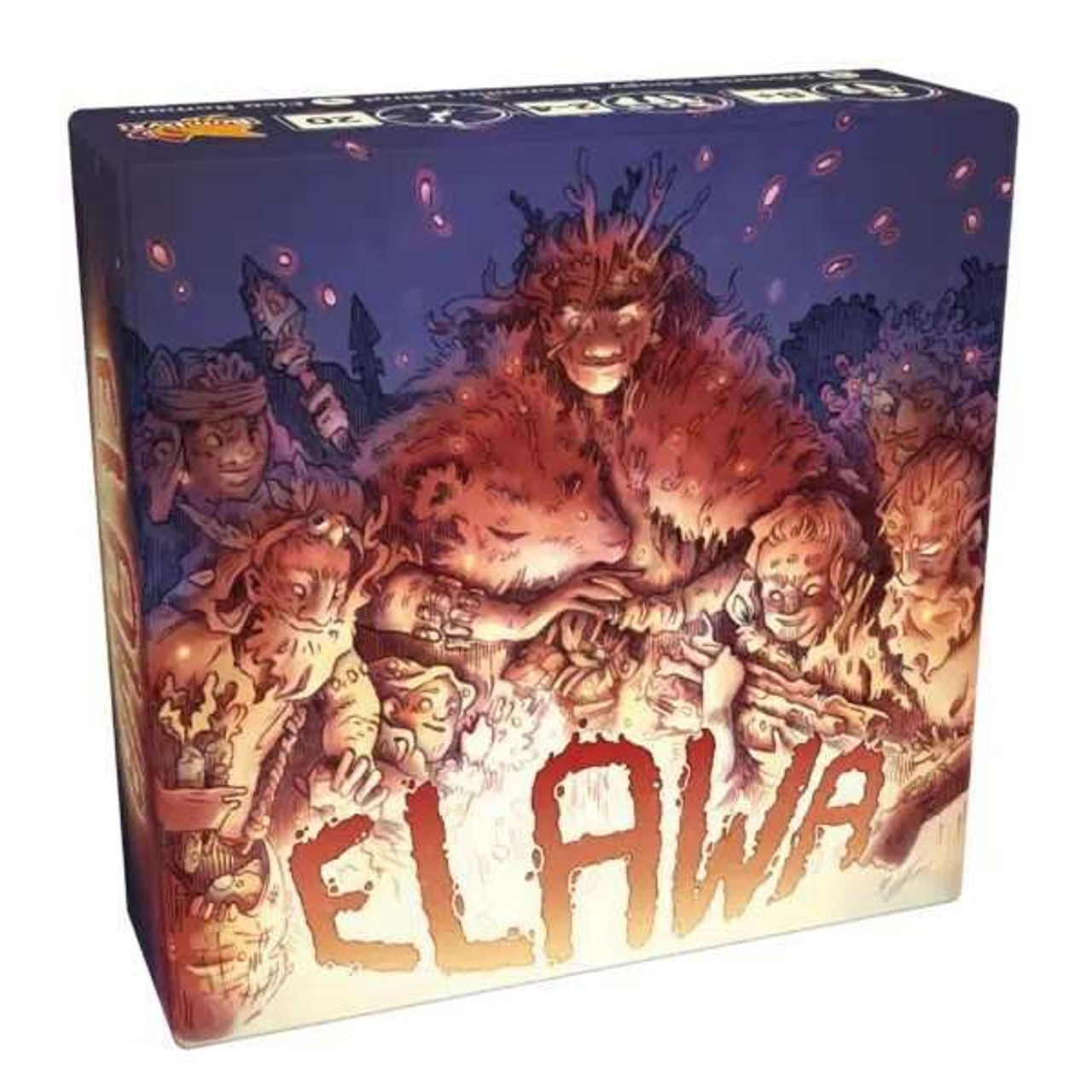
Elawa is a card game of assembling groups of neolithic people in a competitive attempt to build up the best tribe. It’s relatively simple, although there are some nuances to its resource management and set collection that elevate it in an extremely crowded field.
You build your village from Tribe cards; each turn you choose a card from one of the six central stacks. Each card has a resource number; you take a matching number of tokens from the piles in clockwise order from the stack. If a token pile you would take from is empty, you instead collect from the central fire pile and refill the empty resource pile. If the central fire pile is empty then finish the round and the game ends.
The Tribe cards come in four variants: people, each worth a varying amount of victory points; huts, giving points for sets of card colours; storage, which you collect resources on for points; and tools, which reward card type sets. Collection synergy is thus the aim – build two huts that reward purple cards and a purple tool that rewards huts? You’ve mopped up half a victory already.
All the Tribe cards have a range of resource costs; one might need a meat, skin and a berries token to build, whilst another might be free to place in your village. The costs reflect the potential value of the card; since you can only pick up one per turn, choosing carefully is important.
This choice, sadly, is where Elawa comes a little unstuck. There is never quite enough choice to build a winning strategy that is sturdy enough to cope with the variability of cards and resources; I’ve selected a hut that rewards yellow cards, only to see no more yellows for the rest of the game; I also built a storage card that rewarded the rarest resource – skins – with 3 points, only to have my opponent swipe one that rewarded the commonest – berries – with 4 points each!
The mechanism for game end plays into this; the game ends when the central fire pile empties, intentionally opening it up to player manipulation. The added choice is there for players; do they purposefully avoid empty card piles, or do go for it, but hasten triggering the game end? An early finish might be preferable even, especially for the player currently in the lead.
Unfortunately, despite this well-built piece of player control over end-conditions, the rest of the game is usually too luck-based to prevent this just providing a further boon to whoever has found themselves in the lead.
The advanced player mode adds bonus Chieftain Powers to each player. The Powers are a little unbalanced; one could potentially allow a player to pick up an extra resource every single turn; another only allows a player to skip resource piles when picking up. Given that the resources are collected face down, there’s very little advantage to this, whilst an extra token every turn could be an economic game-winner. I found the Powers were more useful as a handicap system, giving my seven year old an advantage over me; “advanced” play should be more strategic than this.
A congratulatory node should be made to the creators more using the ColorAdd system on cards – an inclusive, nondiscriminatory language of symbols that enables colour blind players to identify colours. Increased accessibility in our hobby is a win for everyone.
Despite its flaws, I’ve had a number of enjoyable games of Elawa. It plays slightly better at 4 players than 2 – simply as it becomes impossible to block everyone’s set collection, whereas in a one-on-one game it is possible to quite thoroughly see and prevent someone attaining their goals – but it’s playable and fun at all player counts. Its heavy dependence on luck stops it from being a game I’d recommend heavily, but I could probably be tempted to a quick bout between rounds of something more skilful.
PLAY IT? MAYBE
There are better games for set collection, such as Jaipur or (sort of) Schotten Totten, but if you like the setting and you want something where you can always blame your cards rather than your brain, Elawa may work well for you.
TRY THIS IF YOU liked Hanabi…
…Collecting sets and scoring points, Hanabi is a co-operative approach to the genre, whilst Elawa allows you to take on your friends. Both of them use a fire motif too, although a campfire is less exciting than a rocket exploding.
| About Elawa | |
|---|---|
| Designer | Johannes Goupy & Corentin Lebrat |
| Publisher | Bombyx |
| Playcount | 2-4 Players |
| Age | Age 8+ |
| Price | £15.99 |
| Contents |
|
| Rating | Maybe |
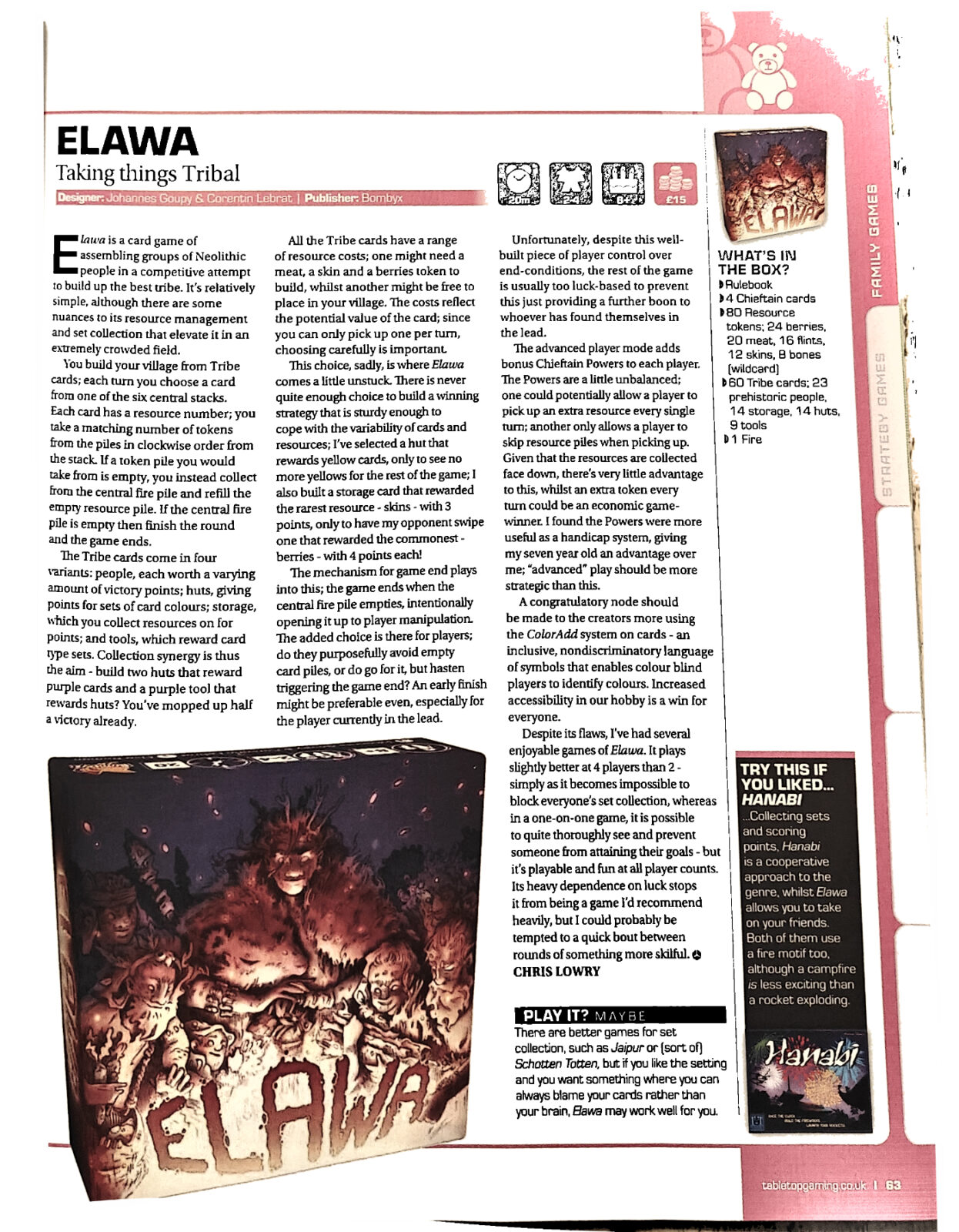
A review written for Tabletop Gaming Magazine. Magazine page copyright to TTG Magazine 2022.