
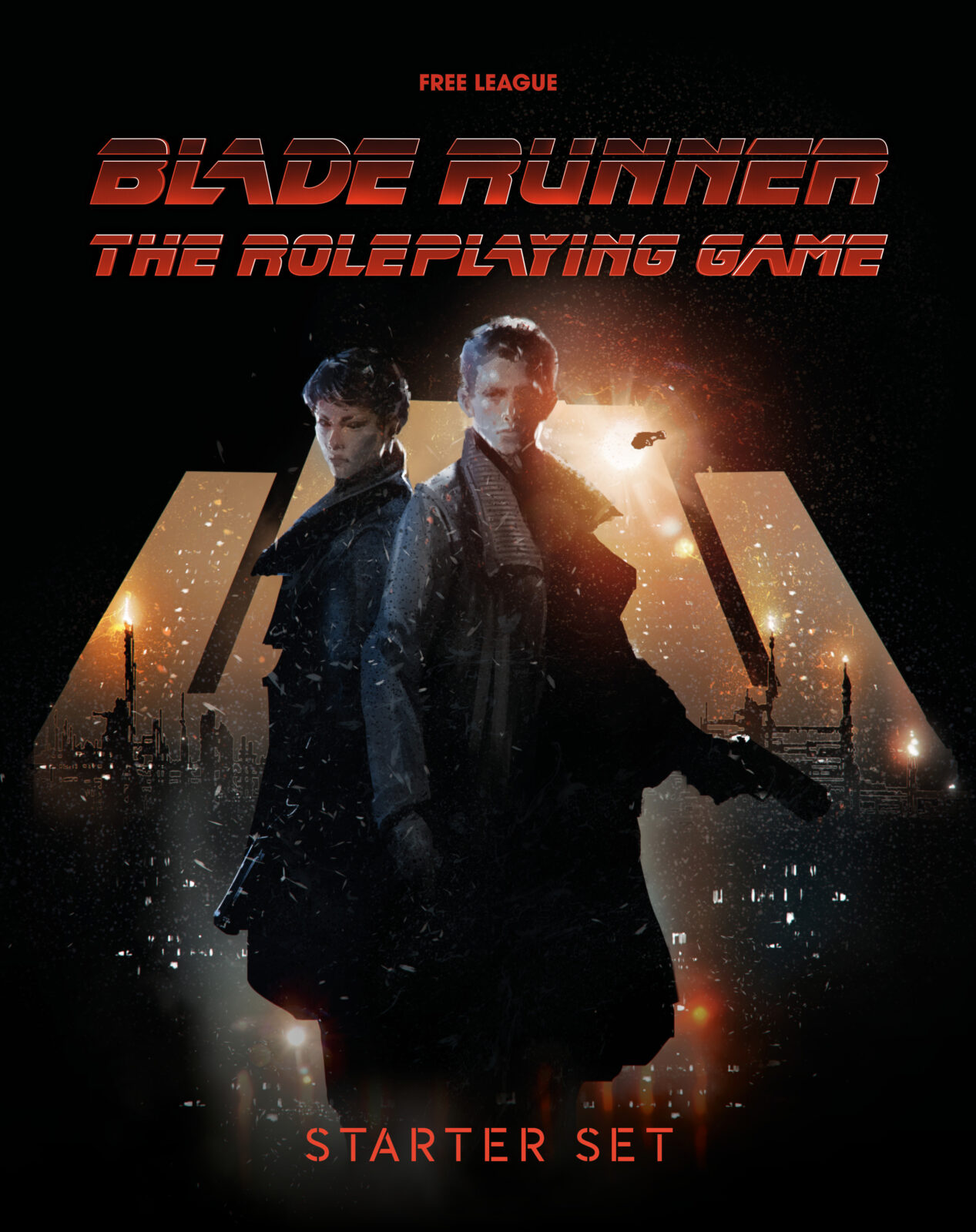
The problem with adaptations of well known books & films is that they are often not as well known as you’d hope. I reviewed Hellboy: The Card Game a few issues back, and ran into a majority of players having absolutely no idea who Hellboy was. Some franchises, like Star Wars and Spiderman are pretty much culturally ubiquitous; others fall a little foul of fame. I would say Blade Runner lands into this space; you’ve probably heard of it, possibly even seen it, but you might not remember much actually about it. A recap then; Blade Runner is a moody neo-noir setting, featuring investigative-detective-hunters – the eponymous Blade Runners – running down renegade android Replicants in a neon-dark future Los Angeles.
A great setting then, for RPG; it has a solid style and aesthetic – who doesn’t want to drive a flying car (a Spinner) at breakneck speed through holographic drizzle in a chase to catch absentee automatons? Even better, Blade Runner is chock-full of unknowns, of grey areas, of unclear definitions between good and bad. The latest film Blade Runner 2049, has a lead detective who is themselves a Series 9 Replicant. A human robot terminating other human robots? Difficult to call out black and white in that situation. Given that human players around the table tend to derail the most patient Game Runner’s plans, having a purposefully ambiguous world can be helpful. Or feel terrifyingly nebulous, depending on your personality.
Blade Runner uses the step-dice adapted version of the Free League’s Year Zero engine, similar to one previously used in Twilight 2000. Instead of pools of D6 dice, where you might roll a handful, aiming to get 6s for a success, Blade Runner uses two dice: one for your skill, and one for your base ability relating to that skill. So, let’s say you have B level Marksmanship, with a C in Agility. You would roll a D10 and a D8. Rolling these, you are aiming to roll 6 or higher, with a result of 10 (or more) counting as two successes. You can always attempt to push your luck on a failed roll – in a mechanic similar to Cezar Capacle’s excellent Push – rerolling your dice and increasing the chance that you’ll take damage or stress if you roll a 1 on either dice. It’s a simple to understand system, and has less modifiers and crunchy adjustments than the Twilight 2000 variant. It frees you to roleplay, rather than do maths.
I love to create handouts and artefacts for players to interact with in games: Blade Runner’s Quickstart box contains a pleasing plethora of these, from a huge map to spread over the table, to photographs, data files and newspaper articles. At its core, Blade Runner is a detective story, so having clues to pore over and an evidence envelope to store everything in helps in suspending disbelief no end.
And yes, the included case, Electric Dreams, is a neatly crafted detecting adventure, with dead ends, dramatic reveals and a satisfying conclusion. It’ll last most groups three or four sessions, and needs fairly minimal preparation; certainly I would struggle to build a one shot of this complexity at all, yet running it is surprisingly easy. Part of this is a very well put together casebook for the Game Runner, but it’s also in the central concept of crime solving. The beauty of a game that involves lead-chasing and clue-hunting is that it’s reasonable to expect the players to perform certain actions: buzzing them as Central Dispatch and saying “We’ve had a call from the Warehouse District about a disturbance” doesn’t feel like railroading in the way it would in other, less hierarchical, settings.
So Blade Runner is a pleasure to play, to read through, and to hold its artefacts. The lovely set of custom dice is the cherry on top; if you have a group who want to explore this type of game and setting, then Blade Runner is certainly a Must-Play.
PLAY IT? MUST PLAY
Flying cars, garish lights and a range of beautifully illustrated futuristic handguns? What more does an undercover replicant need? Certainly if you want a starting adventure that’s covered all the bases, you shouldn’t look any further than Electric Dreams.
TRY THIS IF YOU liked Call of Cthulu…
…but instead of mind-searing tentacled monstrosities and inevitable madness, you’d prefer all your friends to be secretly androids – or even yourself.
| About Blade Runner Starter Set | |
|---|---|
| Designer | Tomas Harenstam & Joe LeFavi |
| Publisher | Free League |
| Playcount | 2-5 Players |
| Age | Age 14+ |
| Price | £35 |
| Contents |
|
| Rating | Must Play |
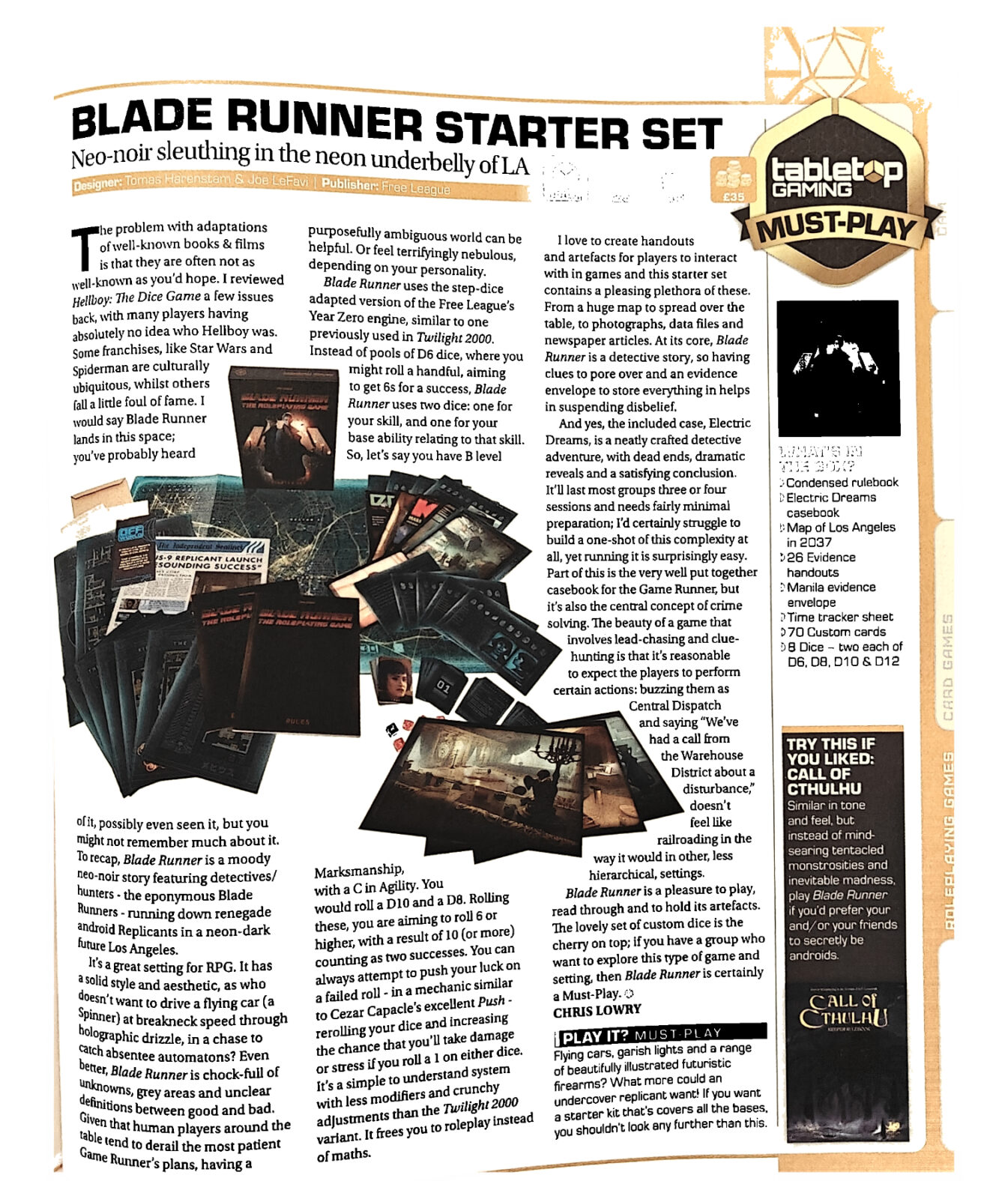
A review written for Tabletop Gaming Magazine. Magazine page copyright to TTG Magazine 2022.