
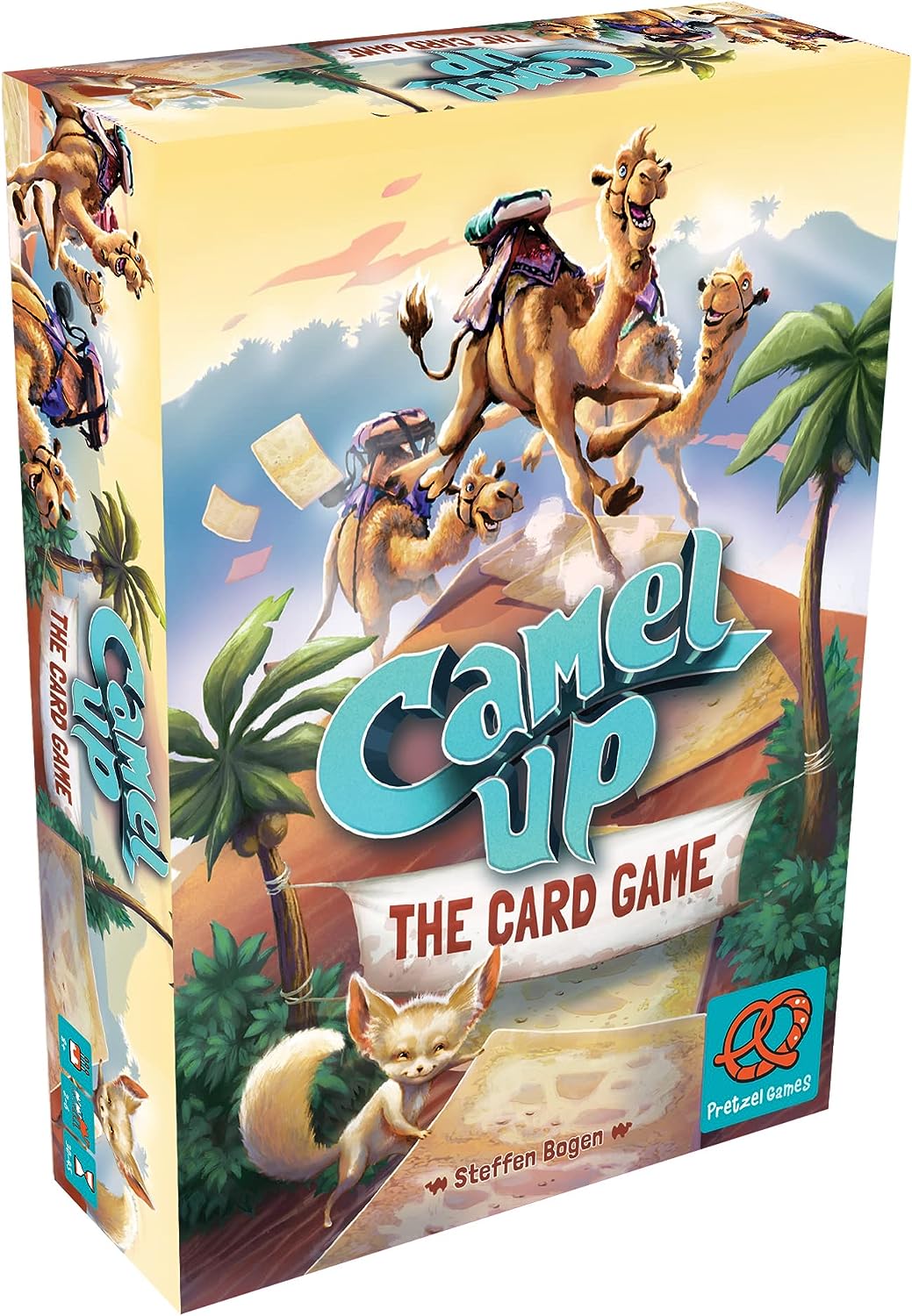
A common approach with very successful games is to bring out a card version. Some of these are as good – or better – than the original. Others are worse; I’m looking at you Castles of Burgundy: the Card Game. Camel Up has taken the same path here, and it leaves me two clear questions: is this a good game, and does it add value, compared to its older sibling?
Camel Up: The Card Game is a light-hearted experience of placing bets on the race performance of extremely unpredictable camels. The dromedaries in question are stackable, meaning that they can land on top of each other, piggy backing their way to victory. This can also result in four camels landing on to of the first placed camel, dropping them disastrously to the back of the pack. Even better, one crazy camel runs in the wrong direction, and can also be landed on, dragging other contestants in the front direction.
Functionally it is fairly similar to Camel Up; the board is replaced with a row of race track card spaces, whilst the cardboard pyramid and chunky dice are exchanged with a randomly shuffled deck of cards. Both add some interesting variation to the game; the course can now extend or shorten length to match events, or to run better with different player counts. Unfortunately this flexibility comes at a cost of significantly increased fiddliness. Perhaps unexpectedly, for a much smaller box, I would estimate The Card Game takes three times longer to set up, and requires three times more administration between each round. Resetting the deck would be a little intimidating to beginner gamers; the sort of people that Camel Up is usually a perfect match for.
The best change is in the new racing cards. In the original, camels move based on the dice of their colour; the orange dice rolls a one, the orange camel moves one space. Camels only ever move once per round. In this version each player receives multiple coloured cards. They discard some, contribute others to the racing deck, and keep a final one back to use if they wish. This gives player far more agency; don’t want green to win? Discard every green card before the round starts, and use your extra card to dump the yellow card unhelpfully on top of that green rascal! Of course everyone else has an equally Machiavellian plan, but the mechanic certainly adds some new choices into the mix.
Another nice touch is the addition of midfield betting – not just guessing who will win the current leg or the overall race, but adding the option to guess “this one will end in the middle of the pack”. Unfortunately this doesn’t make up for the change to the “final result” cards, where only one person can select any winner. In the board game version all of you can make multiple bets about the winners and losers, only finding out at the end just how wrong you all were, and so many times too! It’s always a fun highlight at the end, and it’s completely absent here.
Each player has modifier tokens called “fennecs” and “shortcuts”, that jump camels forwards or back an extra space. In other versions these have, well, much better names, but also a coin bonus each time someone lands on them. In The Card Game there are just penalties for not using them, which is much less fun. A further sad note is the choice to use plastic coins and camels. It’s hard to be perfect, we understand that, but we like to nod towards environmentally sensitive decisions at Tabletop Gaming. The first edition of Camel Up had wooden camels and cardboard money; the second edition switched much of this to plastic. I’d hoped the paper-based version might also take the planet-friendly approach, but sadly not. Only a slight disappointment, but Camel Up: The Card Game has rather too many of them to wholeheartedly recommend.
PLAY IT? MAYBE
It’s good, it’s just hard to recommend the trade-off of a slight increase in control over camels for a hugely higher setup and admin overhead. If you like small boxes and don’t have Camel Up, maybe check it out, but otherwise stick firmly with the original.
TRY THIS IF YOU liked Qwinto…
…A tight little puzzle of dice rolling and hoping to predict the future, Qwinto allows you to select how many dice you roll, harnessing fate a little like Camel Up: The Card Game’s racing card selection.
| About Camel Up: The Card Game | |
|---|---|
| Designer | Steffen Bogen |
| Publisher | Pretzel Games |
| Playcount | 1-4 Players |
| Age | Age 14+ |
| Price | £35 |
| Contents |
|
| Rating | Must Play |
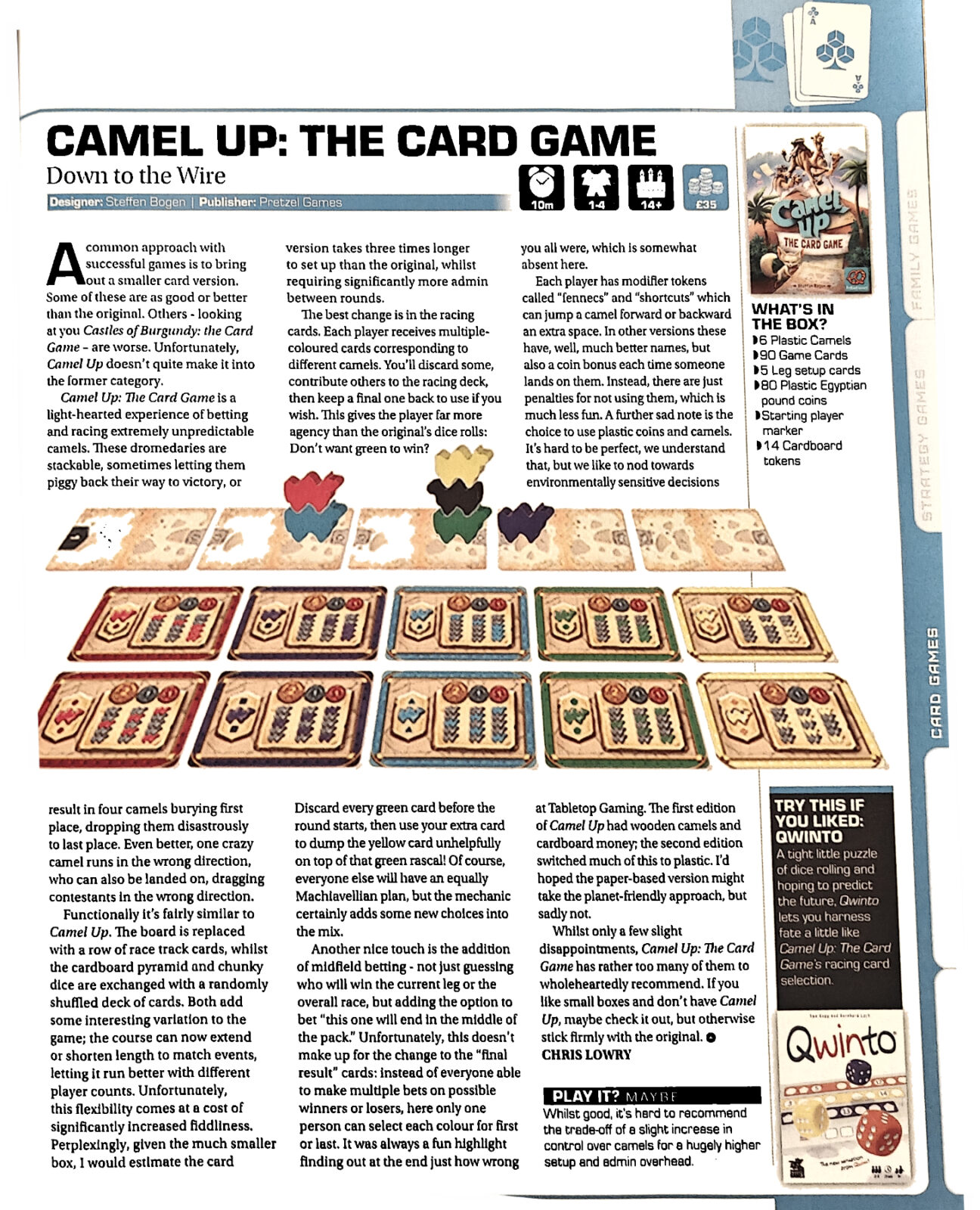
A review written for Tabletop Gaming Magazine. Magazine page copyright to TTG Magazine 2022.