
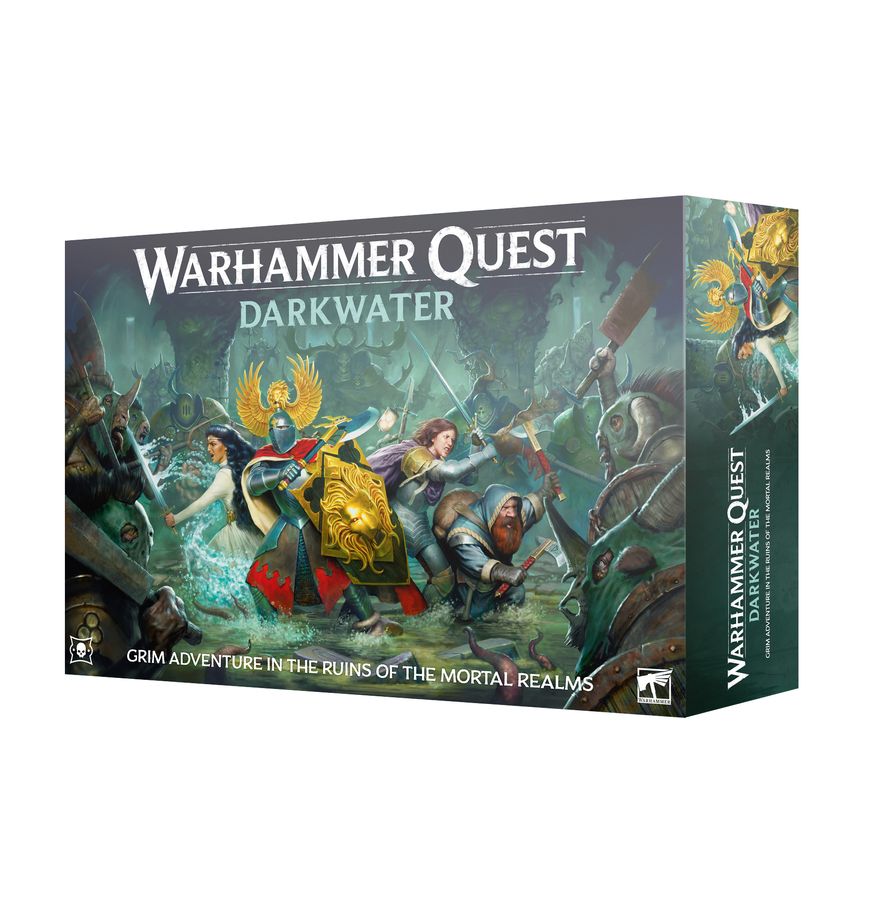
 Warhammer Quest is a near-ancestral game by the standards of our hobby, initially released in 1995 as a refresh of 1989’s even more geriatric HeroQuest. That latter title is arguable the creator of the “dungeon crawl” genre; board games in which a gang of motley adventurers dive into a series of gloomy dungeons in search of skeletons, treasure and fame. Both original games show their age these days, with clunky roll-and-move mechanics and barely any more tactical complexity than Connect Four. There have been a few reboots to Warhammer Quest in recent years, most notably Silver Tower in 2016 and Cursed City in 2021.
First impressions on opening the box for Darkwater are very positive, with plenty of tasty miniatures, custom dice, a concise rulebook, and a beautiful A2 sized map book that feels like a luxury art portfolio. Following in the footsteps of Gloomhaven: Jaws of the Lion, there are no map tiles here, but a wide selection of page spreads in a lay-flat map book. The downside of this is the lack of non-rectangular layouts, and the option of random arrangements of rooms. The obvious plus-side, however, is a map setup time of approximately half a second. There’s also a huge amount of variability across the pages, and a far wider range of scenarios and visuals than a common amount of maps tiles could offer.
Another key change is a new activation system; each character has three Ability cards. You can “expend” a card to activate any Ability, even multiple times; so you might choose to skip your attack in order to move again. Movement distance for most characters is d6 spaces; a roll-and-move approach that has fallen out of favour in recent times, but all players have the option of the “Sprint” double action, which grants them 6 spaces automatically. This adjusts the swingy traditional approach into a push-your-luck option, respecting the classic Quest feel whilst still giving players room for practical tactical planning.
The campaign is split into three Acts, each made from six encounters. Each session begins with choosing between one of two encounter scenario cards; providing an interesting decision to kick off your play session, rather than simply railroading players down a set narrative path. At the end of each Act is a Boss encounter, inhabitated by a punishingly difficult mega-baddy you’ll need to destroy. One-off skirmish games are possible too, with extra reward cards and treasures in later stages to help balance difficulty. Whilst older versions of Quest felt like they had came with mandatory months of play time, in Darkwater it feels like a one off scenario can be standalone or feed into the general story equally well.
Whilst the activation system allows for strategy, it must be said that Darkwater is still a fairly simple game at heart; most encounters boil down to “kill everything”. However, the level of streamlining makes this plenty of fun—no mean feat. I reviewed Street Masters back in TTG105, and found the same task of beating-up-everything-in-sight in that game was irritatingly arduous. *Darkwater’*s designers have taken every opportunity to speed things up. Common rule-ambiguity problem areas like line-of-sight are crystal clear, and enemies have static defence values, minimising dice rolling. One mission we played involved four enemies activating and attacking every turn, but we often resolved this in less than a minute. Enemies roll one of two custom dice, alternating in power between activations, and rolling up actions like “Advance”, “Reposition” all the way up to the punishing “Grievous Blow”, or a Special Action that—all too often—involves horrible respawning or even more ruinous damage levels. These dice actions keeps combat feeling organic and alive, without adding complexity or administrative overhead for players.
Players choose their activation order amongst themselves at the start of an encounter; whilst initially this might seems to have relatively little impact, it very quickly proves of vital importance. In one game my most useful hero managed to be in absolutely the wrong activation slot every turn for the entire game. There are some cards and abilities allow you to adjust the order, and in the right moments these can be very powerful and strategic. One of my favourite aspects of Darkwater is the complete removal of player elimination; when a character reaches zero health, they flip their Ability cards over, replacing them with weaker “Vulnerable” actions, such as “Hinder” instead of “Attack”, which lets you re-roll the dice of other heroes attacking a monster. Vulnerable heroes can be healed by other players, but the process is still costly in terms of the team’s action economy. If all the heroes become Vulnerable, they have lost the encounter.
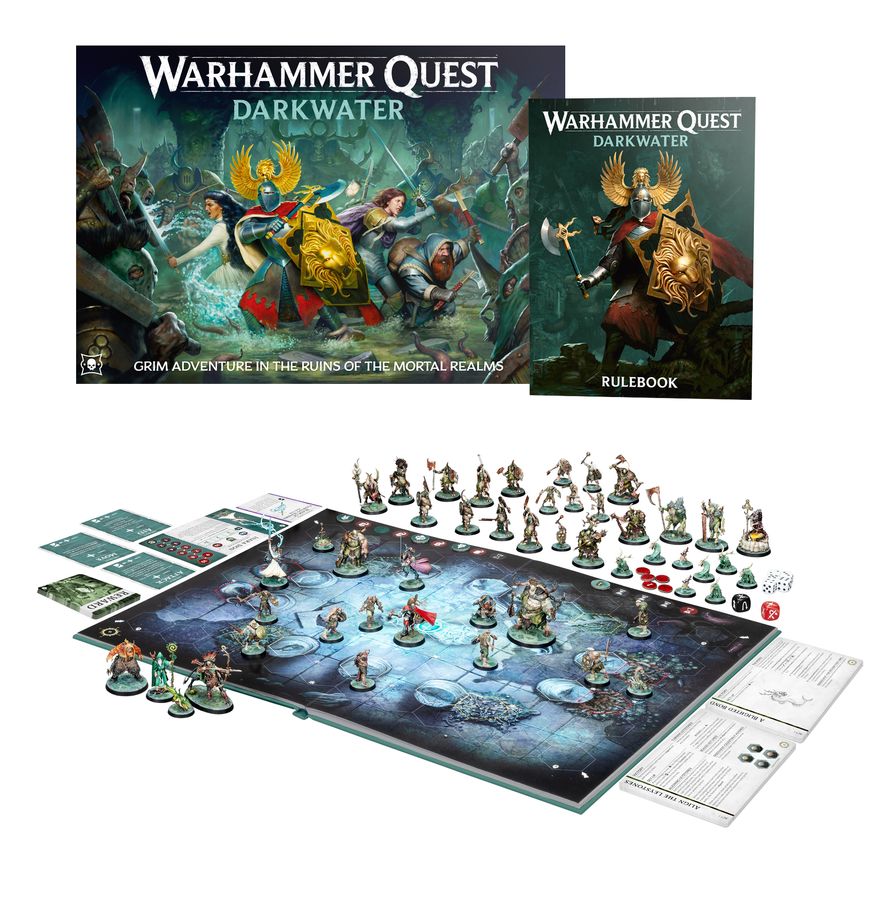 The Darkwater box comes with seven heroes to play; but only four of them are available at the start of the game, whilst others are in sealed containers, and unlocked through various in-campaign actions. There’s a huge amount of advancement and replayability on offer here. Each Act comes with many more encounter cards than will be played through on a first attempt; so you are always going to have new surprises, and frankly, the excellent activation system for NPCs means that replaying an encounter is often still going to feel fresh and unique. The very varied maps and skirmish mode mean that there’s plenty of scope for new experiences, and I feel the sheer range of maps is much more expansive than rearranging the same old tiles each time. The modular system provides a foundation for expansion potential in new encounters, monster and hero cards—and there have already been new heroes added in Games Workshop’s own White Dwarf magazine.
It’s also the most beginner friendly version of Warhammer Quest we’d ever enountered, with a first-play setup guide to hold your hand, and intuitive, streamlined mechanics that make it an ideal option for newcomers to dungeon-crawling. We introduced one person who’s barely played board games at all, and she picked it up effortlessly. Even better, the rules got out of the way so she could focus on inhabiting her character.
I’ve got this far without talking about the miniatures, but they really are superb. Games Workshop undoubtedly produce some of the best models in the business, and these are dynamic, easy to assemble and look magnificent—especially the bosses! The dice are high quality too; even the box outsides look great, with a diorama of all the models around the outside that provides a practical reference as well as being aesthetically pleasing.
Now, it’s not 1995 any more, and there are plenty of dungeon-crawl options available. How does Darkwater stand up to older competitors like Descent, modern giants like Gloomhaven, or Mantic’s Dungeon Saga: Origins? Origins probably comes closest to being a direct competitor for HeroQuest, slightly simpler than Darkwater, but still with a reasonable amount of strategic depth. Nostalgia may need to be your guide here; Warhammer Quest has a rich heritage, and revisiting your childhood can be an adventure all its own. If you are stuck for a decision, consider if Darkwater’s map-book concept and tasty miniatures grab your attention. For crunchy strategy and table-dominating presence, there’s a 10kg elephant in the room—but Darkwater offers lightning-fast setup and a play time that Gloomhaven can only dream of.
PLAY IT? YES
Finally there’s a Warhammer Quest update that revisits the ideas of the past and drags them into a modern board game future; Darkwater is a enjoyable, light-weight experience for any adventurer…. although it may be a touch too repetitive for gamers who like crunchier puzzles.
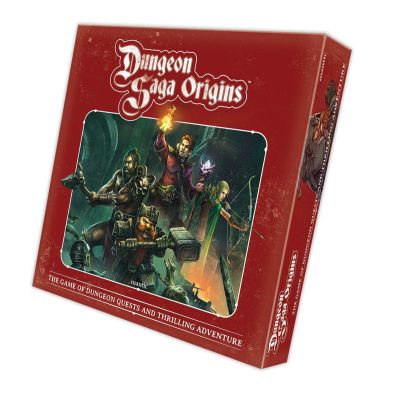 TRY THIS IF YOU liked Dungeon Saga Origins…
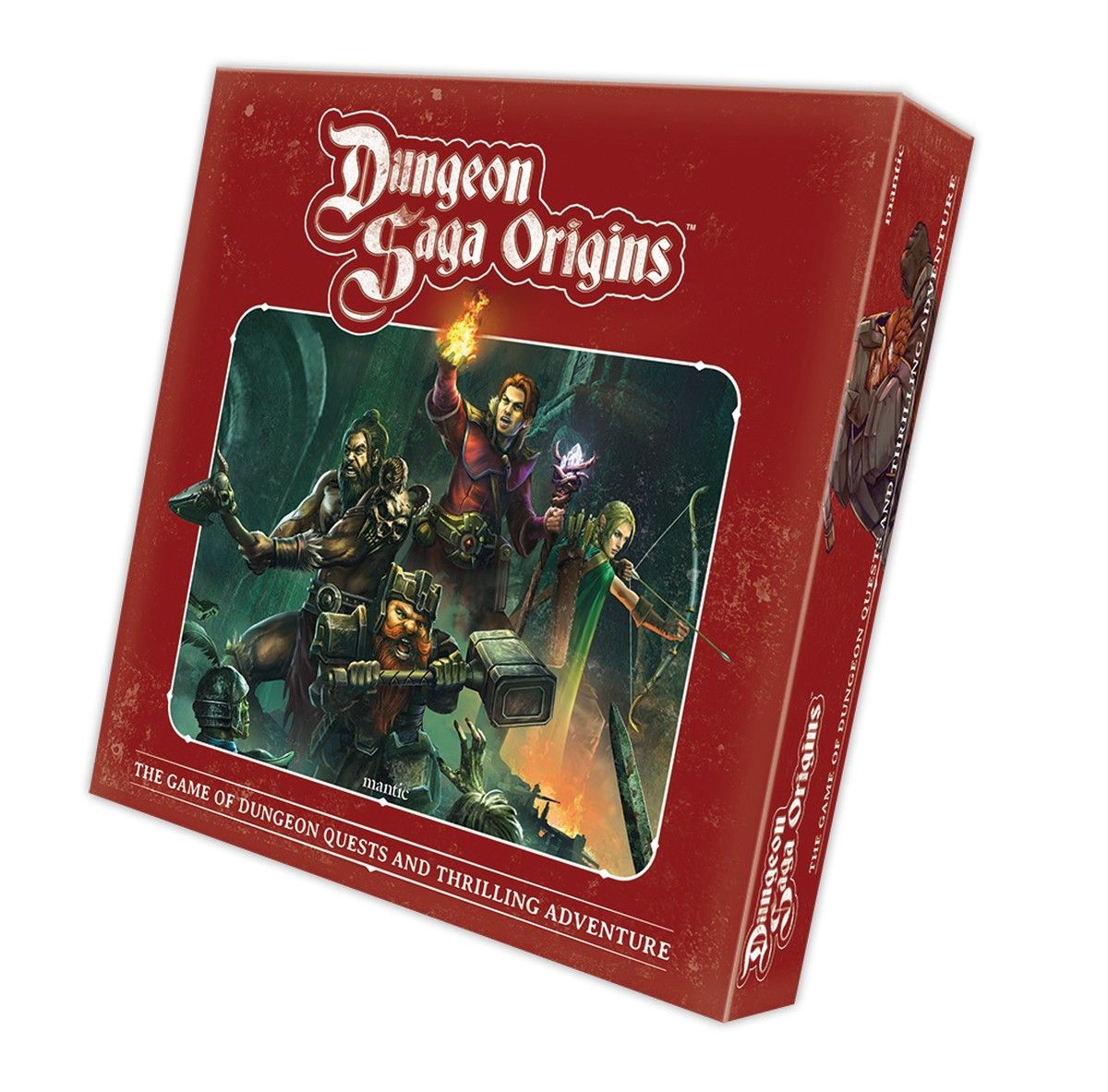
…Dungeon Saga Origins uses a multiple-rooms-on-a-tile tile system rather than a book, and it already has a thousand brilliant expansions, whilst Games Workshop have a fairly uneven history of support for it’s boxed games like Warhammer Quest: Darkwater. I’d look at both and see which one appeals most; neither will let you down.
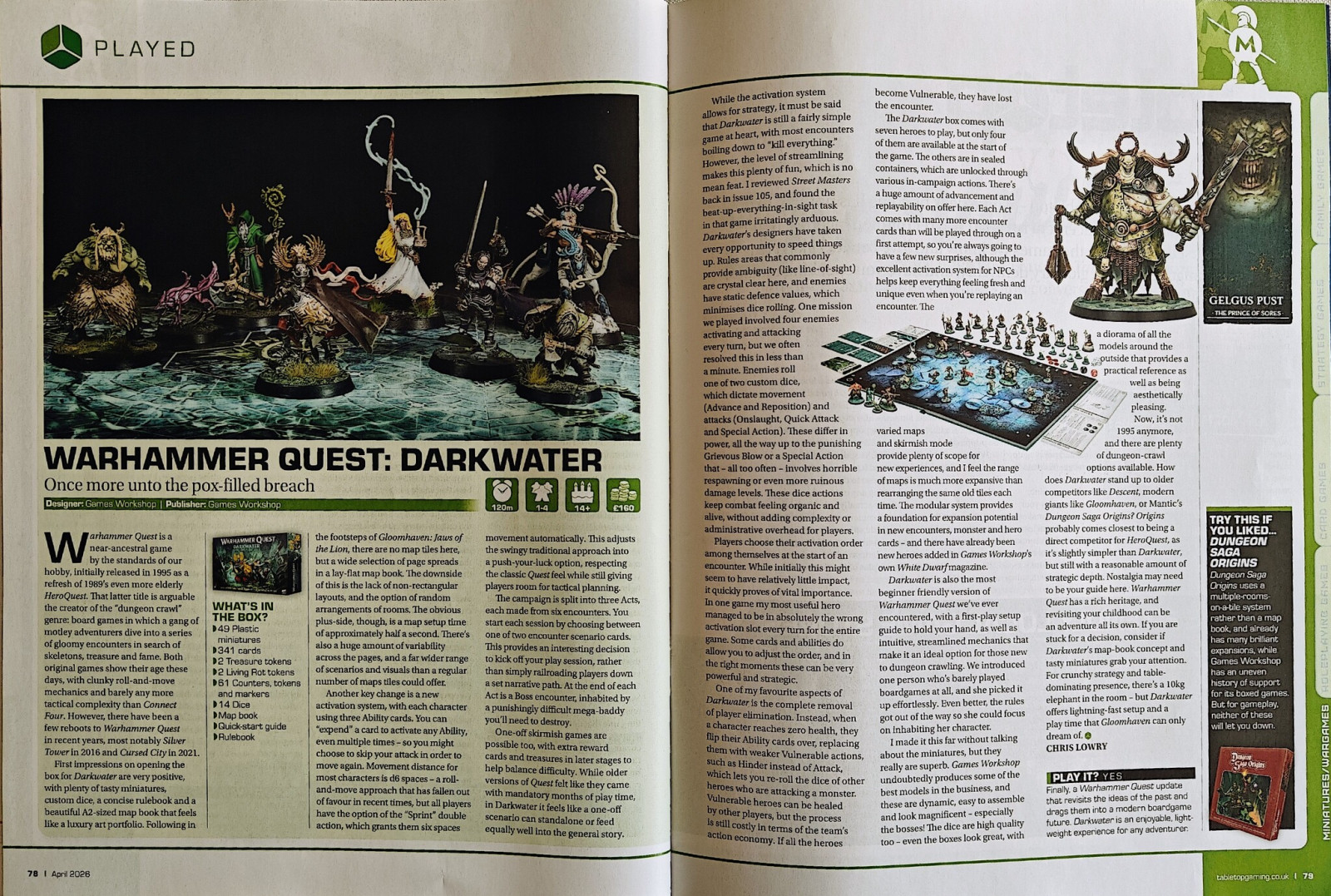
| About Warhammer Quest: Darkwater | |
|---|---|
| Designer | Games Workshop Design Team |
| Publisher | Games Workshop |
| Playcount | 1-4 Players |
| Age | 14+ |
| Price | £160 |
| Contents | - 49 push-fit plastic miniatures - 2 treasure tokens - 2 living rot tokens - 36-page softback rulebook - 38-page hardback map book - 341 cards - Double-sided quick start guide - 61 tokens, counters, and markers - 14 dice, including enemy action dice |
| Rating | Yes |
A review written for Tabletop Gaming Magazine. Magazine page copyright to TTG Magazine 2026.