No one really understands the stock market, not really. They might pretend to, or claim to, but it’s basically wizardry + luck + maths. Certainly none of my fellow competitors appeared to be accountancy mages; I felt we stood on an equal footing as we embarked on our game of Acquire.
I opened my first company, hesitantly, in a neglected area of the board. It was called Luxor, and had the cheapest starting shares possible. That didn’t matter much to me. Firstly, as already mentioned, I don’t have the foggiest idea of how to manipulate the stock market, and secondly, I got a share! For free! I was now the sole owner, operator, manager and general head honcho at Luxor, sprawling across an entire two squares of the twelve-by-nine grid that abstracts the length-and-breadth of commerce in the world of Acquire.
(If this article intrigues you, read my review of Acquire elsewhere on the site)
The sheer power of commercial acquisition rushed to my head, and I threw my meagre mathematical bulk behind this fledgling financial foray. I bought three more shares in Luxor. I now owned four, nearly a quarter of the total twenty five available for any company in the game! Victory seemed near-inevitable.
I muttered under my breath, and resolved to buy more Luxor on my next turn. And to take revenge.
The player to my right had their bowler hat pulled down low, a pinstripe suit set in perfect symmetry. Somewhat unnervingly, they purchased three shares in Luxor too. I was surprised, but not particularly upset, especially as they also added a tile to the company, expanding Luxor in size from two to three spaces, and increasing our share cost in the process. Not only did I hold a majority, but the entire company was worth 50% more! Turns out stocks and shares are easy. Who knew?
Game turns pass quickly in Acquire. Over the next few rounds, a scattering of tiny start-ups formed, and began to rapidly increase in size (and share price).
My tiny three-block company swelled further to four squares, going from a per-share value of $300 to $400. Worryingly however, our company was separated by just a single space on the board from the five-block Tower company. If anyone placed a tile joining the two, either company was vulnerable to a takeover.
Now, mergers are not necessarily a bad thing for shareholders of smaller companies. Everyone gets to sell their shares at their current value, or trade them two-for-one for shares in the larger company. For the players with the most shares, – and second most – a hefty bonus is paid too.
I bought three shares in Tower, hoping to come out on top of any merger that might occur by owning stock in both companies. Bowler Hat took his turn next, outrageously buying two shares in Luxor, the company I founded. I was no longer the majority shareholder! I muttered under my breath, and resolved to buy more Luxor on my next turn. And to take revenge.
Our third player was a tall, sleek woman. An evening dress hung elegantly on her slight frame. She wore multiple pieces of that exquisite, understated jewellery that one hires designers to produce. Frowning, she selected her next tile, and twirled it in one hand. Her expression changed, a thin crescent of satisfaction, and she placed the tile on the board. Directly between Luxor and Tower.
“Tower”, she said, in a voice of powdered diamonds.
The player who causes a merger in Acquire gets to decide which company the connecting piece belongs to. In this situation, Luxor already had four tiles and Tower had five. With an additional tile, Tower was clearly the larger company, and my hopes for returning Luxor to my control were dashed. Even worse, Bowler Hat received the majority bonus as he had more shares than me! He grinned as he took $4,000 from the bank, and more, cashing in his defunct Luxor shares. The $2,000 I received was still significant, but second place left a bitter taste in my mouth. I decided to trade my four Luxor shares for two in Tower, now spreadeagled over nine tiles on the board.
Any pretence at friendliness around the table immediately evaporated. A vitriolic battle for control took place on the other side of the board, as Evening Dress fought with Bowler Hat for dominance. A number of small mergers took place, American taking over Festival, Continental beating out Worldwide. I invested small amounts in companies that looked likely to die, gaining a few thousand dollars here-and-there as a result of minority holdings.
The challenge, it turns out, is keeping cash flow running. Buying shares, especially in bigger companies, is very expensive. Continental was the first company to reach a size of eleven blocks, meaning it was worth $900 a share, but also that it was safe from takeover. Even if a fifteen tile company was adjacent, it wouldn’t be able to force a merger. At that point, Evening Dress held five Continental shares. Just catching up to that would cost $4,500 and take almost two entire turns.
Acquire’s finish arrives fairly quickly. The end condition is either that one company has reached a size of 41 squares, or that all companies on the board are more than 11 squares and thus safe from takeover. The unusual additional mechanic is that the end of the game is only triggered if the active player chooses to point out that these end conditions have been met. If they don’t realise, or if it’s in their strategic interest not to comment on it, the game can continue. Perhaps forever.
As companies ballooned, swallowing up smaller competitors, it was clear we were reaching the final stages. Whilst my opponents had been distracted in American and Continental, I’d been expanding Tower, and buying shares. Just one or two per turn, but enough to ensure my majority holding within the company was unassailable. Unfortunately, that also meant that my fate was tied to Tower’s commercial supremacy.
Bowler Hat placed a strategic tile next to Tower, bringing it to a mighty size ten – just one block size from being merger safe. He purchased three shares too – at $800 each, catching up to my majority would be financially ruinous, but the minority holding was currently his.
I looked at the piece in my hand. The label read “10H”. It was adjacent to Tower’s holdings. If I got the chance to place it, Tower would expand to size 11, and I would have majority control of a safe company, one that would pay out handsomely at the end of the game. A single turn was all I needed.
Evening Dress peered at the board intently. I tried to interpret her expression, but she was unreadable, a perfectly coiffured poker face.
Tower had just a single point of vulnerability on the board. Square 8E. A lone locale where the company sat close enough to American for a merger to be possible. American, currently at size nine. American, a company with Evening Dress as its majority shareholder.
She selected a tile. No emotion crossed her face, her lips a flatline. I hoped, hoped for anything except that tile.
Evening Dress reached out, placing the plastic piece in place. The printed letters burned into my soul. “8E”.
The tile settled, forming an inexorable bridge between American and Tower.
Tower at size ten, American at size nine. However, the choice of which company is expanded by the new tile? That choice went to Evening Dress.
“American”, she said, voice controlled, but with just the tiniest hint of triumph.
Tower size ten, American size ten. A draw. Unfortunately, draws are decided by the mergermaker too.
“Which company wins the merger?”, I asked. Just in case.
Evening Dress simply looked at me for a moment, then flicked the “Tower” marker off the board, making her the majority owner of the only two companies remaining on the board.
“Game over”, she said, and smiled.
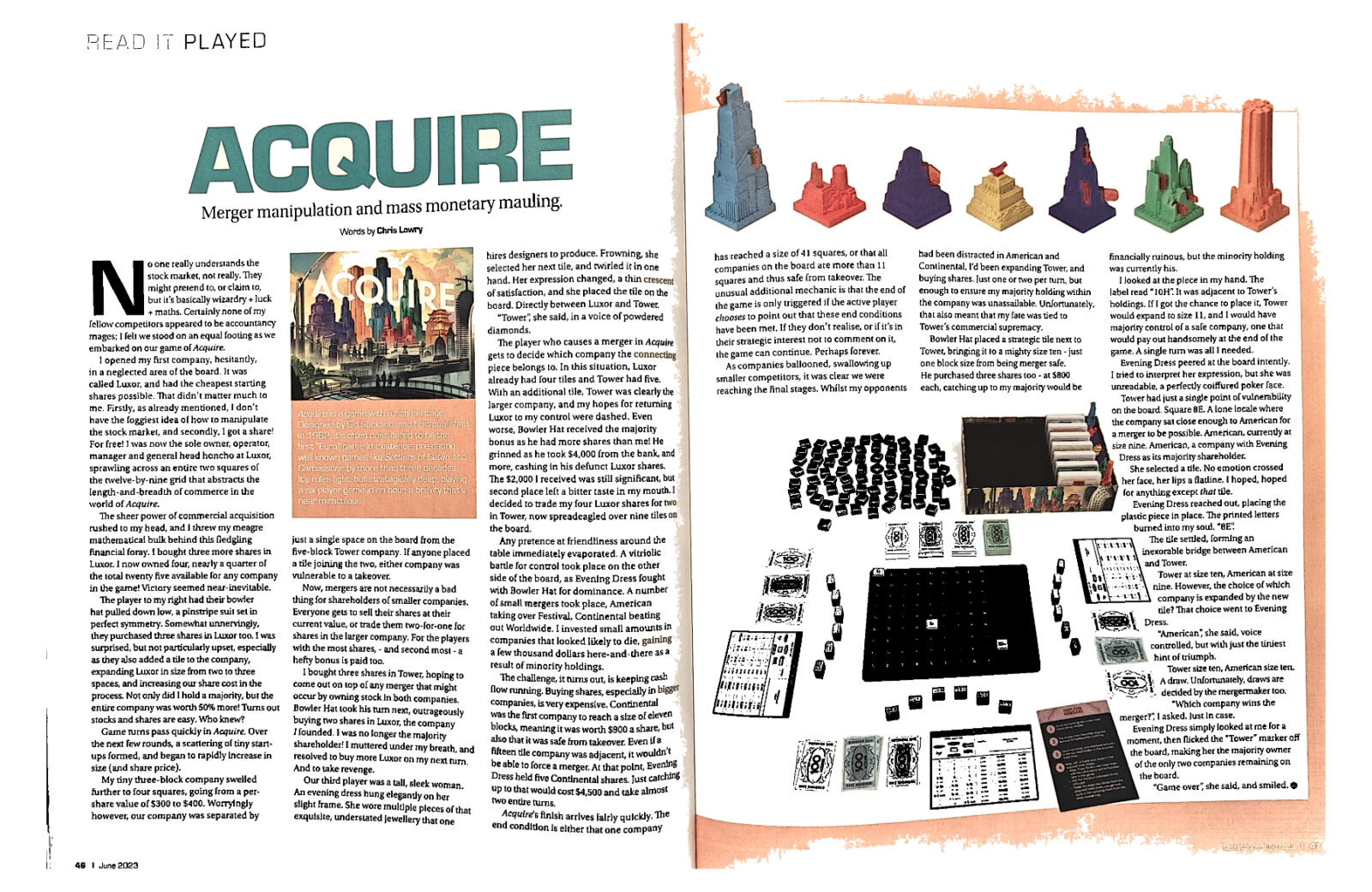
Acquire is a game with a rich heritage. Designed by Sid Sackson, and first published in 1962, it’s often considered to be the first “Euro” game in existence, pre-dating well known games like Settlers of Catan and Carcassone by more than three decades. It’s rules light, but strategically deep, playing a six player game in an hour, a brevity that’s near miraculous.