
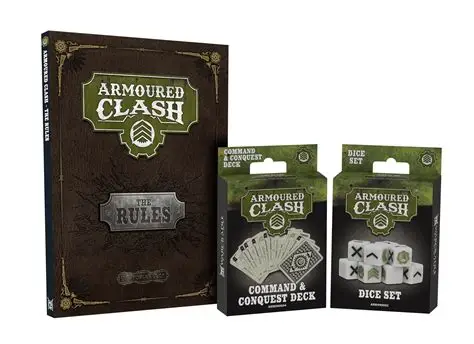
 For my entire lifetime, the undisputed titan of miniatures war-gaming has been Games Workshop. Their key titles Warhammer and Warhammer 40,000 involve tabletops filled with tiny plastic warriors; specifically, tiny 28mm-high warriors. In recent years there’s been a resurgence in much smaller scales, such as 6mm for Mantic’s Warpath, or, in the case of Armoured Clash, 10mm. Why does this matter? It means a much smaller amount of plastic and painting can field you an entire army. Yes, the painting is more fiddly, but it also allows you to recreate truly huge conflicts without remortgaging your house.
Warcradle Studios have released a number of starter boxes for Armoured Clash, but they sent us The Battle For Singapore two player starter set; which contains a very reasonable amount of models for the cost. You’ll have two decent armies; Crown and Empire; along with all the custom dice, tokens, rulers and most of the bits of paper you need to play.
Admittedly, I was slightly hesitant in approaching Armoured Clash; it’s part of the same Dystopian Age series that brought us Dystopian Wars; a somewhat mish-mashed system which caused me to be particularly savage in a review in TTG Issue #. However, I noted that veteran games designer James Hewitt had taken on the project, and I’m a huge fan of his past work, such as Blitz Bowl and Dreadball. I decided to see what special sauce he’d added here…
First things first: where is all this conflict taking place? Armoured Clash is a land battle wargame set between factions grasping at each other across an quasi-Victorian alter-Earth. Steampunk tanks battle cog-wheeled Teutonic Knights to a backdrop of legions bleeding and dying, all serving the flags of imperialist empires. The game includes eight factions, each of which has a distinct flavour, unique units and special rules. The unnecessarily encyclopaedic depth of historical background that Dystopian Wars included has been removed, although I’d have liked perhaps a smidge more flavour in the box; either way, the game has a strong story behind it that brings the table to life, and the downloadable Order of Battles (ORBATs) provide much of the needed narrative oomph if you want to seek it out.
Now, this review isn’t intended as a comparison with Dystopian Wars, but it’s worth noting that significant attempts have been made to rectify mistakes made by the sibling game. Putting together these gorgeous models was reasonably straightforward, even if the otherwise clear online build instructions don’t actually tell you quite how many of each model to build; it turns out that information is in the separate campaign manual. The sprues were fiddly, but relatively easy to cut out and build, and the larger-than-6mm scale and high quality moulding is so detailed you can add eyes at the painting stage. The only issue I had was that Officer models come with some impossibly flimsy flags that immediately broke off; we used a dab of gold paint on those bases instead, but I defy anyone to keep their flags in situ. Overall though, the build experience is probably an 8 out of 10, and your massed armies will look appropriately imposing on the battlefield
Now, my main criticism of the Starter Box is one that’s fairly easy to forgive; the starter rules have been slightly inconsistently condensed out of the main book—although it makes it clear where to download the full rules. For example, in a game that uses large groups of “Models” made into “Units”, terms such as “models”, “figures” and “miniatures” were used without definition throughout. Entire concepts like “Discipline” are missing, and we quickly found lots of edge-case rulings were just not covered, like the specifics of moving and embarking troops from transports.
“How can these omissions be forgivable?” I hear you ask; and there’s an easy answer: the main rulebook for Armoured Clash is the best laid out and written ruleset I’ve ever used. It’s a free download (eat that, GW) and it’s magnanimous in its practicality. Every eventuality is covered, clear and concise; there are hyperlinked page references in any place you could want them; the sidebars in particular seem almost like they read my mind. Take that “Models” and “Units” ambiguity in the quickstart? In the main rulebook it’s laid out perfectly, with zero room for confusion, as the very first heading under “Basic Principles”. True, the quickstart rules offer a simplified version of the game, but in doing so they’ve left out too much, and they’ve not done it as clearly as they could have done. If you want to play Armoured Clash, I’d throw the quickstart rules in the bin, pretend they never existed, and just get to grips with the joy of these main rules from the offset. They are a smidge more complex, but we wasted far more time faffing around with unclearly abbreviated rules from the starter than we did just learning it properly.
So what are these rules, anyway? What makes Armoured Clash stand out? One of the core aspects is a tiered “Combat Rating” paired with a unique dice system. You’ll be throwing handfuls of custom six-sided dice, which have faces for “Miss” “Glancing Strike”, “Strike” and “Heroic Strike”. Each of these has different effects depending on the weapons used, or on the Combat Rating of the troops. Combat Rating sounds complex, but quickly becomes intuitive; you simply sum up the positives and the negatives. So if a Unit took at “Aim” action, and is within “Short Range”, but their target is “Concealed”, those two positives beat the one negative, and the attack is “improved”. Due to this, all “Miss” dice are re-rolled instead of discarded. The flexibility of this dice system means that rolling dice is filled with anticipation before you even roll, as one set of six dice may be potentially eligible for far more re-rolls and bonus dice than another; it also invests players in trying to manoeuvre in ways that advantage their troops and maximise the benefits of the terrain. Armoured Clash elegantly doffs its hat to simulationism without adding the level of crunch that slows similar games down to a crawl.
Alternative unit activations keep players engaged and the battlefield environment constantly responsive to change; whilst each player has an additional hand of Command & Conquest cards that can be spent to either gain bonus victory points, activate one-off strategic moves, or to gain initiative. The card hand limit scales neatly with the size of battle, and significant work seems to have been done ensure balance amongst the varied options available.
I would have loved to see standalone stat cards for Units included; they are printed at the back of the Singapore Campaign book instead. There’s only one of these, meaning players have to wait for their turn with the booklet before they can fully plan moves. I suspect this box was put together by people who already had Unit Cards printed and didn’t realise how annoying more limited access would be. Also, despite the downloadable ORBATs having photos to identify every single Unit, the downloadable Unit cards lack this; a trifle harsh when trying to work out if the tiny square of four men is a “Green Banner Flame Team” or an (extremely similar looking) “Green Banner Guard Platoon”. Even so, this complaint hides a compliment; Armoured Clash manages such diverse units that the extra rules provide a vital strategic element; but slowing down access is a rare misstep in an otherwise streamlined game. The after-market support from Warcradle is also excellent, so future versions of the Unit cards may well be updated!
Armoured Clash is, in summary, excellent. Are you looking for a tiny minis game with a deep well of strategy and relatively-restrained complexity, wrapped up in a archaically futuristic world that’s appealing, inventive and intriguing? Strap on your ornate Victoriana chestplate and polish up that monocle; this is the game for you.
PLAY IT? YES
I’d personally love to have the free time to fall deeply in love with Armoured Clash; the designers have made a system that’s rich, deep and yet accessible at the same time. Here’s wishing you strength and mastery as you crush your opponents in victorious battle!
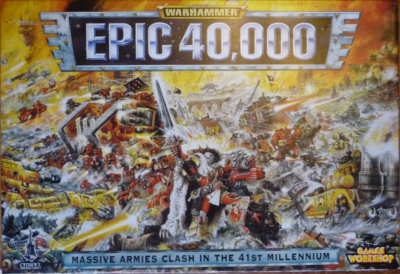 TRY THIS IF YOU liked EPIC 40,000 Third Edition…
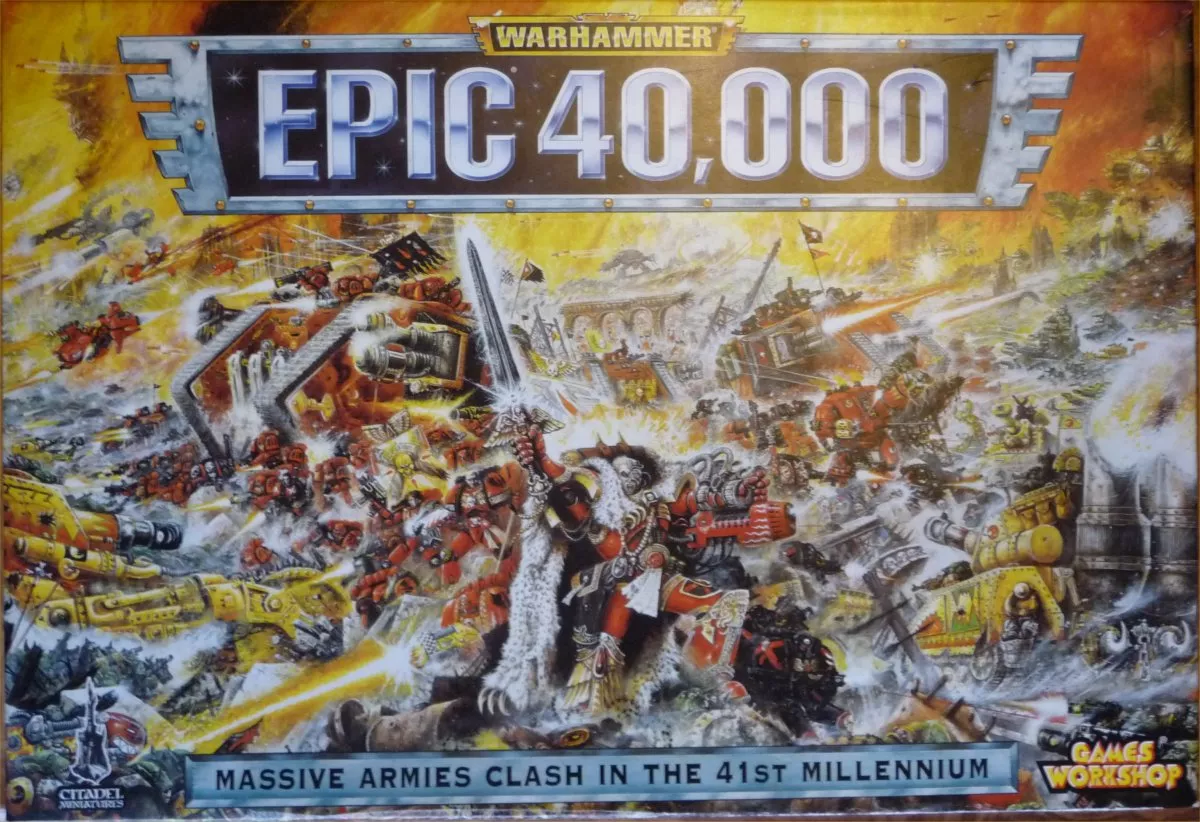
…Nearly 30 years of gaming history separate these two, and Armoured Clash is both more nuanced and more streamlined, but it can’t be denied that without the foundation of EPIC 40,000, it’s likely that there would be no Armoured Clash either.
| About Armoured Clash | |
|---|---|
| Designer | James M Hewitt |
| Publisher | Warcradle Studios |
| Playcount | 2 Players |
| Age | Age 14+ |
| Price | £95 |
| Contents |
|
| Rating | Yes |
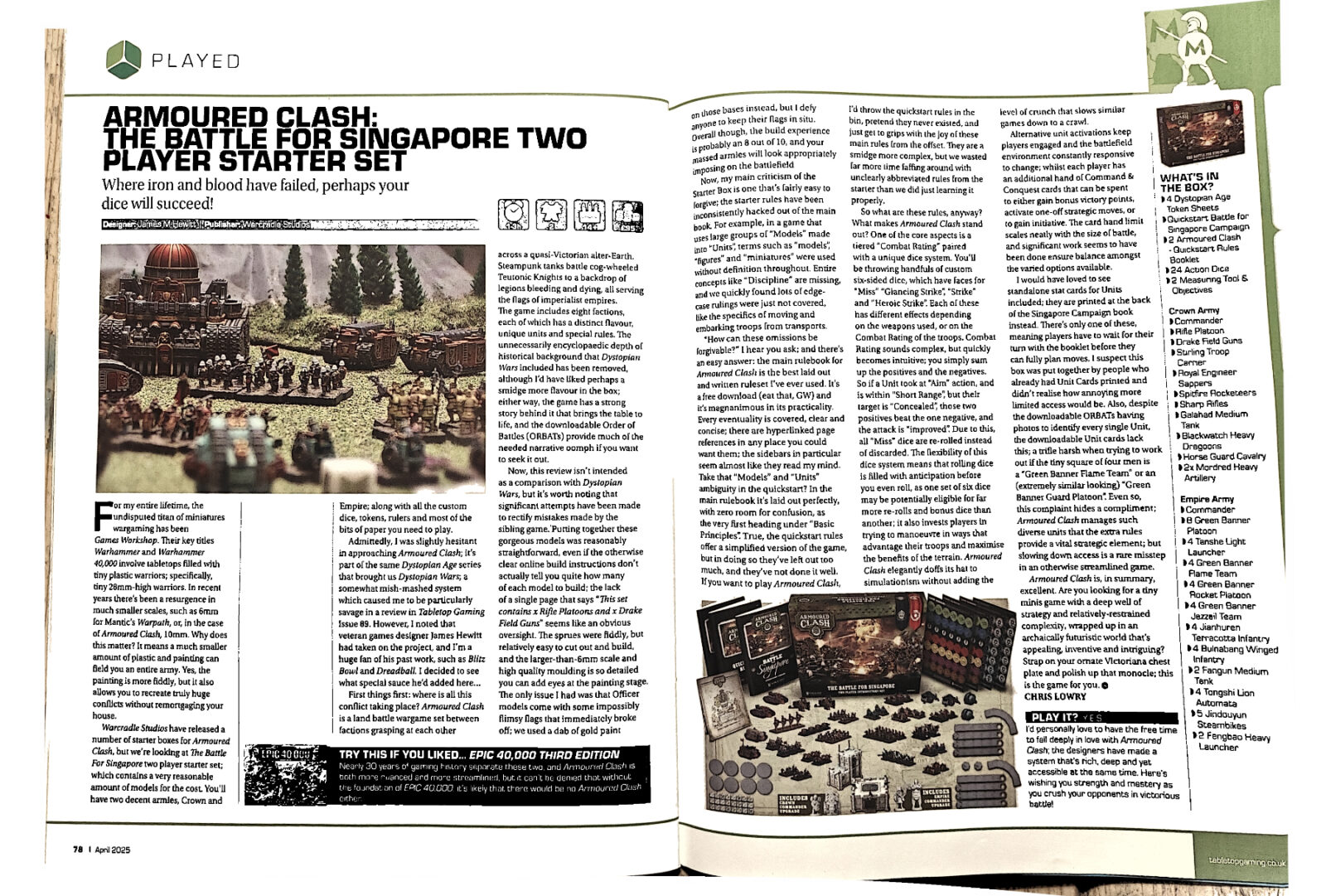
A review written for Tabletop Gaming Magazine. Magazine page copyright to TTG Magazine 2025.