
Stalagbite
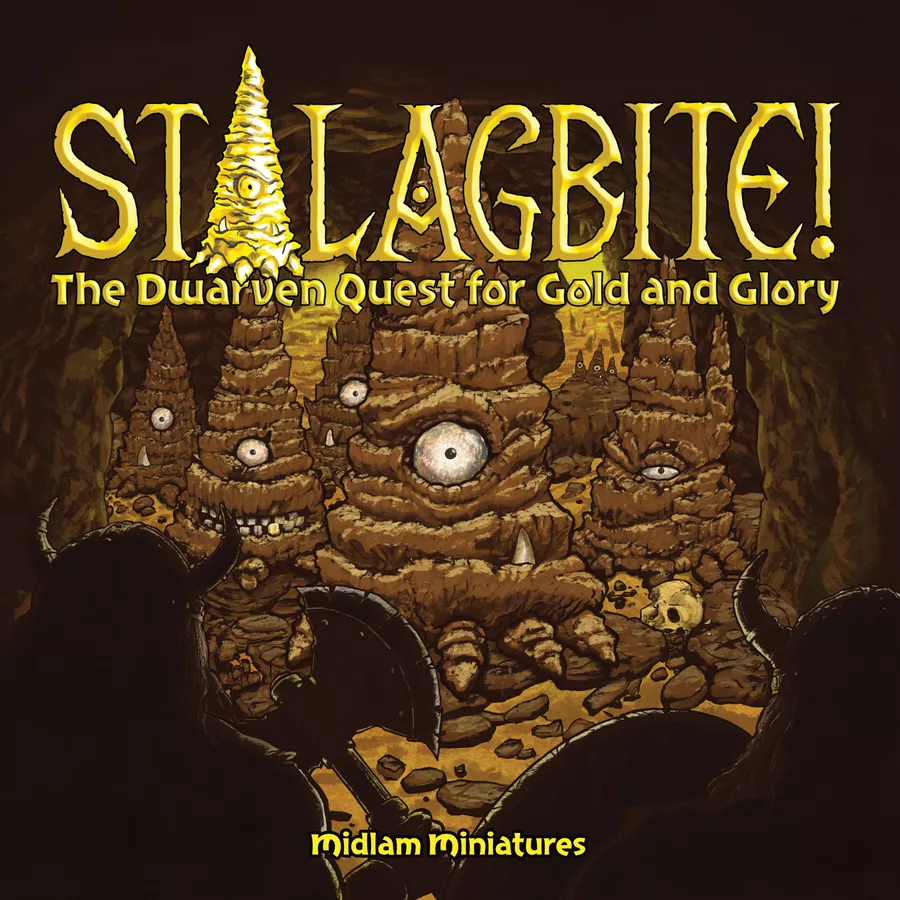
Dungeon diving is a familiar genre, and you generally need a good selling point to stand out from the crowd. Stalagbite does this by casting an anthropomorphic lifeforce onto stalagmites—those pointy outgrowths you find in limestone caves. They also have a few gameplay innovations that give this fun little game extra reason for your attention.
First things first; this is a game of dwarves heading into caves, hunting for gold and glory by hacking their way through crowds of nasty creatures. The aim is to hopefully escape before a crowd of hunting goblins arrive to take care of you. Much like cave-crawler-in-space Level 7: Escape, the game is semi-cooperative, with the players working to clear the cave together, but each hoping to personally gather the most glory and gold in order to win.
Stalagbite has an original take on concluding the action, with several possible triggers for the end game. Predictably enough, if the goblins arrive or a player dies, everyone must scurry for the exit; but my favourite mechanic was the option for a group vote. Any player, looking at their pile of glory and gold and sensing victory, can decide to call for a vote on the party leaving the caves. Every player picks up all their glory tokens, and selects some (or none) to vote for or against leaving. Glory spent on the vote is lost; so it’s tense, and few wish to risk tokens on it unless a win is close at hand. We had five votes in one game, but literally no one spent any points on the vote the first four times. This might seem anti-climatic, but it’s not; it’s hilarious—in any of those votes, a single person could have dictated the entire groups fate, but everyone was too scared to waste any glory. Glory can also be spent on re-rolls, a slippery slope that saw more than one of my players burning their entire lead trying to reverse one bad roll.
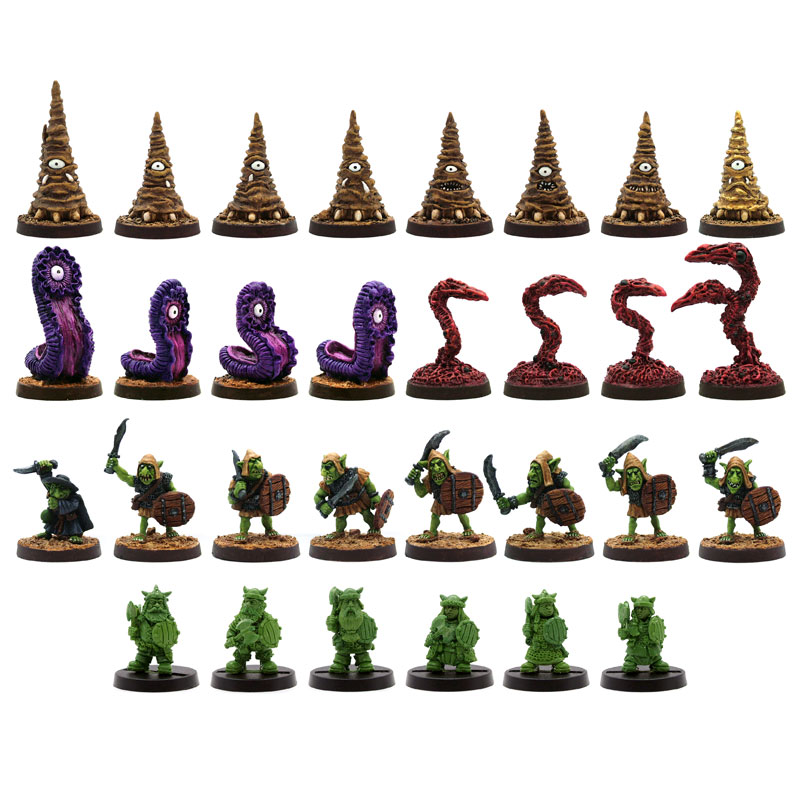 Gold is picked up from exploring caves and obstacles, and occasionally from killing creatures, whilst glory is allocated for impressive actions; such as winning fights, rescuing other players and discovering new caves. Stalagbite includes some chunky custom dice—my Achilles heel in any game—with one for each player, for each game round and for each monster type. Combat is extremely streamlined; simply roll your dwarf dice and the appropriate monster dice. When attacking, axes are a hit, and the monster’s shields block. Two axes versus one shield? That’s a point of damage. A “special” icon adds a little variety, with some monsters having bonus actions, and the potential for counterattack. It could be argued that combat is too simple; it’s very luck based, and not particularly varied; it is, however very fast, which is the only way to save a five player game with this many moving parts from becoming bogged down.
There’s a campaign mode, and a range of relics and skills to build up. These cards are a little too unbalanced, some giving the option to jump over a pit once, whilst others double your glory in many combats forever. The core game plays very well in single player mode, the quick-paced combat running at lightspeed with no one else interfering. However, the rules don’t provide any solo goals or motivation—if the aim is to be the dwarf with the most gold, but you’re the only player, then you win… immediately? These niggles can be home ruled easily, but at TTG we always review the game you get, not the one it could be.
Stalagbite started life as an outlet for miniatures from Midlam Miniatures; it’s well worth hunting out the lovely minis available for it separately, although I found the custom wooden meeples equally enjoyable to play with. If you accept its limitations, there’s a lot of fun to be hard in Stalagbite, and I found it particularly shone in a family and entry level gamers setting.
PLAY IT? YES
A simple game, but one that leads to a satisfying and silly story. Great for families, or for a beer and pretzels evening of dungeon diving and abandoning your friends to the goblins…
TRY THIS IF YOU liked Dungeon Saga Origins…
…Mantic’s second version of their dungeon delving game is similarly streamlined and fast paced. Stalagbite is sillier and even simpler; the wooden pieces are a nice alternative to the “will I ever paint them?” of miniatures.
| About Stalagbite | |
|---|---|
| Designer | Paul Scott & Gary Scott |
| Publisher | Midlam Miniatures |
| Playcount | 1-6 Players |
| Age | Age 12+ |
| Price | £50 |
| Contents |
|
| Rating | Yes |
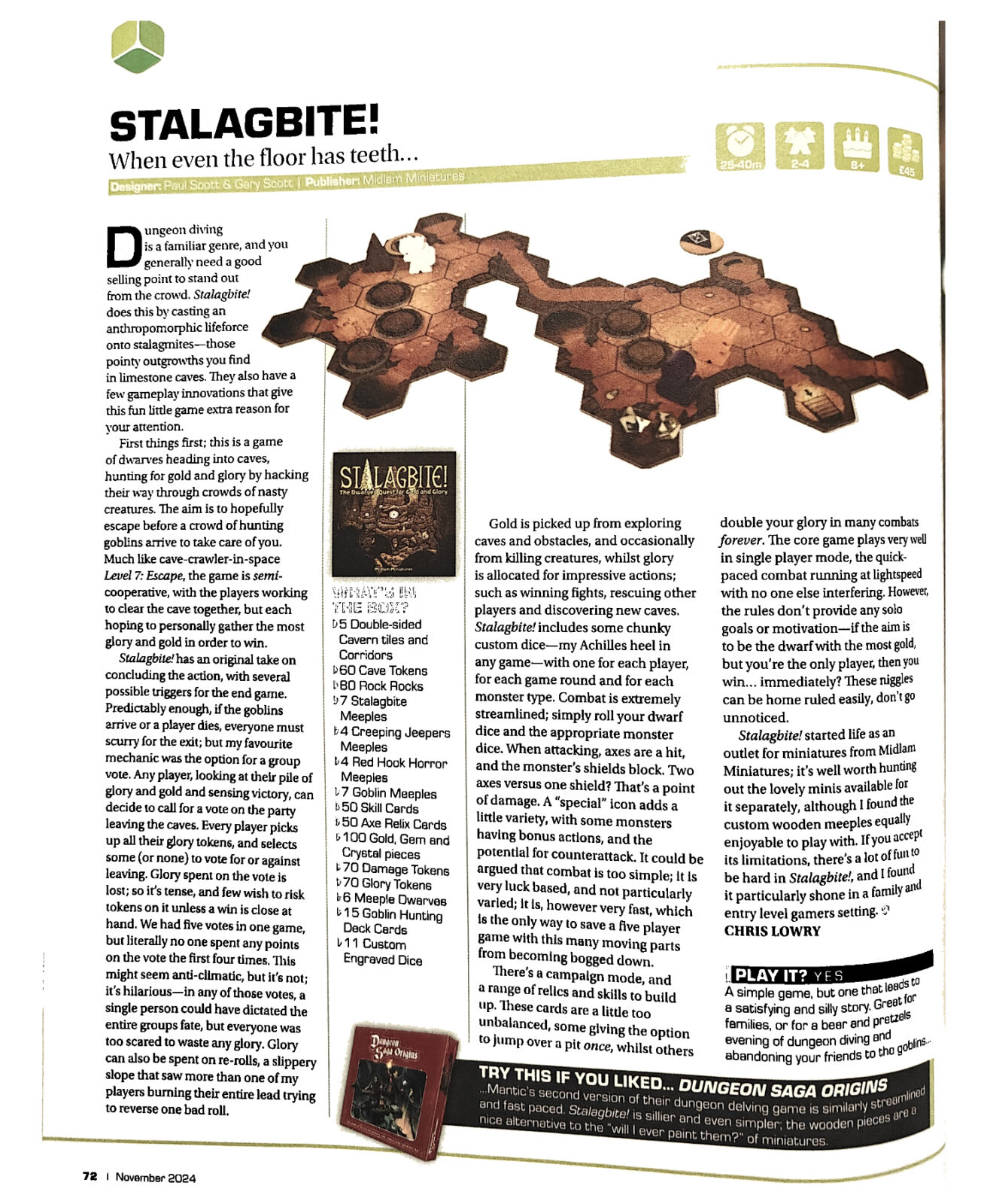
A review written for Tabletop Gaming Magazine. Magazine page copyright to TTG Magazine 2024.