
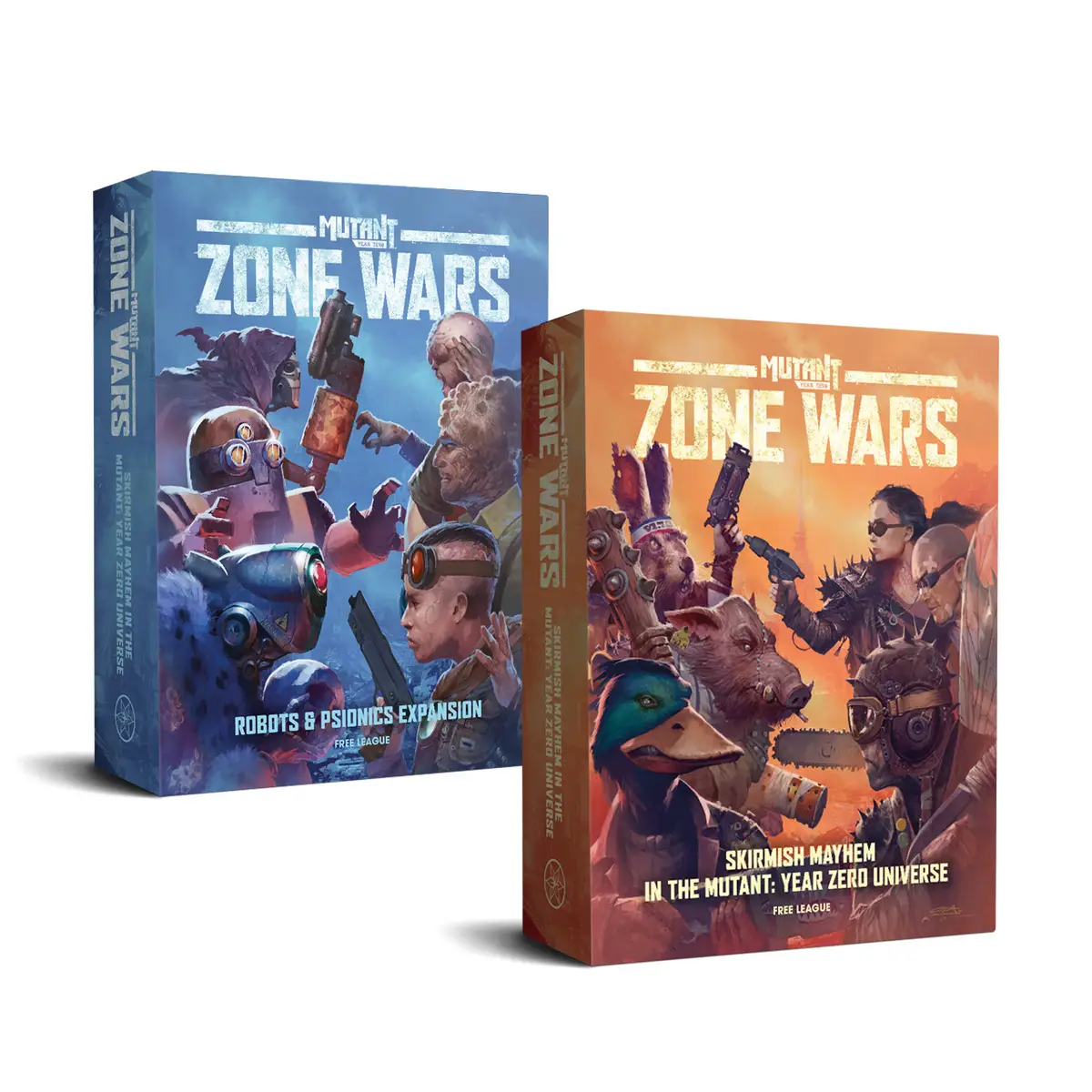
Lots of people find miniatures gaming a little daunting. There’s the idea that you’ll need to learn how to put together armies of complicated miniatures and—even worse—professionally paint them. There’s often a heavily militarised feel to them, with complex books filled with detailed rulings to argue over. And finally, they often seem to last for days.
Free League have the answer to this in Zone Wars. Pre-assembled models? Check. No need to paint? Check. A stylish pre-shading is applied to these models, much like the figures in Unmatched, making further paintwork optional rather than expected. The rules are fast, intuitive and fun, and scenarios are built to run quickly and end dramatically. Zone Wars is the models-on-a-table version of the Mutant: Year Zero RPG, and it’s a fantastic reimplementation.
Year Zero classically uses a pool of chunky custom D6 dice, scoring successes on 6s. Built in is the option to re-roll, “pushing” for the result you need, at the risk of rolling 1s which cause damage or other problems. It turns out that Year Zero system works almost perfectly for miniatures gaming too—not surprising when the adaptation has been done by Necromunda legend Andy Chambers!
All characters have four attributes; Ranged, Melee, Survival and Health. Those are different to the attributes in the RPG, but that’s understandable since this game is entirely about fighting each other; there’s not going to be any complex social manoeuvring or thinking outside the box here. Each attribute has a score which relates to the amount of dice you roll (or for Health, the amount of damage you can take). When you run out of health, you flip your character’s card over to its “Bloodied” state.
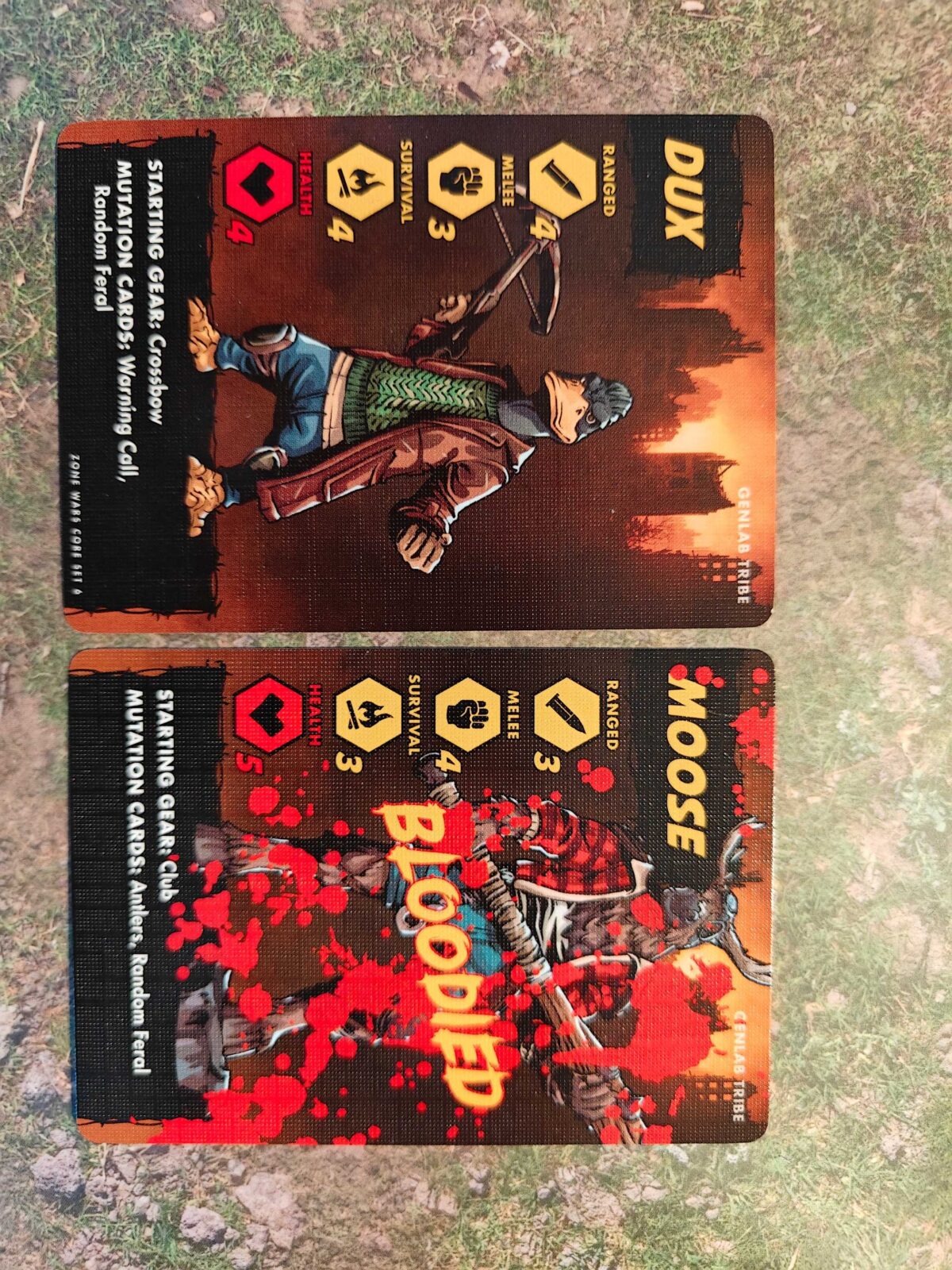 Characters begin with certain characteristics and draw mutation cards. The world of Zone Wars is a post apocalyptic earth, where humans and animals were experimented on and changed irrevocably by both genetics and radiation-linked mutations, so there’s a whole range of cool, weird powers you get to draw from. Most of these impact on fighting, or on giving additional movement options. So “Flesh Eater” turns your character into a zombie, healing itself by the damage it does to others, whilst “Killer Instincts” allows you to do more damage to already Bloodied characters, picking off the weak. My favourite is probably “Frog Legs”, which allows you take extra long moves with your bouncy salientian appendages.
Most mutation cards need activating with m-points; tokens you collect for rolling mutation symbols when pushing rolls. The core mechanics are so simple that the additional action economy of these m-points is no problem at all; it also encourages everyone to push for better results all the time. Even if your weapon breaks, well, you might pick up some more m-points to power cool stuff later on.
There are two main advantages to small squad skirmish games, when compared to full sized wargames: shorter play length, and more differentiation between your characters. A full game of Zone Wars really is playable in an hour, and even on your first time opening the box you’ll likely manage to finish in two. The characters are also very varied, and the small size helps with that. After all, if you had fifty soldiers in a battle, it would be a logistical nightmare if each had different rules. But with three? Well, there’s room there for flavour, and Zone Wars has it in spades. I love that each character has a pre-set mutation and one random one; you’ll be rolling with the punches and using your squad in news ways to best utilise their sudden ability to fly, or to run half the length of the board in one turn.
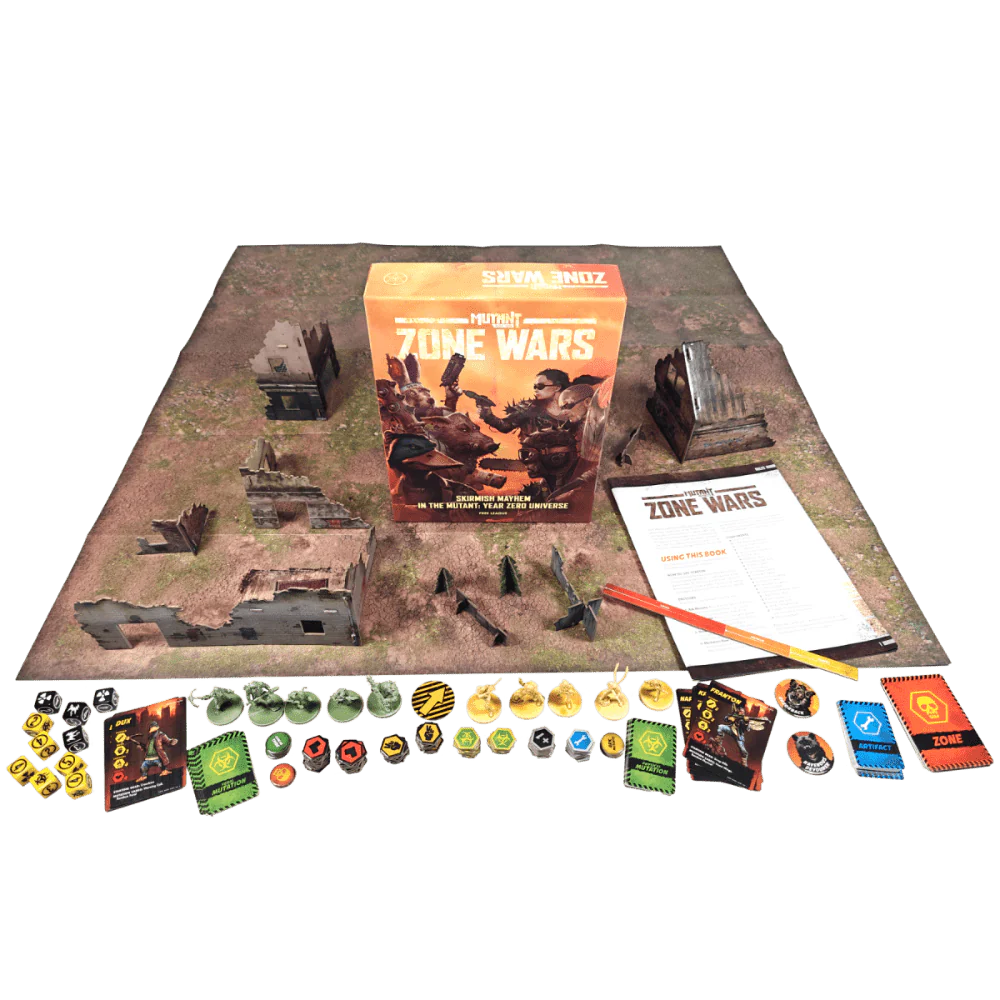
The Zone Wars box set also does a stand up job at dealing with all the fluff needed for an enjoyable tabletop experience. All the tokens, dice, cards and a measuring stick for distances are provided. The base game also comes with a battle map, and a reasonable amount of easy-to-put-together scenery. I still felt my table was a little sparse with just the base set, although adding the extra buildings and fences from the Robots & Psionics expansion filled things up nicely. Cardboard scenery has come a long way over the years, and I certainly think that Zone Wars creates a believable aesthetic in moments.
The main game comes with two factions; Genlab Tribe and the Ark Mutants. Genlab Tribe are extra-intelligence animals—so Zone Wars joins Dragonbane in providing you the opportunity to play an angry anthropomorphised duck—whilst the Ark Mutants are particularly hardened, mutated humans; on of them has a full set of giant insect wings. In the expansion box you also get the Mechatron Hive; a collective of self-aware cobbled together robots and Nova Cult; a secretive bunch with plenty of mind-warping powers. Each faction also has access to a specific extra set of mutation cards, meaning the variability for each is different.
In play the game feels like a mix of straight up hit-em-and-run and “ooh, let’s use this weird power”. It’s definitely a beer-and-pretzels game; fans of Dystopian Wars might find this too simplistic. Initiative for players comes from placing tokens in a cup; this also includes some “Zone” tokens, which trigger strange effects or additional monsters to fight. The latter is an interesting addition to this style of game, generating a new NPC on the field to combat—usually attacking the player that discovers them. They probably make things a little more unbalanced, but thematically they are lots of fun, both in the realism of exploring a post-apocalyptic wasteland and in irritatingly disrupting your well laid plans.
Both sets come with an varied set of scenarios that standalone or can be tied together into a capable. All of them provide a tight timeline and a clear route to victory. Again, you may find them a little simplistic, but I feel they achieve their aim, and often with plenty of flavour. Scenario 1 features a steadily worsening acid rain that initially targets one player, then everyone, then eventually Takes Out anyone still left on the field. “Grab stuff and get out” is the name of the game, but when those pesky Genlab rodents are already in the middle of the field with all the best stuff? Suddenly things get a bit crunchy.
If I have a criticism, beyond the intentionally simple-but-satisfying mechanics, there’s very little background in the box. I’m not expecting a hardback book filled with backstory, but there’s literally a single sentence that describes the Zone as “a post-apocalyptic wasteland”; everything else I’ve used to describe the theme here comes from my knowledge of the RPG! For a series with such brilliant story-telling, I’d have liked a page or two bringing that to life a little more. Obviously, this is easily rectified by picking up one of the RPGs, but it seems a shame to need to ask for that. Still, that aside, this is one of the freshest miniatures games I’ve seen in years.
PLAY IT? MUST PLAY
Look, if you’ve never played a miniature war game, get this! It really has everyone you need, it’s tremendous fun, and the rules are crisp, clear and easy to follow. Plus you get to be a duck with a crossbow!
TRY THIS IF YOU liked DEADZONE…
…I think Mantic’s Deadzone Third Edition is the best tabletop skirmish game out there. Zone Wars has slightly less strategic depth, but a lot of additional fun and flavour.
| About Mutant Year Zero: Zone Wars | |
|---|---|
| Designer | Andy Chambers |
| Publisher | Free League |
| Playcount | 1-4 Players |
| Age | Age 14+ |
| Price | £45 |
| Contents |
|
| Rating | Must Play |
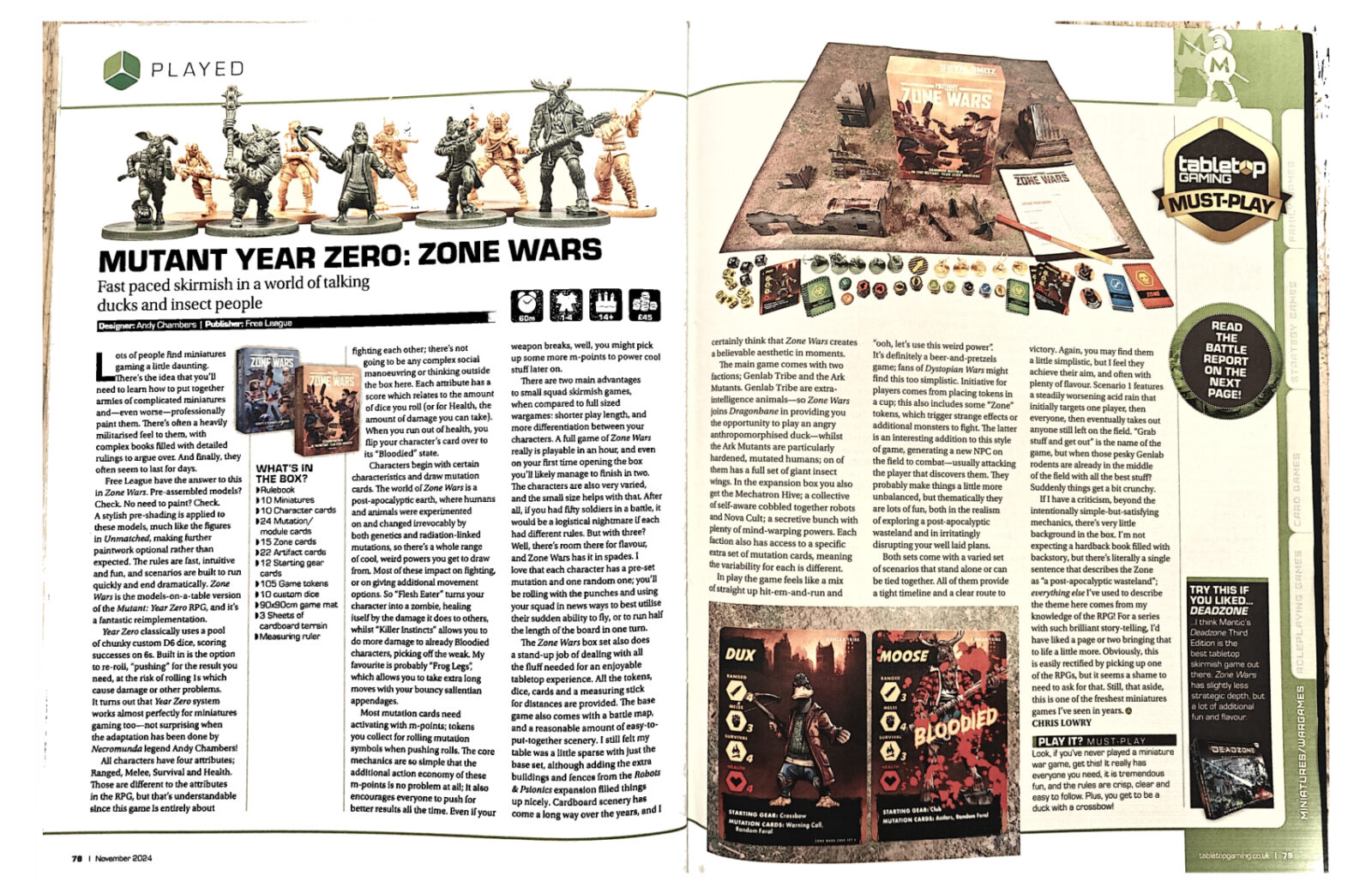
A review written for Tabletop Gaming Magazine. Magazine page copyright to TTG Magazine 2024.