
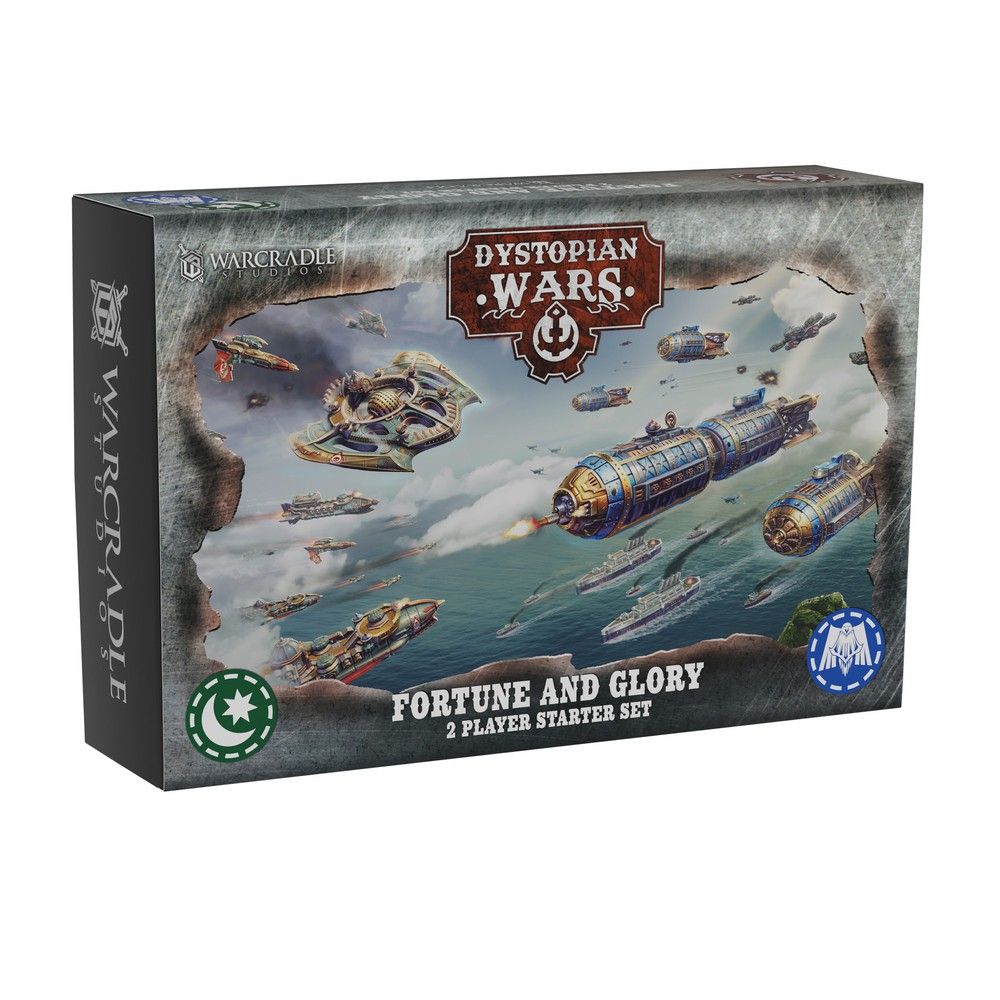
Dystopian Wars is a tabletop miniatures wargame set in an alternative version of the late-Nineteenth Century. In other words, it’s an excuse to play out Victoriana steampunk ship battles on your kitchen table.
Now, there are three pillars that any miniatures gaming system needs to nail; story setting, quality of models, and gameplay.
Let’s start with the Dystopian Age; a time of old-school steel-clad hulls blending with futuristic technology amidst the roiling dregs of empire. The depth of setting for this game is pretty breath-taking; much of that is thanks for the groundwork laid by original creators Spartan Games, and the quarter of a million words written for the lore of the game.
Now, such a vast backlog of information is a bit of a blessing and a curse. On the one hand, if you like alternative history, with the idea of the South winning the American Civil War (with a nice retconning of slavery) and Antarctica homing a secretive, hyper-advanced nation; well, there’s a lot of reading ahead of you. On the other hand, if you don’t really fancy wading through weeks of words to get on top of the history of the game, you’re left feeling a little… left out?
The rulebook for this 3rd Edition box set, for example, contains a huge chunk of lore pages. I’m no stranger to weighty game backgrounds – I’m currently fifty books into Warhammer 40,000’s Horus Heresy series—but I didn’t really feel drawn in by the writing in Dystopian Wars. The prose is almost bone dry, and I felt reluctant to invest the amount of time required to get up to speed with the history of the game. That’s fine; in many ways such a thing is optional, and nice to have for those who want it. That said, I didn’t want it, but I found it here anyway, cluttering up an already dense rulebook.
Moving on to the models; they look absolutely stunning. The level of detail is extremely high, and ships are fairly easy to clip, fit and glue together. As you can see from the next page, they paint well, and look imposing on the tabletop. It’s just a shame that the guidance for what to actually assemble is abysmal. There are typos, references to wrong pages, and models apparently missing from the list. This box set even contains a force that, as far as we could tell, isn’t game legal (it has too many aerial units to create a valid battlefleet). I say “as far as we could tell”, because that information is not readily available. It would be absolutely expected to include an example fleet list in a starter set like this one; “build one Anatolia Heavy Battlecruiser, two Carolus Destroyers”, and so on. There’s nothing like that here; Fortune & Glory doesn’t include rules cards for ships, simply referring players to the website to download them. Even then, some of the ship types available in the box are not in the downloadable Unit Cards list on the Dystopian Wars site, nor do any of them have pictures.
I attempted to put together my Dystopian Wars models on my own, but struggled, so I asked my friend James to help. Between us, we have around 40 years of accumulated miniatures gaming experience, and we still felt daunted by the lack of guidance here. We eventually had to resort to third-party advice on Reddit and Battlescribe, and in the end we still made several mistakes, and glued together some incompatible units. If I were new to miniatures? If I didn’t need to write a review? I would have given up.
So, how does it play? Players play Victory & Valour cards to win initiative, then take turns activating units of ships. Ships begin their activation by drifting, representing their momentum (so big ships float further than small ones). They then move a distance up to their maximum “Speed” value. Turning takes points away from movement. Now, I liked that the first point of turning is still forwards; this penalises making multiple turns rather than just one big one. Overall though, I preferred the approach that Mantic’s naval battle game Armada takes to movement, where you move up or down speed levels, and your movement is governed by inertia from prior turns.
Shooting is divided into arcs, with some guns able to aim in one, two or three directions. Ships have an “Armour” value and a “Citadel” value. Scoring multiples of the Armour damages the hull, but reaching the higher Citadel causes a critical hit. Some rather tasty custom dice allow for multiple hits, defence rolls and exploding dice, and a novel rule is that of “support weapons”, where matching guns from ships in a unit can combine their fire to increase the number of dice rolled. Supporting lets you roll less dice overall than individual attacks, but allows you to have more of them all at once; an interesting choice between aiming for damage or trying to breach the citadel for critical damage results.
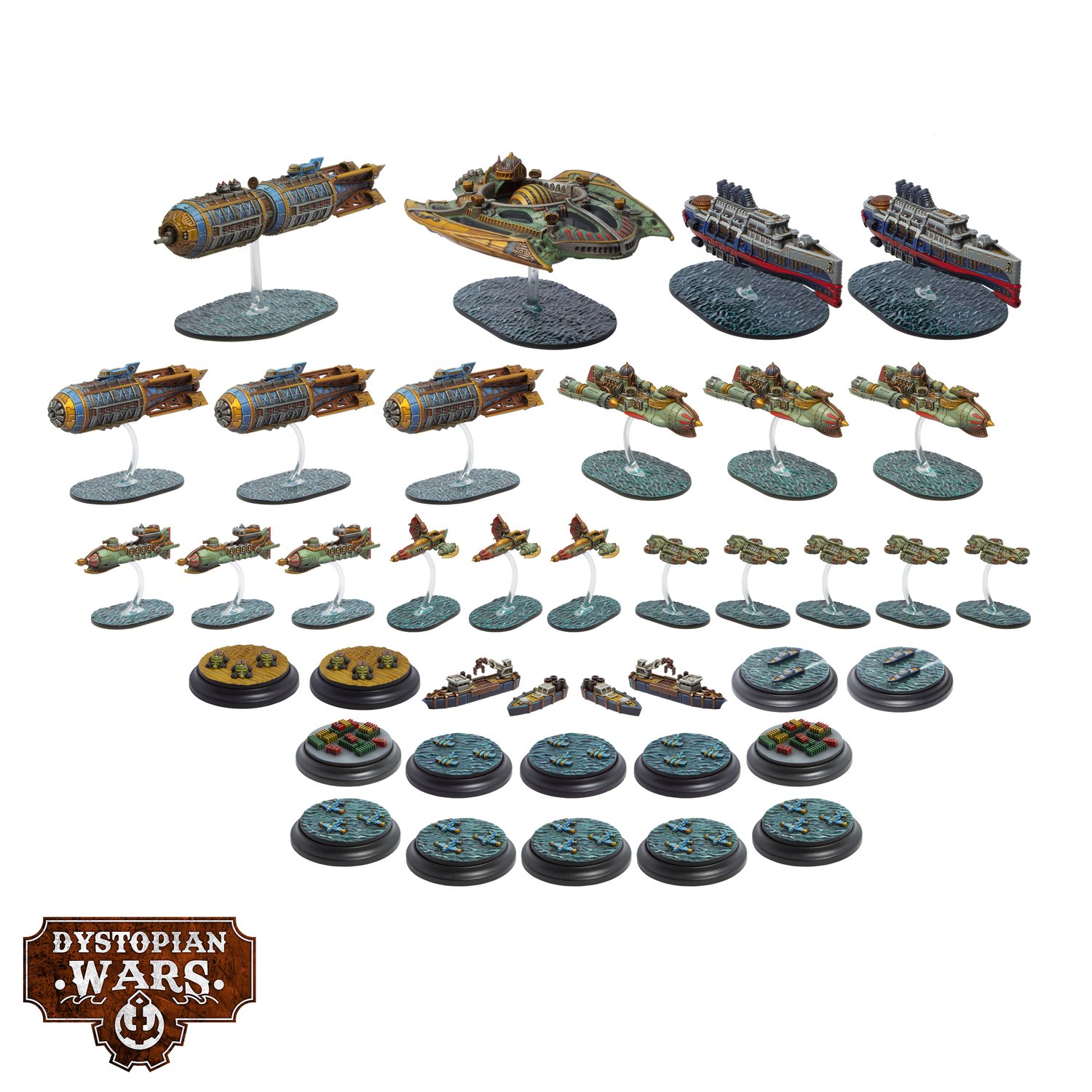 Now, it took us too long to fully understand supporting fire; the rulebook is quite wordy and almost completely lacks explanation diagrams—the most important way to explain concepts like “arcs of fire”. Even now, I wouldn’t argue with you if you were to tell me I’d misunderstood an aspect of combining attacks. The game doesn’t give any advice on the best way to record damage to hulls; we used a dice on each base to represent remaining hits, changing colour for crippled ships. That’s fine for us, but most people don’t have a bag full of varied colour dice at the ready, and the game doesn’t include any.
There were a number of inconsistencies we encountered too. Short Range Squadrons, called “SRS”, are counters that represent tiny groups of fighters or attackers, too small for their own models. Yet in our play, SRS seemed overly strong, accounting for the destruction of more than 50% of ships in one game. Compared to games like Armada or X-Wing, the arcs, turning and bases of ships are rounded or hard to pinpoint, making them imprecise and unclear. The ships may be pretty, but in a competitive tournament setting, precision is key; wooliness can lead to a lot of disagreements.
Victory points were also poorly worked out. In one scenario, searching wreckage could gain a model 10VP. Thus we had one ship gain 20VP(!) through searching, whilst his opponent destroyed a vast flagship over multiple arduous turns of bruising warfare… for just 1VP! This flipped the game into a nonsensical strategy because the VP rewards incentivised unrealistic actions. Initiative also seemed vitally important in our game due to the potential to earn victory points at the beginning of your turn, but ultimately came down to entirely the luck of the cards. Do you get a high card? You can go first, get 10 victory points, and then destroy your opponents wreckage-adjacent ship before they get an opportunity to search.
Ultimately, Dystopian Wars is a game with lots of depth, and a number of highly detailed, granular attack options with weapons. It was fun, but as an opponent, being attacked too often felt like waiting for some maths to take place, for some clunky rules clarifications and eventually just being told what damage you’d taken, rather than a back-and-forth you were truly invested in. Detailed games need clear & precise rulings too; those are lacking here. Coupled with the horrible force-building experience, this is a game for those who love the idea of the setting and the look of the models, and can overlook an Empire’s worth of teething troubles to get there.
PLAY IT? MAYBE
Look, these ships are really pretty, and there’s an unparalleled world of exhaustively comprehensive history on the Dystopian Age. If that appeals, you’ll have years of fun here, but beginners should stay firmly away.
TRY THIS IF YOU liked Armada…
…Mantic’s Armada was a TTG Must Play. It’s fast, fluid and fun. Unlike Dystopian Wars, the rules are crystal clear and razor sharp. The mechanics for wind and momentum especially lead to an experience that really feels like ships tearing around the high seas and firing off cannonballs at each other.
| About Dystopian Wars: Fortune & Glory Starter Set | |
|---|---|
| Designer | Stuart Mackanness |
| Publisher | Warcradle Studios |
| Playcount | 2+ Players |
| Age | Age 14+ |
| Price | £95 |
| Contents |
|
| Rating | Maybe |
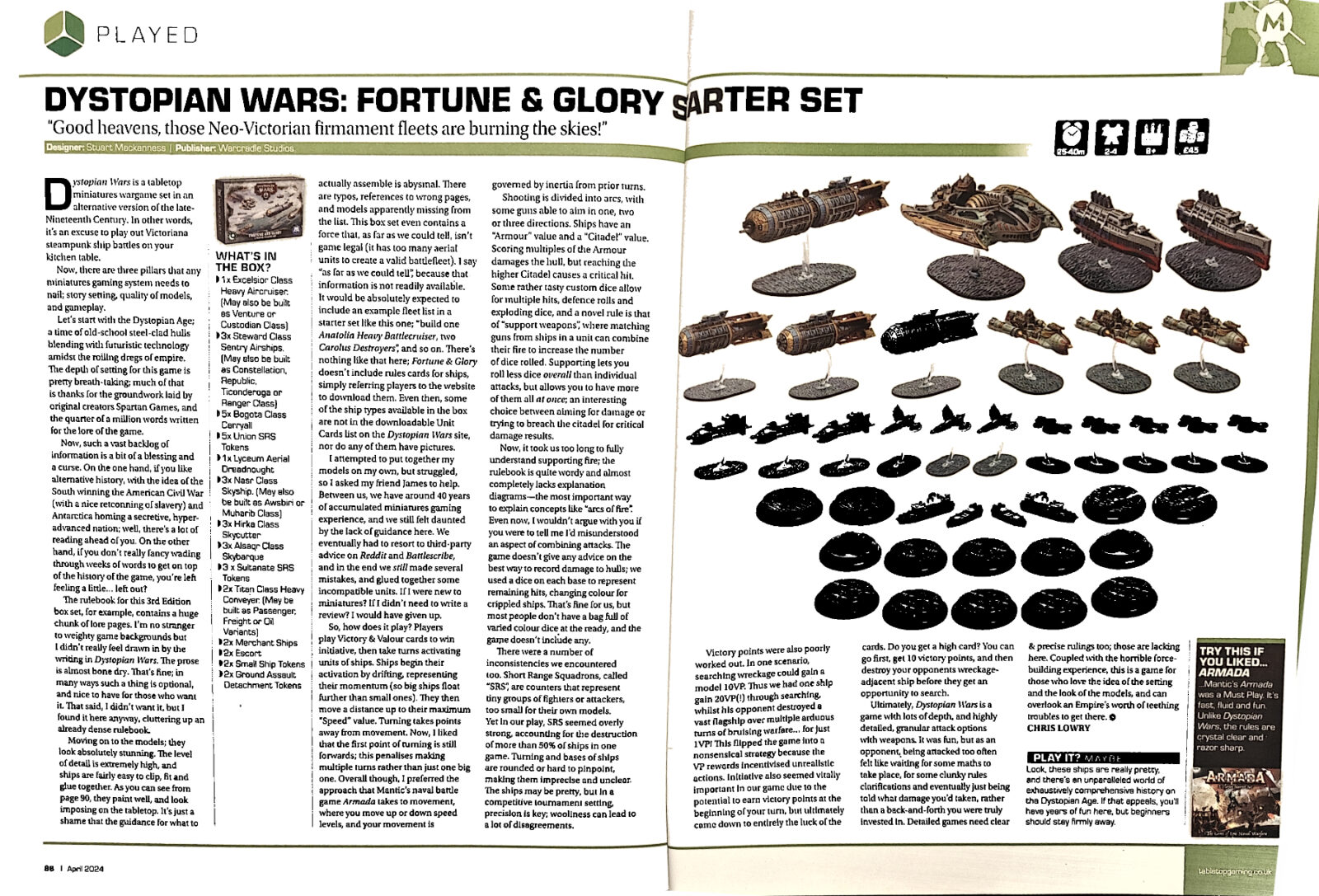
A review written for Tabletop Gaming Magazine. Magazine page copyright to TTG Magazine 2023.