
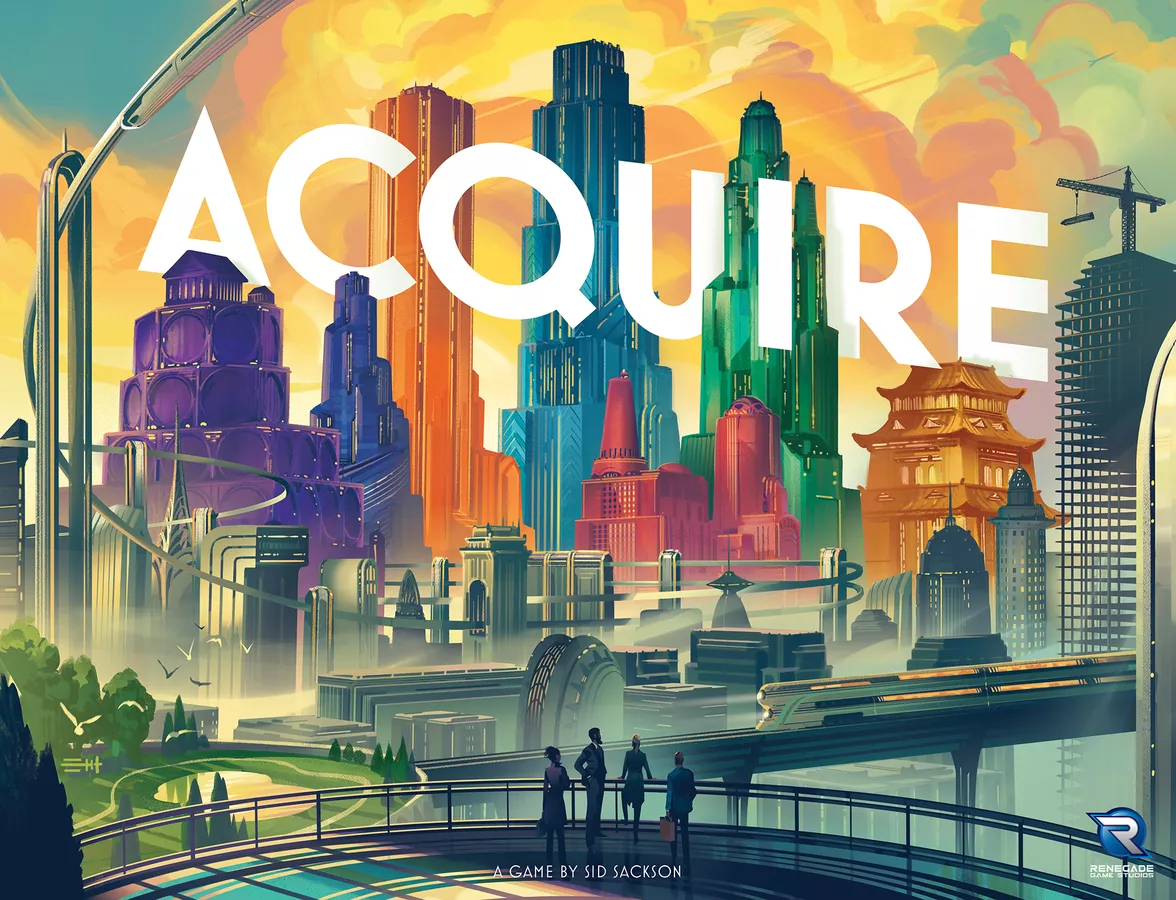
Impartiality warning up front: I love this game. I think Acquire is criminally under-represented in both the tabletop gaming scene, and the world at large. Let’s throw out Cluedo and replace this on a million bookshelves. Done. Article finished!
For those of you who need, you know, a review, and perhaps some sort of journalistic rigour, Acquire is a game of where players compete to build companies and to collect shares in them. The game itself is remarkably simple, consisting of a board, a pile of numbered tiles, some paper money and seven piles of shares. Unlike many stocks-and-shares games, it is pretty pacey, and with a play-length that doesn’t extend at higher player counts either.
On your turn, you place down a numbered building tile, choosing one of the five in your hand. You thus have a limited range of choice, usually enough to place in roughly the area of the board you desire; but rarely exactly. If two tiles end up next to each other, a company is formed. The founder gets a free share, and everyone else can buy stocks in the nascent institution if they wish.
After placing a tile, you can buy up to three stocks in any active company. Draw a replacement building tile for your hand, and that’s your turn over.
So far, nothing particularly stunning, right? Indeed, for the first few turns, very little drama occurs. Players plonk down a piece, then draw another. Then… someone forms the first company! A flurry of share purchasing happens. Then another, then another.
Then, at some point, a company gets bigger. New building pieces placed adjacent to a formed company increase its size—and its share price. Those $200 stocks are now worth $300! Another pother of purchasing takes place as people realise they need to get in on the ground floor of something big.
Soon enough, the real meat of the game takes place: a merger. This is where a building piece is put down in such a position that it joins two companies. At this point, the larger company swallows the smaller one, buying out the owners of the defunct corporation. The largest shareholder gets a huge pay out, with the secondary (and sometimes tertiary) stakeholders receiving smaller, but still substantial, amounts.
At this point it becomes clear: you want to own a company and then sell it for a massive pay-off! Any stocks you have in the old company can be sold, traded two-for-one for shares in the new company, or kept for when the company is re-founded. It’s an interesting problem: “Do I want cash now, or ownership in the bigger beast?”.
Running out of cash is a nightmare to be avoided if at all possible. The only time it’s ever appropriate is in a frantic final burst of stock-buying for a company you know you can merge next turn. Unless, of course, someone else adds to the company in a way that ruins your merger chances. Then you’ll be left with empty pockets and no way to make more money.
The game escalates rapidly, quickly moving out of nickel-and-dime territory into vast multinationals squaring off over commercial territory. It’s an interesting experience, the board almost feeling like an area control game; a counter-intuitive one, where everyone can own all of the armies, and sometimes the losers of a battle are actually the winners.
Companies are “safe” from mergers once they grow larger than eleven tiles, and the game ends when either all the companies are safe, or when any one company is larger than forty-one tiles in size. At that point, a final bonus pays out to the top shareholders of every company and a winner is declared.
The reason Acquire is so exquisite is that it’s incredibly simple to teach, and yet wonderfully strategic. Almost every decision you make can matter; but predicting which will be most important is an art. There’s just enough randomness to blame luck for your failures; but deep down you know that the real reason you lost is that you began to invest in a company just one turn too late, or you’d failed to notice that Brian had so many bloomin’ shares in Imperial!… The balance of frustration to satisfaction is close to perfect. It certainly doesn’t hurt that you’ll get multiple pay outs of thousands of dollars in cash; the subconscious dopamine rush may be the reason my brain wants me to play this game.
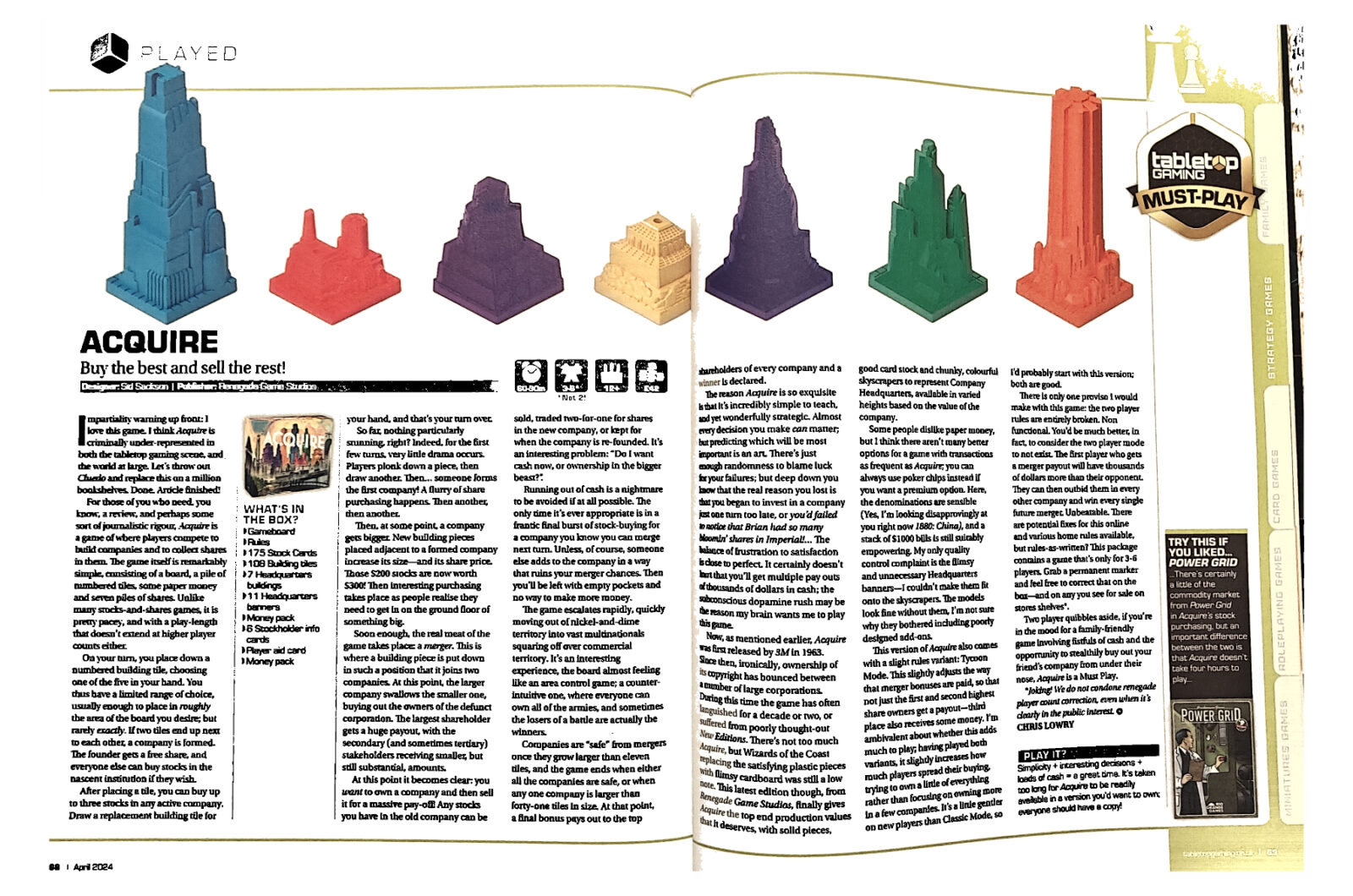
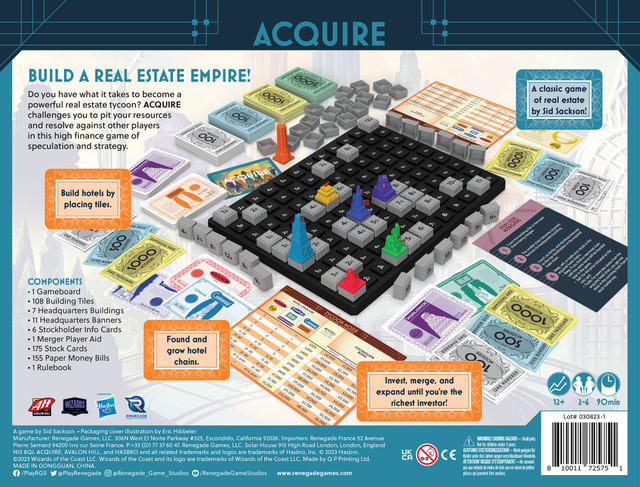 Now, as mentioned earlier, Acquire was first released by 3M in 1963. Since then, ironically, ownership of its copyright has bounced between a number of large corporations. During this time the game has often languished for a decade or two, or suffered from poorly thought-out New Editions. There’s not to much Acquire, but Wizards of the Coast replacing the satisfying plastic pieces with flimsy cardboard was still a low note. This latest edition though, from Renegade Game Studios, finally gives Acquire the top end production values that it deserves, with solid pieces, good card stock and chunky, colourful skyscrapers to represent Company Headquarters, available in varied heights based on the value of the company.
Some people dislike paper money, but I think there aren’t many better options for a game with transactions as frequent as Acquire; you can always use poker chips instead if you want a premium option. Here, the denominations are sensible (Yes, I’m looking disapprovingly at you right now 1880: China), and a stack of $1000 bills is still suitably empowering. My only quality control complaint is the flimsy and unnecessary Headquarters banners—I couldn’t make them fit onto the skyscrapers. The models look fine without them, I’m not sure why they bothered including poorly designed add-ons.
This version of Acquire also comes with a slight rules variant: Tycoon Mode. This slightly adjusts the way that merger bonuses are paid, so that not just the first and second highest share owners get a payout—third place also receives some money. I’m ambivalent about whether this adds much to play; having played both variants, it slightly increases how much players spread their buying, trying to own a little of everything rather than focusing on owning a more in a few companies. It’s a little gentler on new players than Classic Mode, so I’d probably start with this version; both are good.
There is only one proviso I would make with this game: the two player rules are entirely broken. Non functional. You’d be much better, in fact, to consider the two player mode to not exist. The first player who gets a merger payout will have thousands of dollars more than their opponent. They can then outbid them in every other company and win every single future merger. Unbeatable. There are potential fixes for this online and various home rules available, but rules-as-written? This package contains a game that’s only for 3-6 players. Grab a permanent marker and feel free to correct that on the box—and on any you see for sale on stores shelves*.
Two player quibbles aside, if you’re in the mood for a family-friendly game involving fistfuls of cash and the opportunity to stealthily buy out your friend’s company from under their nose, Acquire is a Must Play.
*Joking! TTG does not condone renegade player count correction, even when it’s clearly in the public interest.
PLAY IT? MUST PLAY
Simplicity + interesting decisions + loads of cash = a great time. It’s taken too long for Acquire to be readily available in a version you’d want to own; everyone should have a copy!
TRY THIS IF YOU liked Power Grid…
…There’s certainly a little of the commodity market from Power Grid in Acquire’s stock purchasing, but an important difference between the two is that Acquire doesn’t take four hours to play…
| About Acquire | |
|---|---|
| Designer | Sid Sackson |
| Publisher | Renegade Game Studios |
| Playcount | 3-6 Players (not 2!) |
| Age | Age 12+ |
| Price | £42 |
| Contents |
|
| Rating | Must Play |
A review written for Tabletop Gaming Magazine. Magazine page copyright to TTG Magazine 2023.