
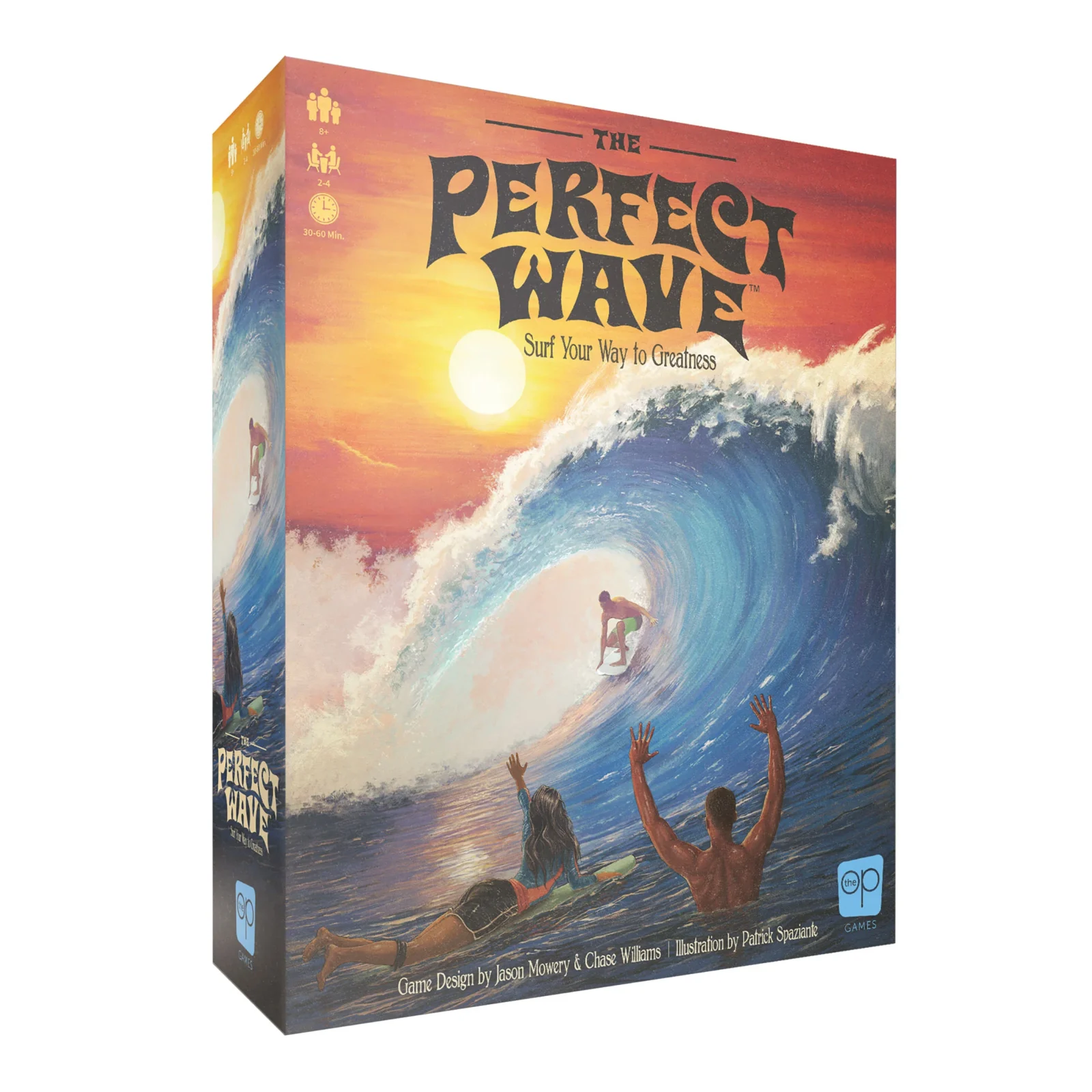
The Perfect Wave is a laid back game about catching waves, set in a sunset snapshot of the seventies. The first thing that will strike you is the game’s presentation. Designer Patrick Spaziante has clearly targeted a specific vibe here—and I’d say he’s absolutely achieved what he set out to do.
It’s faded glory throughout, with a real care and attention taken to period-appropriate typography, and the use of rough recycled paper with printed fold lines making the rulebook seem like a discarded 70s surfing flyer. There’s even something about the matte card stock that adds to a Fear and Loathing in Las Vegas feel of sunglasses and sunshine. As you lay cards down, the progressively larger numbers are illustrated with bigger and splashier waves, forming a tableau all the way to the horizon. The whole package is nearly perfect; even though the nitpicker in me felt frustrated by a few points – especially the unnecessary copyright notice on every cardback, spoiling the serene simplicity.
Gameplay is fairly fast, and certainly quick to pick up. Players collect “wave” cards and lay them down to make Rummy-style combos. The twist here is that you can only lay down cards to the right of your swimmer, as they swim out to sea. Why not just stay at the beach so you can place cards anywhere? Well, at the end of the game, your scoring run begins where your swimmer is, as they turn round, mount their board and surf back. Still on the beach? You’ll get no points!
The balance of the game thus comes down to sacrificing turns, cards and wax tokens to get further out to sea, hopefully after having filled relevant wave slots—and adding manoeuvre cards to score bonus trick points. Each player has a hidden goal card, and there are some public shared goals that players can activate. Doing so costs an entire turn, creating a conundrum—does one do it early and build towards it, or risk having other goals activated instead?
(For those of you used to “making the drop”, the Goal cards are all named after classic surfing location such as Bells Beach in Australia and Nazaré in Portugal).
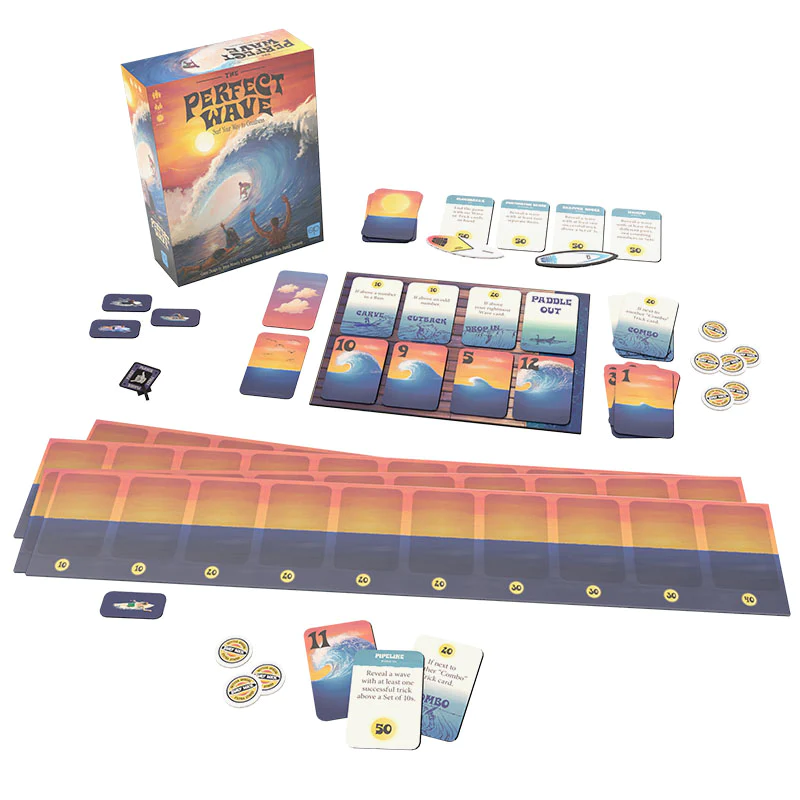 The Perfect Wave presents a satisfying competitive puzzle, although I feel it’s slightly harmed by one aspect; the “Paddle Out” cards. Shuffled into the manoeuvre deck, Paddle Out cards are the main way to move your swimmer out to sea; without them players must spend 1 action and a wax token to swim. Wax tokens are limited, and getting a new one costs 2 actions. If Paddle Out cards come out in an unfair distribution, one player might get to swim out, repeatedly, for free, whilst others have to spend their whole turn just to pick up a single wax. In our experience, this happened too often, especially in the two player game.
Finally, the publishers have made an interesting decision here; using unlaminated cards and a reconstituted cardboard insert tray. It feels and looks much like the production quality of Earthborne Rangers, which has been widely acclaimed for being the only game you can confidently toss on the compost heap – yet The Perfect Wave makes absolutely no claims on its website or printed materials about being more environmentally friendly. Perhaps I’m wrong, and it’s no better for the planet than any of the other ten gazillion games released this year; but if not, well done to The Op Games for putting in the effort.
Overall The Perfect Wave offers a reasonable balance of luck and strategy in a very pretty package. Personally, the Paddle Out cards tilt things a little too much towards Fate’s fickle hands, but either way it’s a enjoyable game.
PLAY IT? YES
Sometimes you just want a simple, beautiful selection of cards to play with. The Perfect Wave isn’t going to win any Mensa awards, but it feels, just enough, like a fierce paddle out from the beach, followed by a bitchin’ break and that sick surf back to shore!
TRY THIS IF YOU liked Game of Trains…
…both of them have pleasing artwork that reward players simply for laying their cards in a row. Game of Trains manages to fit a smaller game into an even smaller box too.
| About The Perfect Wave | |
|---|---|
| Designer | Jason Mowery, Chase Williams |
| Publisher | The Op Games |
| Playcount | 2-4 Players |
| Age | Age 8+ |
| Price | £35 |
| Contents |
|
| Rating | Yes |
A review written for Tabletop Gaming Magazine. Magazine page copyright to TTG Magazine 2023.