
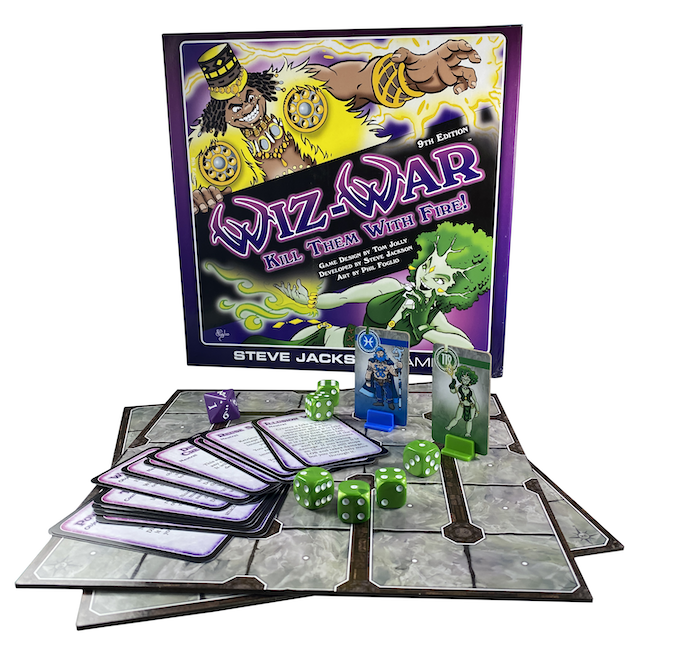
This review is written with two specific groups of people in mind: first are the selection of innocent individuals who have never played or encountered Wiz War before; second are the many who have played (and possibly loved) an older edition. Let us begin with the newbies; our trainee Wizzees…
Wiz War is a zany take-that game of magical mayhem. Players are wizards, running around a maze and firing ridiculous spells at each other in an aim to incapacitate rivals and steal their treasure. The game was first released in 1983, and has had a number of editions since then – this is officially the 9th! In reality, there have been three main versions; several early Jolly Games/Chessex versions; the much-loved and much out-of-print Fantasy Flight 8th Edition; and this latest 9th Edition from Steve Jackson Games.
For those with no experience of wizarding warfare, setting up a game of Wiz War involves plonking down a sector board of maze; one per player. Players then choose a colour, with a matching wizard, lair and two treasures. Starting in their lair, the wizards venture out, travelling to the centre of nearby maze sectors to stealing treasures. Treasures are heavy, and you can only carry one at any time. If you can get someone else’s chest back to your lair, you have earned one point. Kill another wizard? Also one point. Since the winner is the first to reach two points, it would likely be an abruptly short game, but for one key rule; rival’s treasures are only worth a point whilst in your lair. As you head back out to steal another chest, anyone can pop into your sector and steal theirs back again!
The underlying gameplay involves attacking one another with various spell cards. There’s a fun mix here, with spells; such as “Featherweight” which makes your wizard so light that you float away instead of taking points of damage; or “Swap Sector”, which exchanges the places of any two sectors—was your lair just one space away? Well now its the other side of the map!
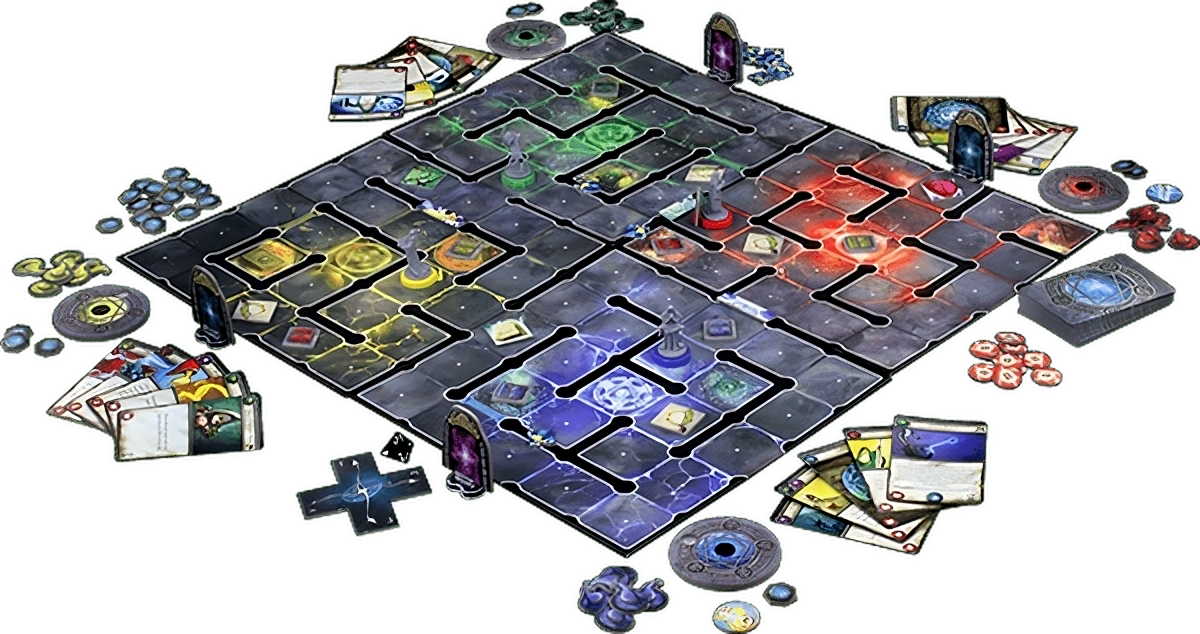
Wiz War has always been a game of gonzo fun; much like Munchkin, lots of things can happen that are “unfair”, including player elimination; you either accept that you are playing a game where you can spend 5 turns making a hole in a wall only to have the entire sector rotated, causing your new entrance to lead back into your own lair; or you play something else.
This latest version has been produced with three main aims; bringing a classic back onto shelves, producing it at an affordable price-point, and streamlining a game that has been renowned for being a bit, well, fiddly. I would say that SJG have achieved all of the above; you can actually buy a copy, and for just £35 or so, and it’s certainly a quicker game to play through than previous versions—and increasing the core-box player count from four to six is very welcome.
I just wish it was prettier.
Sadly, from an art perspective, Wiz War 9th Edition is barren. SJG have utilised absolutely the bare minimum of art it’s acceptable to get away with—or, being realistic, a fair bit less than that. Take a look at the 8th Edition’s vibrant sector boards, swirling with magic and colours; you could feel the enchantment even before you started playing. 9th Edition sectors receive their only colour from the player tokens; your imagination is expected to provide the rest.
Even worse, the cards are boring. That’s right: boring cards! In Wiz War?! This old chestnut has a proud heritage of player contributed cards, chock-full of utterly unbalanced madness; the card decks are the heart of the operation. Even 1st Edition had scrappy, hand-drawn illustrations, but SJG have chosen to use absolutely none. Just text, all in a single colour. Even worse, the cards used to have a nice clear iconography, with symbols like an eye for line-of-sight effects, and a compass for entire map reaches – 9th has none of that. Wiz War is quite a language dependent game, but even so, to make design decisions that increases that dependence (and reduces accessibility) seems lazy and short-sighted.
The 8th Edition had a wonderful variance in schools of magic, where players would construct the play deck from choices of coloured sub-decks such as “Mentalism”, “Conjuring” and “Mutation”. Each school had different spells and abilities – and just deciding which to use in a game was a lot of fun. There’s been a simplification of spells in the new version, and it’s just less wide-ranging and farcical than it deserves to be. I can understand the choice not to include expensive miniatures this time around—but cardboard standees are cheap enough that taking out “Transformation” spells seems a bit… boring. Transforming your wizards into werewolves, slime and gnomes was rarely particularly useful, but it was comedic.
All this simplification might be forgivable if the card and rules were perfectly clear. After eight previous iterations, the rules should be a hallmark of precise perfection, right? Unfortunately that’s not the case; I remain unclear exactly how countering spells works in this new edition; try this paragraph from the rulesheet out for size: “You can counter a Counter, and so on. You can also use multiple Counters against an attack. Anti-Anti is a special card that counters a Counter, and is played on your own turn”. If you can already “counter a Counter”, why do you need “a special card” that does that? There’s also no diagram of Line-of-Sight in the rules, which is a silly omission since it’s a classic place for confusion in a game about wizards blazing fireballs at each other round corners in a maze. In a game of card combat, card text should be also self explanatory. Yet, does the “Lockpick” card unlock a “Jammed” lock? Its an obvious question for a card that “unlocks any door”, but your guess is as good as mine.
Wiz War has always been a beast that one shouldn’t take too seriously, but it also had elements to reward wizardly planning and patience. A rule change in 9th allows players to use as many cards as they want in a turn and always pick back up to seven at the end of their turn. Previously players would be punished for burning through cards too quickly, since they could only pick up two per turn. They were rewarded for saving up for that big hit; wizards weighed down with magic stones and maintained spells paid a price by having less cards to choose from for defence and new attacks. Of course, you can still use the old rules, if you know about them. 8th Edition included an entire page of fun rule variants at the back; SJ Games sadly haven’t seen the need to include that here.
I end, on the weirdest conclusion I’ve ever made on a review. Should you buy this game? If you are in our first group, a necromantic novice, and 9th Edition is your only option to access Wiz War, then you definitely should. Not all the changes are great, but this is still a great game, and the quicker gameplay makes it easier for new players to learn. However, to the seasoned Wiz War veterans out there, with a weathered copy of 8th Edition on their shelves? Stay well away; you already have access to the deep magic—there’s nothing for you here.
PLAY IT? MAYBE
If you want to dip your first magical toe into the weird waters of Wiz War, you should absolutely play this game. However, for the gnarled old Gandalf-types, wise to the Ways of the Wiz? Just stick with the good old stuff.
TRY THIS IF YOU liked Fluxx…
…Many people hate Fluxx for its nonsense; many others love its carefree indifference to design conventions and gaming “good practice”. Wiz War may seem just as random, but there’s a lick of decent strategy underneath that’s far more satisfying.
| About Wiz War 9th Edition | |
|---|---|
| Designer | Tom Jolly |
| Publisher | Steve Jackson Games |
| Playcount | 2-6 Players |
| Age | Age 10+ |
| Price | £40 |
| Contents |
|
| Rating | Maybe |
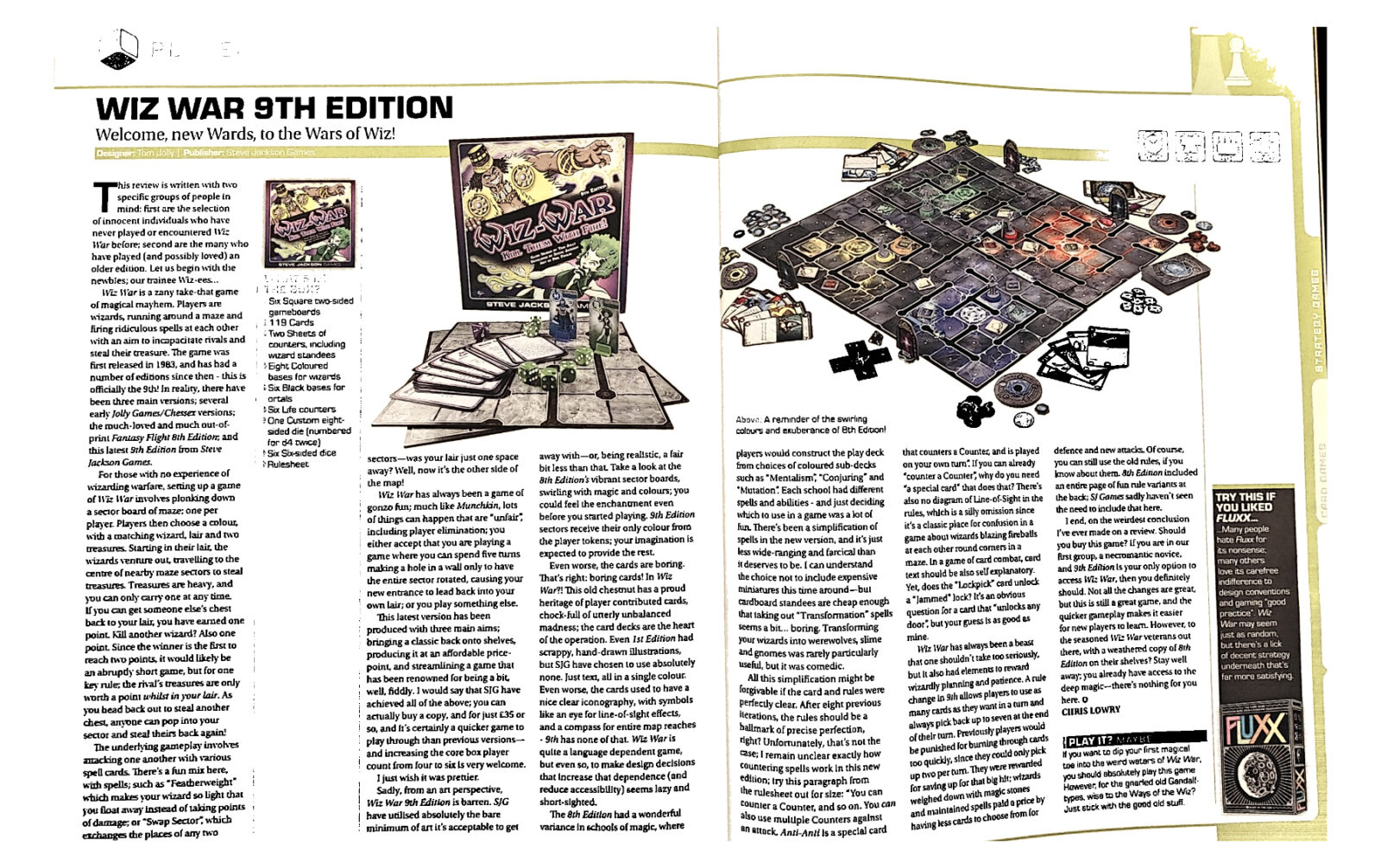
A review written for Tabletop Gaming Magazine. Magazine page copyright to TTG Magazine 2023.