If 2023 was the year of AI hitting the mainstream, 2024 will be the year of the gaming world deciding “What on earth do we do about it?”.
What is Generative AI?
What do we mean when we say AI? Well, it’s a misleading term because we aren’t really talking about “Intelligence” at all. We generally mean “Generative AI”: a collective term for technologies that generate an output using computer networks.
The two key bits of tech are “large language models” and “diffusion models”. These programs use vast databases of written words and images to “understand” text, and to generate images based on those words. When you type “Draw me an apple” into a prompt and the website gives you a picture of an apple? That’s Generative AI in action.
When did Generative AI arrive?
Well, Generative AI has been around for a long time – the first models were available in primitive chatbots in the 1960s! – but the modern versions have been rapidly improving in quality since around 2014. Last year marked the first time when they had the ability to reliably compete with human effort.
In November 2022, a previously unknown product was launched onto the world: ChatGPT. A simple web form with the ability to turn users ideas into fully complete written work, poems and coursework, all in seconds. Within days people were launching entire books onto Amazon that they’d “written” in a few minutes.
Around the same time, the diffusion image models began to appear, most notably Stable Diffusion, DALL-E and Midjourney. Suddenly people with no artistic experience could creative purpose designed artwork at the drop of a (virtual) hat. Earlier models created uncanny models with extra fingers and too many limbs, but even in the space of a single year the AI companies have caught up and improved.
Time + Money vs Artists
Modern gaming is chock full of art. Modern board games have graphics on every tile, card, token and box. Art is also expensive to make and produce, both in time and finances. Anything that makes the process easier has the potential to be very disruptive.
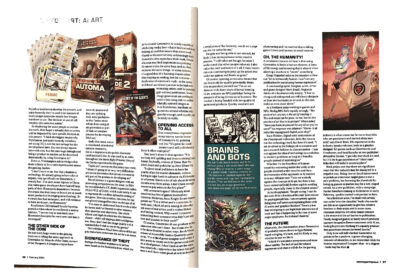
We conducted a survey on social media, asking people’s initial reaction to the statement “How Do You Feel About AI Art?”. As you can see from the graph on the right, the results showed an interesting split – far more landing in the Against camp (69%), but also a reasonably strong showing for Pro (23%). Of course, our pool of responders are likely to be more invested in board games than others; it still appears to highlight strong opinions and division, especially amongst creatives working in the gaming industry.
We spoke to David, owner of Moorhade Games, who pointed out an advantage of using AI; “I am a one man show, and getting a project off the ground with limited funds is very difficult. It would be easy to use AI art and be done with it – but it would feel disingenuous, and cheapen what I am trying to create”.
Despite the obvious financial advantages, they don’t feel it is worth the trade-offs; “Many artists are not able to make a living off their art as is. If AI is able to take the job that an artist would be commissioned for, I think that is unethical. Money is a barrier, and makes it difficult. But the difficult road is often the one that is more wondrous.”
Yet this philosophy is not held by everyone, and contention is not necessarily stopping the uptake of AI Art. Stronghold Games recently stirred up controversy when they revealed that they plan to use Generative AI to create the artwork for their latest Terraforming Mars campaign.
Given that it raised over $2.2 million, many commentators felt that Stronghold could – or even should – support more artists directly, rather than potentially replacing them with algorithms.
When interviewed, Travis Worthington, from Indie Game Studios (Stronghold’s parent company), said “I think the reality is that people are focused on the artist compensation model. Terraforming Mars has always worked internally, so it’s always employed the Fryxelius brothers to develop the artwork, and quite honestly they’ve used a fair amount of stock images and other mostly free images out there to use. The decision to use AI still employs the same two artists.”
In employing the same people to oversee the work, their hope is actually that no artists will be impacted by their specific decision in this project. “I think the biggest reason why FryxGames, and quite honestly ourselves, are using [AI] is not the cost savings but the development time. You can always equate time with cost, but the time to go through and bring a product to market can be decreased dramatically by using Generative AI.”
Even so, Travis acknowledges that there is likely to be a wide repercussion across the gaming market.
“I don’t want to say that this is harmless technology. It’s clearly going to have a lot of impact, very specifically on illustrators. It already has – I’ve seen some reports in China that video game developers have laid off large parts of their illustration department because the artists that they keep on board are so much more productive leveraging AI technology. So it clearly has had an impact, and will continue to have an impact, on illustrators.”
FryxGames CEO himself Enoch Fryxelius posted a video where he confirmed a similar opinion, “I see no way to turn back time – Illustrators lose jobs for every new tool that is developed.”
The other side of the coin
Yet not every large name in the gaming business is taking the same approach to Generative AI. Wizards of the Coast, owners of the Dungeons & Dragons empire have recently announced they are updated their artist guidelines so that “artists must refrain from using AI art generation as part of their art creation process for developing D&D art.”
Sadly this came, not as a considered, intentional mission statement, but as a response to the public discovery (and backlash) that AI was used by an artist throughout the latest Bigby Presents Glory of the Giants expansion for the game.
Travis isn’t convinced this policy can work; “I think it’s gonna be very, very difficult for anyone to determine that AI was not used in any part of the process in developing art.”
Pawe? Kicman is a game designer with an interesting perspective on the issue. In 2022 he crowdfunded a CY_BORG expansion called P!LLS FVLL of GODS, which used solely AI art to represent the soulless dystopian setting of the game. Since its creation, however, he has completely changed his view on the use of AI
“I’ve come to understand how it works a little bit better and I’ve listened to other creators, their anxieties and objections. The whole ethical and legal situation has also become clearer – whilst still staying a little ambiguous too. Also, I don’t feel the image quality is of a standard that I wish to use in my games.”
He’s withdrawn P!LLS from sale until he can pay real artists to recreate the art for a re-issue. He is now focusing on solely human illustrated projects, with Whispers of the Woods live on Kickstarter as we go to publication.
Opening access to all
One anonymous responder to our survey was in favour of Generative AI, pointing out that “It’s great for small creators and self publishers; a force & effort multiplier”.
They aren’t alone in that opinion: “It is exciting and uplifting and democratizing”, says Seann McAnally, creator of Times That Fry Men’s Souls and publisher at Nerd Glows On.
*“*It allows small publishers to have the quality of art the market demands, without having to raise funds in advance via Kickstarter or whatever. There’s a lot of talk about AI taking income away from artists. I don’t have enough money to pay artists in the first place!”
Generative AI represents a potential opportunity for creatives who would never be able to employ artists to expand their range of output. “I don’t know a single artist who makes enough money to live on by illustrating game books. No one is losing much here, and indie publishers are gaining everything”.
Will consumers agree? Obviously most creatives buy lots of games themselves – Christian Nommay, from Knight Errant Games points out “I’m a writer and a consumer. In both case, I think AI art is wrong; it takes the job away of real artists and it makes lifeless and boring content. Why would I consume something from someone who didn’t put any love and passion in their work?”
Of course, Generative AI can produce art for someone who can’t draw – but it can also do it for those limited in other ways. Jacob Wood, creator of Accessible Games Quarterly spoke to us, “I’m a blind game designer and writer. I hire artists to create work for games and zines. As a blind person, I don’t look at art the same way others do. I appreciate the talent that goes into it and I love some good alt text to describe a vivid picture! But honestly, words on a page can do the same for me.”
Despite not being able to see artwork, he finds it has an importance to his creative process, “I still value art though, because I understand that other people value art. I also value the craft and talent of it all. I think there’s value in continuing to prop up the artists that make our games and books so great.”
Of course, opening access also means that the threshold for quality potentially drops. One respondent pointed out “I’m an art director with three years of formal training in art, and also an RPG publisher facing the prospect of being driven out of business. The market is being flooded with low quality AI generated products. Quality standards are plummeting and I’m worried that is killing gamer’s trust and interest in small creators.”
Oh, the humanity!
A consistent concern we hear is that using Generative AI lacks a human element, a force of life energy and meaning that is absent when allowing a machine to “create” something.
Diogo Nogueira’s take on the situation is clear-cut; “Art is intrinsically human. I can’t see any justification for automating human expression”.
A renowned graphic designer, artist, writer and game designer from Brazil; Diogo thinks AI is fundamentally empty, “I fear it’s cheap and widespread use will slowly distance us from the humanity in art and, in the end, make us even more alone.”
As a freelance artist working in games and RPG, Hodag RPG feels equally strongly, “The point of art, any art, is the act of creating it. The end result can be great, or not, but it’s the practice of art that is important”. When asked “Have you been impressed by any AI art you’ve seen?” his response was adamant “Never- it all looks like regurgitated digital paint slop!”
Kaya Oldaker, digital artist and creator of the Flowerpunk webcomic, feels the issue is not the technology itself, but how it’s used. “I am involved in the Solarpunk movement and am a staunch believer in climate justice – I am not against the idea of technology as a solution to modern problems as long as it benefits people instead of exploiting us.”
Whether it’s the heartbeat of human creativity resonating inside the work, or the people involved at the creative coal-face; the humanity of the approach to AI matters to many. Kaya says “I am not entirely against the concept of AI art, but how it has been conceived [will] further exploit working people, especially those in the creative sector.”
As Jacob explained, “Simply saying ‘I can do this with AI for a fraction of the cost’ is no excuse for paying people less. I am completely against firing your staff artists and replacing them with AI artists and “graphics finishers. There’s a fear that we’re going to put legitimate creators out of work and that is happening in the case of some major employers. But it doesn’t have to.”
The Future
Ultimately, the conversation about Generative AI probably comes down to hypothetical hand-wringing. It’s here, and it’s likely to stay whether or not we like it.
“I think it’s less about acceptance and more about apathy. The lack of care for what it represents and what it will do for the gaming industry is what scares me far more than folks who are passionate and excited about new tech”, says David Bock. His experience in the industry speaks volumes, both as a graphic designer for games such as Gloomhaven and Frosthaven, and head honcho at new publisher Binxadinx Games. “I get why they think it’s cool, but it’s the huge population of ‘I don’t care’ folks that will make it commonplace.”
Here at Tabletop Gaming, our concern is the quality and health of our hobby. David points out that there are significant ways that the industry may be disrupted in a negative way. Using nice art (and miniatures) to polish an otherwise turgid game is not a new problem, but lowering the threshold for bringing games to market may be a two-edged sword. As a new publisher, with a campaign Rocket Ranchers coming to Kickstarter in early February, quality control is important to him.
“As a freelance artist, I’ve dealt with several non-artist ‘over-the-shoulder’ leads who would see this as an opportunity to give less creative freedom to their artists and in some cases, eliminate creatives. My other major concern is the removal of the art barrier to publication. Poorly designed games or barely tested products can now be used to fleece consumers with AI art, fooling buyers into thinking it’s a quality product that passionate creators invested time in.”
Our policy at Tabletop Gaming is that we will not be using Generative AI – beyond the examples in this post – preferring to use our platform to highlight human designers, artists and creators. We are just one voice amongst many; we asked followers if they think AI Art will become completely accepted and adopted in the hobby we adore:
“Maybe”, reflects Diogo. “But, for me, it would still be meaningless. Like an empty shell. No humanity. No shortcomings of the artist. No intentionality. We are transferring the responsibility of making human expression to a machine”.
Only time will tell whether Generative AI proves to be a positive, a game-changing remover of obstacles; or an existential crisis for human expression? I suspect that – to a degree – both may be true.
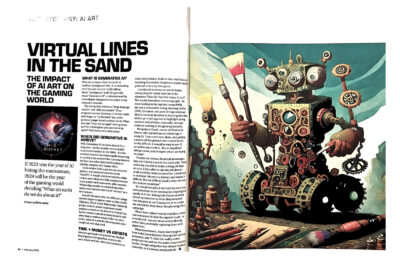
//Brains and Bots
We can’t talk about Artists and AI Art without giving a demonstration! We paid Hodag RPG to draw us a quick image of “a goblin-made machine creating art. The machine is cobbled together with paintbrushes and cogs and mechanisms”. Then we fed exactly the same prompt into an image generator.