
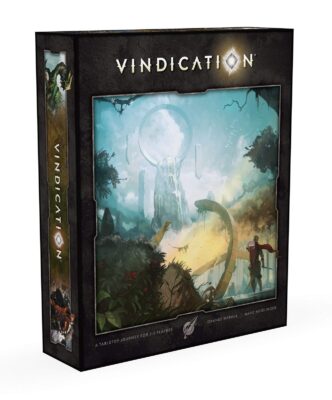
Vindication sets players against one another in the mythical world of The Awakening. You are wretched individuals, having lived lives caught up in wealth and excess, thrown aboard during a revolt by your oppressed workers. You wash up on a remote island; a land of empty hexagons before you and only honour at stake.
At the heart of Vindication is a moderately complex euro game with a rather unique approach to itsveconomy. Each player has a Power Board, with a selection of wooden blocks split into pots of “potential”, “influence” and “conviction”. Throughout the game you can “augment” your power blocks, moving them from potential to influence, and from influence to conviction. If you ever convert all your potential to influence, your character is “Vindicated” and gains honour and a new, more powerful action.
Influence blocks can be spent to activate companions, and also converted into six attributes – strength, inspiration and knowledge are the common attributes and can be converted at a cost of two-to-one into the heroic attributes; wisdom, courage and vision. Finally, conviction can be used to control map regions, boost card drawers and prevent your companions dying in battles. During a game you will explore the island, revealing missing map tiles on your journey, and slowly build up an increasing swathe of companions, relics, traits and battled monsters. Some of these
This power economy is a challenge; use your companions too much and they will accumulate all your influence; build up too many attributes and you won’t have any power left to claim territory, or activate your companions; fail to create attributes and you can’t buy new cards.
This system is challenging and unlike anything I’ve played recently. The weird love-child of Power Grid and Agricola? Use of the power blocks land somewhere between worker placement and more straightforward expendable resources; every turn is a tight balance, but analysis paralysis is actually less of a problem than in other titles. I think this is partly because it is often possible to take several different approaches to solve the same problem. In the same theme, the possible routes to victory increase as the game progresses, starting with two end game trigger cards but ending with six. Games end quickly, and make you want to play again, just to do things differently.
Unfortunately, Vindication is let down in a few key ways. Firstly, and much like Settlers of Catan, the starting setup really swings things. Getting a journey card and a secret quest that work well together, coupled with the synergy of a lucky starting position? It can set you off with an unfair advantage that the other players don’t have. One game I managed to convert all my potential to influence in three actions; my opponents didn’t manage the same feat for nearly an hour and a half. This meant I ran out of power blocks perhaps once in the entire game; my opponents were crippled by it regularly.
Secondly, some of the in-box expansions are of limited value. The smaller ones do add some welcome variability, but with the Myths & Wonders expansion it is possible to completely avoid the central addition; an entire extra board, vast plastic monster miniature and set of mechanics that you can set up, then completely disregard for the entire game. Guilds & Monuments is better, with many layers of additional actions and concepts; it changes the game substantially, but busier is not always better.
Another problem with multiple expansions is that the potential for rules edge-cases increases exponentially with every added concept; unclear areas the rules don’t really cover. For example, are pets are activated when their masters are controlled by another player using a relic card? Can you sacrifice a companion in Myths & Wonders to avoid completely exhausting all your potential? Overall, the rulebook is pretty good, and catches a lot of these, although the weirdly non alphabetical sort-of-index-sort-of-contents at the end was underwhelming.
Finally, here at Tabletop Gaming we care about the environment, and in a world dominated by plastic, it feels, frankly, a bit unsettling to play something so needlessly filled with extraneous polymers. Vindication is a rather good game in an absolutely unnecessarily large box. I would argue that the miniatures add nothing to the mechanics of play – there’s very little interaction with them at all. In fact, in the core game, without expansions, you use absolutely none of them except the starting player statue. Whilst the card stack holders add to the ease of setup, the organisers for player pieces are no more functional than a bag. If there was a low-plastic version of Vindication, for half the price and in half the box, it would indisputably be the better version of the game – and it would still be great fun and visually arresting.
PLAY IT? YES
It’s definitely a very enjoyable game and – gratuitous use of plastic aside – filled with unique and interesting ideas. Vindication may well be unlike anything else you’ve ever played; just be ready to disregard the bits that don’t quite work.
TRY THIS IF YOU liked Food Chain Magnate…
…Vindication is much lighter, but the need to have ten different systems ticking over at the same time feels familiar. Food Chain Magnate also offers many different paths to honour, and to victory.
| About Vindication | |
|---|---|
| Designer | Marc Neidlinger |
| Publisher | Orange Nebula |
| Playcount | 2-5 Players |
| Age | Age 14+ |
| Price | £85 |
| Contents |
|
| Rating | Yes |

A review written for Tabletop Gaming Magazine. Magazine page copyright to TTG Magazine 2022.