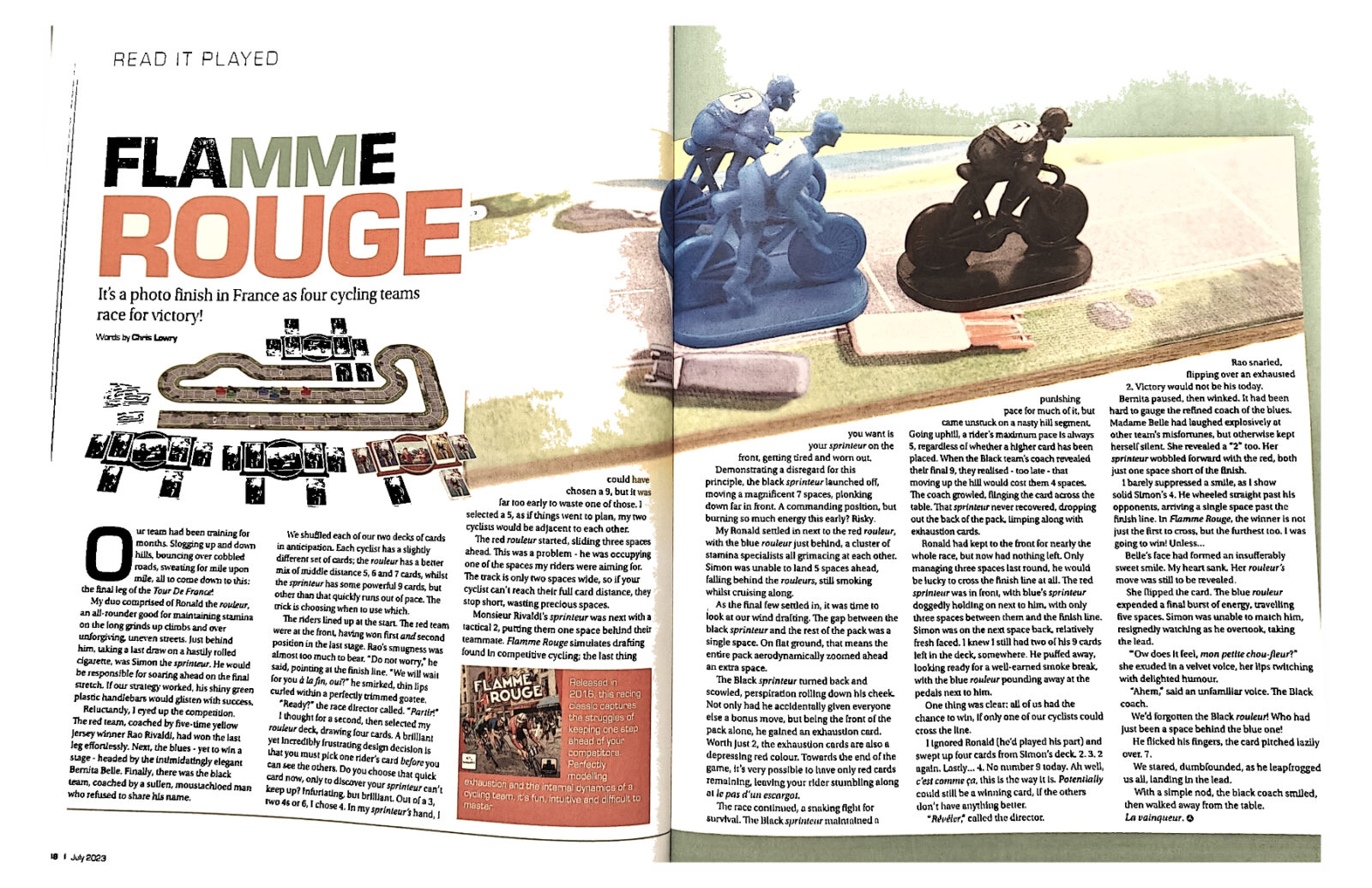
Our team had been training for months. Slogging up and down hills, bouncing over cobbled roads, sweating for mile upon mile, all to come down to this, the final leg of the Tour De France!
My crew, whittled down to two key players, readied themselves on the start line. There was Ronald, our ‘rouleur’, an all-rounder good for maintaining stamina on the long grinds up climbs and over unforgiving uneven streets. His bulbous calves and rigid posture demonstrated a grim determination to get the job done. Just behind him, taking a last draw on a hastily rolled cigarette, was Simon, the team’s ‘sprinteur’”. He would be responsible for the final push, hopefully. If our strategy worked, his shiny Green plastic handlebars would glisten with perspiration – and success.
Reluctantly I eyed up the competition. The Red team, coached by five-time yellow jersey winner Rao Rivaldi, had won the last leg effortlessly. Next, the Blues – yet to win a stage – headed by the intimidatingly elegant Bernita Belle; and finally, the Black team, coached by a sullen, moustachioed man who refused to share his name.
Each coach grasped their two decks of cards in anticipation. Each type of cyclist has a slightly different set of cards; the rouleur has a better mix of middle distance 5, 6 and 7 cards, the sprinteur has some powerful 9 cards, but after that quickly runs out of pace. The trick is choosing when to use which.
The right riders stood in position, ready to proceed. The Red team were at the front, with the rest of us scattered behind. Reds had managed first and second position in the last stage; Rao’s smugness was almost to much to bear. “Do not worry”, he said, pointing at the finish line, “We will wait for you, à la fin, oui?”. He smirked, thin lips curled within a perfectly trimmed goatee.
“Ready?”, the race director called. “Partir!”
I thought for a second, then select my rouleur deck, and drew four cards. In Flamme Rouge you pick one rider’s deck and make your card selection before you can see the other. It’s a brilliant and incredibly annoying design decision. Do you choose that good card now, only to find out your sprinter doesn’t get the option of something strong enough to keep up? Infuriating, but brilliant. Out of “3”, “4”, “4” and “6”, I chose “4”. In my sprinteur’s hand, I even had the opportunity of a “9” – but it was far too early to waste one of those. I selected a “5”, meaning, if things went to plan, my two cyclists would be adjacent to each other.
All the coaches made their choices; a card for each cyclist. “Révéler,” called the director. We revealed our cards.
Each rider moves the number of spaces written on their card, with the order dictated by their current position. The Red rouleur played a “3”, hopping three spaces ahead. This was a problem – he was occupying one of the spaces my riders were heading for. The track is only two spaces wide, so if your cyclist can’t reach their full card distance, they stop short, wasting the vital extra distance.
Monsieur Rivaldi’s sprinteur was next, with a tactical “2” played. This would put the rider 1 space behind the current leaders. Flamme Rouge simulates the wind drafting physics of real competitive cycling – being in the middle of a pack is much easier. The last thing you want is your sprinteur on the front, getting tired and worn out.
Demonstrating a disregard for this principle, the Black sprinteur launched off, moving a magnificent 7 spaces, plonking down far in front of the Red rouleur. A commanding position, but burning so much energy at this point in the race? Risky.
My rouleur Ronald settled in next to the Red rouleur 4 spaces ahead, with the Blue rouleur just behind; a cluster of stamina specialists all grimacing at each other. Simon was unable to land 5 spaces ahead and so fell back to 4, behind the rouleurs. If he was annoyed by this was unclear; he was somehow managing to continue to smoke whilst cruising at nearly 30mph!
The remaining Blue and Black riders clumped in behind, and it was time to look at our wind drafting. The gap between the lead of the Black sprinteur and the rest of the pack was a single space. On flat ground, that means the entire pack benefits from the aerodynamics of the first rider; everyone moved up one space to fill the gap.
The Black sprinteur turned back and scowled, perspiration rolling down his cheek. Not only had he accidentally given everyone else a bonus turn of movement, but he was also the sole person at the front of a pack, so gained an exhaustion card to be added to his deck. Worth just “2” the exhaustion cards are also a depressing red colour. Towards the end of the game it’s very possible to have only red cards remaining, leaving your rider stumbling along at a snail’s pace. Or, indeed, le pas d’un escargot.
The race continued, a snaking fight for survival, with the Black sprinteur maintaining a punishing pace for much of it. He eventually came unstuck on a nasty hill segment. Going uphill, a rider’s maximum pace is always 5, regardless of whether a higher card has been placed. When the Black team’s coach revealed their final “9”, they realised – too late – that their rider would move onto the hill and lose 4 of their movement spaces. The coach growled, flinging the card onto the table. That sprinteur never recovered, soon dropping out the back of the pack and limping along with exhaustion cards 2 spaces at a time.
Eventually, it came down to a gritty end. Ronald, my rouleur, had kept to the front for nearly the whole game, but he had nothing left. He’d only managed 3 spaces last round, and would be lucky to cross the finish line for several more turns. He’d been neck and neck with Rivaldi’s Reds for the entire race, but was further back now.
The Red sprinteur was at the front, with Belle’s Blue sprinteur doggedly holding on next to him; just 3 spaces between them and the finish line. My sprinteur Simon was on the next space back, and relatively fresh faced – I knew I still had two of his “9” cards left in the deck… somewhere. He puffed away, looking ready for a well-earned smoke break, with the Blue rouleur pounding away at the pedals next to him.
It was hard to gauge the refined coach of the Blues. Bernita had laughed explosively at other team’s misfortunes, but otherwise kept herself silent, and her team had taken a mixed strategy of leading, then following; I wasn’t sure which cards she had managed to keep back. One thing was clear; all four of the front riders had the chance to win the race, if only they could cross the line.
We looked at our cards. I ignored Ronald – he’d played his part – and swept up four cards from Simon’s deck. “2”. “3”. “2”, again. And… “4”. No “9” today. Ah well – c’est comme ça; this is the way it is. Potentially could still be a winning card, if the others don’t have anything better.
I glanced, apprehensively at my opponents. They had selected their cards and stared back at me too. Unreadable.
“Révéler,” called the director.
First up, Rivaldi snarled, and flipped over a red, exhausted “2”. His Red sprinteur limped a feeble two spaces forward. Victory would not be his today.
Belle paused, then winked carelessly. She revealed a “2”. Her Blue sprinteur wobbled forward with the Red, both just one space short of the finish.
I barely suppressed a smile, as I showed solid Simon’s “4”. He wheeled straight past the Red and Blue sprinteurs, arriving a single space past the finish line. In Flamme Rouge, the winner is not just the first to cross, but the furthest too. Simon was in poll position. I was going to win, unless…
Belle’s face had formed an insufferably sweet smile. My heart sank. Her rouleur’s move was still to be revealed.
She flipped the card. The Blue rouleur expended a final burst of energy, travelling 5 spaces. Simon was unable to match him, resignedly watching as he overtook, taking the lead. And victory.
In a velvet voice, she exuded, “’Ow does it feel, mon petite chou-fleur?”. Her lips twitched with delighted humour.
“Ahem”, said an unfamiliar voice. The Black coach.
We’d forgotten the Black rouleur! Just a space behind the Blue rouleur!
He flicked his fingers; the card pitched lazily over. “7”.
Dumbfounded, we stared, as the Black rider leapfrogged Red, Green, Blue, and landed. At the front.
With a simple nod, the Black Coach smiled, and walked away from the table. The victor. La vainqueur.
Flamme Rouge is possible the most thematic game I own. Perfectly modelling exhaustion and the internal dynamics of a cycling team, it’s fun, intuitive and difficult to master.